

Ever stumbled across the word bugbear in a book or heard someone mutter “that’s a real bugbear of mine” and wondered what on earth they meant?
You’re not alone, honestly. This quirky little word has been floating around the English language for centuries, and its bugbear meaning is way more interesting than you’d think.
In this article, we’ll break down the bugbear definition, dig into its spooky bugbear origin, and show you exactly how to use it in real life. By the end, you’ll never mix it up again.
Let’s dive right in, shall we.
What Does Bugbear Mean? (Quick Definition)
So, what does bugbear mean in plain English? A bugbear is basically a persistent problem, a source of annoyance, or something that causes ongoing irritation or dread. Think of it as that one thing — a habit, a chore, a recurring issue — that just gets under your skin every single time it comes up.
In modern everyday English, the word is almost always used figuratively. Nobody’s talking about an actual monster (well, mostly). They’re talking about that printer that jams every Monday morning, or the neighbor’s dog that barks at 3 AM. That’s a bugbear.
Here’s the official bugbear definition and meaning as most dictionaries put it:
Bugbear (noun): A recurring problem, cause of fear, or object of dread that continually annoys or worries someone.
Simple enough, right? But the word’s got a much richer backstory than just being a synonym for “annoyance.”
Bugbear Pronunciation
Before we go further, let’s clear up the bugbear pronunciation since a lot of people actually say it wrong. It’s pronounced BUHG-bair (rhymes with “bug” + “bear”). Two syllables, stress on the first one. Not “boo-gbear” or anything fancy like that — just straightforward once you hear it a couple times.
The Origin and History of Bugbear
This is where things get genuinely cool, and honestly its one of my favorite word-origin stories.
Bugbear Etymology: Where Did It Come From?
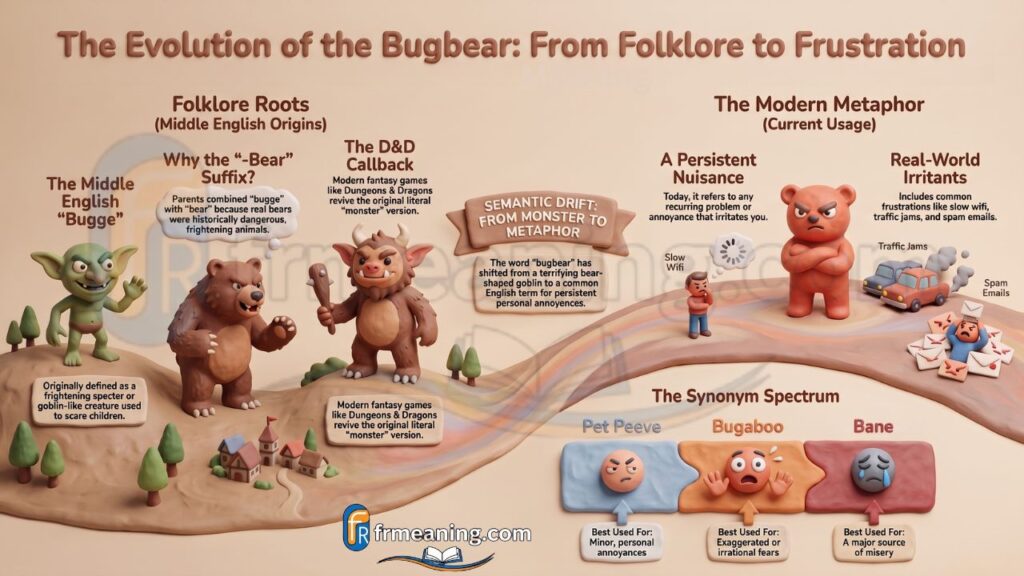
The bugbear etymology traces back to Middle English, where the word combined “bugge” (meaning a frightening specter or goblin-like creature) with “bear.” The bugge → evolved into → bugbear, and the addition of “bear” likely referenced the actual animal, since bears were commonly used in old folk tales to scare children into behaving.
So essentially, a bugbear was originally imagined as a bear-shaped goblin or hobgoblin that lurked around to frighten misbehaving kids. Parents and nursemaids in medieval England would invoke this creature almost like a boogeyman, warning children that if they didn’t behave, the bugbear would get them.
Bugbear in English Folklore
Within English folklore, the bugbear held a firm spot alongside other legendary frightening figures. It wasn’t quite as famous as the bogeyman, but it served a similar cultural purpose — scaring children straight, basically.
Here’s how the bugbear relates to other folklore entities:
- Bugbear → is related to → Goblin, Hobgoblin, and Bogeyman
- Bugbear → was historically depicted as → a frightening, imaginary creature used to scare children
- Bugbear → originates from → the Middle English word “bugge”
These aren’t random word choices, either. Historical texts frequently grouped bugbears with specters, scarecrows, and other imaginary creatures meant to instill a bit of healthy fear in youngsters.
From Literal Monster to Figurative Annoyance
Over the centuries, the word gradually shifted meaning. What started as a literal, physical (well, imaginary but “physical” in folklore terms) monster slowly became a metaphor. By the 17th and 18th centuries, writers were already using “bugbear” to describe abstract fears or nagging problems rather than literal creatures.
This is a classic example of semantic drift, where a word’s meaning changes over time but keeps a thread connecting it back to its roots. The bugbear (literal/historical meaning) → evolved into → bugbear (figurative modern meaning: a persistent problem or annoyance) — and that figurative sense is basically all we use today.
Bugbear Meaning Shakespeare Used
Interesting fact for the literature lovers out there — the bugbear meaning Shakespeare employed pops up in his plays, and it’s a great example of the word’s transitional phase between literal monster and figurative pest.
In Troilus and Cressida, Shakespeare uses the phrase “a bugbear take him” to describe something that inspires dread or fear, closer to the original folklore sense. This shows that even in the Elizabethan era, the word still carried a lot of its monstrous, fear-inducing connotation, even as it started drifting toward broader figurative use in other writings of the period.
Shakespeare wasn’t the only one either — plenty of Renaissance and Restoration-era writers used bugbear to describe irrational or exaggerated fears, kind of paving the way for how we use it today.
Bugbear Synonym: Words That Mean the Same Thing
Looking for a bugbear synonym? Depending on context, you’ve got several solid options:
| Synonym | Best Used When… |
|---|---|
| Pet peeve | Talking about minor, personal annoyances |
| Bugaboo | Referring to an exaggerated fear or worry |
| Nuisance | Describing something generally bothersome |
| Bane | Emphasizing something as a source of misery |
| Thorn in one’s side | Highlighting a persistent, ongoing irritation |
| Bogey | Referring to imaginary fears (older usage) |
The most common bugbear synonyms you’ll actually hear in casual conversation are “pet peeve” and “bugaboo.” Both carry that same sense of a recurring, low-grade annoyance rather than a massive crisis.
Bugbear in a Sentence: Real Examples
Seeing the word in action helps a ton, so here’s several bugbear examples across different contexts and tones.
Everyday/Conversational:
- Slow wifi is a total bugbear of mine, especially when I’m trying to work from home.
- Her biggest bugbear is when people chew with their mouth open.
Formal/Professional: 3. Regulatory compliance remains a persistent bugbear for small businesses navigating new tax laws. 4. Inconsistent data reporting has long been a bugbear for the analytics department.
Literary/Descriptive: 5. The old house creaked at night, as though some ancient bugbear still roamed its halls. 6. To him, deadlines were nothing but an imagined bugbear, more frightening in thought than reality.
Notice how the word flexes depending on tone — it can describe a mild personal irritation or a bigger, systemic issue depending on how it’s framed. That versatility is honestly part of why the word has stuck around so long.
Common Bugbears People Talk About
Just to give you a clearer picture of how the word gets used daily, here’s a quick list of common things people call their “bugbear”:
- Traffic jams during rush hour
- Autocorrect changing words incorrectly
- Long hold times with customer service
- Micromanaging bosses
- Late trains or buses
- Spam emails and robocalls
If you’ve got something that consistently annoys you, congrats — you’ve probably got a bugbear of mine-type situation on your hands too.
Bugbear Meaning in D&D (Dungeons & Dragons)
Here’s a fun tangent that a lot of readers actually search for — the bugbear meaning D&D context is totally different from the figurative, everyday usage.
In Dungeons & Dragons and other tabletop role-playing games, a Bugbear is a specific fictional creature — a large, hairy, goblin-like humanoid known for its stealth and brute strength despite its size. This version leans directly back into the word’s folklore creature roots, reviving the original “monster” sense rather than the figurative “annoyance” meaning.
So basically, D&D took the ancient meaning and ran with it, turning the old folkloric bugbear into a proper (and pretty menacing) game character. It’s a neat little callback that shows how the word’s two meanings — literal monster and figurative nuisance — still coexist depending on context.
Bugbear Meaning in Chinese
For readers curious about translation, the bugbear meaning in Chinese roughly corresponds to 心腹大患 (xīnfù dàhuàn), which conveys the idea of a deep-seated, persistent trouble or threat, or more casually 讨厌的东西 (tǎoyàn de dōngxi) for the “annoying thing” sense.
Translation nuance matters a lot here since Chinese doesn’t have a single word capturing both the folklore and figurative senses the way English does — translators typically pick based on context, whether it’s the “monster” angle or the “annoyance” angle.
Filling the Gaps: A Deeper Look at Bugbear’s Etymology
Most articles stop at “it comes from Middle English bugge,” but let’s go a little deeper here because there’s more to the story.
The Welsh and Old Word Connections
Some etymologists trace bugge further back to a possible connection with the Welsh word “bwg,” meaning ghost or goblin. This suggests the word’s roots might stretch even further into Celtic folklore traditions before making their way into Middle English vocabulary.
Additionally, “bugge” is thought to share ancestry with related old English word forms that eventually produced other spooky vocabulary like:
- Bogey — a mischievous or evil spirit
- Boggart — a household-haunting spirit in British folklore
- Bogeyman — the classic monster-under-the-bed figure
So really, bugbear isn’t an isolated word — it’s part of a whole family tree of English and Celtic-derived “scary creature” vocabulary that developed alongside each other over hundreds of years.
How the “-bear” Suffix Got Attached
Here’s a detail competitors barely touch — why “bear” specifically? Linguists believe the bear reference wasn’t random. Real bears were historically dangerous, unpredictable animals in the British Isles, so pairing “bugge” with “bear” created a mental image that was doubly frightening: an invisible spirit combined with the ferocity of a wild animal. It’s basically medieval marketing for scaring kids into good behavior, when you think about it.
Bugbear Meaning in English: A Quick Recap
To sum up the bugbear meaning in English as we use it today:
- Historical/literal: An imaginary, bear-like goblin used in English folklore to frighten children.
- Figurative/modern: A persistent source of annoyance, worry, or dread.
- Specialized (D&D): A specific fictional monster race in tabletop gaming.
Knowing all three helps you understand the word no matter where you encounter it — whether in an old novel, a casual conversation, or a fantasy game manual.
Frequently Asked Questions
What does bugbear mean in simple terms?
A bugbear means a persistent problem, annoyance, or source of dread that keeps bothering someone repeatedly over time.
What is the bugbear origin?
It originates from Middle English “bugge,” meaning a frightening goblin, combined with “bear” for added fright.
Is bugbear a real creature?
Historically it was an imaginary folklore creature; today it’s mostly used figuratively, except in fantasy games like D&D.
What’s a good bugbear synonym?
Common synonyms include pet peeve, bugaboo, nuisance, bane, and “thorn in one’s side.”
How do you pronounce bugbear correctly?
It’s pronounced BUHG-bair, with stress on the first syllable, rhyming with “bug” and “bear.”
Did Shakespeare use the word bugbear?
Yes, Shakespeare used “bugbear” in Troilus and Cressida to describe something inspiring dread or fear.
What does bugbear mean in D&D?
In Dungeons & Dragons, a Bugbear is a large, hairy, goblin-like humanoid monster known for stealth and strength.