
You just got a message that says “asl?” or maybe someone commented “funny asl” on a TikTok video and you have zero idea what they mean. It happens all the time.
\And the frustrating part? ASL does not have one meaning. It has at least three, and misreading the context can leave you confused — or worse, responding completely wrong.
Let’s break all of it down right now.
What Does ASL Mean?
The Quick Definition of ASL
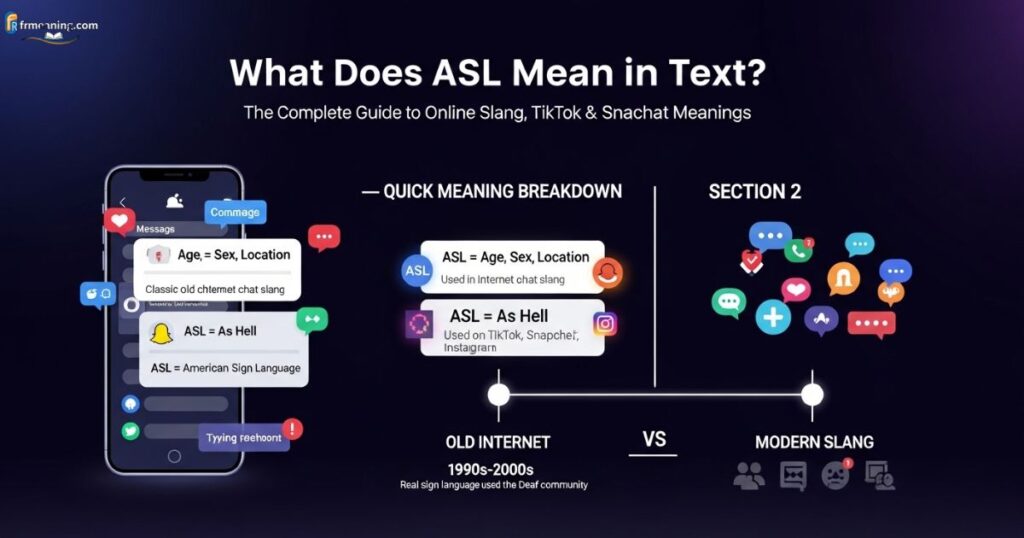
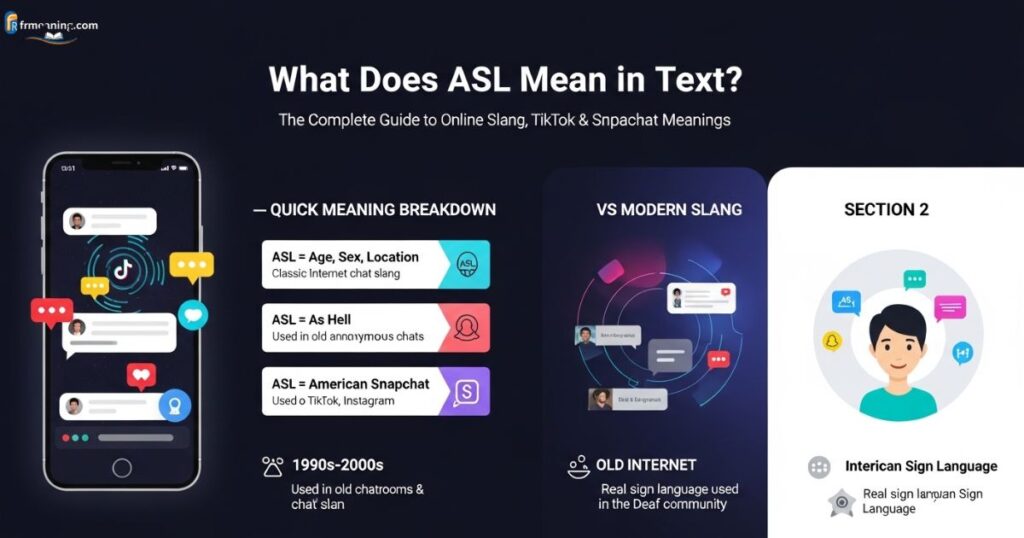
ASL is a texting acronym with three widely used meanings:
- Age, Sex, Location — the original chatroom question asking for basic personal info
- As Hell — a modern Gen Z intensifier used to emphasize a feeling (“tired asl”)
- American Sign Language — the visual language used by the Deaf and hard-of-hearing community
Which one applies depends entirely on context. A message that says “you’re cute asl” is not asking about your age. A message that just says “ASL?” in a new conversation almost certainly is.
Why ASL Has Multiple Meanings
Internet slang evolves fast. Words and abbreviations get recycled across generations and platforms. ASL started as a blunt question in 1990s chatrooms, then got repurposed by younger users who stripped it down to a pure intensifier. Meanwhile, ASL as American Sign Language has existed for decades and carries a totally different context — one tied to education, disability rights, and community.
The same three letters. Three completely different conversations.
ASL Meaning in Texting and Online Chat
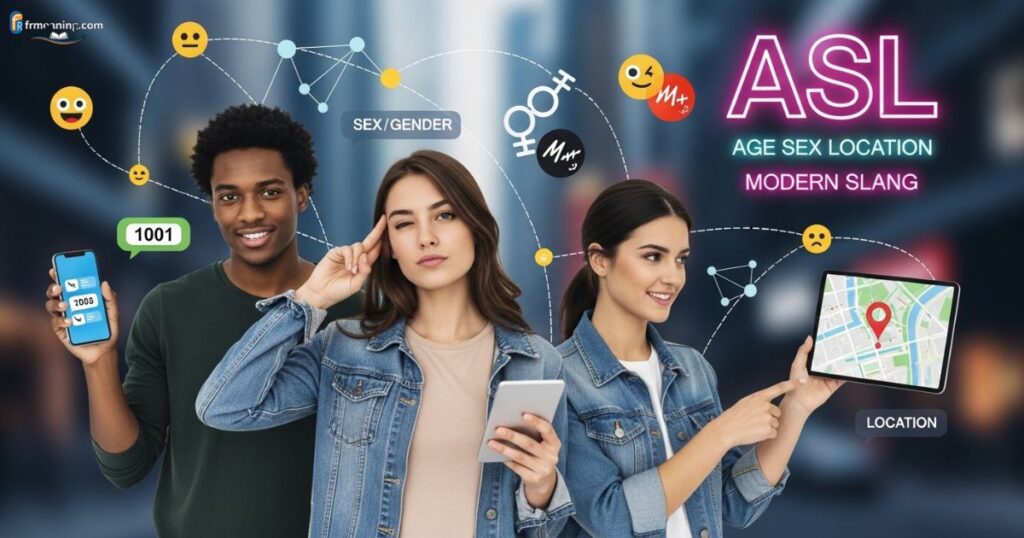
ASL as “Age, Sex, Location”
When someone sends you “ASL?” — especially early in a conversation — they want to know three things:
- Age — How old are you?
- Sex — Are you male or female? (Some people use it loosely to include other identities.)
- Location — Where are you from or currently located?
This was the original meaning of ASL in text. It was shorthand for a question that would otherwise take an entire sentence to type out.
Where This Meaning Originated
Blame AOL Instant Messenger. Back in the late 1990s and early 2000s, online chatrooms were full of strangers. There was no profile photo, no feed, no context. If you wanted to know who you were talking to, the first thing you typed was “ASL?” — and Yahoo Messenger users were just as guilty of it.
It was the internet’s version of a first impression. Three letters replaced “Hi, how old are you, what’s your gender, and where are you from?” Efficient, if a bit blunt.
Why People Still Use It Today
You might think “ASL?” is ancient history. It is not. Anonymous chat apps like Omegle and similar platforms kept it alive well past its AOL peak. Even on Snapchat or Instagram DMs, when someone slides into a stranger’s inbox, dropping an “ASL?” is still a common opener — though it hits differently depending on who’s asking and why.
ASL Meaning in Modern Slang
ASL as “As Hell”
This is the one tripping people up the most right now. Younger users — especially Gen Z — use asl (almost always lowercase) as a direct substitute for “as hell.” It functions as an intensifier that cranks the volume on whatever word comes before it.
Think of it like saying “extremely” or “very” — but with significantly more personality.
Examples of ASL in Sentences
Here is how it looks in real usage:
- “I’m tired asl right now.”
- “That test was hard asl.”
- “She’s talented asl, not gonna lie.”
- “It’s hot asl outside.”
- “That joke was funny asl.”
Notice the pattern: adjective or descriptor, followed by “asl.” It strengthens the statement. That’s it.
TikTok and Snapchat Usage Trends
TikTok is arguably the biggest driver behind the “as hell” usage explosion. Comments like “this is cute asl” or “bro said that serious asl” started showing up en masse around 2020 and have not slowed down. Snapchat picked it up too — you will see it in captions, streaks, and story replies constantly.
The lowercase spelling matters here. “asl” (lowercase) in a sentence almost always means “as hell.” “ASL?” (uppercase, standalone) almost always means “Age, Sex, Location.” The capitalization shift is not accidental — it carries contextual weight.
ASL Meaning as American Sign Language
What American Sign Language Is
American Sign Language is a fully developed, natural language used primarily by Deaf and hard-of-hearing communities in the United States and parts of Canada. It uses hand shapes, facial expressions, and body movements to communicate. It is not a visual version of English — it has its own grammar, syntax, and structure entirely.
More than 500,000 people in North America use ASL as their primary language. It is taught in schools, used in medical settings, and recognized as a legitimate linguistic system by linguists worldwide.
When ASL Refers to the Deaf Community
When you see ASL in an educational context, a medical article, a social justice discussion, or anything related to accessibility and disability — that’s American Sign Language. If someone says “I’m taking ASL classes” or “does this video have ASL interpretation?”, they are absolutely not asking about anyone’s age or location.
Context saves you here every time.
How to Tell Which ASL Meaning Someone Is Using
Context Clues to Watch For
You do not need to guess blindly. These signals tell you exactly which ASL you are dealing with:
ASL probably means “Age, Sex, Location” if:
- It appears as a standalone question mark: “ASL?”
- You just matched or connected with someone new
- It’s on an anonymous chat platform
- The message offers no other context
ASL probably means “as hell” if:
- It follows an adjective: “tired asl,” “funny asl,” “smart asl”
- It is written in all lowercase
- The platform is TikTok, Snapchat, Twitter/X, or Instagram
- The speaker seems to be under 30
ASL probably means American Sign Language if:
- You’re in an educational, healthcare, or accessibility context
- Someone is discussing Deaf culture or disability
- The conversation is about language learning or interpretation
Uppercase vs Lowercase Differences
This is the simplest cheat code for decoding ASL:
| Spelling | Most Likely Meaning |
|---|---|
| ASL? | Age, Sex, Location |
| asl | As Hell |
| ASL (in context) | American Sign Language |
Not a perfect rule, but it holds up about 90% of the time.
Examples From Real Conversations
Conversation A:
“Hey, ASL?” “19, F, Texas. You?”
Classic “Age, Sex, Location” exchange. Uppercase, standalone question.
Conversation B:
“That movie was long asl.” “Right?? I was bored asl.”
Unmistakably “as hell.” Lowercase, attached to a descriptor.
Conversation C:
“Does your school offer ASL courses?” “Yeah, I’m in ASL 2 right now.”
American Sign Language. Educational setting makes it obvious.
Is ASL Safe to Answer Online?
Privacy Concerns With “ASL?”
Here is the honest truth: being asked “ASL?” by a stranger online is a privacy red flag, particularly for younger users. Sharing your age, gender, and location with someone you have never met — on an anonymous platform especially — hands them personal information they did not need.
It is not always predatory. Plenty of people use it innocently. But the combination of those three data points (age + gender + location) can be used to target, manipulate, or track someone.
Tips for Staying Safe in Online Chats
If someone hits you with “ASL?” and you are not comfortable answering, you do not have to. Here is how to handle it:
- Ignore the question entirely. Change the subject. You owe strangers nothing.
- Give vague answers. “20s, somewhere in the US” gives nothing away.
- Trust the discomfort. If the question feels off, the conversation probably is.
- Never share your exact location. City is already more than enough for a stranger.
- Talk to a trusted adult if you are a minor and someone online is pressing for this info.
Parents: if your kid’s phone has apps like Omegle, Discord, or similar chat tools, teach them that “ASL?” from a stranger is a question they do not have to answer.
Common ASL Examples in Text Messages
Funny ASL
“That was funny asl” = “That was extremely funny.” Used in comments, DMs, reaction texts. No question mark, no ambiguity.
Tired ASL
“I’m tired asl” = “I am incredibly tired.” One of the most common uses. If someone says this, they are not subtly asking about your demographics — they are venting.
Cute ASL
“You’re cute asl” = “You are very cute.” A compliment. Common in Instagram DMs and Snapchat messages. If someone sends this to you, take it as a positive.
ASL? in DMs
When someone opens a conversation with just “ASL?” — no other context, often from an unknown account — that is the “Age, Sex, Location” version. You get to decide whether to engage. No pressure either way.
Other Popular Text Slang Similar to ASL
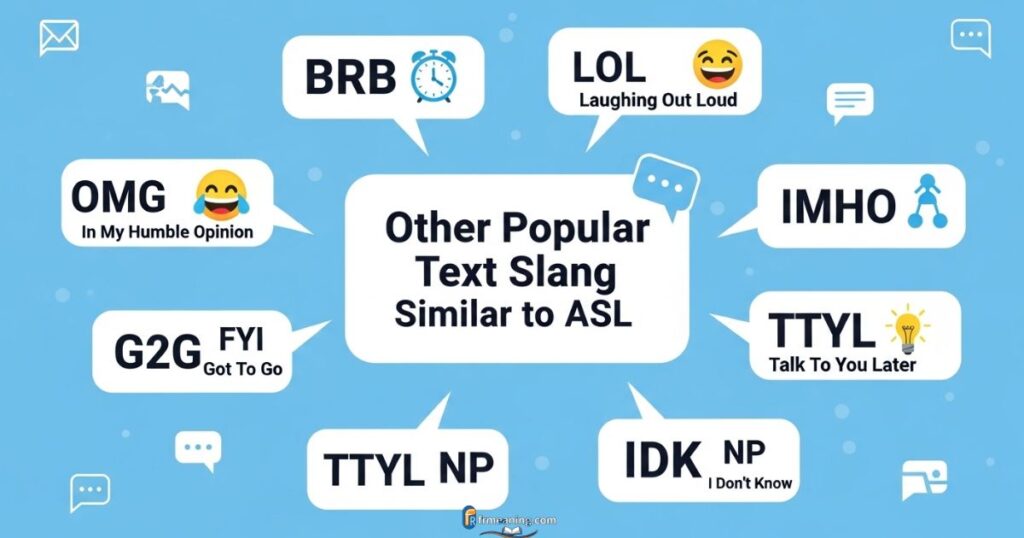
Internet slang does not operate in isolation. ASL lives in a whole ecosystem of abbreviations. Here are a few you will bump into constantly:
AF Meaning
“AF” stands for “as f***” — same grammatical function as “asl” in the “as hell” sense. “Tired AF,” “funny AF.” Older and more widely known than asl, but the same energy.
FR Meaning
“FR” means “for real.” Used to express agreement or sincerity. If someone says “that’s hard fr,” they mean it genuinely. You can learn more about FR and other chat abbreviations like FW if these keep showing up in your messages.
SMH Meaning
“SMH” stands for “shaking my head.” Expresses disappointment, disbelief, or mild frustration. “He showed up late smh.”
IMO Meaning
“IMO” means “in my opinion.” Used to soften a statement or flag it as personal perspective. Sometimes extended to “IMHO” — “in my humble opinion.”
If you are curious about newer slang creeping into your texts, what HY means in text and what ASF means are worth a quick look — they follow similar patterns to asl.
Frequently Asked Questions About ASL Meaning
What does ASL mean from a girl?
Same meanings apply regardless of who sends it. If a girl texts “you’re funny asl,” she means “very funny.” If she opens with “ASL?” she is asking your age, gender, and location. Context, not gender, determines the meaning.
What does ASL mean on TikTok?
On TikTok, “asl” almost exclusively means “as hell.” You will see it in comments like “this is relatable asl” or “she said that confident asl.” The platform’s young, Gen Z-heavy audience normalized this usage starting around 2019–2020.
What does lowercase asl mean?
Lowercase “asl” in a sentence = “as hell.” If it follows an adjective and appears in the middle or end of a sentence, that is your answer. Uppercase “ASL?” as a standalone = “Age, Sex, Location.”
Is ASL outdated?
The “Age, Sex, Location” version feels retro — it peaked in chatroom culture circa 2001. But it never fully disappeared and still shows up on anonymous platforms and in DMs from strangers. The “as hell” usage, by contrast, is completely current and has no signs of slowing down. American Sign Language is, of course, timeless and growing in visibility.
One abbreviation, three timelines.
If you want to go deeper on today’s slang landscape, what ATP means in text and what IDGAF means are two more terms worth knowing — especially if you are navigating online conversations with younger generations.