
Ever wondered what those dreamy Instagram photos are actually named after? If you’ve typed “Seychelles” into Google search bar more than once wondering how to even say it right, you’re honestly not alone.
Seychelles is one of those words that looks fancy, sounds even fancier, and yet most people couldn’t tell you what it actually means or where it came from.
In this guide, we’re breaking down the Seychelles meaning, its French roots, pronunciation, cultural weight, and everything in between so by the end you’ll know this term better than most travel bloggers do.
Let’s get into it.
What Does Seychelles Mean? (Quick Answer)
Seychelles refers to a sovereign island nation made up of roughly 115 islands scattered across the western Indian Ocean, sitting northeast of Madagascar. The word also doubles up as the name for the archipelago itself — basically the physical cluster of islands that forms the country.
So technically, “Seychelles” can mean the country OR the islands, depending on context, which honestly trips a lot of people up at first.
Seychelles → is located in → Western Indian Ocean, northeast of Madagascar.
That’s the core definition. But there’s a lot more nuance packed into this one little word, so let’s dig deeper.
The Origin of the Word “Seychelles” (Filling the Gap Competitors Miss)
Most articles online will happily tell you what Seychelles means today but conveniently skip over where the name actually came from. That’s a shame because the etymology is genuinely interesting.
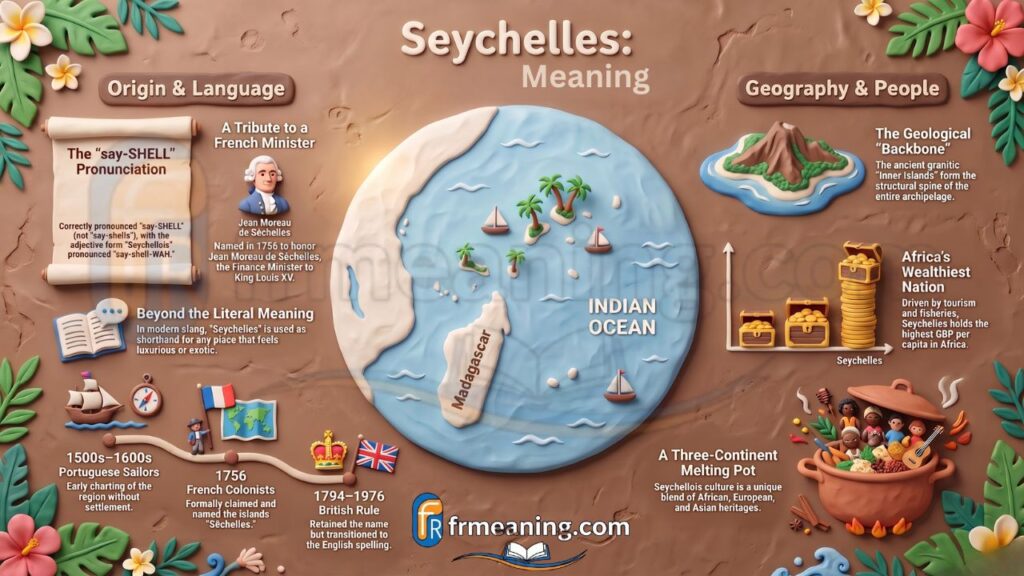
The name Seychelles traces back to French colonial history. It was named in honor of Jean Moreau de Séchelles, who served as the Finance Minister under King Louis XV of France in the mid-1700s.
When French explorers formally claimed the islands in 1756, they named the archipelago “Séchelles” as a tribute to him — and over time this evolved into the modern spelling “Seychelles” that we use today.
Before French colonization though, the islands weren’t exactly unknown. Arab traders are believed to have passed through the region centuries earlier, and Portuguese sailors also charted parts of the archipelago long before the French formally settled it. So while the name is French, the islands themselves have a much older, layered history of contact.
Here’s a quick breakdown:
| Era | Who Named/Explored It | Naming Contribution |
|---|---|---|
| Pre-1500s | Arab traders (theorized) | Early informal contact, no lasting name |
| 1500s-1600s | Portuguese sailors | Charted region, no permanent settlement |
| 1756 | French colonists | Named after Jean Moreau de Séchelles |
| 1794-1976 | British rule | Retained French name, Anglicized spelling |
So when someone asks “why is it called Seychelles,” the honest answer is: it’s basically a 260-year-old shoutout to a French finance minister who probably never even set foot on the islands himself.
Seychelles Pronunciation: How Do You Actually Say It?
This is probably the most Googled confusion around this word, and fair enough — it doesn’t look like it sounds.
The correct Seychelles pronunciation is say-SHELL (sometimes written phonetically as /seɪˈʃɛl/). A lot of people mistakenly say “SAY-chells” or try to pronounce every letter individually, but that’s not quite right. Think of it like this:
- Say it like “say” + “shell” (as in seashell, minus the “sea”)
- The emphasis lands on the second part — “SHELL,” not “SAY”
- Don’t pronounce the “s” at the end too hard — it’s soft, almost silent in casual speech
And if you’re wondering about the adjective form, Seychellois is pronounced roughly “say-shell-WAH,” which is the French-influenced way of saying it (French words ending in “-ois” typically drop the hard consonant sound).
Seychelles Meaning in English
In plain English, Seychelles meaning simply refers to the country’s name — there isn’t some deep hidden English translation buried in there. It’s a proper noun, meaning it doesn’t technically “translate” the way common nouns do. However, in everyday English usage, people use “Seychelles” to refer to:
- The Republic of Seychelles as a sovereign nation
- The physical archipelago of islands themselves
- Occasionally, informally, as shorthand for “a tropical paradise getaway” (more on that slang usage below)
Seychelles Meaning in French
Since the name literally originated in French, this one’s interesting. In French, Seychelles doesn’t translate into a separate word — it is the French word, adapted from “Séchelles.” The French pronunciation is closer to “say-SHELL” too, though with that classic French nasal touch. French remains one of the official languages spoken in Seychelles today, alongside English and Seychellois Creole, which tells you a lot about how deeply the colonial history shaped the culture.
Seychelles Meaning Slang in English Language
This one’s a bit more casual, and honestly kind of fun. In modern slang, especially among younger travelers and on social media, “Seychelles” has started being used loosely to describe anything that feels luxurious, exotic, or paradise-like — even outside the literal islands. You might hear someone jokingly say “this backyard looks like Seychelles” to mean it’s ridiculously scenic or dreamy. It’s not an official dictionary slang term, but it’s definitely become cultural shorthand for tropical luxury.
Seychelles Meaning Spiritual
Some people, particularly in wellness and travel-spirituality circles, associate Seychelles with themes of renewal, isolation from chaos, and connection to raw nature. The islands’ untouched beaches and biodiversity hotspot status feed into this idea of Seychelles being a place of spiritual reset — a “return to nature” destination. While this isn’t rooted in the word’s literal etymology, it’s become part of the modern cultural meaning attached to the name, especially in honeymoon and wellness tourism marketing.
Seychelles Meaning Connections & “Backbone Meaning”
Interestingly, the granitic islands that make up the Inner Islands of Seychelles are often described as the geological “backbone” of the archipelago. This isn’t a coincidence — these granite formations are literally the oldest and most structurally central part of the island chain, acting as a geological spine that the rest of the archipelago (the coral-based Outer Islands) sort of branches out from. So when people talk about the “backbone meaning” in relation to Seychelles, they’re usually referring to this geological centrality — the Inner Islands being the foundation everything else connects to, both physically and historically.
Granitic islands → form the geological backbone of → the Seychelles archipelago.
Where Is Seychelles? (Seychelles Map & Location)
If you pull up a Seychelles map, you’ll notice it’s basically a scatter of dots across a huge stretch of open ocean — which is part of what makes it so remote and appealing. The archipelago sits in the western Indian Ocean, roughly 1,500 km east of mainland Africa and just northeast of Madagascar. It’s divided into two main geographical zones:
- Inner Islands – the granitic, mountainous islands (including Mahé, the main island and capital region)
- Outer Islands – low-lying coralline islands spread across a much wider oceanic area
This division matters because it affects everything from climate to tourism infrastructure — the Inner Islands are far more developed, while the Outer Islands remain wild and largely untouched.
Seychelles Capital, Population & People
The capital of Seychelles is Victoria, located on Mahé island — the largest and most populated island in the entire archipelago. Victoria’s actually one of the smallest capital cities in the world by population, which gives you a sense of just how compact this nation really is.
As for Seychelles population, the country has roughly 100,000-120,000 residents (numbers fluctuate slightly year to year), making it one of the smallest nations in Africa by population, despite covering a large maritime area.
The Seychelles people, officially called Seychellois, represent a genuinely unique cultural blend:
- African heritage (from early settlers and enslaved populations brought during colonial rule)
- European influence (primarily French and British)
- Asian roots (Chinese and Indian traders who settled over generations)
Seychellois culture → is shaped by → African, European, and Asian influences.
This mixed heritage shows up in everything — the food, the Creole language, the music, even architecture. It’s genuinely one of the more culturally diverse small nations you’ll come across.
Seychelles Currency
The official Seychelles currency is the Seychellois Rupee (SCR). It’s used for all local transactions, though in tourist-heavy areas, especially resorts, Euros and US Dollars are often accepted too. If you’re planning a trip, it’s worth exchanging some currency locally since rates at the airport aren’t always the best deal — a small tip most travel guides forget to mention.
Seychelles From India: Travel Connection
For Indian travelers specifically, Seychelles from India has become an increasingly popular honeymoon and luxury getaway destination. Direct flights connect major Indian cities like Mumbai to Mahé, and the flight time is roughly 5 hours, making it a surprisingly accessible tropical escape. Seychelles has also historically had strong diplomatic and trade ties with India, and a notable Indian-origin community lives on the islands today, adding another layer to that African-European-Asian cultural mix we mentioned earlier.
Is Seychelles Safe? A Quick Reality Check
Yes, generally speaking, Seychelles is considered one of the safer travel destinations in the Indian Ocean region and across Africa broadly. Crime rates targeting tourists are low, and the biggest safety concerns tend to be more mundane things like strong ocean currents or sun exposure rather than anything related to personal security. That said, like anywhere, basic common sense (don’t flash expensive gear, stick to recommended swimming areas) goes a long way.
Tourism → serves as → major pillar of Seychelles’ economy, which honestly incentivizes the country to keep things safe and welcoming for visitors — it’s in their economic interest, not just goodwill.
Why Seychelles Belongs to the African Union
As a sovereign nation, the Republic of Seychelles is a member of the African Union, reflecting its geographic and political identity as an African nation, despite its cultural ties stretching across Europe and Asia too. This membership plays into broader diplomatic and trade relationships across the continent.
Frequently Asked Questions
What does Seychelles mean in English slang?
In casual slang, “Seychelles” loosely describes anything luxurious, exotic, or paradise-like, beyond just the literal island nation itself.
What does the word “Seychelles” mean?
It refers to a sovereign island nation of roughly 115 islands in the western Indian Ocean, named after a French finance minister.
Why is Seychelles so famous?
Seychelles is famous for its pristine beaches, coral reefs, unique granitic islands, and status as a global biodiversity hotspot.
Why is it called Seychelles?
It’s named after Jean Moreau de Séchelles, France’s Finance Minister when the islands were claimed in 1756.
What is a Seychelles person called?
A person from Seychelles is called Seychellois, also used as the adjective describing anything from the nation.
What are some synonyms for “Seychelles”?
Common alternatives include “the Republic of Seychelles” and “the Seychelles archipelago,” both referring to the same place.
How do you say Seychelles in English?
It’s pronounced “say-SHELL,” with emphasis on the second syllable, not each letter individually.
Is Seychelles a happy country?
Yes, Seychelles consistently ranks among Africa’s happiest nations, thanks to strong healthcare, education, and quality of life.
Is Seychelles a poor or rich country?
Seychelles is actually Africa’s wealthiest nation by GDP per capita, driven largely by tourism and fisheries industries.
Is Seychelles cheap or expensive?
Seychelles is generally expensive, especially for accommodation and imported goods, given its remote island location.
Which is better, Bali or Seychelles?
It depends — Bali offers more budget options and culture, while Seychelles offers more exclusivity and untouched nature.