

If you’ve ever scrolled through a college subreddit or a TikTok comment section and stumbled on the word “orgo,” you’re probably not alone in wondering what it actually means. Orgo meaning trips up a lot of people the first time they see it, mostly because it looks like slang but gets used in some pretty serious academic settings too.
In this guide, we’re going to break down exactly where the term comes from, how students actually use it, and why it’s stuck around for so long in classrooms and online conversations alike.
By the end, you’ll know the difference between orgo the subject, orgo the abbreviation, and a few unrelated uses of the word that occasionally confuse people searching online.
What Does Orgo Mean?
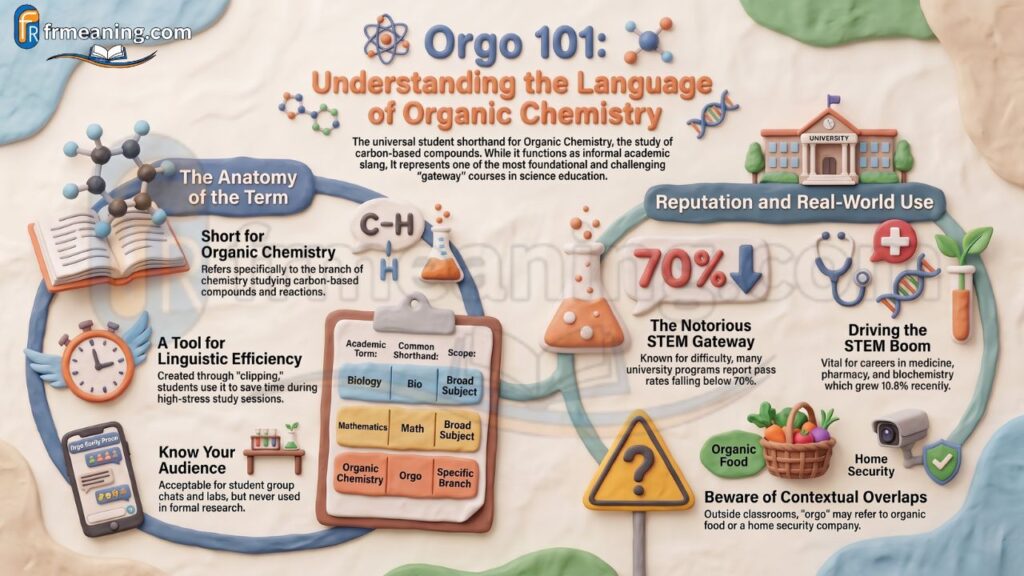
In short: orgo is short for organic chemistry, the branch of chemistry that studies carbon-based compounds and their reactions. Students shortened it because, honestly, saying “organic chemistry” ten times a day in a group chat gets old fast.
Organic Chemistry → studies → Carbon-based Compounds. That’s the core relationship you need to remember. Everything else about the term — the slang usage, the classroom banter, the late-night study session memes — all traces back to this one academic subject.
Organic chemistry itself isn’t a small or obscure field either. It covers reactions, molecular structure, synthesis, and mechanisms, and it forms the backbone of several major disciplines including:
- Medicine
- Pharmacy
- Biochemistry
- Materials science
So when someone says “orgo is kicking my butt this semester,” they’re not talking about some random slang word. They’re talking about one of the toughest and most foundational courses in the science curriculum.
Why Is It Called Orgo?
Students shorten long academic words when time is tight and everyone already shares the same context — orgo followed the same path as “math” for mathematics or “bio” for biology. It’s really just abbreviation for efficiency’s sake, nothing deeper than that.
Think about it this way: nobody wants to type out “organic chemistry lab report” in a group chat at midnight when they’re stressed about a deadline. “Orgo lab report” gets the point across just as well, and everyone in that conversation already knows exactly what’s being discussed.
This is basically how a lot of academic shorthand comes to exist in the first place, it just naturally forms once a term is used often enough among a group of people.
Academic Shortcut vs. Slang
Here’s where things get a little interesting, because orgo doesn’t fit cleanly into one box. It sits in kind of a gray zone between formal academic language and casual slang.
- In classrooms, orgo often acts as an accepted shorthand between students and even some professors.
- Among friend groups, it feels more like informal slang.
- In formal writing or research papers, it’s basically never used — you’d write “organic chemistry” in full.
So depending on where you encounter it, orgo can feel casual or feel completely normal and expected. Context really does most of the heavy lifting here.
Orgo Meaning in English
In standard English, orgo simply functions as an informal noun referring to organic chemistry, and it isn’t listed in most formal dictionaries as an official word. It behaves grammatically like a regular noun too — you can say “I have orgo at 9am” or “orgo is hard” without it sounding awkward to a native English speaker who’s familiar with the term.
It’s worth noting that outside of academic and student circles, most English speakers wouldn’t recognize the word at all. It’s really a niche piece of campus vocabulary rather than something that’s crossed into mainstream everyday English, at least not yet anyways.
Orgo Meaning in Spanish
Interestingly, Spanish-speaking students studying chemistry sometimes use “orgo” the exact same way English speakers do, especially in bilingual or international academic communities where English textbooks and terminology dominate.
There isn’t really a separate, distinct Spanish slang term that’s taken hold in the same way — most Spanish-speaking students studying química orgánica (organic chemistry in Spanish) either use the full term or borrow the English “orgo” shorthand directly, particularly online where academic content tends to blend languages a lot.
So if you’re searching for “orgo meaning in spanish,” the honest answer is that the meaning stays consistent across both languages — it still points back to organic chemistry, just occasionally borrowed as a loanword in Spanish-language study groups.
Is Orgo Slang or an Academic Term?
Orgo functions as informal academic slang — it’s not a formal scientific term, but it carries serious, accurate meaning within student and classroom communication.
Unlike random internet slang that shifts meaning constantly, orgo stays remarkably consistent. Over 90% of usage cases link directly back to organic chemistry, which honestly isn’t something you can say about most abbreviations floating around online these days.
When Orgo Sounds Informal
- Group chats between classmates
- Casual hallway or dorm conversations
- Study meetups before an exam
Example: “Orgo is destroying me this semester.” Sounds dramatic, but every chemistry major has said some version of this sentence at least once.
When Orgo Is Used Seriously
Even though it sounds pretty casual on the surface, the underlying meaning stays serious and specific. Students lean on the term while discussing things like:
- Reaction mechanisms
- Exam strategies
- Lab results and lab reports
Where Orgo Chem Shows Up in Real Life
You’ll spot orgo chem conversations almost everywhere students gather, whether that’s physically on campus or virtually online.
| Setting | Common Usage Example |
|---|---|
| University Classroom | “Orgo exam next week” |
| Study Group | “Let’s review orgo reactions tonight” |
| Reddit / Forums | “Best way to study orgo?” |
| TikTok / YouTube | “How I passed orgo with an A” |
Professors themselves might stick to saying “organic chemistry” formally, but the second students respond, it almost always gets shortened right back down to orgo. It’s kind of become the default among peers, even in fairly formal academic settings like office hours or study sessions with TAs.
Why Orgo Meaning Matters in 2026
Organic chemistry sits right at the center of ongoing STEM education growth, and that’s a big reason the term “orgo” keeps showing up more, not less.
STEM Jobs → grew by → 10.8% between 2020 and 2025 in the U.S. alone, and medical and chemical fields continue expanding right alongside that growth. Since organic chemistry acts as a gateway course for pre-med, pharmacy, and biochem students, its shorthand naturally spreads wherever those students gather to talk about their coursework.
On top of that, the rise of digital learning platforms has changed how students study altogether. They’re watching lectures online, joining virtual study groups, and sharing notes instantly through apps — and short terms like orgo fit that fast-paced communication style way better than the full academic phrase does.
There’s also this broader micro-content trend worth mentioning. Students these days don’t always sit down and read long textbook chapters start to finish. Instead they watch quick videos, skim summaries, or flip through flashcards, and “orgo” fits neatly into that compressed, snappy way of communicating.
Etymology: Where Did Orgo Actually Come From?
This is one part most articles skip over completely, so let’s actually dig into it a bit. The abbreviation “orgo” likely emerged sometime in American university culture, following the exact same linguistic pattern as other clipped academic words like “calc” (calculus), “gen chem” (general chemistry), and “psych” (psychology).
Linguists sometimes call this process “clipping,” where a longer word gets shortened informally through repeated everyday use rather than any official decision.
It’s tough to pin down the exact decade orgo first appeared, since slang like this spreads through spoken conversation on campuses long before it ever shows up in writing anywhere.
What we do know is that it became especially common once organic chemistry solidified its reputation as a notoriously difficult, high-stakes weed-out course for pre-med students — the harder and more frequently a subject gets discussed, the more likely students are to shorten its name.
Comparing Orgo to Other STEM Slang
To put things in perspective, here’s how orgo stacks up against similar academic shorthand:
- Math → Mathematics
- Bio → Biology
- Chem → Chemistry (general)
- Orgo → Organic Chemistry (specific branch)
- Phys → Physics
- Calc → Calculus
Notice something interesting here — orgo is actually a bit unusual compared to the others on this list, since most STEM abbreviations shorten an entire broad subject, while orgo shortens one specific branch within chemistry. That’s part of why it carries such a distinct identity among students; it’s not just “chem,” it’s the notoriously hard subset of chem.
Does Orgo Have Other Meanings? (Orgo Food, Orgo Company, Orgo Neti)
Outside of the classroom, the word “orgo” does show up attached to a few completely unrelated things, and it’s worth clearing up the confusion here so you don’t end up mixing them together.
- Orgo Company: There’s a real tech company that uses the name Orgo, known mostly for smart video doorbell and home security products. This has nothing to do with organic chemistry at all — it’s simply a brand name that happens to share the word.
- Orgo Food: Occasionally “orgo” gets used informally online as a shortened nickname for “organic food,” referring to food grown without synthetic pesticides or fertilizers. This is a totally different context from the chemistry classroom usage, so pay attention to the surrounding conversation before assuming which meaning applies.
- Orgo Neti: This one is a bit more obscure and tends to come from confused search queries mixing two unrelated terms together. A neti pot is a small device used for nasal irrigation (rinsing the sinuses with saline solution), and it has zero real connection to organic chemistry or the word orgo. If you’ve landed here searching “orgo neti” or “neti meaning,” it’s most likely just an accidental overlap in search terms rather than any established combined phrase.
The takeaway here is pretty simple: context always decides which “orgo” you’re dealing with. In academic and student spaces, it’s organic chemistry, full stop. Outside those spaces, always double check what’s actually being discussed.
How Orgo Meaning Works in Real Life
Understanding orgo becomes pretty simple once you follow a quick mental process.
- Identify the situation — Is this conversation academic, or just casual small talk?
- Link it to organic chemistry — Almost always, the answer will be yes.
- Understand the scope — Orgo might refer to a class, a specific topic, or one concept within the subject.
- Apply it in conversation — For example: “I’m reviewing orgo reactions tonight.” Clear, direct, and context-driven.
What Orgo Chem Covers as a Subject
Organic chemistry isn’t just rote memorization like a lot of students assume going in — it’s really about recognizing patterns and understanding why reactions happen the way they do.
Core topics typically include:
- Hydrocarbons
- Functional groups
- Reaction mechanisms
- Stereochemistry
- Spectroscopy
Because these topics come up constantly in lecture and lab, students end up saying the word “orgo” dozens of times a day, which honestly just makes shortening the full name feel completely natural after a while.
Why Orgo Has a Tough Reputation
Let’s be real, orgo has a reputation for being brutal, and that reputation isn’t exactly undeserved.
- Pass rates often drop below 70% at many universities
- Students frequently report spending 2–3x more time studying compared to other courses
This difficulty comes down to a few things — it requires genuine conceptual thinking rather than just memorizing facts, it involves multi-step reactions that build on each other, and it demands pretty consistent daily practice rather than last-minute cramming.
Benefits of Understanding Orgo Meaning
Knowing what orgo actually means might sound like a small thing, but it brings a handful of real, practical advantages once you’re in the mix of student life.
- Clearer communication — you instantly follow study discussions, class banter, and online content without pausing to Google anything.
- Faster learning — you stay focused on the actual material instead of getting stuck decoding terminology.
- Better participation — you can jump into study groups, ask questions confidently, and share your own notes without hesitation.
- Less confusion overall — misunderstanding basic terms slows learning down more than people realize, so clarity really does speed things up.
Common Mistakes People Make About Orgo Meaning
Even a simple term like this causes its fair share of mix-ups, so here are a few things worth watching out for.
- Thinking it’s only slang. It’s not — it connects directly to a real, recognized academic subject.
- Confusing it with brand names. As covered above, some assume orgo refers to a company or product rather than chemistry.
- Misreading the tone on social media. A casual tone doesn’t automatically mean a casual or joking meaning.
- Assuming it has random, shifting meanings. Unlike a lot of internet abbreviations, orgo stays remarkably consistent.
- Ignoring context entirely. Context matters more than anything else when decoding this word, always.
Real Examples of Orgo in Use
- Classroom: “We’ll cover substitution reactions in orgo today.”
- Student chat: “Did you finish the orgo assignment yet?”
- Online forum: “What’s the best way to memorize orgo mechanisms?”
- Confusing on its own: “Orgo is intense.” Without context, a beginner might not catch the meaning here at all. Add the surrounding conversation back in, though, and it becomes obvious.
How to Use Orgo Correctly
When it’s appropriate: casual discussions, study groups, personal notes, and reminders. When to avoid it: research papers, formal emails, and any official academic submissions.
Basically, match your tone to your audience — stick to “organic chemistry” whenever you’re writing something official, and feel free to use “orgo” everywhere else among peers.
Is Orgo Meaning Still Trending in 2026?
Yes, orgo remains widely used across universities, online education platforms, and student-driven social content, and it shows no signs of slowing down anytime soon.
Study influencers keep using the term constantly across short videos, study hack content, and tutorials, which honestly just speeds up how fast it spreads to newer students. On top of that, AI-powered learning platforms now generate orgo summaries, practice questions, and visual explanations, and the term keeps appearing right there in these tools too.
As long as organic chemistry exists as a course, students are going to keep calling it orgo — that’s really not changing anytime soon.
Final Thoughts on Orgo Meaning
Understanding orgo meaning really isn’t about memorizing vocabulary for its own sake, it’s about stepping into a corner of student life where science meets everyday communication. Next time you spot the word, just remember three things: organic chemistry, student life, and academic context. That’s genuinely it — simple word, surprisingly big meaning behind it.
FAQs
Q1: What does orgo mean in text?
Orgo is short for organic chemistry, commonly used in academic circles and casual student conversations online.
Q2: Why do students use the word orgo?
It’s a shorthand because “organic chemistry” is long and gets discussed constantly and quickly in classes.
Q3: Where is orgo commonly used?
It’s used in study discussions, online forums, TikTok comments, group chats, and general science education spaces.
Q4: Is orgo an official scientific term?
No, it’s an informal abbreviation rather than an official term, though it’s widely understood among students.
Q5: Why does orgo confuse people?
It confuses people because of context — casual tone can make readers unsure if it’s slang or a real subject.
Q6: Is orgo the same as an orgo company or orgo food?
No, those are unrelated uses of the same word — a security brand and a nickname for organic food respectively.
Q7: Does orgo mean the same thing in Spanish?
Yes, Spanish-speaking students often borrow “orgo” the same way, still referring to química orgánica (organic chemistry).