

So you’ve spotted the word “Cantab” tucked after someone’s name on a CV, or maybe you stumbled on it in an old book and thought, wait, what even is that. You’re not alone, honestly this word trips up a LOT of people, even folks who went to university themselves.
In short, Cantab meaning boils down to “of Cambridge” it’s a shorthand tag that tells you a degree, title, or person is connected to the University of Cambridge.
But there’s way more nuance to it than that one-liner, and by the end of this guide you’ll know exactly where the word comes from, how to use it correctly, and why you keep seeing it pop up in totally different contexts online (yes, including puzzle games and random internet slang threads).
Let’s get into it.
What Does Cantab Mean? (Quick Definition)
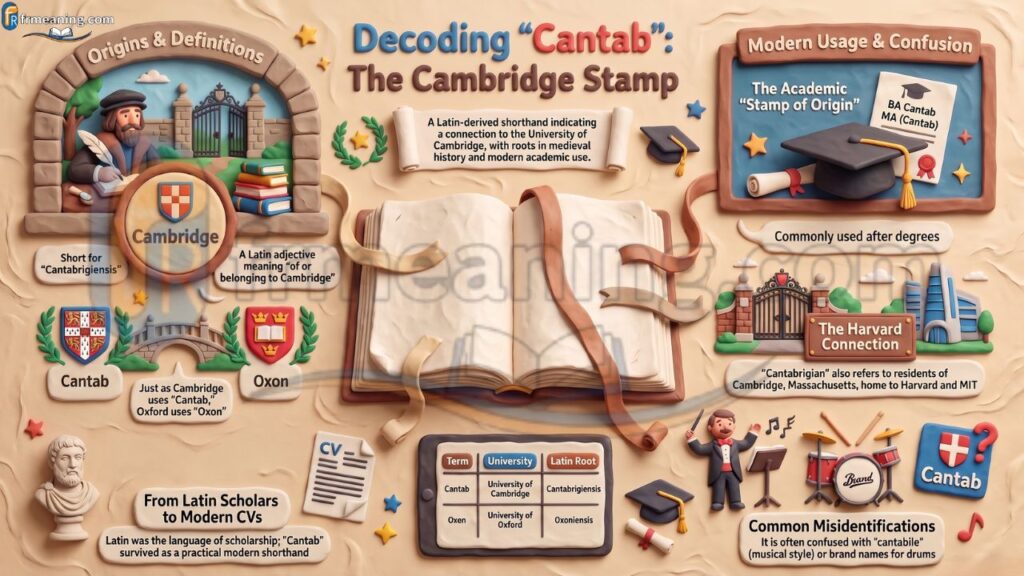
Cantab is an abbreviation of the Latin word Cantabrigiensis, which translates loosely to “of Cambridge” or “belonging to Cambridge.” It’s most commonly attached after an academic degree — think “MA Cantab” or “PhD (Cantab)” — to show that the degree was awarded by the University of Cambridge in England, not some other institution.
Think of it like a little stamp of origin. In the same way a wine label might say “Bordeaux” to show where the grapes came from, “Cantab” shows where the academic credential came from. Pretty simple once you break it down, but the Latin roots do confuse people at first glance (and honestly who can blame them, Latin abbreviations are everywhere in British academia and nobody really explains them anywhere).
A quick note before we dive deeper: this word shows up in way more places than you’d expect. From formal degree titles to random puzzle games to musical scores, “Cantab” has kind of quietly wormed its way into a bunch of unrelated corners of the internet, and that’s exactly why we’re covering all of them here, not just the academic definition.
So stick around, even if you already know the “of Cambridge” bit, because chances are one of the sections further down is the actual reason you searched this in the first place.
Cantab Meaning in English
If we’re translating cantab meaning in English plainly, it means “Cambridge” or, more precisely, “of or belonging to Cambridge.” The word itself isn’t really an English word at all — it’s a truncated Latin adjective that English speakers, particularly in the UK academic world, adopted wholesale.
So when a document says someone holds an “MA Cantab,” in plain English that reads as “a Master of Arts degree from Cambridge University.”
It’s worth noting that in everyday conversational English, almost nobody actually says the word “Cantab” out loud. It lives mostly in written form — CVs, book jackets, official biographies, formal letters, and academic citations.
You’ll rarely hear “she’s a Cantab” said casually, though it does happen among British academics and Cambridge alumni who use it almost as an in-joke or badge of identity.
Cantab Meaning in Urdu
For readers searching cantab meaning in Urdu, the closest translation would be کیمبرج کا (Cambridge ka), meaning “of Cambridge” or “belonging to Cambridge University.” There isn’t really a direct one-word equivalent in Urdu because the term itself is a Latin-derived academic abbreviation specific to British university tradition — it doesn’t map onto a native Urdu concept.
So translators and students generally explain it descriptively rather than translating it word-for-word, something along the lines of “کیمبرج یونیورسٹی سے متعلق” (related to Cambridge University). If you’re writing or translating academic documents from English to Urdu, it’s usually best practice to keep “Cantab” as-is and add a bracketed explanation the first time it appears.
The Etymology and Origin of “Cantab”
The Latin Root: Cantabrigiensis
The story starts with the Latin name for Cambridge itself: Cantabrigia. From this root, the adjective Cantabrigiensis was formed, meaning “of Cambridge” or “Cambridge-related.” Over centuries of academic Latin usage, this got shortened for practical purposes (nobody wants to write “Cantabrigiensis” every single time) down to the four letters we recognize today: Cantab.
How the Abbreviation Took Hold
British universities have long used Latin post-nominal abbreviations as a formal, almost ceremonial way of marking where degrees were earned. This tradition goes back hundreds of years, tied to the fact that Latin was the official language of scholarship across Europe for most of the medieval and early modern period. Cambridge → Cantabrigiensis → Cantab followed the same pattern used for Oxford (Oxoniensis → Oxon) and other ancient universities.
A Quick Historical Timeline
- Medieval period — Cambridge referred to formally in Latin documents as Cantabrigia.
- 16th–18th centuries — Latin remains the dominant language of formal academic correspondence; Cantabrigiensis used in official records.
- 19th century onward — As English replaces Latin in everyday academic writing, the shortened “Cantab” becomes the practical, standard abbreviation.
- Modern day — “Cantab” survives mainly in formal, ceremonial, and biographical contexts, plus a handful of surprising modern uses we’ll get into below.
How “Cantab” Is Used Today
Cantab After Academic Degrees
This is the big one — the use case most people are actually searching for. When you see something like “BA Cantab” or “MA (Cantab),” it’s telling you the degree holder studied at Cambridge University. You’ll often see it styled a few different ways:
- MA Cantab
- MA (Cantab)
- MA Cantab.
All three are broadly accepted, though style guides differ slightly on the punctuation. The parenthetical version tends to look cleanest in modern CVs and is probably your safest bet if you’re unsure.
Cantab as a Noun or Adjective (Cantabrigian)
Beyond degrees, “Cantab” is sometimes used informally as shorthand for a person connected to Cambridge — a student, graduate, or even resident of the city. The fuller, more formal term for this is Cantabrigian, and honestly you’ll see this word used more often in journalism and biography writing than the clipped “Cantab” when referring to a person rather than a degree.
Punctuation and Formatting Rules
There’s a bit of disagreement here, not gonna lie. Some style guides insist on a full stop after abbreviated Latin words (Cantab.), while others drop it entirely since Cantab isn’t technically a truncation ending mid-word the same way, say, “Assoc.” is.
Our recommendation: match whatever formatting convention the rest of the document uses, and stay consistent. If you’re writing a CV or academic bio, parentheses — like “(Cantab)” — read the cleanest to a modern audience.
Cantab Meaning at Harvard
A surprisingly common search is cantab meaning Harvard, and this one trips people up because it seems totally unrelated to Cambridge in England. Here’s the deal: “Cantabrigian” is also, confusingly, the term used to describe a resident of Cambridge, Massachusetts — the city where Harvard University (and MIT) is located.
Cambridge, Massachusetts was actually named after Cambridge, England back in colonial times, so the Latin-derived adjective got carried over too.
So depending on context, “Cantab” or “Cantabrigian” could refer to:
- Someone connected to Cambridge University in England, or
- A resident of Cambridge, Massachusetts, home to Harvard and MIT
This is genuinely one of the more confusing overlaps in the word’s usage, and it’s a big reason searches for “cantab meaning Harvard” show up at all. Context always decides which meaning applies — if you’re reading a British academic CV, it’s almost certainly Cambridge, England. If you’re reading a Boston newspaper, it’s probably referring to the Massachusetts city.
Other Modern and Unrelated Uses of “Cantab”
Here’s where things get interesting, and honestly this is the section most guides skip entirely, which is a shame because a LOT of people searching this term aren’t looking for the academic definition at all.
Cantab Drum
“Cantab” also shows up as a brand or product name in the world of steel tongue drums and handpan-style percussion instruments — often marketed simply as a “Cantab drum.” These have zero etymological connection to Cambridge University; it’s just a product naming choice by the manufacturer.
If you landed here searching for a musical instrument rather than an academic term, that’s likely what you’re thinking of, and it’s worth double-checking the specific brand or seller you saw the term on.
Cantab Meaning in Music
Similarly, cantab meaning in music sometimes gets confused with the Italian musical direction “cantabile,” which means “in a singing style” — a tempo/expression marking telling a performer to play smoothly and melodically, as if singing.
“Cantab” and “cantabile” look alike and share a Latin root (cantare, “to sing”), but they are NOT the same word. Cantabile relates to musical performance style; Cantab relates to Cambridge University. Easy mix-up, totally different meanings.
Cantab Meaning in Connections (the Word Puzzle)
If you searched cantab meaning connections, you probably encountered the word as an answer or clue in the New York Times’ Connections word puzzle game, or a similar daily word game. In puzzle contexts, “Cantab” typically appears as a clever, lesser-known abbreviation testing players’ vocabulary — usually grouped with other university-related terms like Oxon, alum, or grad. It’s the same core meaning (Cambridge-related) just repurposed as trivia.
Cantab Internet Meaning
As for cantab internet meaning, there isn’t a widely established internet slang definition separate from the academic one most online usage you’ll find still traces back to the Cambridge abbreviation, just used more casually in forums, Reddit threads, or social bios (e.g., someone listing “Cantab” in their Twitter/X bio to flag their Cambridge background).
Occasionally it pops up as a username or handle too, unrelated to any specific meaning at all, just a recognizable-sounding word people liked.
Cantab vs. Oxon: What’s the Difference?
Naturally, if Cambridge has “Cantab,” Oxford has its own version too — Oxon, short for Oxoniensis. Both work exactly the same way structurally; they just point to different universities.
| Term | University | Latin Root | Example Usage |
|---|---|---|---|
| Cantab | University of Cambridge | Cantabrigiensis | MA (Cantab) |
| Oxon | University of Oxford | Oxoniensis | MA (Oxon) |
So if you ever see “Oxon” instead of “Cantab” after someone’s degree, that’s simply telling you they studied at Oxford, not Cambridge. Same logic, different school, and honestly it’s one of the easiest ways to spot which of the two famous “Oxbridge” universities someone attended just by glancing at their post-nominal letters.
Other Similar Academic Abbreviations
Cambridge and Oxford aren’t the only UK universities with Latin-based post-nominal abbreviations, though they’re by far the most commonly seen ones.
- Dunelm — short for Dunelmensis, referring to Durham University
- Ebor — short for Eboracensis, referring to York (used more in ecclesiastical contexts, like the Archbishop of York)
- Cantuar — referring to Canterbury, again mostly used in church/clergy titles
These crop up far less frequently than Cantab and Oxon in everyday CVs, but they follow the exact same naming logic, and it helps to recognize them if you’re reading formal British biographical writing.
Common Examples of “Cantab” in a Sentence
To really nail down how this word is used practically, here’s a handful of real-world style examples:
- “Dr. Jane Whitfield, MA (Cantab), PhD, joined the faculty in 2021.”
- “He signed the letter simply as ‘James Ashworth, Cantab.'”
- “The book’s author bio reads: educated at Cambridge (Cantab), now living in London.”
- “As a proud Cantabrigian, she still returns to Cambridge every reunion year.”
- “Both Cantab and Oxon graduates were represented on the panel.”
Notice how in nearly every case, “Cantab” appears right after a degree title or name — it’s almost never used as a standalone word on its own in formal writing.
Should You Use “Cantab” On Your Own CV or Bio?
This is a fair question, and the honest answer is: it depends on your audience. If you’re applying for a role in British academia, publishing, law, or the civil service, adding “(Cantab)” after your degree can signal credibility and is fairly standard practice among Cambridge graduates writing formal bios.
Outside the UK, though, it can come across as a bit obscure or even pretentious to readers who’ve never encountered the abbreviation before — an American or Asian hiring manager might just be puzzled by it rather than impressed.
A good middle ground many Cambridge graduates use: write out “University of Cambridge” in full the first time it appears on a CV, and reserve the shorter “Cantab” notation for more formal or UK-specific contexts, like a book jacket bio, an academic paper, or a professional directory listing.
It’s really about knowing your reader — the same word that reads as elegant shorthand to one audience might just look like a typo to another.
Key Takeaways
- Cantab is a Latin-derived abbreviation of Cantabrigiensis, meaning “of Cambridge.”
- It’s most commonly used after academic degree titles to show the degree is from the University of Cambridge.
- The related term Cantabrigian can also describe a person, whether connected to Cambridge, England, or Cambridge, Massachusetts (home of Harvard).
- The word has some unrelated modern uses too — a drum brand, confusion with the musical term “cantabile,” and appearances in word puzzles like Connections.
- Its direct counterpart at Oxford is Oxon.
Honestly, once you see the pattern, you’ll start noticing “Cantab” (and “Oxon”) popping up everywhere in British formal writing, and it stops being confusing pretty fast.
Frequently Asked Questions
What does Cantab mean in simple terms?
Cantab is short for Cantabrigiensis, a Latin word meaning “of Cambridge,” used after degree titles from Cambridge University.
Is Cantab the same as Cantabrigian?
Not exactly — Cantab is the abbreviated form, while Cantabrigian is the fuller adjective/noun describing a Cambridge-connected person.
What is the difference between Cantab and Oxon?
Cantab refers to Cambridge University; Oxon refers to Oxford University — same naming pattern, different schools entirely.
How do you correctly write Cantab after a degree?
Common formats include “MA (Cantab),” “MA Cantab,” or “MA Cantab.” — consistency within your document matters most.
Does Cantab relate to Harvard University?
Not directly, but “Cantabrigian” also describes Cambridge, Massachusetts residents, where Harvard and MIT are located.
Why does Cantab show up in word games like Connections?
Puzzle games often use lesser-known academic abbreviations like Cantab as tricky, vocabulary-testing answers or clues.
Is “Cantab” related to the musical term “cantabile”?
No, they just sound alike — cantabile is an Italian musical direction meaning “in a singing style,” unrelated to Cambridge.