
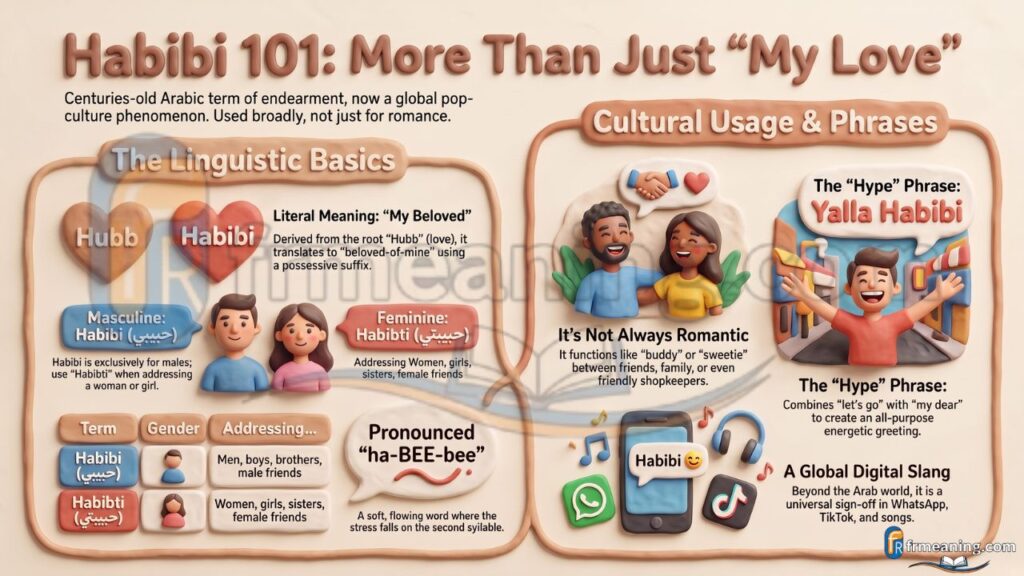

If you’ve ever scrolled through TikTok, listened to an Arabic pop song, or chatted with someone from the Middle East, you’ve probably heard the word “Habibi” thrown around a lot. So what does it actually mean? In short, the Habibi meaning boils down to “my love,” “my dear,” or “my beloved” but honestly, that’s just scratching the surface.
This little word carries centuries of cultural weight behind it, and once you understand where it comes from, you’ll start noticing it everywhere (and maybe even using it yourself, if you’re brave enough).
This guide breaks down everything the literal translation, the Arabic root, how it’s used across different countries including Pakistan, and even what it means from an Islamic and religious lens. Let’s get into it.
What Does Habibi Mean?
Put simply, Habibi (حبيبي) means “my beloved” or “my dear” and it’s used almost exclusively to address a male. It’s one of the most common terms of endearment in the Arabic-speaking world, and it shows up in romantic relationships, friendships, and family conversations alike.
Literal Translation
Word for word, Habibi translates to “my beloved one.” The word is built from two parts — the root that means “love,” and a possessive suffix meaning “my.” So technically, you’re saying “beloved-of-mine” every time you use it. Pretty poetic if you think about it.
Arabic Spelling (حبيبي)
In Arabic script, the word is written حبيبي. If you’re learning Arabic, it’s worth practicing this spelling since it’ll pop up constantly in texts, song lyrics, and social captions.
English Meaning
In terms of the habibi meaning in english, the closest equivalents are “darling,” “sweetheart,” “my dear,” or “my love.” None of these English words fully capture the warmth behind Habibi though — English just doesn’t really have a single-word equivalent that’s used this casually across friends, family, AND romantic partners all at once.
Where Does the Word Habibi Come From?
Habibi didn’t just appear out of nowhere — it’s rooted deep in Arabic grammar and classical vocabulary.
Arabic Root “حب” (Hubb)
The whole word traces back to the Arabic root Hubb (حب), which simply means “love.” This is a core building block in the language, and dozens of other Arabic words related to affection and romance come from this same three-letter root. So basically: Hubb → derives into → Habib, and from there the word keeps evolving.
Meaning of Habib
Before we get “Habibi,” there’s the base word Habib (حبيب), meaning “beloved” or “dear one.” This is actually a common first name in the Arab world too — lots of people are literally named Habib.
How “-i” Changes the Meaning
Here’s where the grammar gets interesting. Adding the suffix “-i” to Habib turns it into “my beloved” — it’s a possessive marker, kind of like adding “my” in English. So Arabic Grammar (the suffix “-i”) → transforms → Habib into Habibi (“my beloved”). This same pattern shows up all over Arabic, not just with this word.
Habibi Meaning in Arabic vs. Everyday Usage
While the dictionary definition sounds intensely romantic, the real-world habibi meaning in arabic conversation is way more relaxed than you’d expect. Native speakers say it constantly — to friends, cousins, coworkers, even to strangers sometimes as a friendly gesture. It’s less “I love you” and more like a warm, casual way of saying “hey buddy” or “sweetie,” depending on who you’re talking to.
How Do Arabs Use Habibi?
This is honestly the part most guides get wrong — they make it sound purely romantic, when in reality it’s used in a bunch of different everyday situations.
- Between Couples — Romantic partners use it constantly, similar to “baby” or “honey” in English.
- Between Friends — Close male friends say it to each other all the time, it’s totally normal and not weird at all.
- Within Families — Parents call their sons Habibi, siblings use it too, it’s a general family term of warmth.
- With Customers — In shops, taxis, or restaurants across the Middle East, you’ll hear vendors say “yes habibi” to be friendly and polite.
- Everyday Conversations — Basically anywhere affection or friendliness needs expressing, this word shows up.
Arab Culture → dictates the appropriate usage of → Habibi, meaning context is everything here — you really can’t just apply one fixed rule to when it’s okay to say it.
Habibi Meaning to a Boy vs Habibi Meaning to a Girl
This is probably the single most searched confusion point, so let’s clear it up properly.
The habibi meaning to a boy context is straightforward — Habibi is the masculine form, so it’s used when addressing a male, whether that’s a friend, brother, son, or partner.
Meanwhile, the habibi meaning to a girl situation is a little different — technically, Habibi shouldn’t be used for females because Arabic is a gendered language. Instead, the feminine form Habibti (حبيبتي) is what gets used for women and girls.
That said, in casual slang (especially online), some people use Habibi loosely for anyone regardless of gender, but grammatically correct Arabic would call for Habibti when addressing a girl.
Habibi vs Habibti
Here’s a quick side-by-side comparison to make the distinction crystal clear:
| Feature | Habibi (حبيبي) | Habibti (حبيبتي) |
|---|---|---|
| Gender | Masculine | Feminine |
| Used for | Men, boys | Women, girls |
| Meaning | My beloved (male) | My beloved (female) |
| Common in | Songs, texts, everyday speech | Songs, texts, everyday speech |
Habibi → is the masculine equivalent of → Habibti, and once you remember that one rule, the rest becomes pretty easy to keep straight.
Is Habibi Romantic?
Not always — and this trips people up constantly. Yes, it can absolutely be romantic when a couple uses it with each other, but it’s just as common in totally non-romantic settings. Think of it kind of like “buddy” or “pal” in English, except with a much warmer emotional undertone. Context, tone of voice, and relationship all determine whether it’s romantic, friendly, familial, or just plain casual.
How to Pronounce Habibi
Pronunciation is actually pretty simple once you break it down phonetically.
- Arabic Script: حبيبي
- Romanization: ha-BEE-bee
- IPA: /ħaˈbiːbi/
- English Approximation: Say “ha” then “bee” then “bee” again, stress falls on the second syllable
It’s a soft, flowing word — nothing too tricky for English speakers to pick up after a bit of practice.
Common Habibi Phrases
Once you know the base word, these related phrases will make way more sense.
Ya Habibi
“Ya” is basically a vocative particle (like saying “oh” or “hey” before a name). So “Ya Habibi” roughly means “oh my dear” or “hey love.”
Yalla Habibi Meaning
The yalla habibi meaning combines two super common Arabic words — “Yalla” (which means “let’s go” or “come on”) and “Habibi.” Together it translates to something like “come on, my love” or “let’s go, buddy” — you’ll hear this constantly in Arabic music and casual conversation, it’s basically an all-purpose hype phrase.
Wallah Habibi
“Wallah” means “I swear to God,” so this phrase is used for emphasis, like “I swear, my friend.”
Habibi Habibi
Repetition here is just for emphasis or as a catchy lyrical hook — you’ll hear this a LOT in Arabic pop songs.
Habibi in Text Messages
In digital conversations, Habibi has basically become a universal sign-off of warmth. Whether it’s:
- WhatsApp — used to soften a message or add friendliness
- Instagram — comment sections are FULL of it
- TikTok — often used jokingly or as an internet meme now
- Snapchat — casual affectionate texting between friends or partners
Honestly this word has kind of transcended language at this point, non-Arabic speakers use it in texts too just because it’s caught on as a vibe.
Habibi in Songs and Pop Culture
Arabic music has basically exported this word to the entire globe. From classic Arabic love songs to modern pop hits, Habibi shows up in lyrics constantly, and its popularity spread even further thanks to viral memes and remixes online.
It’s become such a recognizable piece of internet culture that even people with zero connection to Arabic language or Arab culture know the word now, even if they don’t fully understand its depth.
Habibi Meaning in Islam
A common misconception is that Habibi is a religious term, but that’s not quite accurate. In terms of the habibi meaning in islam, the word itself is secular it’s just an everyday Arabic term of affection, not a religious title.
However, it does hold spiritual resonance in some contexts: the Prophet Muhammad (peace be upon him) is sometimes referred to as “Al-Habib” or “Habib Allah” (beloved of God) in devotional and religious poetry.
So while “Habibi” in casual conversation is not inherently religious, the root concept of “beloved” does carry meaning within Islamic tradition and Sufi poetry specifically.
Habibi Meaning in Urdu and Regional South Asian Usage
Interestingly, this word has crossed over into South Asian languages too. The habibi meaning in urdu context is basically identical to Arabic — it’s understood as “my love” or “my dear,” and it’s frequently used by Urdu speakers who have Arabic-Islamic cultural influence, especially those familiar with Arabic through religious study or exposure to Gulf culture.
Habibi Meaning in Pakistan
Similarly, the habibi meaning in pakistan has grown thanks to a mix of factors — large numbers of Pakistani workers living in Gulf countries (UAE, Saudi Arabia, Qatar), Arabic music popularity, and social media trends.
It’s not a native Urdu or Pakistani word, but it’s been fully absorbed into casual youth slang, especially online, where people use it jokingly or affectionately regardless of strict grammar rules.
Regional Dialect Differences: How Usage Shifts Across the Arab World
Most guides skip this part entirely, but honestly it’s one of the more interesting bits. The word Habibi doesn’t sound or feel exactly the same everywhere.
- Egyptian Arabic — Extremely casual, used constantly among friends and even strangers, almost like a filler word of friendliness.
- Levantine Arabic (Lebanon, Syria, Jordan, Palestine) — Slightly softer tone, often used affectionately in music and poetry, very common in romantic contexts.
- Gulf Arabic (UAE, Saudi, Qatar, Kuwait) — Used a bit more formally in public settings, though still common between close friends and family.
So while the core meaning stays consistent, the frequency and tone genuinely shift depending on which dialect region you’re in.
Beyond Singular Forms: Habibna and Group Usage
Another gap most articles miss — Habibi isn’t limited to just singular masculine and feminine forms. There’s also Habibna (حبيبنا), meaning “our beloved,” used when a group collectively refers to someone with affection.
You’ll also hear variations in business or hospitality contexts, like a shopkeeper calling a customer “habibi” purely as a polite, friendly gesture with zero romantic or even personal undertone — it’s basically just Middle Eastern customer-service warmth.
Can Non-Arabic Speakers Say Habibi?
Yes, generally it’s totally fine, and most Arabic speakers actually appreciate it when non-natives try to use the word. A few tips though:
- Use it with people you’re already somewhat familiar or friendly with, not total strangers in formal settings.
- Get the pronunciation reasonably close, mispronouncing it badly can come off a bit clumsy.
- Avoid using it in professional emails or formal writing — it’s a casual/affectionate term, not corporate language.
Common Mistakes People Make
- Using Habibi for a woman instead of Habibti
- Assuming it’s ALWAYS romantic when it’s often just friendly
- Mispronouncing the stress (it’s ha-BEE-bee, not HA-bee-bee)
- Confusing the meme/slang usage with its actual literal, cultural meaning
Frequently Asked Questions
What does Habibi mean in Arabic?
Habibi (حبيبي) means “my beloved,” “my dear,” or “my love” in Arabic, typically used to address males affectionately.
Is Habibi romantic?
It can be romantic between couples, but it’s also used casually among friends, family, and even strangers.
What is the difference between Habibi and Habibti?
Habibi is masculine (for males), while Habibti is feminine, used specifically when addressing women or girls.
Can girls say Habibi?
Yes, women commonly say “Habibi” to men or boys, while “Habibti” is reserved for addressing females.
Is Habibi offensive?
No, it’s not offensive at all — it’s a warm, friendly term used respectfully across many everyday situations.
What does Yalla Habibi mean?
“Yalla Habibi” combines “let’s go/come on” with “my dear,” roughly meaning “come on, my love” or “let’s go, buddy.”
Is Habibi used only in romantic relationships?
No, it’s also common between friends, family members, and even customers in casual, friendly conversation.