

So you stumbled across the word “skink” somewhere maybe in a nature documentary, a school textbook, or a random Scrabble game and now you’re wondering what on earth it actually means. Good news, it’s not some obscure slang term or a typo of “skunk.”
The skink meaning in English points to a very real, very fascinating little animal, and by the end of this guide you’ll know exactly what it is, where the word came from, and how to use it correctly in a sentence.
This article goes a little deeper than most, too. We’re not just covering the basic definition we’ll also touch on the word’s odd history (yes, “skink” once meant something completely different), its rare slang usage, and even a few curious tangents like “skink meaning spiritual” and “skink meaning Scottish” that most guides skip right over.
What Is the Skink Meaning in English?
In simple terms, a skink is a small reptile belonging to the lizard family, known for its smooth, shiny scales and quick, darting movements. It’s a real, physical animal — not a slang word, not an insult, not a metaphor. If someone uses the word “skink” in a normal English sentence, they are almost always referring to this lizard.
Skink → belongs to → the lizard family (Scincidae). This is the core fact you need to remember. Skinks are cold-blooded, land-dwelling creatures that show up constantly in science classes, wildlife documentaries, and nature books across the United States and beyond.
Unlike words with shifting meanings depending on context, “skink” stays pretty consistent. You won’t find it changing tone between a formal essay and a casual chat — it’s always the animal.
Simple Definition of Skink
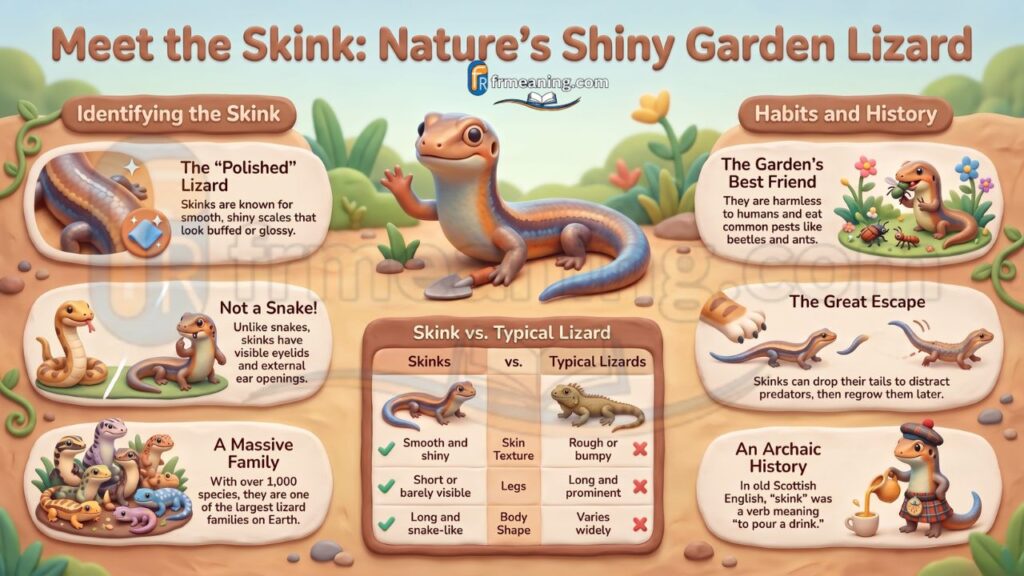
A simple definition of skink is: a small lizard with smooth, polished-looking skin and often very short (or barely visible) legs.
This definition is deliberately kept easy because, honestly, most people asking about skinks are students, parents helping with homework, or curious readers — not herpetologists. Compared to rough or spiky lizards you might picture from cartoons, skinks look almost glossy, like someone buffed their scales with a cloth. That single visual detail is usually enough for beginners to lock in the meaning.
What Is a Skink, Exactly?
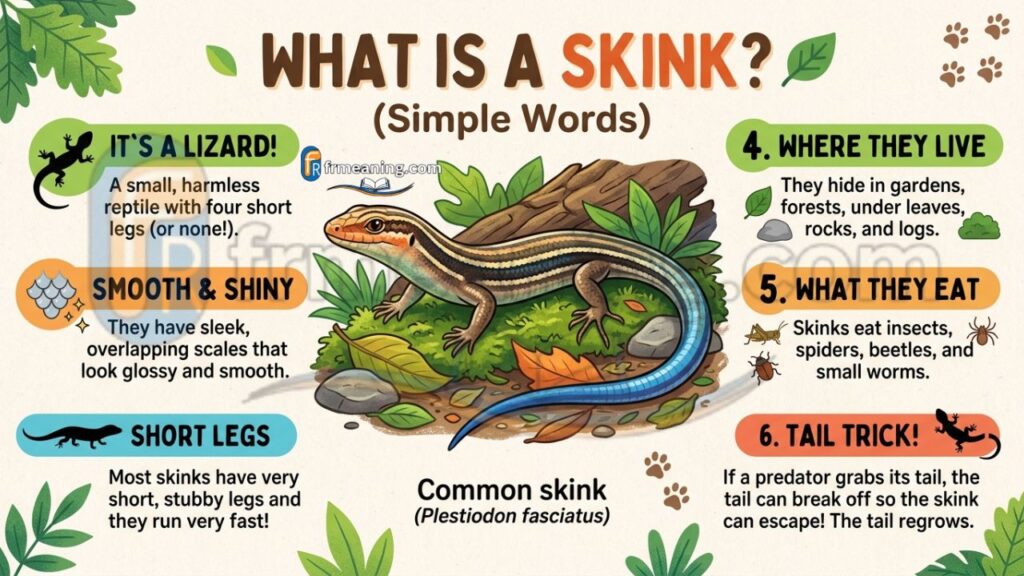
A skink is a ground-dwelling reptile that spends most its life hiding under rocks, leaves, or fallen logs, only coming out to hunt or soak up some sun.
Here’s what makes them tick, behaviorally speaking:
- They’re cold-blooded (ectothermic), meaning they can’t generate their own body heat and rely on basking in sunlight to warm up.
- They mostly eat insects and small bugs, occasionally nibbling on plant matter too.
- They’re fast — like, genuinely surprising-you-mid-step fast — and use that speed to dodge predators.
Because of their insect-heavy diet, skinks actually do gardeners a favor by keeping bug populations in check. So next time one darts across your patio, maybe don’t scream and just say thanks instead.
Skink as a Type of Lizard
Scientifically speaking, skink → is classified under → the family Scincidae, which is honestly one of the largest lizard families on the planet, home to well over a thousand different species.
What sets skinks apart from your average lizard:
| Feature | Skinks | Typical Lizards (e.g., iguanas, geckos) |
|---|---|---|
| Skin texture | Smooth and shiny | Often rough or bumpy |
| Legs | Short, sometimes barely visible | Usually longer and more prominent |
| Body shape | Long, slim, snake-like | Varies widely |
A lot of people in the U.S. actually mix up skinks with snakes because some species have legs so tiny they’re almost invisible. But don’t be fooled — skinks have eyelids and external ear openings, two features snakes simply don’t have. That’s the giveaway every time.
Skink Meaning in Simple Words
If you just want the quick, no-fuss version: a skink is a small, shiny lizard that runs fast and loves sunbathing.
Think of it like the friendly, slightly shy garden lizard that helps keep your yard bug-free. It’s not dangerous, it’s not aggressive, and honestly it probably wants nothing to do with you either. This is usually the version taught to kids and beginner English learners because it skips the scientific jargon entirely.
Skink Definition According to Dictionary
Standard English dictionaries describe a skink as a smooth-scaled lizard, typically with a long body and short legs, commonly found in warm climates around the globe.
“A skink is a smooth-scaled lizard, often found in warm regions.”
This dictionary-style definition backs up everything discussed so far. Whether the word shows up in a textbook, a Merriam-Webster entry, or a random nature blog, it circles back to the exact same creature every time.
Where Did the Word “Skink” Come From? (Etymology Explained)
Okay, here’s where it gets genuinely interesting — and this is the part most competing articles gloss right over.
The English word “skink” traces back through Latin “scincus” and further back to Greek “skinkos,” both of which referred directly to the lizard. So the animal-meaning of skink has been around, more or less unchanged, for centuries. That part’s straightforward.
But — and this is the twist — there’s an entirely separate, older word that’s spelled and pronounced the same way: an archaic verb “skink,” found mainly in Scottish and older British English, meaning “to pour out drink” (like pouring ale or wine). This comes from Old English/Old Norse roots (“scencan”), completely unrelated to lizards.
So when people search “does skink mean to pour out,” they’re technically half right — but they’re thinking of a totally different, mostly extinct word that just happens to share the same spelling as the lizard. It’s a classic case of homonyms: two words, same spelling, wildly different origins and meanings.
Skink meaning Scottish, in this older sense, essentially referred to someone serving drinks — a “skinker” was literally a bartender or cupbearer in old Scots dialect. You won’t hear this used in everyday conversation anymore, but it occasionally pops up in historical fiction or old poetry.
Skink Other Meaning: Slang and Betrayal Usage
Here’s another gap worth filling in properly. A few informal or regional slang uses of “skink” do exist, though they’re rare and definitely not mainstream:
- Skink meaning slang: In some British and Caribbean informal speech, “skink” has occasionally been used as a mildly negative term for a sneaky or untrustworthy person — kind of like calling someone a “snake,” oddly fitting given the lizard connection.
- Skink meaning betray: This isn’t a formal dictionary definition, but it’s tied loosely to the slang usage above — someone acting “skinky” or being called a “skink” in certain slang contexts implies shady or two-faced behavior, similar to being called a snake in the grass.
- Skink meaning spiritual: There isn’t a widely recognized spiritual or symbolic meaning attached to skinks in mainstream Western culture, unlike animals such as owls or snakes. However, in some folk traditions, lizards broadly (including skinks) are associated with regeneration and renewal, largely because of their real-life ability to regrow their tails.
- Skink meaning dog: This one’s a bit of an internet myth — there’s no established dictionary or regional dialect where “skink” means “dog.” It’s most likely confusion with similar-sounding slang terms or a misheard phrase somewhere online.
None of these slang or symbolic uses are common enough to override the primary, dictionary-recognized skink meaning in English — the lizard. But knowing they exist helps you avoid confusion if you stumble across them in casual conversation or old texts.
Pronunciation and Grammar Usage
Quick and practical: “skink” is pronounced /skɪŋk/ — rhymes with “think” and “pink,” just swap the first letter. It’s a countable noun, so the plural is simply “skinks” (no irregular spelling weirdness here, thankfully).
Common mix-up alert: people frequently confuse “skink” with “skunk” (the smelly mammal) purely because the words look similar on paper. They are, obviously, not related in any way — one’s a reptile, the other’s a mammal known for its, uh, defensive spray.
Examples of Skink in Sentences
Seeing the word used naturally really helps things click.
| Sentence | What It Shows |
|---|---|
| The skink ran quickly under the rock. | Fast movement, natural behavior |
| We saw a blue-tailed skink in the garden. | Common species reference |
| The skink warmed itself in the sun. | Typical reptile basking behavior |
Simple beginner sentences work great too: “The skink is a lizard” or “A skink lives in warm places.” Both are commonly found in children’s books and ESL classrooms across the U.S.
Is Skink an Animal or a Reptile?
A skink is both — it’s an animal first, and more specifically, a reptile. All reptiles fall under the animal kingdom, but obviously not all animals are reptiles (your dog isn’t a reptile, for instance).
Skink → is classified as → a reptile, placing it in the same broad group as snakes, turtles, and crocodiles. This is a pretty important distinction for students learning basic biology, since exam questions love to test this exact classification.
Types of Skinks Found Worldwide
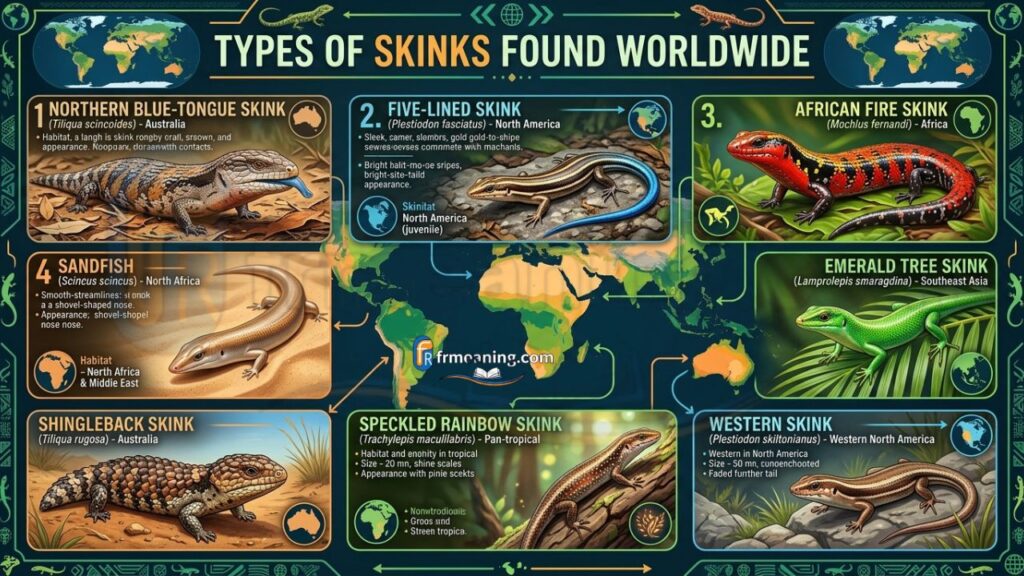
There’s honestly a huge variety of skinks out there, from dull brown ground-dwellers to strikingly colorful species.
| Skink Type | Region |
|---|---|
| Five-lined skink | United States |
| Blue-tongued skink | Australia |
| Sand skink | Florida |
| Fire skink | Africa |
The five-lined skink is probably the most recognized species in the U.S., easily identified by the bright blue tail on juveniles (which fades as they age, interestingly enough).
Where Do Skinks Live?
Skinks thrive in warm, mild environments where they can hide easily and soak up plenty of sun.
In the U.S., you’ll typically spot them in:
- Forests and woodland edges
- Backyard gardens
- Grasslands and open fields
- Rocky, sheltered areas
Because skinks adapt so well to human-populated areas, loads of people see them near their homes without even realizing what they’re looking at.
Skink vs. Basilisk: What’s the Difference?
Quick tangent worth addressing since people often search both terms together — basilisk meaning in the reptile world refers to a completely different (and much larger) lizard, famous for its ability to run across water, earning it the nickname “Jesus Christ lizard.” Basilisks belong to the family Corytophanidae, not Scincidae, and they’re notably bigger, with distinctive head crests.
So while both are lizards, a skink and a basilisk are not the same animal — skinks are small, smooth, and ground-hugging, while basilisks are larger, crested, and famously water-walking. Easy way to remember it: if it’s small and shiny, it’s a skink; if it’s sprinting across a pond, that’s a basilisk.
Difference Between Skink and Lizard
Technically speaking, every skink is a lizard — but not every lizard is a skink, if that makes sense. “Lizard” is the broader umbrella term, and “skink” is one specific family within it.
Key distinguishing traits:
- Skin: Skinks have notably smoother, shinier scales compared to many other lizards.
- Legs: Skink legs tend to be shorter, sometimes nearly absent in certain species.
- Body: Skinks generally have longer, more slender bodies than typical lizards like geckos or iguanas.
Is a Skink Dangerous to Humans?
No, skinks are not dangerous to humans in any meaningful way. They’re shy, they avoid confrontation, and they’ll bolt the second they sense you nearby.
Skink → poses → no venom threat to humans. Even in the rare case one bites (usually only if it feels cornered), it’s harmless — more startling than painful. If anything, skinks are doing you a favor by eating garden pests like ants, beetles, and small bugs.
Fun Facts About Skinks
A handful of genuinely cool traits worth knowing:
- Many skinks can drop their tails on purpose to escape predators, a defense mechanism called autotomy. The tail eventually grows back, though usually a slightly different shade or texture.
- Some skink species give live birth instead of laying eggs, which is unusual among reptiles and surprises a lot of first-time learners.
- Skinks can regenerate fairly quickly, which is part of why some cultures loosely associate lizards with renewal and resilience.
Skink Meaning for Kids
For younger readers, keep it dead simple: a skink is a small, shiny lizard that runs really fast and loves sitting in the sun. Teachers across the U.S. often use skinks as an easy, harmless example when introducing kids to reptiles, mostly because they’re common, safe, and genuinely fun to observe.
Why Learning the Skink Meaning in English Matters
Understanding this word does more than just settle a random curiosity — it builds vocabulary confidence, especially for English learners tackling science-heavy texts. Once you know a skink is simply a smooth-scaled lizard, reading nature books, watching documentaries, or working through biology homework becomes a whole lot less confusing.
It also helps clear up the handful of misconceptions floating around — the rare slang usage, the old Scottish drink-pouring verb, and the total myth around “skink meaning dog.” Knowing the full picture means you’ll never second-guess yourself next time the word pops up.
Frequently Asked Questions
What does skink mean?
Skink refers to a small, smooth-scaled lizard belonging to the family Scincidae, commonly found in warm regions worldwide.
Does skink mean to pour out?
Not in modern usage. That’s an archaic Scottish/British verb, unrelated to the lizard, historically meaning to pour drinks.
What is a skink in British slang?
Rarely, skink meaning slang refers to a sneaky or untrustworthy person, though this usage is uncommon and outdated.
What’s the difference between a skink and a basilisk?
A skink is small and smooth-skinned; a basilisk is a larger, crested lizard famous for running across water.
Is skink meaning betray a real definition?
Not officially — it’s a loose slang association, likening a sneaky “skink” to a snake-like, untrustworthy character.
Does skink have any spiritual meaning?
No major mainstream tradition assigns one, though lizards broadly symbolize renewal, tied to their tail-regrowing ability.
Is a skink the same as a common house lizard?
Not always — skinks are one specific lizard family, while “house lizard” can refer to geckos or other species too.
What does skink mean in slang?
In slang, “skink” can refer to a skink lizard, while in some regional usage it may describe serving or pouring a drink.
What is skink in English?
In English, a skink is a small-to-medium lizard belonging to the skink family, Scincidae, commonly recognized by its smooth, shiny scales.
Does skink mean to pour out?
Yes, “skink” can mean to pour or serve a drink, especially in Scottish usage. It is an older or regional verb.
What do skinks symbolize?
Skinks can symbolize adaptability, renewal, protection, and resilience because these lizards survive in diverse environments and can adapt effectively to changing surroundings.
What can skink refer to?
“Skink” can refer to a type of lizard, a Scottish soup, or a Scottish verb meaning to serve or pour a drink.
What does “skinking” mean?
“Skinking” generally means pouring or serving a drink in Scottish usage. Depending on context, it may also relate to preparing or serving skink soup.
What does skink mean in Scotland?
In Scotland, “skink” can mean a traditional soup, especially Cullen skink, or a verb meaning to serve or pour drinks.
Where does the word “skink” come from?
The word “skink” has historical roots in Scots and Middle English, with connections to terms describing a shin, leg, soup, or serving drinks.
What do you call a skink?
A skink is generally called a lizard because it belongs to the family Scincidae. Specific species have individual common names.
Can skink be a verb?
Yes, “skink” can function as a verb, particularly in Scottish English, where it traditionally means to pour or serve a drink.