


So you’ve told someone you’re planning to elope, and instead of excitement, you got a confused look and the question, “wait, what does elope mean, exactly?” You’re not alone this happens to almost every couple who chooses this path.
Despite being a centuries-old word, elope is still one of the most misunderstood terms in the wedding world, and honestly, a lot of that confusion comes from outdated ideas about what eloping actually looks like today.
In this guide, we’re breaking down the true elope meaning, where the word came from, how its definition has shifted over time, and even touching on a totally different (yes, medical) use of the word that a lot of people search for without realizing it’s unrelated to weddings at all.
By the end, you’ll have a full, comprehensive understanding of what eloping really means and maybe a clearer idea of whether it’s right for you.
What Does Elope Mean? A Quick Definition
At its core, elope means to get married in a small, intimate, and often spontaneous way, usually without the large guest list, formal venue, or traditional trappings of a wedding. That’s the modern definition, anyway.
The word itself, when used as eloping meaning in everyday conversation, typically refers to a couple choosing to marry privately, sometimes in a meaningful location like a mountaintop, a courthouse, or even their own backyard, without inviting dozens (or hundreds) of guests. It’s less about secrecy these days and more about intentionality prioritizing the marriage itself over the production of a big event.
The Origin of the Word Elope (And How It Changed)
Here’s where things get interesting. The word “elope” has honestly had a bit of a glow-up over the years, and it’s kind of a fun one to trace.
Historically, to elope meant “to run away secretly in order to get married,” often implying the couple was doing so against the wishes of their family, or without their family’s knowledge at all. This is likely where the whole idea that eloping is “selfish” or “sneaky” came from — an idea that, frankly, doesn’t hold up anymore.
Today, dictionaries (including Merriam-Webster) have updated their definition to reflect how the word is actually used now, describing eloping as shifting toward a small destination wedding. That’s a pretty massive shift in tone. What used to imply rebellion or secrecy now implies intention, simplicity, and choice.
Word origin → shifted meaning → modern usage: this is the clearest way to understand it. The word hasn’t changed, but the cultural context around marriage absolutely has, and the definition evolved right along with it.
Eloping Meaning Today vs. the Old-School Definition
To make this easier to digest, here’s a quick side-by-side comparison of how the term has evolved.
| Aspect | Old-School Definition | Modern Definition |
|---|---|---|
| Family Involvement | Secretive, often without family knowledge | Family can be included or informed |
| Motivation | Running away, often to avoid disapproval | Intentional choice for intimacy |
| Guest Count | Typically zero guests | Often 0–15 guests |
| Location | Wherever was convenient/fast | Meaningful, often adventurous locations |
| Reputation | Seen as “selfish” or impulsive | Seen as thoughtful and personal |
As you can see, the shift is pretty dramatic. If your grandma still thinks eloping means “running off to Vegas without telling a soul,” she’s not wrong historically — she’s just working off an old definition.
What Does It Mean to Elope With Someone?

When people ask what does it mean to elope with someone, they’re usually asking about the relationship dynamic behind the decision, not just the legal act of marrying. Eloping with someone means choosing to commit to that person in a deeply personal, low-pressure setting, one that’s centered around the two of you rather than external expectations.
There’s also an emotional layer here that a lot of guides skip over. The elope meaning in love context is really about prioritizing connection over performance.
Couples who elope often describe the experience as more emotionally present, because there’s no 200-person guest list to manage, no seating chart drama, and no pressure to “perform” for an audience. It’s just you, your partner, and the decision you’re making together.
What Is “Getting Eloped,” Exactly?
A lot of people phrase it this way, asking what is getting eloped as if it’s something that happens to you rather than a choice you make. To clear this up: eloping is an active decision made jointly by both partners, not something one person does to the other (despite the old “runaway bride” trope).
Elopement → is defined by → a small guest count, usually under 15 people. That’s generally the line where photographers and planners draw the distinction — once you cross that threshold, the day starts to look and feel more like a traditional wedding, with all the logistics that come with it.
How Many People Is Considered an Elopement?
There’s no universal legal number, but most wedding professionals agree that an elopement typically includes 15 guests or fewer. Some couples elope completely alone with just an officiant and photographer present; others invite a small handful of close family or friends.
If you’re struggling to keep your list small enough to still feel like an elopement, here’s a tip that comes up a lot: elope with just the two of you (or a tiny group), then host a larger, casual reception later for everyone else. This way you get the intimacy of eloping without feeling like you’re excluding people who matter to you.
What Do You Need to Elope?
Here’s the good news — you genuinely don’t need much. Elopement → requires → a marriage license, regardless of where or how you do it. Beyond that legal necessity, the requirements are refreshingly minimal.
A basic elopement checklist looks something like this:
- The two of you (obviously the most important part)
- A meaningful location — this could be a national park, a beach, or your own backyard
- A marriage license, which varies by state or country
- An officiant (in most, but not all, places)
- Witnesses, if required by your local laws
- A Special Use Permit, if you’re eloping somewhere like a national park
- A photographer, to capture the day (this one’s optional but highly recommended so you actually have memories of it!)
Every location has different rules, so it really is worth double-checking before you book flights or pick a spot.
Elopement vs. Micro-Wedding vs. Destination Wedding: What’s the Real Difference?
This is where a lot of couples (and honestly, a lot of articles) get a little sloppy with terminology, using these three terms almost interchangeably. They’re related, but they’re not the same thing, and understanding the distinction actually helps a ton when you’re planning.
Elopement
An elopement is the smallest and most intimate of the three, usually 0–15 people, with an emphasis on adventure, simplicity, and the couple’s connection over event logistics. It’s less “planned event” and more “meaningful experience.”
Micro-Wedding
A micro-wedding sits in the middle ground. Think 20–50 guests, still a real wedding with a ceremony and reception, just scaled down. There’s often a dinner, some decor, maybe even a first dance — just with a much shorter guest list and lower price tag than a full wedding.
Destination Wedding
A destination wedding can actually have a large guest list (50, 100, even 200+ people) — the defining feature isn’t size, it’s location. Guests travel somewhere special, often over multiple days, and it typically includes all the traditional elements of a wedding: a reception, formal attire, a wedding party, and so on.
So while an elopement can technically happen at a destination, not every destination wedding is an elopement. Size and intention are what really separate these three.
Marriage License and Legal Requirements: What Varies by State
One thing competitor guides tend to gloss over is just how differently marriage laws work depending on where you elope. State marriage laws → determine → whether you need witnesses, an officiant, or waiting periods, and the differences can honestly be pretty surprising.
Here’s a small snapshot to show how much variation exists:
| State | Witness Required? | Waiting Period | Notable Quirk |
|---|---|---|---|
| Alabama | No | None | No witnesses required at all |
| Colorado | No | None | Allows self-solemnization (you can legally marry yourselves — even a dog can “officiate” since no officiant is required) |
| California | Yes (1) | None | Requires a licensed officiant |
| New York | Yes (1) | 24-hour wait (waivable) | Marriage license valid for 60 days only |
This is far from exhaustive (there are 50 states plus countless countries, after all), but the point is clear: don’t assume your home state’s rules apply everywhere. Always check the specific requirements of wherever you plan to say “I do,” because getting this wrong can mean your marriage isn’t actually legal.
Ways to Include Loved Ones in Your Elopement
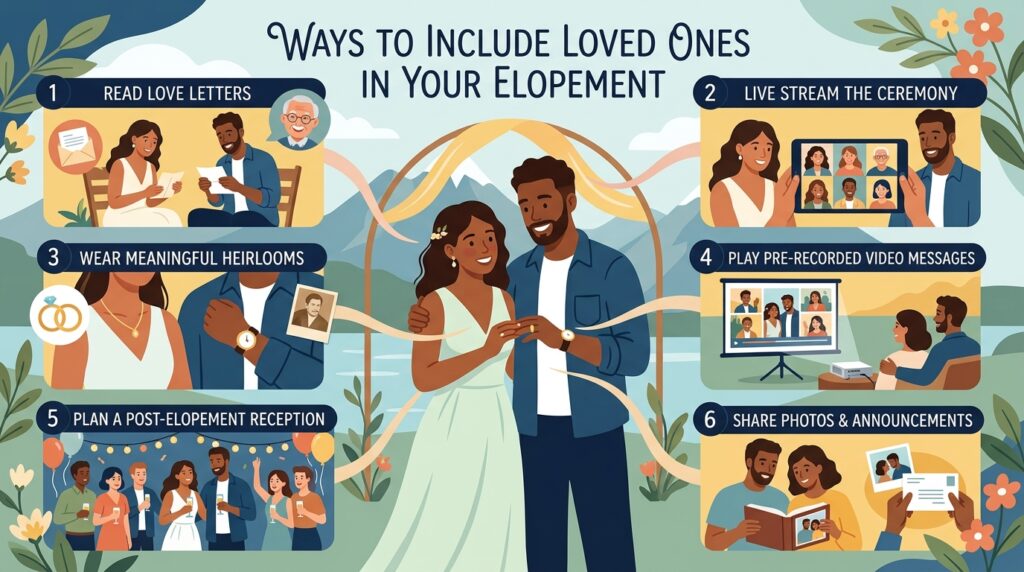
A common misconception is that eloping means completely cutting out family and friends, but that’s really not true anymore, and it’s honestly one of the more underexplained parts of this topic. There’s a lot of middle ground here.
Some popular ways couples include loved ones without losing the intimate feel of an elopement:
- Video calling family during the ceremony so they can watch live, even from far away
- Hosting a small “first look” gathering the morning of, then eloping privately for the actual ceremony
- Planning a casual post-elopement party weeks or months later, so everyone can celebrate without the pressure of a formal event
- Bringing a handful of closest people, like parents or siblings, while still keeping numbers low
The bottom line is, elopement doesn’t have to mean isolation. It just means you get to choose how much (or how little) involvement feels right for you as a couple.
Are There Any Disadvantages of Eloping?
Truthfully, most disadvantages associated with eloping are more about perception and planning than actual dealbreakers. Still, it’s worth being upfront about them.
Disapproval From Family or Friends
Not everyone will immediately understand or support your decision, especially older relatives who might associate eloping with the outdated “runaway” definition. This can sting, but it’s usually more about their own expectations than a reflection of your choice.
Confusion About Etiquette
Traditional weddings come with decades of established etiquette — gift registries, save-the-dates, bachelor and bachelorette parties. Elopements don’t really have that rulebook yet, which can feel freeing to some and a little disorienting to others.
Being at the Mercy of Mother Nature
If you’re eloping outdoors (which a lot of couples do), there’s typically no indoor backup plan the way traditional venues offer. Weather can shift your plans last minute, though plenty of couples say unexpected weather actually made their day more memorable, not less.
Do Elopement Marriages Last?
Yes — an elopement marriage is not statistically or emotionally different from a marriage that begins with a traditional wedding. The type of ceremony you have has very little bearing on the strength or longevity of the relationship itself; what matters far more is the day-to-day commitment between partners, not how many people watched you say “I do.”
Do Brides Regret Eloping?
For the most part, no — couples who elope tend to report high satisfaction with their decision, often citing the intentionality and low-stress nature of the day as a major positive. Because eloping requires more deliberate thought (you can’t just “go with the flow” of tradition), couples often feel more confident it was genuinely the right choice for them.
Elope Meaning Beyond Weddings: The Medical and Clinical Definition
Here’s something a lot of wedding-focused guides completely skip, but it’s actually a really common search: elope meaning medical context has nothing to do with romance at all. In healthcare and caregiving settings, “elopement” refers to a patient or resident leaving a facility, or a supervised area, without authorization or awareness of the risks involved.
This is a pretty important distinction, especially for caregivers, parents, and medical professionals searching this term for entirely different reasons than someone planning a wedding.
Elope Meaning for Autism
In the context of autism, elopement refers to a child or adult wandering or bolting away from a safe, supervised environment, often without recognizing the potential danger involved (like traffic, water, or getting lost). This is a significant safety concern for many families, and elopement prevention strategies (like door alarms, ID bracelets, or fenced yards) are a common topic in autism caregiving resources.
Elope Meaning for Adults
For adults, particularly in dementia or memory care settings, elopement describes a resident leaving a care facility unsupervised and unnoticed, which can pose serious safety risks. Facilities often implement security measures like coded exits or monitored alarms specifically to prevent this kind of elopement.
Elope Meaning for Children
Similarly, elope meaning children in a general caregiving or educational context refers to a child leaving a designated safe area, like a classroom or playground, without permission. Schools and childcare centers sometimes have “elopement protocols” in place specifically to respond to this.
So if you found this article searching one of those medical phrases, hopefully this section actually answered your question, even though the rest of the guide is wedding-focused.
How “Elope” Translates Across Languages and Cultures
Since marriage traditions vary so widely around the world, it’s worth briefly touching on how the concept of eloping is understood in other languages, even though exact translations can shift depending on regional dialect and context.
Elope Meaning in Farsi
In Farsi (Persian), there isn’t necessarily a single one-to-one word that captures every nuance of “elope” the way English does, since the cultural framing of marriage differs quite a bit.
Generally, the concept is expressed through phrases meaning something closer to “secret marriage” or “marrying without family ceremony,” rather than a direct single-word equivalent.
If this matters for a specific personal or legal situation, it’s worth confirming with a native speaker or professional translator, since nuance here really does matter.
Elope Meaning in Chinese
In Chinese, the idea of eloping is often expressed with terms that literally translate closer to “private marriage” or historically, phrases implying a couple ran off together against family wishes. As with Farsi, the exact phrasing can shift depending on dialect (Mandarin vs. Cantonese, for example) and regional cultural context, so again, a native speaker is your best resource for precision here.
Should You Elope? Final Thoughts
At the end of the day, whether or not to elope is a deeply personal decision, and there’s no universally “right” answer. What we can say confidently is that the modern elope meaning in English has shifted dramatically away from its old “runaway marriage” reputation, and today represents a totally valid, intentional way to get married.
If you’re drawn to the idea of an intimate, meaningful day free of the stress and expectation that often comes with a traditional wedding, eloping might genuinely be worth exploring. And if you’re still torn, remember: it doesn’t have to be all-or-nothing. Plenty of couples find a version that blends both worlds, eloping first, celebrating later, on their own terms.
Frequently Asked Questions
What does elope mean in simple terms?
It means marrying in a small, intimate, and intentional way, typically with few or no guests, rather than a large traditional wedding.
What does it mean to elope with someone?
It means choosing to marry that person privately and intentionally, prioritizing connection over a large, formal event.
Is eloping the same as having a small wedding?
Not exactly — elopements are typically smaller (under 15 people) and more spontaneous than scaled-down “micro-weddings.”
Do you need a marriage license to elope?
Yes, a valid marriage license is always required, no matter where or how small your elopement ceremony is.
What does elope mean in a medical context?
It refers to a patient, child, or resident leaving a supervised area without permission, often raising safety concerns.
Can you elope without telling anyone?
Yes, though it’s increasingly common for couples to include a few loved ones or inform family beforehand.
Do people regret eloping?
Most couples report high satisfaction with eloping, often citing the intimacy and low stress as major benefits.
Before You Leave…
https://frmeaning.com/futz-meaning/
https://frmeaning.com/what-does-lfg-mean-in-text/
https://frmeaning.com/luffy-meaning/

