If you’ve ever seen someone text “sorry, I was futzing with my playlist” and thought, wait, what does that even mean you’re honestly not alone. The word futz pops up a lot more than people realize, and most of us just kind of guess at it from context and move on.
But if you actually want to know the futz meaning properly, and use it right yourself without sounding weird, this guide breaks the whole thing down origin, tone, examples, the works.
In short: futz means to fiddle around with something, tinker aimlessly, or waste a bit of time on small stuff instead of getting to the real task. It’s casual, it’s American English through and through, and it’s rarely meant to hurt anyone’s feelings.
Let’s dig into where it comes from, how it shifts meaning depending on the sentence, and when you should probably avoid using it altogether.
What Does Futz Mean?
The futz meaning in English boils down to this: to fiddle, putter, or spend time on minor, often unnecessary tasks rather than the main job at hand.
It’s not an insult exactly, and it’s not really a compliment either — it just describes a certain kind of behavior, the low-stakes fiddling we all do sometimes.
| Detail | Explanation |
|---|---|
| Most Common Meaning | To fiddle, putter around, or waste time on small tasks |
| Full Form | None — it’s a standalone informal word, not an acronym |
| Tone | Casual, usually light and a little playful |
| Common Platforms | Texting, everyday talk, social media, forums |
| Formal or Informal | Strictly informal |
| Pronunciation | Rhymes with “guts” — one syllable, “fuhts” |
One thing people ask a lot: is there a futz meaning audio clip anywhere so they can hear it said out loud? Most online dictionaries (Merriam-Webster included) actually have small audio pronunciation buttons next to the entry, which is honestly the easiest way to nail it if you’ve only ever seen it written down. It’s a short, punchy word — say it fast, almost clipped.
The Main Meaning of Futz
When somebody says a person is “futzing around,” they basically mean that person is adjusting, tinkering, or busying themselves with small stuff instead of finishing what actually matters.
The tone here is usually playful, not harsh. Take this example:
“Stop futzing with your desk and finish your homework.”
Nobody’s accusing the kid of doing something bad — the parent’s just pointing out that organizing pens and papers is a distraction from the real task, which is homework. That’s the whole vibe of the word, honestly.
Common phrases you’ll bump into:
- Futz around
- Futz with something
- Quit futzing
- Stop futzing around
All of these lean toward the same idea — unnecessary or excessive fiddling that’s keeping someone from the point.
Alternative Meanings of Futz
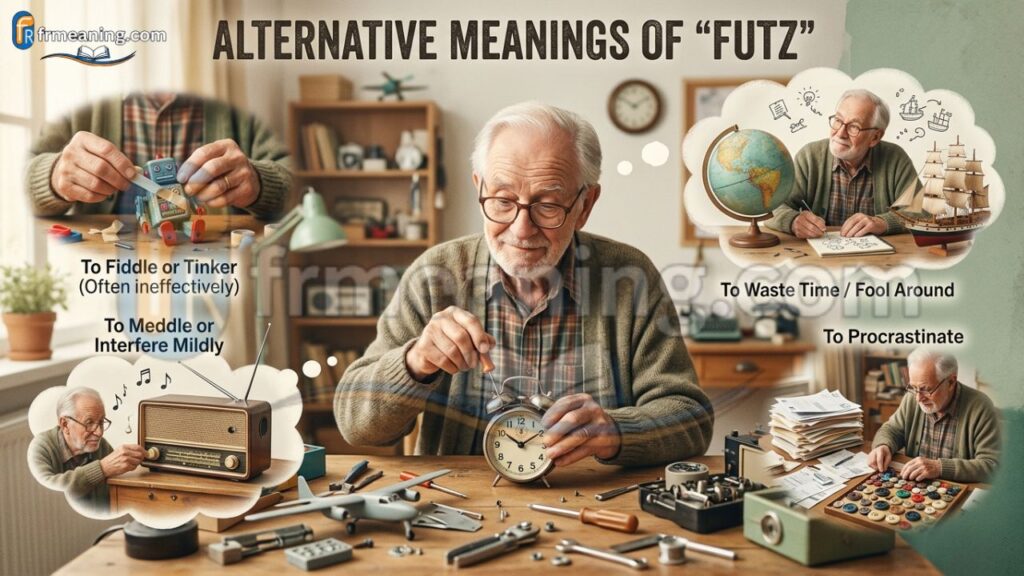
While the everyday “fiddle around” sense is what most people mean, futz does stretch into a couple other contexts depending on who’s talking.
| Meaning | Context | Tone | Example |
|---|---|---|---|
| To fiddle or tinker | Everyday conversation | Casual | “He kept futzing with the TV remote.” |
| To waste time | Informal speech | Mildly critical | “We futzed around all afternoon.” |
| To make small adjustments | DIY or hobbies | Neutral | “She’s futzing with the camera settings.” |
Some older dictionaries note stronger, more vulgar Yiddish-rooted slang uses of the word, but honestly those meanings barely show up in modern conversation anymore. Nowadays, if someone says futz, 99% of the time they just mean “messing around with something.”
How Context Changes the Meaning
Here’s the thing about futz — the word itself doesn’t carry a fixed judgment. Context → determines → whether it means harmless tinkering or lazy procrastination. The words sitting around it (around, with, on) do most of the heavy lifting.
Small adjustments
“I’m just futzing with the settings.” This usually means someone’s making minor tweaks to improve something — not wasting time exactly, just fine-tuning.
Wasting time
“Quit futzing around and let’s leave.” Here it’s basically a nudge to stop delaying. It’s mildly impatient but still not really rude.
Casual tinkering
“Dad loves futzing in the garage.” This one’s neutral-to-positive — it means he enjoys puttering around on small projects without any rush or pressure attached.
Organizing instead of working
“I’ve been futzing with my email folders.” This suggests someone’s spending time on low-priority organizing when they probably should be doing something more important. A little self-aware, a little guilty even.
Meaning on Different Platforms
Unlike a lot of internet slang that shifts meaning wildly depending on where you see it, futz stays pretty consistent no matter the platform.
Text Messages and WhatsApp
People usually use it here to explain procrastination or unnecessary tinkering in a casual, conversational way.
Example: “Sorry I’m late — I was futzing with my playlist.” Tone: relaxed, no big deal.
Reddit and Online Forums
Futz shows up a ton in threads about hobbies, home improvement, tech troubleshooting, and electronics.
Example: “I spent two hours futzing with my PC before realizing the cable was loose.” Tone: self-deprecating, a bit humorous — the classic “I wasted my own time” confession.
Social Media
On Instagram, X, or Facebook, futz gets used pretty loosely for everyday tasks people are half-joking about.
Example: “Spent the whole morning futzing with my room instead of cleaning it.” Tone: lighthearted, relatable, kind of a shrug-emoji energy.
Workplace Chats
Among coworkers who know each other, futz can describe unnecessary tweaking on a project or document.
Example: “Don’t futz with the report anymore — we’re ready to send it.” Tone: friendly nudge rather than an actual complaint.
Real Conversation Examples
Seeing it in real back-and-forth dialogue honestly clears things up faster than any definition:
Example 1 Person A: “Why isn’t the project finished yet?” Person B: “I kept futzing with the formatting.” Meaning: They spent too much time on small changes instead of finishing.
Example 2 Person A: “What took you so long?” Person B: “I was futzing around in the garage.” Meaning: Casual, unhurried tinkering.
Example 3 Person A: “Ready to go?” Person B: “Give me a minute — I’m still futzing with my backpack.” Meaning: Making last-minute small adjustments before leaving.
Tone and Emotional Meaning
Most of the time, futz sounds friendly and pretty informal — informal register → shapes → how playful or mildly critical the word comes across. Depending on delivery, it can suggest:
- Mild impatience
- Gentle teasing
- Self-deprecating humor
- Just plain casual chit-chat
It’s rarely, if ever, used as a serious insult toward someone.
Is Futz Rude?
Usually, no — not at all. If a friend says “you’re futzing around again,” it typically lands as playful teasing, not an attack. That said, tone matters a lot here. Say it sharply mid-argument and it can suddenly sound dismissive or impatient, so read the room before you fire it off.
Is Futz Offensive?
Generally, no. Modern English speakers treat it as a harmless, informal verb. It does have historical roots tied to Yiddish slang (more on that below), but its everyday meaning today isn’t considered offensive by pretty much anyone.
How to Reply to Futz
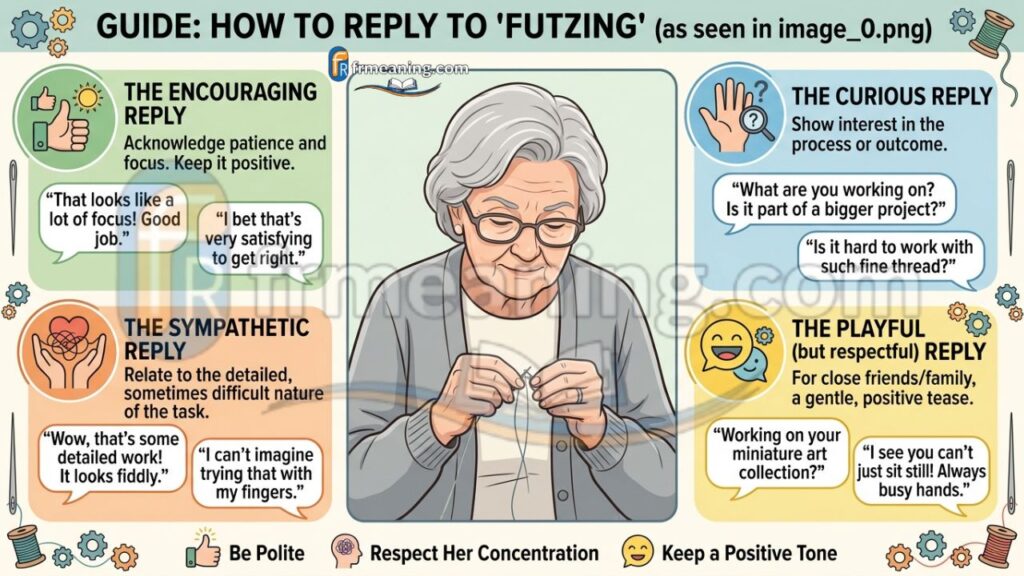
If someone tells you that you’re futzing around, how you respond kind of depends on whether they’re joking with you or actually nudging you to focus up.
Friendly Replies
- “You’re probably right!”
- “Just making a few adjustments.”
- “Almost done!”
- “Give me one more minute.”
- “I’m getting there.”
Funny Replies
- “This is advanced-level futzing.”
- “Perfection takes time!”
- “I’m professionally procrastinating.”
- “I call this productive fiddling.”
Replies When You’re Confused
- “What do you mean by futzing?”
- “Are you saying I’m wasting time?”
- “Do you mean I’m overthinking it?”
When to Use the Term
Futz works great in relaxed, low-stakes conversations where nobody’s going to raise an eyebrow at slang. Good spots for it include:
- Talking with friends
- Family conversations
- Casual text messages
- Hobby discussions
- DIY projects
- Gaming chats
- Informal workplace chit-chat
It just feels natural wherever people are already speaking loose, everyday American English.
When to Avoid the Term
You’ll want clearer, more formal wording anywhere professionalism actually matters. Avoid futz in situations like:
- Business emails
- Job applications
- Academic papers
- Client communication
- Formal presentations
- Sensitive conversations with people you don’t know well
In these cases, words like adjust, modify, delay, or tinker communicate the same idea without sounding out of place.
Common Mistakes
People trip up on futz in a few predictable ways.
| Common Mistake | Correct Understanding |
|---|---|
| Thinking futz is an acronym | It’s a regular word, not an abbreviation of anything |
| Assuming it always means wasting time | It can also mean harmless tinkering or small adjustments |
| Believing it’s always rude | Usually it’s playful or mildly critical, tone depending |
| Confusing it with “fritz” | Different word entirely — see below |
Futz vs. Fritz — Don’t Mix These Up
This one trips a lot of people up. Fritz meaning is completely different from futz — “on the fritz” describes something broken or malfunctioning, usually a machine or device (like “my TV’s on the fritz again”). Futz, on the other hand, describes a behavior — fiddling or tinkering — not a broken object. They sound almost identical when spoken fast, which is probably why folks confuse the two so often, but they’re unrelated in origin and meaning.
Similar Slang Terms
While these words overlap in spirit, futz leans hardest into the idea of fiddling with small details specifically.
| Term | Meaning | Main Difference |
|---|---|---|
| Fiddle | Make small adjustments | More widely used, slightly less informal |
| Tinker | Experiment or repair casually | Often implies fixing or building something |
| Putter around | Spend time on small tasks | Slower pace, more relaxed |
| Mess around | Waste time or play | Broader meaning, sometimes less productive |
| Dillydally | Delay unnecessarily | Focuses on stalling more than adjusting |
A futz synonym list wouldn’t be complete without mentioning that none of these are perfect one-to-one swaps — each carries a slightly different flavor, so pick based on what you actually want to imply.
Origin and Popularity
Futz Etymology and Its Yiddish Roots
The exact history of futz isn’t 100% nailed down, but most language experts trace it back to Yiddish influence on American English, likely entering common speech sometime in the early-to-mid 20th century through immigrant communities in the U.S. The futz meaning in Yiddish context is believed to connect to a coarser, more vulgar root word — something closer to “fart around” in tone — though that harsher edge has basically worn off over the decades.
This kind of linguistic softening actually happens a lot. Ersatz meaning, for comparison, is another word with German/Yiddish-adjacent European roots (it means a substitute or imitation, usually inferior) that entered English and picked up its own specific, narrower usage over time same general path as futz, different destination.
Today, futz shows up mostly in spoken, informal English and casual writing rather than anything formal. It’s popular in American conversational English specifically, and while it does travel into text and online slang, it hasn’t really been “translated” or adopted the same way in other language communities so a direct futz meaning in Urdu or other South Asian languages doesn’t really exist as an established term.
The closest you’d get is explaining the concept — something like “waqt zaya karna” (wasting time) or “fuzool mein lage rehna” (staying busy with pointless stuff) — since futz itself is such a specifically American slang word that it doesn’t cleanly translate word-for-word.
Why the Meaning Shifted Over Time
Language tends to smooth out rough edges the more a word gets used casually, and futz is a textbook case. What may have started as a somewhat crude Yiddish-rooted expression eventually turned into something you’d say in front of your grandma without anyone blinking.
That’s actually pretty common — slang loses its bite the more mainstream it becomes, and futz is a good example of a word that mellowed out almost completely.
Quick Recap
- Futz usually means to fiddle with something or spend time on minor tasks
- It’s a standalone word — not an abbreviation, not an acronym
- The tone is generally casual, playful, or just a touch critical
- Context (the words around it) determines whether it means tinkering or flat-out procrastinating
- Friendly replies usually just acknowledge the comment with a laugh or quick reassurance
- Avoid it in professional or formal writing — stick to “adjust” or “modify” instead
Frequently Asked Questions
What does futz mean in text?
It usually means someone’s fiddling with something or spending time on small tasks instead of finishing the main activity.
Does futz stand for anything?
No, futz is a standalone informal word — it isn’t an acronym or abbreviation of anything else.
What does futz mean on social media?
It keeps roughly the same meaning — tinkering, unnecessary adjustments, or joking about procrastinating on something.
Is futz rude?
No, it’s usually a lighthearted, informal expression, though sharp tone can occasionally make it sound impatient.
Can futz have different meanings?
Yes — it can mean tinkering, making small adjustments, or wasting time, depending entirely on context.
What’s the difference between futz and fritz?
Futz describes fiddling behavior; fritz (as in “on the fritz”) describes something broken or malfunctioning — totally different words.
Is there an official futz meaning in Urdu or other languages?
Not really — futz is distinctly American slang, so it’s usually explained conceptually rather than directly translated.
Final Thoughts
At the end of the day, the futz meaning comes down to something pretty simple fiddling with something, making small adjustments, or spending time on less important stuff instead of the main task. It’s informal, it’s American through and through, and it almost always carries a friendly or gently teasing tone rather than anything sharp.
Since so much of its meaning depends on the words wrapped around it, paying attention to context is really the whole trick to using — or understanding — it correctly.
Next time you hear someone say they’re “futzing with the settings” or “futzing around,” you’ll know exactly what they mean: nothing serious, just a bit of harmless tinkering or a touch of procrastination.