
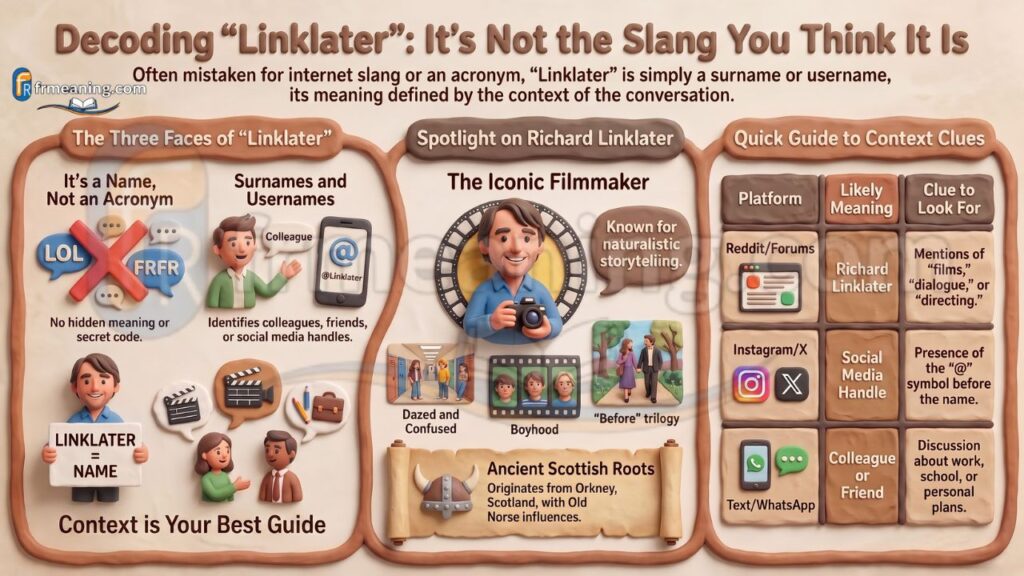

You’re scrolling through a group chat or maybe a Reddit thread, and there it is “Linklater.” No caps, no context clues, just… there. And now you’re stuck wondering if you missed some new slang everyone else already knows about.
Don’t worry, you didn’t miss anything. The linklater meaning is actually way simpler than people expect it to be, and honestly once you get it, you’ll never overthink this word again.
In this guide we’re going to break down exactly what Linklater means, where it shows up, why context is basically everything here, and because most articles on this topic stop short we’ll also cover the one thing nearly everybody searching this term actually wants to know: who is the famous Linklater people keep talking about in movie discussions.
What Does Linklater Mean?
Linklater does not have an official slang definition in texting or online chat. In most cases, it’s simply a surname, a username, or a reference to a specific person known by that last name.
So if you were expecting some secret Gen Z code or a hidden meaning behind the word, that’s not really what’s going on here. Unlike terms like “FR FR” or “NGL” that carry an actual defined slang usage, Linklater functions the way any last name would — it identifies someone.
Here’s a quick breakdown of how the term typically behaves:
| Detail | Explanation |
|---|---|
| Most Common Meaning | A surname or personal identifier |
| Full Form | Not an acronym — there’s no hidden expansion |
| Tone | Neutral by default |
| Common Platforms | Text messages, social media, forums, streaming discussions |
| Formal or Informal | Works in either setting depending on context |
If a friend just texts you “Linklater” out of nowhere with zero context, honestly your best move is just to look back at whatever was being talked about before that. That’s basically 90% of decoding this word right there.
The Main Meaning of Linklater

Linklater is primarily a family name, not a texting acronym like “LOL” or “BRB.”
People use surnames as a kind of shorthand all the time — when talking about coworkers, classmates, authors, athletes, or public figures, we often just default to the last name because it’s quicker and, frankly, it just sounds more natural in conversation. Linklater fits right into that pattern.
For example:
“I watched another Linklater movie last night.”
Here, the entity being referenced is a person — specifically a filmmaker, which we’ll get into more below. It’s not slang, it’s an identifier.
Another example:
“Linklater sent the files this morning.”
This one’s even more straightforward. It’s just naming a coworker or colleague by surname, the same way you’d say “Smith emailed me” or “Jones is running late.”
The meaning always comes from the surrounding conversation, not from the word itself. That’s the single most important thing to remember here, and it’s a rule that basically applies for the rest of this guide too.
Who Is Richard Linklater? The Filmmaker Behind the Name
Here’s something a lot of guides on this topic tend to gloss over, and it’s honestly a pretty big miss.
When people mention “Linklater” in the context of movies, TV, or pop culture discussions, they are very often referring to Richard Linklater, an American film director, screenwriter, and producer. He’s one of the more distinctive voices in modern indie and mainstream cinema, known for his naturalistic dialogue and unconventional storytelling structures.
Some of his most recognized works include:
- Dazed and Confused (1993) — a coming-of-age comedy that’s become a cult classic
- Before Sunrise, Before Sunset, and Before Midnight — the “Before” trilogy, filmed nearly a decade apart each time
- Boyhood (2014) — filmed over 12 years with the same cast, which earned Linklater an Academy Award nomination for Best Director
- School of Rock (2003) — his most mainstream commercial hit, starring Jack Black
So when a Reddit thread says something like “Linklater’s storytelling style is unique,” this isn’t some cryptic reference — it’s film fans discussing a specific, well-known director. Richard Linklater → directed → Boyhood, Dazed and Confused, and the Before trilogy. That’s a semantic relationship worth knowing if you’re trying to fully understand where this term pops up online.
Not every mention of Linklater is about him, of course — plenty of times it really is just someone’s coworker or a random username. But if the surrounding chat involves films, directors, or “his dialogue felt so real,” there’s a good chance the filmmaker is exactly who’s being discussed.
Alternative Meanings of Linklater
While there’s no accepted slang definition, the word does shift depending on where and how it’s used.
| Meaning | Context | Tone | Example |
|---|---|---|---|
| A surname | Everyday conversation | Neutral | “Linklater called earlier.” |
| A username | Gaming or social media | Casual | “@Linklater replied.” |
| A reference to a public figure | Movies, interviews, film discussion | Neutral | “I’m a fan of Linklater’s work.” |
Outside of these three main uses, there isn’t really a widely recognized alternate internet meaning floating around. If someone tells you it secretly stands for something else, that’s probably just not accurate.
How Context Changes the Meaning
Since Linklater isn’t slang, context does almost all of the heavy lifting when it comes to figuring out what someone means.
Let’s run through a few quick examples so this actually clicks.
Example 1 Message: “Linklater recommended that book.” Meaning: Someone whose last name is Linklater made a book suggestion.
Example 2 Message: “@Linklater liked your post.” Meaning: A social media account using that username interacted with your content.
Example 3 Message: “I’m watching another Linklater film.” Meaning: The conversation’s about the filmmaker (most likely Richard Linklater, as covered above).
Example 4 Message: “Did Linklater reply yet?” Meaning: The speaker’s simply asking if a particular person got back to them.
A few things that’ll help you figure out which meaning applies:
- What’s the general topic being discussed
- Whether the word shows up with an @ symbol
- Any nearby names, titles, or job references
- Whether the group is talking movies, school, work, or social platforms
Context → drives → correct interpretation of Linklater. Miss the context, and you’ll probably guess wrong.
Meaning on Different Platforms
The core meaning doesn’t really change much depending on where you see it, but the likely interpretation shifts a bit by platform.
Text Messages and WhatsApp
In personal one-on-one or group chats, Linklater usually just refers to someone’s last name — a friend, coworker, or acquaintance everyone in the chat already knows.
Example: Person A: “Did Linklater confirm dinner?” Person B: “Yes, we’re meeting at seven.”
Pretty straightforward, right? The tone here stays personal and direct, nothing hidden about it.
Instagram and X
On these platforms it’s way more likely to show up as a username or handle.
Example: “@Linklater commented on my photo.”
In this case it’s identifying an account, not a slang phrase or coded message. The @ symbol is honestly your biggest clue here.
Reddit and Discussion Forums
This is where things lean toward the public figure interpretation, especially in film, book club, or general pop-culture subreddits.
Example: “I think Linklater’s storytelling style is unique.”
Given what we covered above, this is almost certainly about Richard Linklater the director — not some random forum user.
Real Conversation Examples
Conversation 1 Person A: “Did Linklater email the class?” Person B: “Yes, the assignment is due Friday.” Meaning: Refers to a teacher or instructor named Linklater.
Conversation 2 Person A: “I followed Linklater yesterday.” Person B: “I saw that account too.” Meaning: Refers to a username on social media.
Conversation 3 Person A: “I’m watching another Linklater movie.” Person B: “His dialogue always feels natural.” Meaning: Refers to the filmmaker by surname — and honestly, “dialogue feels natural” is a pretty classic compliment people give Richard Linklater’s writing specifically.
Tone and Emotional Meaning
On its own, the word Linklater carries zero built-in emotional tone. It’s neutral, plain, just a name. Whatever emotion a sentence has comes entirely from the words around it.
Is Linklater Rude?
No, not at all. The word by itself is completely neutral, and it only comes across as rude if there’s sarcasm, tone, or extra wording layered on top of it.
For example: “Linklater helped us.” — Totally neutral. “Typical Linklater…” — Now that could read as sarcastic, but again, that’s the phrasing doing the work, not the name itself.
Is Linklater Offensive?

No. There’s genuinely nothing offensive baked into this word. It’s just a name, same as Smith or Johnson, unless somebody’s deliberately using it in a negative or mocking way — which, again, would be about their intent, not the term itself.
How to Reply
Since Linklater is basically always a reference to a person (real or online), your reply should just match whatever the conversation actually needs.
Friendly Replies
- “Yes, I talked to them earlier.”
- “I think they’re joining us later.”
- “I’ll check with them.”
- “Thanks for letting me know.”
Polite Replies
- “Could you clarify which Linklater you mean?”
- “I’ll reach out and confirm.”
- “I’ll wait for their response.”
Replies When You’re Confused
- “Who is Linklater referring to?”
- “Do you mean the person or the account?”
- “Can you give me a little more context?”
Honestly, that last category is probably the most useful one. There’s no shame in just asking — better than guessing wrong and replying to the wrong “Linklater” entirely.
When to Use the Term
Use Linklater when you’re referring to:
- Someone whose actual surname is Linklater
- A specific username or online profile
- A public figure commonly identified by that surname (like the director)
- A shared conversation where everybody already knows exactly who’s being discussed
Because it functions as a proper name rather than slang, clarity matters a lot more here than it would with, say, casual internet abbreviations. If there’s any chance multiple people could fit the description, tossing in a first name saves everyone some confusion later.
When to Avoid the Term
Avoid using just the surname when:
- The audience might not know who you’re talking about
- You’re writing something more formal or professional where a full name reads better
- You’re introducing someone for the first time
- There’s more than one person in the conversation with a similar name
In most of these situations, using a full name is just clearer communication, plain and simple.
Common Mistakes
| Common Mistake | Correct Understanding |
|---|---|
| Assuming it’s a texting acronym | It’s generally a surname or username, not shorthand |
| Looking for a hidden full form | There is no recognized acronym expansion for this word |
| Believing it always refers to the same person | Who’s meant depends entirely on the surrounding context |
Similar Terms People May Confuse
| Term | Meaning | Main Difference |
|---|---|---|
| Username | An online account name | Linklater may simply be someone’s chosen username |
| Handle | A social media identity | Handles typically start with the “@” symbol |
| Nickname | An informal personal name | Linklater tends to function as a surname instead |
| Display name | A public-facing profile name | May or may not actually match someone’s real surname |
Origin and Popularity
Linklater is a genuinely established surname, and it didn’t start out as internet slang or some kind of abbreviation.
What a lot of definition-style articles skip over is where the name actually comes from. Linklater → traces its origin to → Orkney, Scotland, where it developed as a locational and occupational surname. Some etymological research links it to Old Norse influence in the region, given Orkney’s long history of Norse settlement, with the name possibly connected to land or farm holdings in that area.
It’s not an especially common surname globally, but it’s held onto a consistent, recognizable presence in Scottish genealogy for generations.
That regional Scottish root is actually part of why the name feels distinctive enough to stick in people’s minds when they encounter it, whether that’s through a colleague, a Reddit username, or — most commonly online — through the filmmaker Richard Linklater, whose family name traces back to that same Scottish lineage.
So no, there isn’t solid evidence this word ever functioned as slang or a coded internet term. If someone insists it secretly stands for a hidden phrase, that claim just isn’t backed up by how the word actually gets used.
Quick Recap
- Linklater is generally a surname, not internet slang
- It doesn’t have a recognized texting full form or acronym
- Context is what determines which person or account is actually being referenced
- The word itself carries a neutral tone and isn’t offensive
- It’s also the surname of acclaimed filmmaker Richard Linklater, which explains a lot of its appearance in movie-related conversations
- If you’re ever unsure, just ask for clarification — it’s honestly the easiest fix
Frequently Asked Questions
What does Linklater mean in text?
It usually refers to a person’s surname or username rather than a recognized texting abbreviation or slang term.
Does Linklater stand for anything?
No, Linklater is not a commonly accepted acronym, abbreviation, or hidden internet code.
What does Linklater mean on social media?
It most often identifies a username, profile, or surname, frequently appearing alongside an “@” symbol.
Is Linklater related to a famous person?
Yes — it’s often a reference to Richard Linklater, the acclaimed American film director and screenwriter.
How should you reply to Linklater?
Respond according to the conversation, or politely ask which person or account is being referenced.
Can Linklater have different meanings?
Yes, it can refer to different people or accounts, though it’s never an established slang expression.
Where does the surname Linklater originate from?
It originates from Orkney, Scotland, with roots tied to the region’s Norse-influenced history.
What is the linklater technique?
The Linklater Technique is a vocal training method developed by Kristin Linklater, focused on freeing the natural voice from tension so actors sound authentic, expressive, and emotionally connected on stage.
Who is Linklater?
Linklater generally refers to a surname, though it can also mean Richard Linklater, the film director, or Kristin Linklater, the renowned voice and acting coach.
What does “link” mean in slang?
In slang, “link” usually means to meet up or connect with someone, as in “let’s link later,” which is completely unrelated to the surname Linklater.
Who is Kristin Linklater?
Kristin Linklater was a Scottish-American voice teacher and author who created the widely used Linklater Technique, influencing generations of actors, directors, and theater voice coaches worldwide.
What is the vocal technique?
Vocal technique refers to methods actors and singers use to control breath, resonance, pitch, and articulation, helping produce a clear, natural, and sustainable speaking or singing voice.
What techniques do voice actors use?
Voice actors commonly use breath control, resonance placement, articulation drills, character voice modulation, and relaxation exercises like the Linklater Technique to develop range and authenticity.
What are some effective voice training techniques?
Effective techniques include diaphragmatic breathing, humming exercises, tongue twisters, resonance work, pitch variation drills, and structured programs like the Linklater method for natural vocal freedom.
Final Thoughts
At the end of the day, the real linklater meaning boils down to something pretty simple it’s a surname, a username, or a way of identifying a specific person, most notably filmmaker Richard Linklater.
There’s no secret code to crack here. When you spot it in a text, a comment, or a forum post, just glance at the surrounding conversation and you’ll usually figure out exactly who or what’s being talked about. And if you’re still not sure? Just ask. It’s honestly the fastest way to clear things up.