
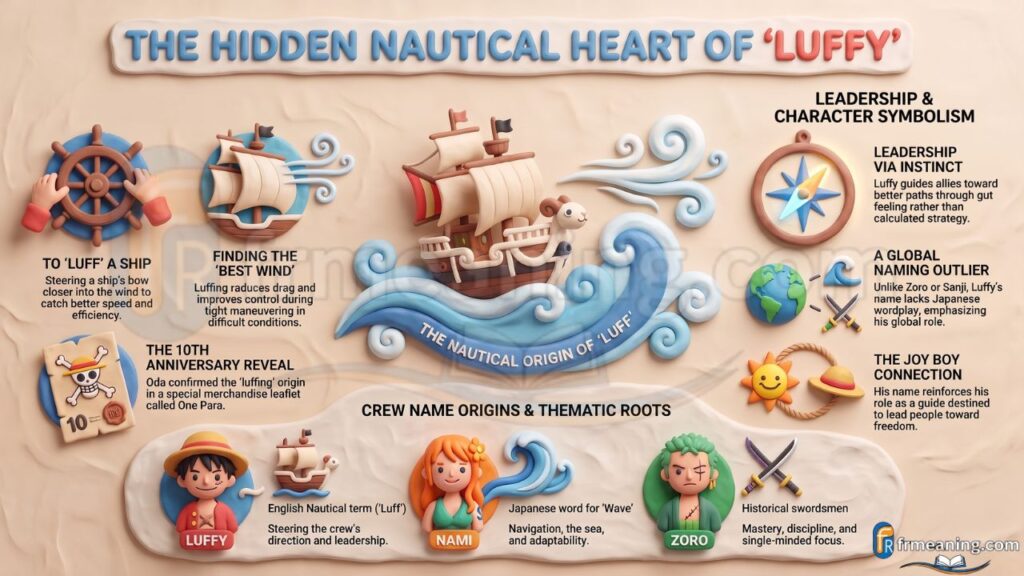

If you’ve ever paused mid-episode and wondered, “wait, what does Luffy actually mean?” you’re definitely not alone. Millions of fans have typed some version of luffy meaning into Google, hoping for a straight answer that goes beyond “it’s just a cool pirate name.”
The truth is way more interesting than that, and it ties directly into who Monkey D. Luffy is as a captain, a leader, and honestly, one of the most beloved characters in modern storytelling.
This article breaks down the real origin of the name, its sailing roots, its cultural interpretations across different languages, and why it fits Luffy’s character almost too perfectly to be an accident (even though Oda insists it kinda was).
Let’s get into it.
What Does Luffy Mean? Quick Answer
So what does Luffy mean, in the simplest terms possible? According to creator Eiichiro Oda, the name Monkey D. Luffy comes from the nautical word “luff,” which is a sailing term describing the act of steering a ship’s bow closer into the wind.
Basically, it’s a maneuver sailors use to catch better wind and sail more efficiently. Oda revealed this in One Para, a small leaflet series that came bundled with merchandise for One Piece’s 10th anniversary, and it’s one of those trivia bits that completely changes how you look at the character once you know it.
It’s a small detail, sure, but once you connect it to Luffy’s actual behavior in the story always pushing forward, always finding the “best wind” for his crew even when things look chaotic it stops feeling like trivia and starts feeling like intentional design.
Luffy Meaning in English: Breaking Down the Sailing Term
In English, the word “luff” isn’t something most non-sailors use in daily conversation, which is probably why so many fans never made the connection on their own. To luff a ship means to turn its head (the bow) more directly into the wind, which reduces the pressure on the sails temporarily but allows for a more efficient, faster overall course afterward.
Here’s a rough breakdown of what luffing actually involves:
- Adjusting the ship’s direction to align closer with the wind’s origin point
- Reducing drag so the vessel can pick up speed once repositioned
- Improving control during tricky wind conditions, especially in racing or tight maneuvering
- Preventing the sails from luffing uncontrollably (a “luffing sail” flaps loosely when it’s not catching wind properly — ironic, right?)
So when you look at luffy meaning in english from a purely nautical standpoint, it’s really about navigation, adjustment, and finding the fastest, smartest path forward. Kinda on-brand for a guy whose entire life goal is finding the One Piece by, well, adjusting and pushing forward no matter what gets thrown at him.
Luffy Meaning in Japanese: Is There a Deeper Cultural Layer?

This one trips a lot of people up. Since One Piece is a Japanese manga, plenty of fans assume Luffy’s name must have Japanese linguistic roots or hidden kanji meaning similar to how many other anime character names carry symbolic Japanese wordplay. But that’s not really the case here.
When it comes to luffy meaning in japanese, there isn’t an established native Japanese word that “Luffy” (ルフィ, Rufi) directly translates from. Oda has explained the name using the English/nautical “luff” origin rather than a Japanese-language pun, which actually makes Luffy a bit of an outlier compared to characters like Zoro or Sanji, whose names carry more layered linguistic references within Japanese culture and food terminology.
This doesn’t make the name any less meaningful it just means the “meaning” lives in the sailing world rather than in Japanese etymology.
One Piece Luffy Meaning: How It Reflects His Character
This is really the heart of the whole discussion. The one piece luffy meaning isn’t just a fun fact — it’s practically a thesis statement for who Luffy is throughout the entire series.
Luffy → embodies → the concept of luffing (adjusting course to find the best path) Luffing (as a sailing action) → symbolizes → Luffy’s natural leadership instincts
Think about it. Every time Luffy makes a decision — whether it’s picking a fight he probably shouldn’t, recruiting a new crewmate on a whim, or steering the Straw Hats through insane danger — it somehow works out. Not because he’s calculating every move (he’s really, really not), but because he has this uncanny knack for finding the right direction, almost like a ship instinctively adjusting into the wind.
Luffy’s leadership isn’t built on strategy manuals or careful planning. It’s built on:
- Charisma that pulls people toward him without him even trying
- Instinct that somehow lands him in the right place at the right time
- Loyalty that makes people want to follow him even into insane danger
- Consistency in his goals, even when his methods look completely reckless
Oda has said he considers this connection a coincidence, and maybe it is. But honestly, coincidence or not, it’s one of those details that just makes the whole character click into place a little more.
Luffy Meaning in Slang: What Fans Use It For Online
Outside the official etymology, there’s also a more casual, internet-driven side to this. The luffy meaning in slang context usually pops up in fan communities, Discord servers, and social media captions where “Luffy” gets used almost as shorthand for someone who’s:
- Fearless to the point of being reckless
- Loyal to their friend group no matter what
- Weirdly lucky or always “winning” despite chaos around them
- Simple-minded but somehow always right in the end
You’ll sometimes see people jokingly call a friend “such a Luffy” when that friend does something impulsive that somehow works out great. It’s not an official dictionary term by any means, but it’s a genuine part of internet pop culture now, which honestly says a lot about how far the character’s influence has spread beyond just the anime and manga.
Luffy Meaning Bird: Clearing Up a Common Misconception
Okay, this one is a fun rabbit hole. A decent chunk of people search luffy meaning bird, and it seems to stem from confusion with similarly-spelled or similarly-sounding words in other contexts, or possibly mixing up “Luffy” with unrelated bird species names that sound close to it phonetically.
To be clear there is no official or widely recognized connection between the name Luffy and any bird species. This appears to be a misassociation rather than an actual etymological branch, and it’s not something Oda or any official One Piece material has ever referenced.
If you landed here searching for that, the real answer stays consistent: Luffy’s name comes from the sailing term “luff,” not from ornithology (that’s the fancy word for bird study, in case you were wondering).
Luffy Meaning in Arabic: A Cross-Cultural Curiosity

Given One Piece’s massive global fanbase, it makes total sense that people search for luffy meaning in arabic too. In Arabic, “Luffy” doesn’t correspond to a native word with an established meaning the way it might seem to in English through the sailing connection.
The name is essentially treated as a transliterated foreign proper noun meaning Arabic-speaking fans generally use it exactly as pronounced (لوفي), without any localized translation attached to it.
This is actually pretty common with character names that originate in one language and travel globally through translated media. The cultural interpretation shifts depending on the region, but the core, “official” meaning always traces back to Oda’s sailing explanation, regardless of what language you’re discussing it in.
Luffy Meaning Connections: Tying It All to the Bigger One Piece Story
Here’s where things get really satisfying for longtime fans. The luffy meaning connections don’t stop at just “his name sounds like a sailing term, neat.” They stretch into some of the biggest plot threads in the entire series.
| Connection | How It Ties to Luffy’s Name |
|---|---|
| Joy Boy | Luffy inherits Joy Boy’s power and will, reinforcing the idea that he’s meant to guide people toward a better future — much like luffing guides a ship toward better wind |
| Gol D. Roger | As the successor to Roger’s legacy, Luffy carries forward a role that’s always been about charting new, uncharted courses |
| Four Emperors status | Luffy’s rise to becoming one of the Four Emperors shows the payoff of his “luffing” instincts finally being recognized on a world-scale level |
| The Straw Hat Crew | Every member joined because Luffy, in some chaotic way, pointed them toward a better direction in their own lives |
When you line these up, it’s hard not to see the pattern. Luffy → inherits power from → Joy Boy and Roger, and that inherited legacy → reinforces → his role as a guide, both narratively and symbolically. Whether Oda planned every bit of this from day one or the meaning just naturally grew alongside the story, it works remarkably well either way.
Luffy Meaning Not Anime: Understanding the Name Outside of One Piece Context
Some searchers specifically look for luffy meaning not anime, wanting to know if “Luffy” exists as a word or name completely separate from the manga/anime franchise. And the honest answer is — not really, at least not as a standalone, commonly recognized English word or established given name.
Outside of One Piece, “Luffy” isn’t a dictionary term, and it’s not a traditional first or last name you’d find in historical records either. Its closest real-world relative is that nautical term “luff” (without the “y”), which is a legitimate, centuries-old sailing word used by actual sailors long before Oda ever picked up a pen. So while “Luffy” itself is essentially an Oda creation, its linguistic root does have genuine, real-world grounding in maritime history.
Oda’s Naming Philosophy: Why This Detail Matters More Than You’d Think
This is honestly a gap a lot of other articles skip over, and it’s worth digging into. Eiichiro Oda has a pretty distinct pattern when naming his characters — many Straw Hat names carry double meanings tied to food, weapons, animals, or professions relevant to that character’s role or backstory. For example:
- Zoro draws on samurai and swordsman-related naming traditions
- Sanji connects to cooking-related wordplay and numerology within Japanese naming conventions
- Nami literally means “wave” in Japanese, fitting her role as navigator perfectly
Luffy stands out a bit because his name’s meaning comes from an English nautical term rather than a native Japanese pun. This actually makes sense contextually — as captain, Luffy is the one steering the entire crew’s direction, literally and figuratively, so tying his name to actual ship navigation terminology (even from another language) reinforces his central role in a way that feels almost too fitting to be random.
Luffy as a Source of Charisma and Luck Throughout One Piece

Even setting the etymology aside for a second, it’s honestly impossible to talk about Luffy’s character without talking about how absurdly lucky and magnetic the guy is. Like, objectively, some of the situations he stumbles into should not work out in his favor — and yet they almost always do. Fans have debated for years whether this is bad writing (it’s not, for the record) or intentional symbolism, and once you know about the “luffing” connection, it starts to read a lot more like the latter.
A few examples where this charisma and luck combo shows up hard:
- Recruiting Zoro, a literal pirate hunter, within the first arc just by being weirdly persistent and genuine
- Talking down or straight-up befriending former enemies like Buggy, Crocodile (sort of), and even parts of the World Government’s inner circle over time
- Surviving fights that, on paper, he had no business walking away from
- Somehow always being in the exact right place when a major turning point in the story happens
None of this is because Luffy is some genius tactician — he’s really not, and the series never pretends otherwise. It’s because Luffy operates almost entirely on gut feeling and forward momentum, which, again, mirrors what luffing literally does on a ship. He’s not overthinking the wind, he’s just adjusting and moving, and somehow ending up exactly where he needs to be.
By the time Luffy reaches Four Emperors status, this pattern isn’t subtle anymore — it’s basically the entire throughline of his arc. He didn’t claw his way up through cold calculation. He got there because people kept choosing to follow him, again and again, arc after arc, largely because of that same magnetic, “everything works out” energy his name seems to hint at from the very beginning.
How Luffy’s Name Compares to Other Straw Hat Crew Members
To really appreciate why Luffy’s naming is a little unusual, it helps to line it up against a few of his crewmates. Oda clearly puts thought into these names, but the type of meaning varies a lot from character to character, and that variety is honestly part of what makes the world of One Piece feel so layered once you start digging.
| Character | Name Origin Type | Thematic Connection |
|---|---|---|
| Monkey D. Luffy | English nautical term (“luff”) | Leadership, guiding others, finding the right direction |
| Roronoa Zoro | Historical/pop-culture swordsman references | Combat mastery, discipline, single-minded focus |
| Nami | Native Japanese word meaning “wave” | Navigation, the sea, adaptability |
| Sanji | Japanese numerology/cooking-related wordplay | Culinary identity, family numbering tradition |
| Nico Robin | Historical/archaeological references | Knowledge, history, uncovering hidden truths |
Looking at it this way, you can see that Oda doesn’t stick to one single “formula” for names. Some are rooted in Japanese vocabulary, some in real-world history, and Luffy’s just happens to land in the nautical/English category.
It’s a small reminder that One Piece, despite being a Japanese series, pulls its inspiration from a genuinely global well of language and culture which honestly tracks, given the whole story is about sailing the entire world.
Why This Kind of Hidden Meaning Matters to Long-Time Fans
There’s a reason threads about Luffy meaning and similar hidden-detail topics keep resurfacing in fan spaces years after the original reveal. It’s not just trivia for trivia’s sake — it’s part of what makes long-running series like One Piece feel like they reward genuine attention rather than passive watching.
A few reasons this specific detail lands so well with the fanbase:
- It wasn’t marketed loudly — it was buried in a small merchandise leaflet, so finding it feels like a genuine discovery rather than something spoon-fed to you
- It connects a real-world, slightly obscure vocabulary word to a completely fictional character in a way that feels organic instead of forced
- It retroactively makes years of Luffy’s behavior — all the impulsive choices, the reckless leadership calls — feel a little more purposeful in hindsight
- It ties neatly into bigger, later reveals like the Joy Boy connection, which came out much further into the story
This is really the mark of a well-built long-form narrative. Small, quiet details planted early (or even coincidentally, as Oda claims) end up harmonizing with massive plot reveals that come out a literal decade or more later. Whether or not it was all mapped out from day one, it works, and that’s ultimately what keeps fans coming back to dissect every little thing about this world.
A Quick Timeline: How the Meaning Was Revealed
For readers who want the historical context laid out simply, here’s how this all came to light:
- One Piece begins serialization in 1997, with no public explanation of Luffy’s name origin given at the time
- Years of fan speculation follow, with theories ranging from monkey-related meanings to random creative choice
- One Piece’s 10th anniversary arrives, and Shueisha releases promotional merchandise alongside it
- One Para leaflets are included as bonus content, and in the fourth edition, Oda directly addresses the name’s sailing origin
- Fans piece together the symbolism, connecting “luffing” to Luffy’s leadership style over the following years and story arcs
This slow reveal is part of why the meaning still feels like a fresh discovery to a lot of newer fans even now — it wasn’t loudly marketed, it was quietly dropped into a small merchandise leaflet and left for dedicated readers to find.
Final Thoughts: Why the Meaning Behind Luffy’s Name Still Resonates
At the end of the day, Luffy’s name being rooted in “luff” isn’t some massive plot twist that changes how you read One Piece.
But it’s one of those small, well-placed details that rewards close readers and long-term fans. It reframes Luffy not just as a reckless, rubber-powered kid chasing treasure, but as someone whose entire identity even down to the letters in his name — is about finding direction, adjusting course when things get rough, and pulling people along toward something better.
Whether Oda intended every layer of this symbolism from the start or the meaning simply grew more fitting as the story matured, one thing’s clear: it’s a genuinely great piece of trivia that adds real depth to one of anime’s most iconic protagonists.
Frequently Asked Questions
What does the name Luffy actually mean?
Luffy’s name comes from “luff,” a sailing term for steering a ship’s bow closer into the wind for better speed.
Who revealed the meaning behind Luffy’s name?
Eiichiro Oda revealed it in One Para, a leaflet series released for One Piece’s 10th anniversary merchandise line.
Does Luffy’s name have a Japanese meaning?
No, unlike many other Straw Hat names, Luffy’s meaning traces to English nautical terminology, not Japanese wordplay.
Is Luffy’s name meaning intentional or coincidental?
Oda has stated it was largely coincidental, though many fans believe it fits Luffy’s character too well to be accidental.
What does luffing mean in real-world sailing?
Luffing means turning a ship’s bow closer to the wind, improving control and enabling faster, smoother sailing afterward.
How does Luffy’s name relate to his leadership style?
Like luffing adjusts a ship’s course, Luffy naturally guides his crew and allies toward better paths through instinct and charisma.
Is there a connection between Luffy’s name and Joy Boy?
Yes, Luffy inheriting Joy Boy’s will reinforces his symbolic role as a guide, echoing the meaning behind his own name.


