
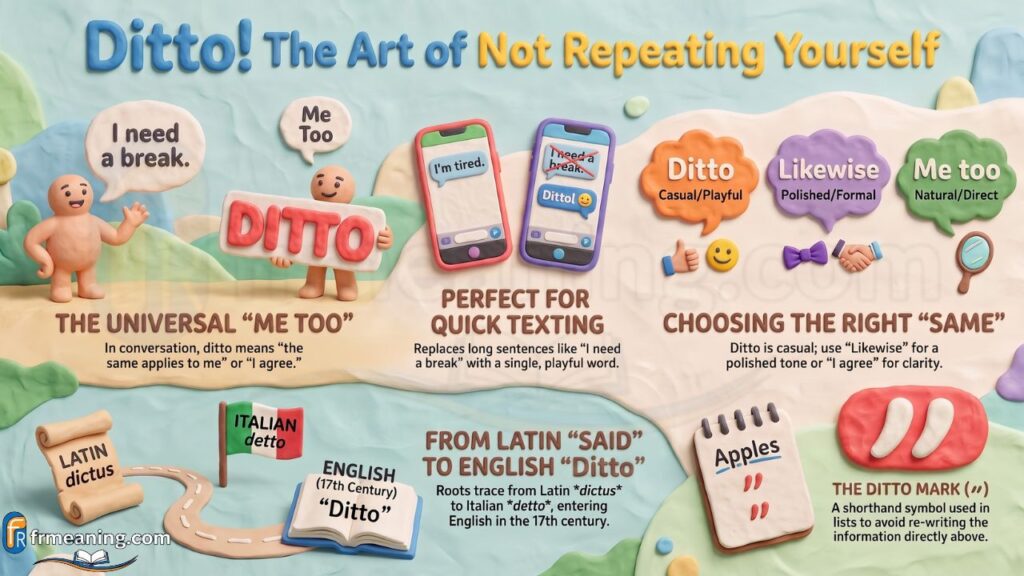

You’ve probably seen ditto in a text, heard someone say it in conversation, or spotted it in an old list and wondered, “Wait, does that mean same?” The short answer is yes, usually. But there’s a little more going on.
Ditto means the same as something that was just said or written. In everyday conversation, it can mean “same,” “me too,” or “I agree.” In writing, it can indicate that information should be repeated without writing it out again.
That small word has a surprisingly long history. It connects modern English conversation with Italian detto, Latin dictus, old record-keeping practices, and the familiar ditto mark. Let’s break it down so you can recognize and use it naturally.
What Does “Ditto” Mean?
The most common ditto meaning is “the same as what was previously mentioned.”
Imagine someone says:
“I’m exhausted after that exam.”
You could answer:
“Ditto.”
You are not merely repeating their exact words. You are saying that you feel the same way.
Dictionary definitions describe ditto as an informal expression used to agree with something already said or to avoid repeating it.
In simple English, you can usually understand ditto as:
- Same
- Same here
- Me too
- I agree
- Likewise
- As mentioned before
- The same applies
The exact interpretation depends on the sentence around it.
Ditto Meaning in Simple English
If you want the easiest possible explanation, remember this:
Ditto = the same thing again, or the same feeling/opinion as someone else.
For example:
Person A: “I love rainy evenings.”
Person B: “Ditto.”
Person B means, “I love rainy evenings too.”
It can also work without a direct statement of agreement:
The first restaurant was expensive. The second one was ditto.
Here, ditto means the second restaurant was also expensive.
So the word has two closely related ideas: agreement and repetition.
Ditto Definition and Part of Speech
Ditto is commonly used as an adverb, especially when it means “the same applies” or “as stated before.” Oxford also lists ditto as a noun when it refers to the mark used to show repetition.
That distinction matters.
As an adverb:
“I enjoyed the movie.”
“Ditto.”
As a noun:
The list used a ditto mark for repeated entries.
In other words, the same word can describe the act of repeating or agreeing and the symbol used to indicate repetition.
Ditto Pronunciation
Wondering how to say it?
In British English, ditto is pronounced approximately DITH-oh, represented by Cambridge as /ˈdɪt.əʊ/.
In American English, it is approximately DIT-oh, represented as /ˈdɪt̬.oʊ/.
The first syllable is stressed:
DIT-to
It is not pronounced like “die-to” or “dee-to.”
What Does Ditto Mean in Texting?
The ditto meaning in text is usually straightforward: “same,” “me too,” or “I agree.”
Because texting often favors short responses, ditto can replace an entire sentence.
For example:
Friend: “I really need a break this weekend.”
You: “Ditto.”
That means:
“I really need a break this weekend too.”
Another example:
Friend: “That was the funniest movie I’ve seen all year.”
You: “Ditto!”
The response expresses agreement without repeating the entire thought.
Ditto Meaning in Slang
People sometimes search for ditto meaning slang, but ditto is not really modern slang in the same sense as highly informal internet expressions. It is an established English word that can be used casually.
In everyday speech or online conversation, it may feel relaxed:
“I’m hungry.”
“Ditto.”
It can sound slightly playful or old-fashioned depending on the speaker and situation.
That is why you might see it in casual messages, comments, conversations, books, and journalism rather than only in slang-heavy online language.
Ditto Meaning Same
If someone asks, “Does ditto mean same?”, the answer is yes, in many everyday contexts.
Consider:
“I think this homework is difficult.”
“Ditto.”
The second speaker means:
“I think the same thing.”
But ditto can be broader than simply “same.” It can also mean that something previously mentioned applies again.
For example:
Monday was extremely busy. Tuesday was ditto.
Here, ditto means Tuesday was also extremely busy.
Ditto Meaning Love
When people search ditto meaning love, the word itself does not specifically mean “love.”
Its meaning comes from the context.
If someone says:
“I love you.”
and another person responds:
“Ditto.”
the second person is effectively saying “I feel the same way.”
So ditto can express agreement with a loving statement, but love is not the dictionary meaning of the word. It simply inherits the meaning of whatever statement came before it.
Ditto Meaning in English
In English, ditto generally carries one of two connected meanings:
- The same as something previously said
- A mark showing that the information above is repeated
The conversational sense is generally informal, while the written sense has a longer historical connection with lists and records. Oxford labels the conversational adverbial use as informal.
How to Use “Ditto” in a Sentence
Using ditto is easy once you understand what it replaces. The key is that something must already have been stated or implied.
Ditto as a Response
This is probably the easiest pattern.
“I’m ready for the weekend.”
“Ditto.”
Meaning:
“I’m ready for the weekend too.”
Another example:
“That lecture was confusing.”
“Ditto.”
Meaning:
“I also thought it was confusing.”
It works especially well when the second person wants to agree without repeating the first person’s entire sentence.
Ditto in Everyday Conversation
You can use ditto for opinions, preferences, feelings, experiences, and observations.
Opinion:
“The ending was disappointing.”
“Ditto.”
Preference:
“I’d rather stay home tonight.”
“Ditto.”
Feeling:
“I’m nervous about tomorrow.”
“Ditto.”
Experience:
“I had trouble understanding that chapter.”
“Ditto.”
The pattern is simple: someone makes a statement, and you use “ditto” when the same statement applies to you.
Ditto in Writing
Written usage can work differently.
Instead of repeating a word or phrase, ditto can indicate that the previous information applies again.
For example:
| Item | Color |
|---|---|
| Shirt | Blue |
| Jacket | Ditto |
| Scarf | Red |
Here, ditto means the jacket is blue, just like the entry immediately above it.
In ordinary modern writing, though, you should usually write the information directly when clarity matters. Ditto is most useful when the repetition is obvious.
Ditto Examples
Seeing several examples makes the meaning much easier to recognize.
Examples Showing Agreement
“I think we should leave early.”
“Ditto.”
Meaning: I agree that we should leave early.
“This book is surprisingly good.”
“Ditto.”
Meaning: I agree; I also think it is surprisingly good.
Examples Meaning “Me Too”
“I’m tired.”
“Ditto.”
Meaning: I’m tired too.
“I want pizza tonight.”
“Ditto.”
Meaning: I want pizza too.
“I’ve never been there.”
“Ditto.”
Meaning: I have never been there either.
Examples Showing Repetition
The first team finished early; the second team did ditto.
Here, the word points back to the action already mentioned.
A more natural construction in everyday English might simply repeat the verb, but ditto can be used when the connection is clear.
Another pattern is:
The first proposal was rejected. The second was ditto.
That means the second proposal was also rejected.
Examples in Lists and Records
The older written use becomes clearer in a table:
| Student | Grade |
|---|---|
| Aisha | A |
| Hamza | Ditto |
| Sara | B |
Here, ditto tells the reader to repeat the value from the row immediately above: Hamza received an A.
Historically, this kind of shorthand saved writers from repeatedly copying identical information.
What Is the Origin of “Ditto”?
The origin of ditto is one of the more interesting parts of the word’s story.
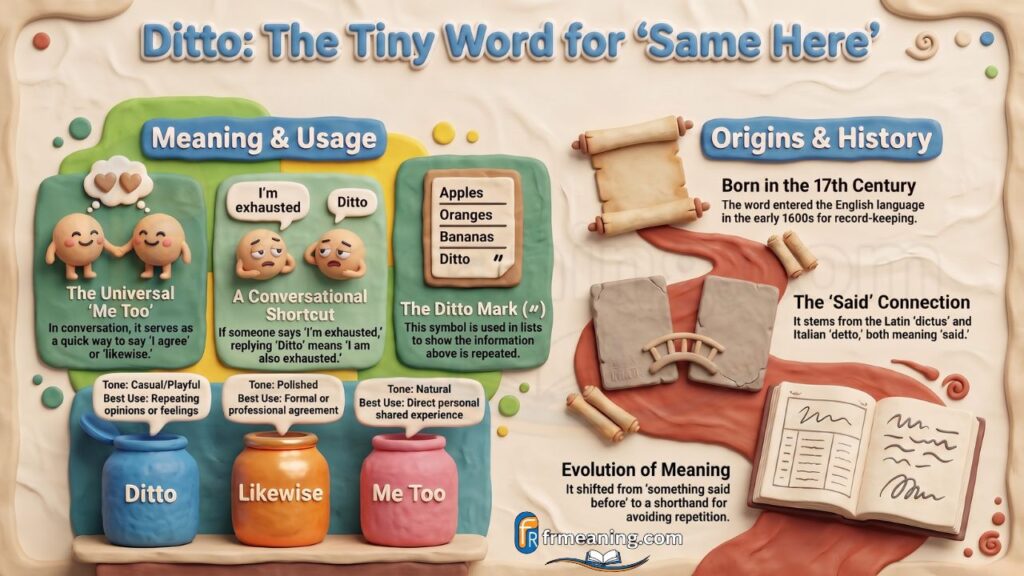
Oxford traces it to the early 17th century, originally in a sense connected with “in the aforesaid month.” The word came through a Tuscan dialect form related to Italian detto, meaning “said,” and ultimately from Latin dictus, also meaning “said.”
So its history can be simplified like this:
Latin dictus → Italian detto → Tuscan usage → English ditto
The original connection to something already “said” makes its modern meaning easier to understand.
Italian and Tuscan Roots
Italian detto is related to the idea of said or stated.
That connection eventually produced the English idea of referring back to something that had already been mentioned.
The meaning shifted naturally:
something said before → the same thing as before → repeat the previous information → same as what someone just said
Language often develops through these small shifts.
Latin Root
The deeper root is Latin dictus, meaning “said.”
It is connected with the Latin verb dicere, meaning “to say” or “to speak.” Oxford specifically identifies dictus as part of the word’s etymological path.
That makes ditto part of a surprisingly large family of words connected historically with speaking, saying, or declaring.
When Did “Ditto” Enter English?
Oxford dates the English word to the early 17th century. Its earliest sense was associated with referring back to something already specified, including an earlier month in a record.
Over time, the word became useful for repeated information in lists and documents.
Eventually, the conversational meaning became familiar too:
“I agree with what you just said.”
That is the version most people encounter today.
How Its Meaning Developed
The semantic journey is easier to picture as a progression:
- Something has already been said.
- You refer back to that information.
- You avoid writing the same information again.
- Ditto becomes shorthand for “the same.”
- In conversation, it develops into a quick way of saying “me too” or “I agree.”
So the modern conversational meaning is not random. It grew from the basic idea of referring back to something already stated.
What Is a Ditto Mark?
A ditto mark is a symbol used to show that information should be repeated.
The symbol is commonly represented as 〃, although older or typographic forms may appear differently. Dictionaries describe it as a mark used in lists to indicate that the word or phrase above should be repeated.
For example:
| Product | Country |
|---|---|
| Tea | India |
| Coffee | 〃 |
| Rice | Pakistan |
The mark under “India” indicates that the value for the next entry is India as well.
How Ditto Marks Were Used
Ditto marks were particularly useful in:
- Lists
- Ledgers
- Inventories
- Tables
- Administrative records
- Historical documents
- Repetitive forms
Before digital copy-and-paste made duplication effortless, avoiding unnecessary writing had practical value.
A tiny mark could replace an entire word or phrase.
Ditto Mark vs. Quotation Marks
The two can look similar in some forms, but their functions are different.
Quotation marks normally identify quoted speech or text.
A ditto mark indicates repetition of information from above.
That distinction matters when you’re reading older documents or historical records. A mark that resembles quotation punctuation may actually be telling you, “repeat the entry above.”
Is “Ditto” Formal or Informal?
The answer depends on how you’re using it.
The conversational meaning is generally informal. Oxford explicitly labels its adverbial conversational usage as informal.
So this sounds natural:
“I’m ready to go home.”
“Ditto.”
But in a formal report, simply writing ditto may be less clear than repeating the information.
When Is It Appropriate to Say “Ditto”?
Use it when:
- The previous statement is obvious.
- You are having a casual conversation.
- You want a short agreement.
- The repeated information is easy to identify.
- You are writing a list where repetition is clear.
It is especially natural as a one-word response.
When Should You Use “Same,” “Likewise,” or “Me Too” Instead?
These expressions overlap, but they have slightly different tones.
| Expression | Basic meaning | Typical feel |
|---|---|---|
| Ditto | The same applies | Casual, sometimes playful |
| Same | I feel the same | Very casual |
| Me too | I also do/feel this | Direct and natural |
| Likewise | The same applies to me | More polished |
| I agree | I share your opinion | Clear and direct |
If you’re talking with friends, “same” or “ditto” can work.
If you want maximum clarity, “I agree” or “me too” is often better.
Common Mistakes When Using “Ditto”
A few misunderstandings appear regularly.
Assuming Ditto Only Means “Copy”
It can indicate repetition, but in conversation it usually means “I agree” or “same here.”
Using It When Nothing Came Before
Ditto points backward.
If nobody has said or written anything to repeat, the word has no clear reference.
Confusing It With Quotation Marks
A ditto mark is used to repeat information. Quotation marks serve a different grammatical purpose.
Assuming Ditto Is an Acronym
It isn’t an acronym. It is an established English word with a long etymological history.
Using It in Every Formal Situation
The word is perfectly understandable, but the conversational sense is informal. In a formal document, repeating the actual information may be clearer and more professional.
Ditto Synonyms and Similar Expressions
Depending on the context, useful alternatives include:
- Same
- Same here
- Me too
- Likewise
- Similarly
- I agree
- As above
- The same applies
- Repeated
But don’t treat these as perfect substitutes in every sentence.
For example, “me too” works naturally for a personal feeling:
“I’m excited.”
“Me too.”
Ditto works there as well, but it can sound a little more playful:
“I’m excited.”
“Ditto.”
Meanwhile, “as above” is much more suited to written material than casual conversation.
Frequently Asked Questions About Ditto
What does “ditto” mean?
Ditto means the same as something previously said or written. In conversation, it can express agreement, meaning “same,” “me too,” or “I agree.”
Does “ditto” mean “same”?
Yes. In everyday conversation, ditto commonly means “same” or “the same applies.” Its broader idea is avoiding repetition or referring back to something already stated.
What does “ditto” mean in texting?
In texting, ditto usually means “same,” “me too,” or “I agree.” It is a short way to show that you share the previous person’s feeling, opinion, or experience.
How do you use “ditto” in a sentence?
You can use ditto as a short response to a previous statement: “I’m exhausted.” “Ditto.” It means the second speaker is also exhausted.
What is the origin of the word “ditto”?
Ditto dates to the early 17th century and comes through a Tuscan form related to Italian detto, from Latin dictus, meaning “said.”
What is a ditto mark?
A ditto mark is a symbol used in lists or records to show that the information from above should be repeated. It is commonly represented as 〃.
Final Takeaway: Ditto Meaning in One Line
If you remember only one thing, make it this:
Ditto means “the same as what was just said or written.”
In conversation, that usually becomes “same,” “me too,” or “I agree.” In writing, it can indicate that information should be repeated without writing the same words again.
Its history makes the word even more interesting: ditto entered English in the early 17th century through Tuscan and Italian usage, with an ultimate connection to Latin dictus, “said.”
So the next time someone says, “I could really use a holiday,” and you feel exactly the same way, you have a perfectly good response: