

If you searched for finlet meaning because you saw the word somewhere and thought, “Wait, is that a fish term, slang, or something related to a camera?” you are not alone. The word appears in several different-looking search contexts, which can make a very simple term surprisingly confusing.
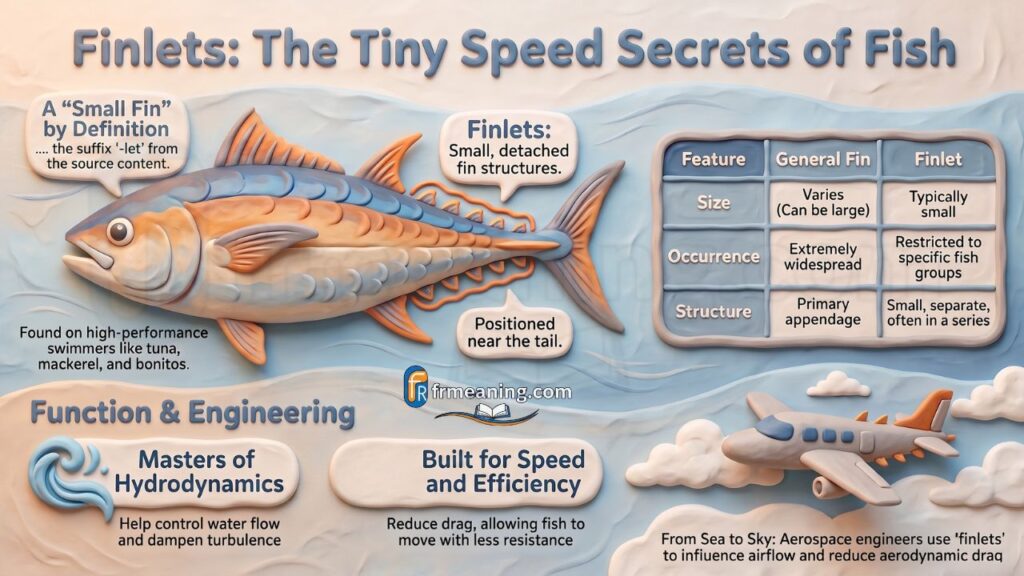
The established meaning is much more specific: a finlet is a small fin or small detached fin structure found on certain fish, particularly species such as mackerels, tunas, and bonitos. Dictionaries record the word as an English noun, while fisheries references use it as a technical term in fish anatomy.
But there is more to the word than a one-line dictionary entry. Finlets have a particular location on the fish, they are associated with fast-swimming species, and scientists have studied how these tiny structures interact with water flow.
There are also a few confusing searches around “finlet,” including finlet meaning slang Urban Dictionary, finlet lens, and even finlet aircraft. Those deserve some clarification too.
What Does Finlet Mean?
The standard finlet meaning is a small fin or small detached ray of a fin in certain fishes.
Dictionary.com lists finlet as a noun and specifically gives mackerels as an example. The word is pronounced approximately FIN-lit, and its recorded origin dates to 1870–75, formed from fin plus the diminutive suffix -let.
In simple terms, you can think of a finlet as a small, separate fin-like structure positioned toward the rear of certain fish.
That distinction matters. A finlet isn’t simply any unusually small fish fin. In biological writing, the term refers to a particular anatomical structure found in certain species.
Finlet Definition in Simple English
A useful everyday explanation is:
A finlet is a small fin located near the tail of certain fish, often appearing as one of a series of small fins.
FishBase describes finlets as small individual fins positioned posterior to the second dorsal and anal fins, giving tuna as an example.
So, if you’re looking at a tuna or mackerel and notice several tiny fin-like structures between the main fins and the tail, those are finlets.
Finlet Fish: Where Are Finlets Found?
The finlet fish connection is where the word becomes especially interesting.
Finlets occur in several groups of fish, with particularly well-known examples belonging to the Scombridae family. This family includes mackerels, tunas, and bonitos. Fisheries references also identify finlets in other groups, including sauries, snake mackerels, and bichirs.
For many scombrid fishes, the finlets are:
- Small
- Located toward the rear of the body
- Found behind the dorsal and/or anal fins
- Non-retractable
- Often arranged in a series
- Positioned before the caudal fin
That arrangement gives you a much better visual clue than the definition alone.
Mackerel and Finlets
Mackerel provide one of the clearest examples.
The Food and Agriculture Organization describes Atlantic and chub mackerel as having several finlets between the second dorsal fin and the tail and between the anal fin and the tail. In the examples described by the FAO, there are commonly four to six, usually five, finlets in these areas.
Look closely at a mackerel’s rear body and you can see why the term makes sense. Instead of one uninterrupted transition from the main dorsal or anal fin to the tail, a series of small structures appears along the body.
Tuna and Finlets
Tuna are another classic example.
FishBase specifically describes finlets in relation to tuna, placing the small individual fins behind the second dorsal and anal fins.
Tuna are also famous for their speed, which makes finlets particularly interesting to researchers studying fish locomotion and hydrodynamics.
Bonito and Other Fish
Bonitos, sauries, snake mackerels, and some other fish can also possess finlets.
One unusual example is the bichir. Unlike the typical arrangement seen in scombrid fishes, bichirs have dorsal finlets that effectively take the place of a conventional dorsal fin.
So “finlet” doesn’t identify one particular fish. It describes an anatomical structure shared by several groups.
Where Are Finlets Located?
This is one of the easiest ways to recognize them.
In many finlet-bearing fish, the small structures sit between the main dorsal or anal fins and the caudal fin.
The basic arrangement looks something like this:
Dorsal fin → finlets → caudal fin
And on the underside:
Anal fin → finlets → caudal fin
The caudal fin is the large tail fin responsible for much of the fish’s propulsion. The area immediately in front of it is associated with the caudal peduncle, the narrower part of the body connecting the main body to the tail.
Finlets occupy this rear section in many of the species where they occur.
That location isn’t random. Researchers have examined how these structures interact with water flowing around the fish’s body and tail.
What Do Finlets Do?
It is tempting to assume that such tiny structures must be insignificant.
Not necessarily.
Finlets have been studied because many fish that possess them are powerful, efficient swimmers. Research into scombrid locomotion has examined whether finlets influence water flow, vortices, drag, and the movement of water toward the caudal fin.
One proposed role involves controlling or modifying flow around the rear portion of the fish.
That does not mean every finlet has one simple job that scientists have completely settled. Their hydrodynamic behavior is more complicated than that.
Finlets and Hydrodynamics
Hydrodynamics is simply the study of how liquids behave when objects move through them.
For a fast-swimming fish, water flow matters enormously.
As the fish moves, water passes over its body and around its fins. Near the tail, that flow becomes especially important because the caudal fin interacts with the surrounding water to generate propulsion.
Finlets may influence this flow before it reaches the tail.
Research discussed by fisheries sources suggests that finlets may help dampen cross-flow turbulence around the caudal peduncle and may contribute to locomotion in high-performance swimmers.
So those little fins aren’t merely decorative.
Finlet vs. Fin: What’s the Difference?
The words are related, but they aren’t interchangeable in technical fish anatomy.
A fin is a broad anatomical category. Fish have different types, including dorsal, anal, pectoral, pelvic, and caudal fins.
A finlet is much smaller and usually refers to a specialized, separate structure occurring in a series near the rear of certain fish.
| Feature | Fin | Finlet |
|---|---|---|
| Meaning | General fish appendage | Small specialized fin |
| Size | Can be large or small | Typically small |
| Location | Various parts of the body | Often near the tail |
| Occurrence | Extremely widespread | Restricted to certain fish groups |
| Example | Dorsal fin | Small finlets behind a tuna’s dorsal fin |
This distinction is useful when reading fish-identification guides or scientific descriptions.
Finlet Meaning and Word Origin
The word itself is fairly straightforward.
Finlet = fin + -let
The suffix -let is commonly used in English to indicate something small. Think of words such as “booklet,” meaning a small book.
The same basic idea applies here.
A finlet is essentially a small fin.
Dictionary.com records the first use of finlet around 1870–75.
That makes the word considerably older than modern internet slang or social-media terminology.
Finlet Meaning Slang: Is It Really Slang?
This is where search results can become messy.
Searches for finlet meaning slang Urban Dictionary may lead you toward pages claiming that finlet is an internet nickname or humorous expression for something tiny, unnecessary, cute, or insignificant.
Those interpretations should be treated carefully.
The established dictionary meaning is the biological one: a small fin or detached fin structure in certain fish.
Some newer websites do describe supposed online slang uses, but those claims do not have the same authority as established dictionaries or fisheries references. In other words, seeing a word used creatively online doesn’t automatically create a standard English definition.
If someone uses “finlet” jokingly in a chat, the meaning depends on their particular context.
For formal writing, biology, fishing, or education, stick with the recognized fish-anatomy meaning.
Finlet Meaning Photo: What Should You Look For?
If you searched finlet meaning photo, a labeled fish diagram can be much more useful than a paragraph.
The most helpful image would show a tuna or mackerel from the side and label:
- First dorsal fin
- Second dorsal fin
- Finlets
- Caudal peduncle
- Caudal fin
- Anal fin
- Anal finlets
The easiest visual clue is the series of small fins immediately before the tail.
Don’t confuse these with the large dorsal fin farther forward on the body.
Finlet Lens and Finlet Camera: Are These Related?
If you encountered finlet lens or finlet camera while researching the word, don’t automatically connect those searches to fish anatomy.
There is no standard dictionary meaning of finlet that refers to an ordinary camera lens or a common camera component. The established word is primarily biological.
Search engines sometimes combine unrelated terms because users search for similar words, product names, technical inventions, or niche terminology.
The same caution applies to phrases such as finlet meaning lens. Without a specific product, brand, or technical document establishing that meaning, it should not be presented as a standard definition of finlet.
In other words:
Finlet does not ordinarily mean “camera lens.”
If you saw the term attached to a particular camera product, the surrounding product description would be necessary to determine what the manufacturer meant.
Finlet Aircraft: A Different Technical Use
There is, however, a legitimate engineering use of the word finlet outside fish biology.
Aircraft-related research and patents have used the term for small aerodynamic surfaces associated with an aircraft’s aft body. For example, a U.S. patent titled Finlets for aircraft aft-body drag reduction describes finlets intended to influence airflow around an aircraft fuselage.
That’s a useful distinction.
The word can describe a small fin-like aerodynamic structure in an engineering context, even though its best-known dictionary meaning relates to fish.
So if you encounter “finlet aircraft” in an aerospace document, don’t assume the author is talking about tuna or mackerel.
Context decides the meaning.
Is Finlet a Common English Word?
Not really.
It is an established English word, but it is much more common in specialized contexts than in everyday conversation.
You’ll most likely encounter it in:
- Fish identification
- Marine biology
- Ichthyology
- Fisheries science
- Zoology
- Scientific research
- Aerospace engineering
If you read an ordinary conversation, newspaper article, or general essay, you may never encounter it.
That explains why the word can feel unfamiliar even though dictionaries recognize it.
How to Use Finlet in a Sentence
Here are some natural examples:
- The tuna has several finlets between its dorsal fin and tail.
- Researchers examined how finlets affect water flow around fast-swimming fish.
- The mackerel’s finlets are visible near the caudal fin.
- Finlets are characteristic of several scombrid fishes.
- The fish’s small posterior finlets helped identify its family.
- An aircraft designer may use finlets to influence airflow around the aft fuselage.
Notice how context makes the intended meaning obvious.
In the first five sentences, finlet refers to fish anatomy. In the last one, it refers to an engineering structure.
Frequently Asked Questions About Finlet Meaning
What does finlet mean?
A finlet is a small fin or detached fin structure found on certain fish, particularly mackerels, tunas, and bonitos. It commonly appears near the tail, behind the dorsal or anal fins.
What is a finlet on a fish?
A finlet is one of the small fins positioned toward the rear of certain fish. In many scombrid species, finlets occur between the second dorsal or anal fins and the caudal fin.
Which fish have finlets?
Finlets are associated with several groups, including mackerels, tunas, bonitos, sauries, snake mackerels, and bichirs. Their exact arrangement varies among fish groups.
Are finlets found on tuna?
Yes. Tuna are a classic example of finlet-bearing fish. FishBase describes these as small individual fins positioned behind the second dorsal and anal fins.
What is the difference between a fin and a finlet?
A fin is a general fish anatomical structure, while a finlet is a much smaller specialized fin that commonly appears in a series near the tail of certain fish.
Is finlet a slang word?
The established meaning of finlet is a biological term referring to a small fish fin. Some websites describe newer humorous internet uses, but those should not be confused with the standard dictionary definition.
What does finlet mean in aircraft engineering?
In aircraft engineering, finlet can describe a small aerodynamic surface designed to affect airflow around an aircraft’s aft body. Patented designs have explored finlets for reducing aerodynamic drag.
Final Takeaway
The simplest answer to finlet meaning is also the most accurate: a finlet is a small fin-like structure, especially one of a series found near the tail of certain fish.
Mackerels, tunas, and bonitos are the examples you’re most likely to encounter. Their finlets sit behind the main dorsal and/or anal fins and before the caudal fin, and researchers have studied their relationship with swimming and water flow.
If you encountered “finlet” in a slang post, camera-related search, or aerospace document, don’t assume all uses have the same meaning. The surrounding context matters. In standard dictionaries and fish biology, though, the answer is clear: finlet is primarily a small fin associated with certain fish.