

If you searched Linklater meaning because the surname appeared in your family tree, on an old document, or simply caught your attention, you probably want more than a one-line definition. Where did it come from? Why does it appear alongside names such as Linklet and Linkletter? And is there really an Old Norse meaning behind it?
The short answer is fascinating: Linklater is a Scottish surname strongly associated with Orkney, and it is generally understood as a habitational name connected with places called Linklater and Linklet. Its history reaches back into medieval Orkney, where Norse influence left a lasting mark on local place-names and family names.
But the spelling has changed over time. So has the way researchers interpret its earliest forms.
Let’s trace it from the landscape of Orkney to the surname you recognize today.
What Does Linklater Mean?
The Linklater surname meaning is primarily geographical rather than a description of a person’s occupation, personality, or physical appearance.
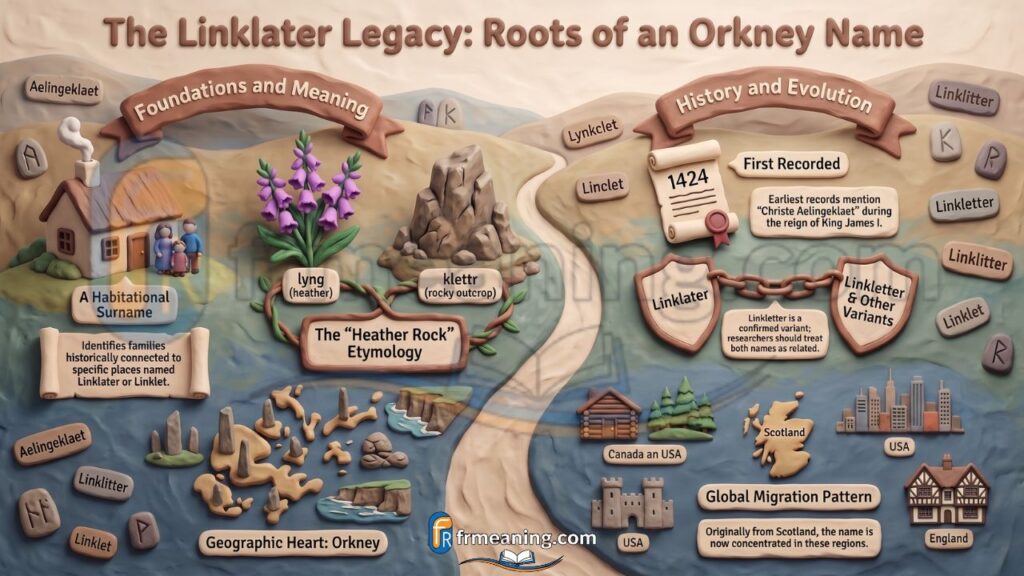
Genealogical references classify Linklater as a Scottish (Orkney) habitational surname. That means the name was associated with a particular place. In this case, the relevant locations include two places called Linklater, one in South Ronaldsay and another in North Sandwick, as well as Linklet in North Ronaldsay.
Here is the basic picture:
- Origin: Scotland, particularly Orkney
- Surname type: Habitational or locational
- Associated places: Linklater and Linklet
- Important related spelling: Linkletter
- Linguistic background: Strong Old Norse influence
- Historical setting: Medieval and later Orkney
So, when someone asks, “What does Linklater mean?”, the safest answer is that it identifies a person or family connected historically with a place bearing that name.
That distinction matters. The surname does not necessarily have one simple English translation.
Linklater Meaning in English
If you are specifically searching for Linklater meaning in English, you may see the name explained through Old Norse elements traditionally interpreted as relating to heather and rock. Wiktionary gives an etymology from Old Norse lyng (“heather”) and klettr (“rock”), while surname references similarly connect the place-name with those elements.
That produces the often-repeated interpretation of something like “heather rock.”
There is an important caveat, though.
It is better to call this an etymological interpretation than to present “heather rock” as an unquestionable literal translation of the modern surname. The more firmly established point is that Linklater is a habitational Orkney surname whose place-name history has Old Norse connections.
That wording keeps the history accurate without turning a complicated medieval place-name into an overly neat translation.
Where Does the Linklater Surname Come From?
The Linklater surname origin leads us to the Orkney Islands, an archipelago off the northern coast of Scotland.
This is not a vague regional association. Genealogical references specifically identify several places connected with the surname.
Linklater in South Ronaldsay
South Ronaldsay is one of the Orkney Islands, and a place called Linklater is located there.
Historical surname sources report that this location appeared in older records in forms such as Linclet. Forebears notes that Linklater in South Ronaldsay was recorded as Linclet in 1500 and Linklet in 1596.
That older spelling is useful because it shows why the surname cannot be understood simply by looking at its modern form.
Linklater in North Sandwick
A second place associated with the surname was in North Sandwick.
Historical records cited by surname researchers give the form Lynkclet in 1500. The similarity between this form and Linclet or Linklet helps explain the network of spellings surrounding the modern surname.
Linklet in North Ronaldsay
North Ronaldsay provides another important piece of the puzzle.
There is a place called Linklet on the island, and modern surname references specifically include Linklet when explaining the origin of Linklater.
The island itself has a striking connection to the name. North Ronaldsay includes Linklet Bay, a geographic feature on its eastern shoreline.
Put those locations together and the geographic pattern becomes much clearer:
Orkney → Linklater/Linklet place-names → habitational surname → Linklater family name
The Old Norse Roots of Linklater
Orkney’s linguistic history is essential to understanding the surname.
The islands were deeply influenced by Norse settlement and culture, and Old Norse place-names remain embedded in the geography. That background helps explain why a Scottish surname can have an etymological history rooted in an older Scandinavian language.
The traditional interpretation breaks the place-name into Old Norse elements associated with:
- lyng — heather
- klettr — rock or rocky outcrop
Some surname references describe the resulting place-name as Lynglettr, while modern explanations commonly render the idea as “heather rock.”
Still, medieval names are rarely as tidy as modern translations make them appear.
Place-names were spoken, recorded by different scribes, adapted into different languages, and sometimes written according to local pronunciation. A spelling found in a fifteenth-century record does not necessarily tell us exactly how the name sounded generations earlier.
That is why the Old Norse connection is useful, but the safest explanation remains that Linklater developed as a place-based surname in the Norse-influenced landscape of Orkney.
History of the Linklater Surname
The historical record becomes particularly interesting when we move back to the fifteenth century.
The 1424 Reference to Christe Aelingeklaet
One of the earliest references commonly associated with the surname is dated to 1424.
Surname histories cite a man named Christe Aelingeklaet, described as a “goodman,” in records connected with the Earldom of Orkney. The spelling is very different from Linklater, but researchers connect it with the early development of the name.
The record dates from the reign of King James I of Scotland, who ruled from 1406 to 1437.
It is worth being careful here. Calling a medieval spelling the exact modern surname can oversimplify the evidence. The historical forms are better viewed as part of the name’s development.
Historical Spelling Variants
Old records were not standardized in the way modern databases are.
A surname could appear differently from one document to another, especially when a clerk recorded a name according to sound. The Linklater family history contains several such forms.
Examples include:
- Aelingeklaet
- Linclet
- Lynkclet
- Linklet
- Linkletter
- Linklitter
- Linklater
Some of these forms are historical place-name forms, while others became surname variants. That distinction is important when researching genealogy.
If your ancestor’s record says Linkletter instead of Linklater, that does not automatically mean you have found the wrong family.
How the Modern Linklater Spelling Developed
The evolution from older forms to Linklater was not necessarily a single, straight-line change.
Historical records show forms such as Linclet and Lynkclet, while later sources record Linkletter, Linklitter, Linklet, and Linklater.
One traditional explanation is particularly interesting: the earliest form may have incorporated an English or Middle English preposition into the recorded name. Surname researchers have interpreted the opening element in the 1424 form in this context.
For a genealogy researcher, the practical lesson is simple:
Do not search only for the spelling Linklater.
Try historical variants as well.
That can uncover records that a modern surname search misses.
Is Linkletter Related to Linklater?
Yes. Linkletter is recognized as a variant of Linklater in modern surname references.
Ancestry’s surname research identifies Linkletter as a Scottish (Orkney) variant of Linklater, while FamilySearch also lists Linkletter among the similar surnames associated with Linklater.
This matters when following family records across generations.
A surname could shift spelling because of:
- Different clerks recording the same family.
- Local pronunciation.
- Migration into another country.
- Anglicization or adaptation of older forms.
- Families adopting a spelling that became conventional in their branch.
So Linkletter and Linklater should be investigated together when the historical evidence supports the connection, rather than treated as completely unrelated names.
Linklater Family History and Genealogy
If you’re researching Linklater family history, Orkney is the logical place to begin.
Start with the geography. Then move into records.
A useful research sequence is:
- Identify the earliest known Linklater ancestor in your family.
- Record every spelling used in their documents.
- Note the exact parish or island where each record originated.
- Search neighboring Orkney communities rather than one location alone.
- Compare census, birth, marriage, death, immigration, and military records.
- Follow migration records when the family leaves Scotland.
- Build each generation from documented evidence rather than assuming every Linklater belongs to one lineage.
That last point is especially important.
A shared surname does not prove that two families have a common recent ancestor. Habitational surnames could develop independently among people connected to the same place.
Migration Beyond Scotland
The Linklater surname eventually appears outside Scotland.
Ancestry’s historical records show Linklater families in the USA, UK, Canada, and Scotland during the nineteenth and early twentieth centuries.
FamilySearch’s current surname data also shows Linklater records concentrated in Scotland, Canada, and England within its family-tree database.
Those figures should not be treated as a complete census of everyone carrying the surname. Genealogy databases measure the records they contain, not necessarily the entire living population.
Still, the pattern is useful. It shows how an Orkney surname became part of a much wider Scottish and international family-history story.
Where Is the Linklater Surname Found Today?
The surname remains relatively uncommon compared with many major Scottish surnames.
Forebears’ current database lists 594 Linklaters in Scotland and 114 in England, along with smaller numbers in several other countries.
Different databases produce different totals because their sources, dates, and coverage vary.
For genealogy, distribution is therefore best used as a clue rather than proof.
If your family story says a Linklater ancestor moved from Orkney to Canada, for example, a Canadian concentration may support the direction of your research. It does not establish the family connection by itself.
Linklater Spelling Variations
Surname variants can make or break historical research.
The most relevant forms to watch for include:
- Linklater
- Linkletter
- Linklet
- Linklitter
- Lynkclet
- Linclet
HouseofNames and other surname references document several of these as historical or spelling variants.
If you are searching an old parish register, don’t assume the modern spelling was used.
A flexible search strategy can reveal much more.
Famous and Notable People Named Linklater
The surname also appears in historical records connected with notable individuals.
Peter Linklater and HMS Bounty
One of the most interesting historical figures carrying the name was Peter Linklater, also recorded in variant forms such as Peter Linkleter.
Surname histories identify him as a quartermaster aboard HMS Bounty during the famous 1789 mutiny and state that he remained loyal to Captain William Bligh.
His story gives the surname an unexpected connection to one of the best-known maritime episodes of the eighteenth century.
Andrew Linklater
Historical surname references also mention Andrew Linklater of that Ilk, described as a lawrikman in North Sandwick in 1678.
These records help place the surname firmly within the historical communities of Orkney rather than treating it as a modern family name with no documented geographic roots.
Is Linklater a Scottish Name?
Yes.
Linklater is generally classified as a Scottish surname, specifically associated with Orkney. The strongest modern surname references describe it as a Scottish (Orkney) habitational name.
Its Scottish identity and its Old Norse linguistic background are not contradictory.
Orkney’s history explains why the two can exist together: the surname developed within Scotland, while the underlying place-name tradition reflects the islands’ Norse linguistic heritage.
That combination is one of the most interesting things about the name.
Is Linklater a Rare Surname?
Compared with common surnames such as Smith, Brown, or Wilson, Linklater is uncommon.
Its strongest historical association is with Orkney, although records show the name spreading to other parts of Britain and overseas.
Rarity can make genealogical research easier in one sense. A distinctive surname gives you a narrower starting point.
But it can also create confusion when spelling variants are ignored.
For that reason, researchers should treat Linklater, Linkletter, Linklet, and related historical forms as possible search leads rather than relying on one spelling.
What Does “Brattily” Mean?
If you arrived here after searching brattily meaning, that is a separate English-language question and has no known connection to the Linklater surname.
Brattily is an adverb derived from bratty, generally describing something done in a bratty, spoiled, cheeky, or badly behaved manner.
It is therefore unrelated to the Scottish surname Linklater.
The two phrases may appear together in search data because search engines group many different queries around broad “meaning” topics. They do not share the same etymological history.
What Are the Best Linklater Movies?
There is another possible source of confusion: best Linklater movies usually refers to filmmaker Richard Linklater, not the Linklater surname.
Richard Linklater is an American filmmaker known for films including:
- Before Sunrise
- Before Sunset
- Before Midnight
- Boyhood
- Dazed and Confused
- School of Rock
- Everybody Wants Some!!
- Apollo 10½: A Space Age Childhood
That is a completely different search intent.
If you’re researching the Linklater name meaning, you are looking at a Scottish/Orkney surname. If you’re searching for Linklater movies, you’re almost certainly looking for the filmography of Richard Linklater.
Keeping those two entities separate prevents a surprisingly common search-engine mix-up.
Frequently Asked Questions About Linklater
What does the surname Linklater mean?
Linklater is a Scottish habitational surname associated with places named Linklater in Orkney and with Linklet in North Ronaldsay.
Where does the Linklater surname come from?
The surname comes from Orkney, Scotland, with documented connections to South Ronaldsay, North Sandwick, and North Ronaldsay.
Is Linklater a Scottish name?
Yes. Modern surname references specifically classify Linklater as a Scottish (Orkney) habitational surname.
What is the Old Norse meaning of Linklater?
Traditional etymologies connect the place-name with Old Norse elements interpreted as heather and rock, although “heather rock” should be treated as an interpretation rather than a definitive modern translation.
Is Linkletter related to Linklater?
Yes. Linkletter is documented as a variant of Linklater, and historical spelling differences are important when researching the family.
When was Linklater first recorded?
A commonly cited early reference dates to 1424, involving Christe Aelingeklaet in records connected with the Earldom of Orkney. The spelling differs considerably from modern Linklater.
Final Takeaway: The Story Behind the Linklater Name
The Linklater meaning makes much more sense when you stop treating the surname as an isolated word.
Its story begins with geography.
Scotland → Orkney → Linklater and Linklet place-names → Old Norse influence → medieval records → spelling variations → Linklater surname → migration and genealogy.
That chain explains why the name has such a distinctive character.
The strongest evidence identifies Linklater as a Scottish Orkney habitational surname, while traditional etymology connects its underlying place-name with Old Norse elements associated with heather and rock. Historical forms such as Linclet, Lynkclet, Linklet, and Linkletter show how dramatically surnames could change on the page over centuries.
If you’re researching your own family, don’t stop at the spelling Linklater. Search the variants. Check Orkney records. Follow the places. Then let the documents—not assumptions—build the family story.