

You may have seen someone described as naive and wondered whether it was meant as an insult, a compliment, or simply an observation. The word can be confusing because its meaning changes slightly with context. A naive person may be inexperienced, innocent, overly trusting, or simply unfamiliar with how something works.
So, what does naive mean in everyday English? Generally, it describes someone who lacks experience or worldly knowledge and may believe things too easily. However, the word is broader than simply saying someone is “dumb” or “gullible.”
Let’s look at what the word really means, how people use it, and where it fits compared with similar words.
What Does Naive Mean?
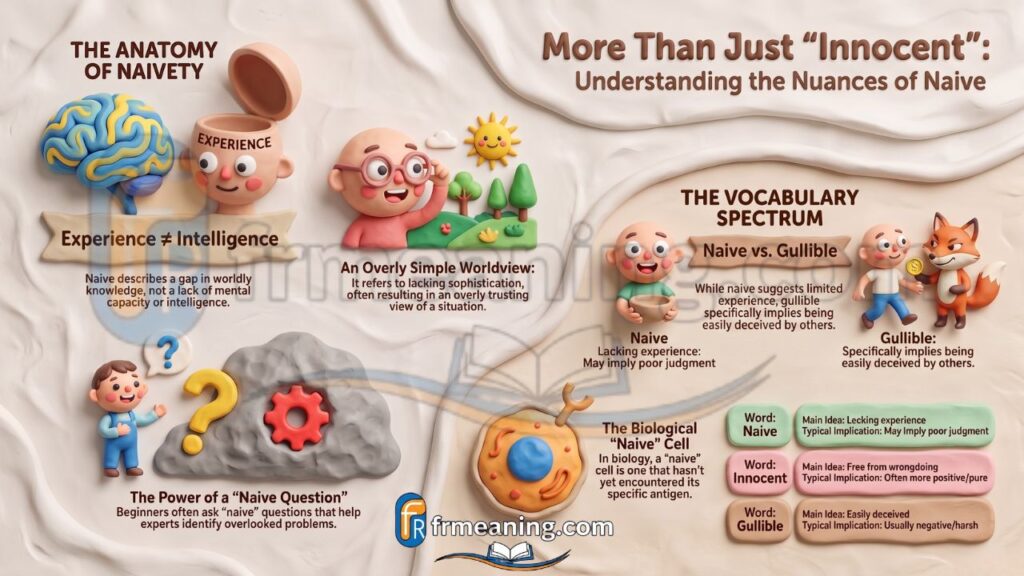
Naive means lacking experience, knowledge, or sophistication about a particular situation, often resulting in an overly simple or trusting view of the world.
It is an adjective, so it is normally used to describe a person, idea, belief, assumption, approach, or action.
For example:
- She was naive about how difficult the job would be.
- It was naive to believe that everyone would agree immediately.
- He was young and naive when he first moved abroad.
- That is a naive assumption about how businesses operate.
The word can suggest that someone does not yet understand the complexities of a situation. Sometimes that lack of understanding is harmless. In other cases, it can lead to poor judgment or make someone easier to deceive.
The spelling naïve is also common. The two spellings refer to the same word.
Naive Meaning in Simple Words
In simple English, naive means “not experienced enough to understand how something really works.”
Imagine someone who has never dealt with dishonest people before. They might assume that everyone tells the truth because they have no reason, based on their own experience, to think otherwise.
That person could be described as naive.
Being naive does not necessarily mean being unintelligent. Someone can be highly educated and still be naive about a subject they have never experienced.
For instance, a talented student may understand advanced mathematics but have a naive understanding of running a business because they have never managed one.
That distinction matters.
Naive usually describes a lack of experience or worldly understanding, not a lack of intelligence.
Naive Meaning in English: Common Contexts
The meaning of naive becomes easier to understand when you see how the word works in different situations.
A Naive Person
A naive person may have limited experience and therefore trust others or interpret situations too simply.
For example:
Maya was naive enough to believe that every online offer was genuine.
Here, naive suggests that Maya lacks experience with misleading offers.
A Naive Belief
A naive belief is an assumption that overlooks important complications.
For example:
It is naive to think that success happens overnight.
The statement does not necessarily suggest that the person is unintelligent. Instead, their belief is too simple because it ignores the time, effort, and setbacks usually involved.
A Naive Question
A naive question is a question asked by someone who does not yet understand the subject.
This can actually be useful. Beginners often ask questions that experienced people stop thinking about.
For example:
His naive question helped the team notice a problem everyone else had overlooked.
So, calling a question naive is not automatically negative.
A Naive Approach
A naive approach usually means an approach that does not account for the complexities of a situation.
For example:
The plan sounded reasonable, but it was too naive for such a complicated project.
The speaker is suggesting that the plan needs more realistic consideration.
A Naive Assumption
A naive assumption is an expectation based on incomplete knowledge or experience.
For example:
Assuming that every customer will behave the same way is a naive assumption.
The problem is not necessarily the person’s intelligence. The assumption simply ignores real-world variation.
Naive Meaning Example Sentences
Seeing the word in complete sentences can make its meaning much clearer.
Naive Examples About People
- He was naive when he first entered the business world.
- The young traveler was naive about the risks of traveling alone.
- She seemed naive, but she learned quickly from experience.
- I was naive to think that the process would be easy.
Naive Examples About Beliefs
- It would be naive to believe that every problem has a simple solution.
- His belief that everyone is honest seemed naive.
- That is a naive view of a complicated political issue.
Naive Examples in Everyday Conversation
You might hear:
“I know this sounds naive, but why can’t we just fix the problem?”
Here, the speaker recognizes that the question may overlook some complications.
Another example:
“Don’t be so naive. People don’t always say exactly what they mean.”
In this context, naive has a more negative tone because it suggests excessive trust or insufficient awareness.
Naive Examples at School or Work
A student might have a naive understanding of a difficult subject before gaining experience.
At work, someone might make a naive prediction such as:
“We’ll finish the entire project tomorrow.”
If the project involves many people, deadlines, testing, and unexpected problems, that prediction may be considered naive because it underestimates the situation.
Is Being Naive a Good or Bad Thing?
There is no single answer. Naive can be neutral, mildly negative, or occasionally positive depending on context.
The surrounding words and the speaker’s intention matter.
When Naive Can Sound Negative
Naive often sounds negative when it describes:
- Excessive trust
- Poor judgment
- Unrealistic expectations
- Lack of worldly experience
- An overly simple understanding
- Failure to recognize potential problems
For example:
“It was naive of him to trust a stranger with all his money.”
The sentence criticizes the decision because the person’s lack of caution created an obvious risk.
When Naive Can Sound Neutral or Positive
The word can also point toward qualities such as innocence, openness, honesty, or a lack of cynicism.
An artist might be described as having a naive style, for example, without the word necessarily being an insult. In this setting, it can refer to simplicity or an unsophisticated approach.
Likewise, someone might describe a child’s view of the world as naive because the child has not yet encountered many difficult realities.
The key is context.
Naive does not automatically mean stupid.
Naive vs. Innocent
Naive and innocent overlap, but they are not identical.
Innocent commonly describes someone who is free from wrongdoing, guilt, or corruption. It can also describe someone who lacks knowledge of something.
Naive, by contrast, focuses more strongly on limited experience, worldly knowledge, or an overly trusting understanding.
Compare these examples:
| Word | Main idea | Typical implication |
|---|---|---|
| Naive | Lacking experience or worldly knowledge | May imply poor judgment |
| Innocent | Free from wrongdoing or corruption | Often more positive |
| Gullible | Easily deceived | Usually negative |
| Inexperienced | Lacking practical experience | Usually neutral |
Someone can be innocent without being naive.
Someone can also be naive without being innocent in every sense.
For example, an experienced professional may be completely innocent of wrongdoing but still be naive about a new technology they have never used.
Naive vs. Gullible
These words are closely related, but gullible is more specific.
A gullible person is particularly likely to believe things that are untrue or allow themselves to be deceived.
A naive person may simply lack experience.
For example:
She was naive about investing.
This means she did not understand the complexities of investing.
But:
She was gullible enough to believe the fake investment offer.
This specifically emphasizes that she was easily deceived.
So, gullible is usually a stronger and more negative word than naive.
Naive Meaning Synonyms
Depending on the context, possible synonyms for naive include:
- Inexperienced
- Innocent
- Trusting
- Gullible
- Credulous
- Unsophisticated
- Artless
- Ingenuous
However, these words are not perfect replacements in every sentence.
Inexperienced
Focuses specifically on a lack of practical experience.
Innocent
Often emphasizes purity, lack of wrongdoing, or limited knowledge.
Gullible
Emphasizes a tendency to believe things too easily.
Credulous
Means willing to believe something, sometimes without sufficient evidence.
Unsophisticated
Can describe someone or something lacking worldly, social, or technical sophistication.
Ingenuous
Often suggests openness, sincerity, and lack of deception.
Understanding these differences helps you choose a more precise word rather than treating every synonym as interchangeable.
Naive Antonyms
The opposite of naive depends on what aspect of the word you mean.
Common antonyms include:
- Experienced
- Sophisticated
- Worldly
- Knowledgeable
- Discerning
- Cautious
- Wise
For example:
Naive: He trusted the advertisement immediately.
Discerning: He examined the claims carefully before believing them.
The contrast is about judgment and experience rather than intelligence alone.
How Do You Pronounce Naive?
The standard pronunciation of naive is:
/naɪˈiːv/
A simple approximation is “nye-EVE.”
The word is sometimes written naïve, where the two dots over the “i” are called a diaeresis. The mark helps indicate that the vowels are pronounced separately rather than being treated as one combined sound.
The pronunciation remains the same whether you write:
- naive
- naïve
Both forms are used in English.
Naive or Naïve: Which Spelling Is Correct?
Both naive and naïve are accepted spellings.
Naïve preserves the diacritic associated with the word’s French spelling, while naive is the simplified English spelling commonly used in modern writing.
You may therefore encounter either form in books, websites, newspapers, academic writing, or everyday communication.
The meaning does not change.
Naive Meaning and Word Origin
The history of naive reaches back through French and Old French to Latin.
The modern English word came through French naïve, the feminine form related to Old French naïf. Its deeper origin is connected with the Latin nativus, meaning “native” or related to being natural or innate.
Over time, the English word developed its modern associations with natural simplicity, lack of experience, and unsophisticated judgment.
That history helps explain why naive can sometimes carry a sense of being natural or artless rather than simply foolish.
Forms of the Word Naive
The word appears in several grammatical forms.
Naively
Naively is the adverbial form.
Example:
He naively assumed that everyone would support the proposal.
It describes the manner in which someone thinks or acts.
Naivety and Naiveté
Naivety and naiveté are noun forms referring to the quality or state of being naive.
Example:
Her naivety disappeared after years of practical experience.
Both spellings are encountered in English.
Naiver and Naivest
The comparative and superlative forms can be used when comparing degrees of naivety:
- Naive
- Naiver
- Naivest
For example:
His first plan was naive, but his second idea was even naiver.
In formal writing, some speakers may instead choose phrases such as more naive or most naive, depending on style.
Naive Meaning in Slang
When naive appears in slang or casual online conversation, it generally keeps its standard meaning but may sound sharper or more dismissive.
Someone might say:
“That’s naive.”
They may mean that the person’s idea is unrealistic, overly trusting, or missing an important part of the situation.
Online, however, people sometimes use naive loosely when they really mean “inexperienced,” “unaware,” or even “wrong.” The exact meaning therefore depends on the surrounding conversation.
It is useful to distinguish ordinary usage from an exaggerated insult.
Naive Meaning: Dumb or Stupid?
Naive does not directly mean dumb or stupid.
This distinction is important.
Someone can be extremely intelligent yet naive about a particular subject. A brilliant scientist who has never negotiated a business contract may make naive assumptions about business negotiations.
Likewise, a person with considerable life experience may still make an occasional naive decision.
Dumb or stupid attacks or questions a person’s intelligence. Naive generally describes a gap in experience, knowledge, or judgment.
That makes the two words fundamentally different.
Sexually Naive Meaning
The phrase sexually naive refers to someone who has limited knowledge or experience concerning sexual matters.
It does not automatically mean that the person is unintelligent. In many contexts, it simply indicates limited exposure, education, or experience.
The phrase should also be understood from context. Someone may be knowledgeable in many areas while having limited knowledge about this particular subject.
When discussing the term in educational writing, it is more useful to focus on knowledge, experience, communication, and healthy boundaries rather than treating naivety as a measure of intelligence or personal worth.
Naive Meaning in Biology
In biology and related scientific fields, naive can have a more specialized meaning.
For example, scientists may use the term naive cell or naive T cell to describe an immune cell that has not yet encountered its specific antigen.
Here, naive does not mean foolish, gullible, or inexperienced in the everyday human sense.
It means that the cell is in a particular biological state, typically referring to a cell that has not yet been activated through the relevant antigen exposure.
This is a good example of why context matters when interpreting vocabulary. The same word can have a specialized technical meaning that differs significantly from everyday conversation.
Frequently Asked Questions About Naive
What does naive mean?
Naive generally means lacking experience, knowledge, or worldly understanding, often causing someone to trust too easily or view a complicated situation too simply.
Is naive a positive or negative word?
Naive can be neutral, positive, or negative depending on context, although it often carries a mildly negative meaning when referring to poor judgment or excessive trust.
Is naive the same as innocent?
Not exactly. Innocent usually emphasizes freedom from wrongdoing or corruption, while naive more often emphasizes limited experience or worldly knowledge.
What is a synonym for naive?
Common synonyms include inexperienced, innocent, trusting, gullible, credulous, unsophisticated, artless, and ingenuous, although each has a slightly different meaning.
What is the opposite of naive?
Common opposites include experienced, sophisticated, worldly, knowledgeable, discerning, cautious, and wise.
How do you use naive in a sentence?
You can use naive to describe an inexperienced person, an overly trusting belief, or an assumption that overlooks the complexities of a situation.
Final Takeaway
The easiest way to remember the naive meaning is to connect it with limited experience or worldly knowledge.
A naive person may trust others too easily, make overly simple assumptions, or fail to recognize complications that a more experienced person would notice. But naive does not automatically mean unintelligent.
Context changes everything.
Sometimes the word describes innocence or openness. Sometimes it points to poor judgment. In specialized fields such as biology, it can even have a technical meaning unrelated to everyday ideas about gullibility.
If you’re trying to choose between naive, innocent, gullible, inexperienced, or unsophisticated, look at what you actually want to communicate. That small distinction can completely change the tone of a sentence.