

So you got a text that just said “rd” and now you’re sitting there squinting at your phone like it’s a foreign language. Yeah, we’ve all been there. If you’re wondering what does rd mean in text, you’re definitely not alone this little two-letter combo shows up everywhere these days, from Snapchat streaks to random Instagram comments, and honestly it can mean a bunch of different things depending on who’s texting you.
Most of the time, though, “rd” is short for “real deal,” which is basically slang for saying something (or someone) is genuine, authentic, or just plain the best. But that’s not the whole story, and by the end of this guide you’ll know exactly how to spot which meaning applies, when to use it yourself, and how to avoid looking clueless in a group chat.
Let’s break it all down, piece by piece.
The Main Meaning of RD in Text
The most common meaning of “rd” in texting is “real deal.” This phrase gets used to highlight authenticity or top-tier quality — basically calling something the genuine article, no hype, no fakes attached. So if your buddy texts “that new phone is the rd,” they mean it’s actually worth the money and it lives up to whatever claims were made about it. It’s a popular way to give props or show approval in casual chats, and you’ll see it pop up in social media comments too, like “This artist’s work is rd!” as a quick compliment.
There’s a small style difference worth noting: lowercase “rd” fits the relaxed, low-effort vibe of everyday texting, while uppercase “RD” tends to show up in more formal contexts, though honestly that’s pretty rare in casual slang usage. Sources like Urban Dictionary and other slang-tracking sites confirm “real deal” as the go-to definition in modern messaging.
The term started out as a shorthand way to shorten compliments, and it’s stuck around because, well, it’s quick and it hits different than typing out the whole phrase. Sometimes people use it ironically too, but the core idea something real, solid, dependable stays pretty consistent. Once you spot this usage, you’ll get a much better sense of the enthusiasm (or sarcasm) behind the message.
Related Post: What Does “TBH” Mean in Text?
Other Possible Meanings of RD
Beyond “real deal,” rd can mean several other things and honestly context is doing most of the heavy lifting here. Here’s a quick rundown of the alternate meanings you’ll run into:
- “Alright” — often shortened from “ard” in lazy, fast-typed texting. Example: “I’ll meet you there, rd?” This one shows up a ton among teens in quick back-and-forth exchanges.
- “Read” — a speedy way of confirming you’ve seen a message, like “I rd your email already.”
- “Road” — the standard abbreviation used in addresses and directions, like “Turn left on Main Rd.” This is basically the default meaning outside of slang contexts, like on maps and invitations.
- “Reminder” — less common, but you might see something like “Don’t forget the rd about the party.”
- “Research and Development” — this one isn’t slang at all, it’s a legit business term that pops up in professional or corporate texts.
There’s also a regional twist worth mentioning: in Philly slang, “rd” ties back to “ard” as a way of showing agreement or emphasis, which adds a distinct local flavor to the term. Context clears it up every single time — always check the surrounding words before assuming which meaning applies. These variations are what make rd both versatile and, occasionally, a little tricky to parse at first glance.
Common Confusions and Mistakes with RD
People mix up “rd” more than you’d think, and it can lead to some genuinely funny (or awkward) misunderstandings. The biggest one? Confusing it with “road” when someone actually meant “real deal.” Picture getting a text like “you’re the rd” and thinking it’s some kind of direction reference instead of a compliment total mismatch. Non-native speakers and folks who are newer to slang sometimes default to assuming it always means “read,” which means they completely miss the authenticity angle of the message.
In Philly areas specifically, rd gets tangled up with the local lingo for “alright,” which can leave outsiders scratching their heads trying to figure out what’s actually being said. There’s also, unfortunately, an outdated and offensive interpretation floating around where some people think it stands for a slur that’s just wrong and should be avoided completely, it has nothing to do with the actual slang usage. Viral posts on TikTok and Reddit have highlighted these mix-ups plenty of times, with users debating the “correct” meaning in comment sections.
Another small error people make: typing “RD” in all caps for emphasis, when really it can end up looking like an acronym for a company name or something totally unrelated. The fix here is simple read the whole message in context and reply based on the natural flow of the conversation. If you’re genuinely not sure, just ask. It beats guessing wrong and sending a confusing reply back. These slip-ups happen mostly because slang evolves so fast, but a little awareness goes a long way toward keeping conversations smooth.
The History and Origins of RD

RD as a piece of slang didn’t just show up overnight, it’s actually got some real history behind it. The “real deal” meaning traces all the way back to the late 1800s in American trade culture, where the phrase was used to distinguish genuine items from cheap knockoffs. By the mid-1900s, “real deal” had made its way into everyday conversation as a way of describing honest people or good-quality goods.
Fast forward to the 1990s, and early internet chatrooms and pagers kicked off a boom in abbreviations meant to save time — this is roughly where “rd” as a shortcut started to take shape. Early Urban Dictionary entries from the early 2000s already list it under both “real deal” and “alright,” which shows how quickly it was growing across online spaces like forums and AIM (RIP to that whole era of messaging). The shift from “ard” to “rd” for “alright” popped up specifically in urban dialects, especially around Philadelphia, roughly around the same period.
Once smartphones took over in the 2010s, lowercase “rd” basically became the standard for speed-typing. Today it’s everywhere on apps like Snapchat and Instagram, where quick, snappy replies rule the whole interaction style.
Linguists generally view this kind of shift as part of how the English language adapts to digital limitations, turning longer phrases into compact, expressive codes. Regional twists like Philly slang add another layer on top of that. Its staying power basically comes down to being simple yet expressive — perfect for the pace of modern texting.
How and When to Use RD Properly
Using rd correctly keeps your texts sounding natural instead of forced. For the “real deal” meaning, drop it in whenever you’re praising something authentic: “That burger joint is rd best I’ve had.” It fits right into casual conversations with friends or social media posts. For the “alright” meaning, use it as a laid-back response: “Sounds good, rd.” Generally you’ll want to keep it lowercase to match the texting vibe going full caps can come across a bit stiff or weirdly formal.
In directions, something like “Take Elm Rd to the end” works fine for clarity, no confusion there since it’s the standard abbreviation. As “read,” it works well for quick confirmations: “Rd your note, thanks.” One tip worth remembering: don’t overuse it. One “rd” per message is usually plenty, otherwise it starts feeling repetitive and a bit try-hard.
A few more situational tips:
- On platforms like TikTok, pairing it with an emoji adds a bit of flair: “This track is rd 🔥.”
- In group chats, it’s a fast way to signal agreement without derailing the conversation.
- For work or formal texts, it’s usually better to spell things out fully — unless your team already has a pretty casual texting culture going.
- Teens tend to lean into it for speed, while adults might still default to full phrases like “genuine” or “okay.”
Practice swapping it into places where “okay” or “authentic” would normally fit, and you’ll start getting the timing right pretty naturally. Nail the timing and you’ll sound like you’re actually in the loop, without trying too hard to seem like it.
Myths and Facts About RD
There’s a handful of myths floating around about rd that trip people up more often than you’d expect. Let’s clear a few up.
| Myth | Fact |
|---|---|
| RD always means “road” | True only in addresses — in slang, “real deal” is the dominant meaning |
| RD is a new Gen Z invention | False — it dates back decades, evolving from 1800s trade lingo into digital shorthand |
| Using RD is lazy or rude | False — it’s simply efficient communication, and it can add warmth as a compliment |
| Uppercase “RD” changes the meaning | Mostly false — it’s a style choice, though caps can add emphasis |
| RD is only Philly slang for “alright” | False — Urban Dictionary and other sources show it’s used way more broadly |
| RD stands for an offensive slur | False and harmful — that’s an outdated misconception, not the actual usage |
Clearing up these myths genuinely helps people text better and avoid embarrassing mix-ups. As slang continues to shift and evolve, sticking to the facts keeps you current instead of falling for random rumors you saw online. At the end of the day, it’s really about using rd thoughtfully so your chats stay clear and, honestly, kind of fun.
RD Across Different Platforms and Slang Ecosystems
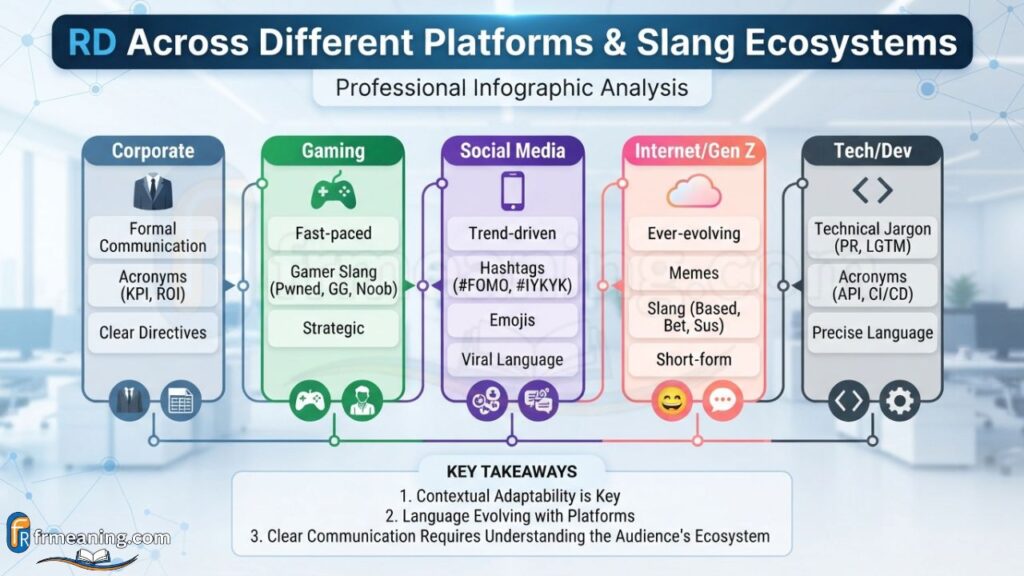
This is where a lot of guides stop short, but it’s worth digging into because usage genuinely shifts depending on where you’re texting. Not every platform treats “rd” the same way, and knowing the difference can save you from a mismatched reply.
- Snapchat: Here rd tends to lean toward “real deal” or quick agreement in streak replies and private chats — speed matters more than clarity since you already know the context of the convo.
- TikTok: Comments sections use rd almost exclusively as a compliment tied to authenticity — “this dance is rd” praises the creator’s skill or originality, often stacked with emojis for extra emphasis.
- Instagram: Similar to TikTok, but you’ll also see it show up in captions themselves, not just comments, functioning almost like a mini-review of the photo or product being shown.
- Reddit: Threads and forum-style replies use rd less for slang and more as shorthand for “read,” since Reddit culture skews slightly more literal and text-heavy compared to short-form video apps.
It also helps to place rd within the wider “authenticity slang” ecosystem — a whole cluster of terms that essentially do the same job of signaling something is genuine or high-quality. Terms like “no cap,” “fr fr” (for real, for real), “legit,” “based,” and “the real” all orbit around the same core idea. RD → belongs to → this authenticity-slang family, and understanding that family helps you read tone way faster than trying to memorize each term in isolation.
If you already know what “no cap” means, picking up “rd” becomes almost intuitive because the underlying function is nearly identical — both signal sincerity or genuine praise without needing a long explanation.
Semantic Relationships Worth Remembering
To keep things simple, here’s how the core pieces of this topic connect to each other:
- RD → most commonly means → “Real Deal”
- “Ard” → shortens to → “RD” (in the sense of “alright”)
- Context → determines → the correct meaning of RD in any given message
- RD (as “real deal”) → originated in → 1800s American trade slang
- Philadelphia slang → popularized → RD as “alright”
Keeping these relationships in mind makes it way easier to instantly parse a text instead of pausing to overthink it every time someone sends you a lone “rd.”
Final Words
In today’s fast-moving messaging world, rd plays a genuinely useful role in keeping conversations efficient without sacrificing warmth. It lets you convey approval, agreement, or authenticity without typing out a whole paragraph, which matters when everyone’s juggling a dozen conversations at once.
Friends use it to build rapport through quick compliments calling a shared experience “rd” says more than it seems to on the surface. On social media, it adds a layer of authenticity to posts and comments, and even in more relaxed workplace chats, a casual “rd” can soften an otherwise dry update.
As more people communicate primarily through screens, shortcuts like this one bridge generational and cultural gaps, especially once non-native speakers or older users pick up on the nuance. It’s a small but real example of how language keeps adapting to technology from pagers all the way to today’s apps.
Spotting rd in a text and knowing exactly which meaning applies shows you’re genuinely tuned into how people communicate now. At the end of the day, it packs a surprising amount of meaning into just two letters so embrace it, and your texts will feel just a little more natural and in-the-know.
FAQs
What does RD mean in text?
RD most commonly means “real deal,” referring to something genuine or high-quality. It can also mean “alright,” “read,” or “road.”
Is RD the same as “ard”?
Yes, RD is often a shorter version of “ard,” meaning “alright.” It’s commonly used in casual replies to show agreement.
Can RD mean “road” in messages?
Yes, RD is a standard abbreviation for “road” in addresses or directions, like “Meet me at 123 Main Rd.”
Why do people use RD instead of full words?
It’s faster to type and matches the casual style of texting. Shortcuts like RD keep conversations quick and natural.
Is RD used on social media?
Yes, it’s common on Snapchat, Instagram, and TikTok to praise authenticity, such as “This outfit is RD!”
Does uppercase RD mean something different than lowercase rd?
Not really — it’s mostly a style choice. Lowercase feels casual, while uppercase can add slight emphasis.
How do I know which meaning of RD someone means?
Check the surrounding context and platform. Slang chats usually mean “real deal,” while directions mean “road.”