
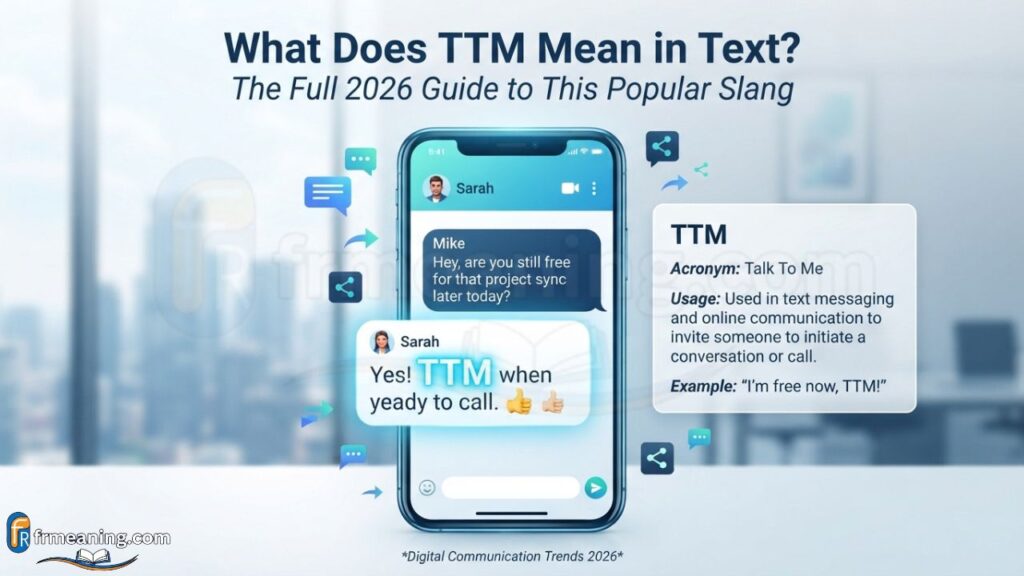

Ever got a text that just said “TTM” and had no clue what it meant? Yeah, same. You’re scrolling through your phone, minding your business, and suddenly this three-letter combo pops up in a DM or a story reply and you’re left staring at it like it’s a math problem.
So, what does TTM mean in text? In most everyday American texting, TTM stands for “Talk To Me” a short, casual way of asking someone to reply, chat, or open up a bit. It’s simple once you know it, but the tone behind it can shift depending on who’s sending it and when.
This guide breaks down everything the meaning, the history, the emotional layers, and even the lesser-known uses of TTM in finance and parenting forums. Lets get into it.
Quick Answer
What Does TTM Mean in Text? In the United States, TTM usually means “Talk To Me.” It’s a casual, low-pressure way to invite conversation, ask for a reply, or just show someone you’re interested in hearing from them.
More broadly, TTM can also hint at emotional openness, curiosity, or a friendly social nudge — it’s rarely just about the literal words.
TL;DR
- TTM usually means “Talk To Me”
- It invites a reply or restarts a conversation
- Americans use it mostly in casual texting and DMs
- Tone can range from friendly to caring to flirty
- It grew out of early internet and SMS shorthand
- Context matters way more than the actual letters
What Is TTM in Texting?
Basic Meaning
TTM is basically short for “Talk To Me.” People fire it off when they want someone to answer back, start chatting, or just open up a little. Nothing complicated really.
In American texting culture, being brief is kind of the whole point. Because of that, TTM feels a lot lighter and less demanding than typing out the entire phrase every single time.
Why It Matters in the USA
Text slang in the U.S. carries a lot of social weight, more than people realize honestly. TTM isn’t only asking for words back — it’s also signaling emotional availability in a weirdly efficient way.
- A quick check-in after things went quiet
- A casual attempt to restart a stalled conversation
- A softer, less pushy version of “reply now”
- A small social cue that basically says “I’m here, whenever”
Where TTM Usually Appears
TTM shows up mostly in spaces where fast, informal replies matter most. That’s exactly why it appears way more in personal chat spaces than in anything formal or work-related.
Common Platforms
Americans tend to use this kind of shorthand in mobile-first spaces where short, punchy language just feels natural to type.
- Text messages between friends
- Snapchat story replies
- Instagram direct messages
- TikTok comment threads
- Group chats after a period of quiet
- Discord and gaming chat rooms
Typical Situations
TTM often pops up when someone wants contact but doesn’t wanna sound too intense about it. For example: “Haven’t heard from you in a while. TTM.”
Instagram DMs, Snapchat story replies, and TikTok comments are probably the three biggest hotspots for this abbreviation right now, mainly because these platforms are built around quick, low-effort exchanges rather than long paragraphs.
The Digital Roots of TTM

Early Internet History
TTM didn’t come from some ancient myth or deep cultural tradition — nothing like that. Instead, it came straight out of early digital shorthand, the kind that internet users basically invented on the fly.
During the late 1990s and early 2000s, texting actually cost money per character on a lot of American phone plans. Because of that, short forms like TTM, BRB, and LOL spread incredibly fast across the early internet/SMS era.
Why Shorthand Became Symbolic
Over time these little abbreviations turned into something bigger than just typing shortcuts. They started signaling belonging, almost like a digital handshake.
Using TTM back then (and honestly still today) showed a certain familiarity with digital culture that outsiders didn’t always get.
- Faster typing on old flip phones and early smartphones
- Character-saving habits from pay-per-text plans
- Early chat room language (think AIM, Yahoo Messenger)
- Instant messenger culture generally
- Social identity built through shorthand and slang
Semantic relationship: Character-limited SMS plans of the 1990s and 2000s → gave rise to → digital shorthand like TTM. This isn’t just a coincidence, it’s basically cause and effect — cost pressure shaped how an entire generation communicated.
Why TTM Feels Symbolic
More Than Just Letters
TTM might technically be slang, but it still functions kind of like a symbol in conversation. It represents connection, attention, and access — all packed into three letters.
A full sentence like “Please talk to me, I’d love to hear from you” can feel a bit formal or even needy. TTM feels softer, lighter, and honestly a lot safer socially.
What It Often Signals
In a lot of American conversations, TTM quietly communicates an emotional undertone without spelling it out directly.
- “I want to hear from you”
- “I’m interested in what’s going on”
- “Tell me what happened”
- “I’m open to talking whenever”
- “Don’t disappear on me now”
TTM Meaning in American Culture
Social Meaning in the USA
In the United States, texting often replaces the quick face-to-face check-ins people used to have. Because of that, short phrases like TTM end up carrying extra emotional weight than they probably should.
TTM fits naturally into American casual communication style. It’s direct, sure, but not heavy or demanding.
Why Americans Use It
TTM matches the fast, informal rhythm of modern U.S. conversation pretty well — it’s basically built for it.
| Context | Meaning in the USA | Common Associations | Notes |
|---|---|---|---|
| Friends texting | Start chatting | Casual connection | Usually lighthearted |
| After silence | Reconnect | Curiosity | Can feel caring |
| Story reply | Ask for details | Interest | Common on social media |
| Flirty DM | Invite more talk | Attraction | Tone depends on context |
| Group chat | Restart conversation | Social energy | Often playful |
Emotional Meaning of TTM

Psychological Signals
Text slang often carries little emotional clues buried inside it. TTM might feel small and throwaway, but it often reflects a real social need underneath.
Sometimes it just means someone’s bored. Other times it means they genuinely want reassurance or connection.
Common Feelings Linked to TTM
Because TTM is pretty open-ended by nature, it can hold several emotional shades all at once.
- Curiosity about someone’s day
- Mild loneliness or boredom creeping in
- Friendly warmth, nothing deeper
- A quiet wish for attention
- Genuine emotional openness
- A low-pressure invitation to talk
Is TTM Friendly, Flirty, or Serious?
Tone Depends on Context
TTM doesn’t come with one fixed emotional meaning attached to it — context is really doing all the heavy lifting here.
“TTM when free” sounds pretty casual and relaxed. “TTM tonight?” on the other hand can sound a lot more personal, maybe even a little loaded.
How Tone Changes
American readers often judge the tone of TTM based on timing, emojis used, and the actual relationship between the two people.
- With friends: relaxed and friendly, no big deal
- After an argument: peace-making gesture
- Late at night: sometimes flirty, depends on who
- After big news: curious and supportive
- In a dry, slow chat: could sound a bit urgent
TTM Across Other Cultures
English Beyond America
TTM is understood across a lot of English-speaking online spaces, not just the U.S. That said, it still feels strongest and most natural within U.S.-style texting culture specifically.
Social media has helped this little abbreviation travel globally pretty fast, honestly faster than most slang manages to.
Cross-Cultural Notes
Outside the United States, the phrase may still get understood by most digitally-savvy users. However, not everybody uses it as naturally or as often.
In some countries and cultures, writing out the full phrase still feels more polite or appropriate than dropping an abbreviation like this.
TTM on Social Media in 2025–2026
Why It Still Works
A lot of slang terms come and go pretty fast online. TTM, though, has stuck around because it just stays useful — it hasn’t gotten stale.
It’s flexible, short, and emotionally neutral enough to fit almost any casual situation you throw at it.
Where It’s Most Visible Today
Across 2025 and 2026, TTM still shows up constantly in youth-driven online spaces, especially among Gen Z users.
- Story reactions asking for more details
- Casual check-ins after someone posts something
- Comments left under vague or cryptic captions
- Private messages sent after viral clips
- Light flirting tucked into short conversations
Other Meanings of TTM
Why Confusion Happens
In most everyday texts, TTM means “Talk To Me.” However, these same three letters can mean something totally different depending on the setting you’re in.
That’s exactly why context always matters more than the acronym itself.
Alternative Uses
Outside of texting, TTM shows up in a few other fields with completely unrelated meanings.
- Finance: Trailing Twelve Months, a common metric used to measure a company’s financial performance over the past 12 months (revenue, earnings, etc.)
- Parenting forums: Third Time Mom, used by moms discussing their third pregnancy or child
- Niche platforms: Brand-specific or community-specific meanings
- Internal work chats: Private team shorthand that’s basically an inside joke
In everyday American texting though, “Talk To Me” remains by far the most common meaning you’ll run into.
Semantic relationship: TTM → has an alternate meaning in → finance, where it stands for Trailing Twelve Months rather than “Talk To Me.”
How Should You Reply to TTM? (Real Examples)
This is honestly where a lot of guides fall short — they’ll tell you TTM means “talk to me” but never actually show you how to respond depending on who sent it. So here’s a practical breakdown.
Replying to a Friend’s TTM
Keep it light and easy, no pressure needed. Something like:
- “Lol nothing much, just bored. You?”
- “Omg I have SO much to tell you, one sec”
- “Just here vibing, what’s up with you”
Replying to a Flirty or Romantic TTM
If the tone feels a little more personal or late-night, you can match the energy without overthinking it too much:
- “Missed talking to you tbh”
- “I was just thinking about you actually”
- “Depends, what do you wanna talk about? 👀”
Replying to a TTM After Silence or an Argument
This one usually calls for a slightly warmer, reassuring tone since it’s often a peace offering of sorts:
- “Hey, yeah I’m here. Sorry for going quiet”
- “I’m good, just been busy. Glad you reached out”
- “Let’s talk, I’ve got some time now”
Replying to a TTM From Someone You Don’t Know Well
Stay a bit more cautious and neutral here, no need to overshare right away:
- “Hey! What’s up, did you need something?”
- “Sure, what’s on your mind?”
A Detailed Timeline: From Pagers to DMs
Most articles on this topic vaguely mention “early internet history” without giving specifics, so let’s actually walk through it properly.
- Late 1980s–early 1990s: Pager culture popularizes numeric and early alphanumeric shorthand codes.
- Mid-to-late 1990s: AOL Instant Messenger (AIM) and similar instant messenger platforms normalize abbreviations like BRB, TTYL, and eventually TTM among younger users.
- Early-to-mid 2000s: SMS text messaging becomes mainstream, and pay-per-character or pay-per-text plans push users to shorten everything possible, cementing shorthand as the norm.
- Late 2000s–2010s: Smartphones and unlimited texting plans arrive, but the shorthand habit sticks around anyway, now driven more by speed and culture than cost.
- 2010s–early 2020s: Social media DMs, Snapchat, and group chats adopt the same shorthand culture, spreading TTM well beyond just SMS.
- 2025–2026: TTM survives as a stable, recognizable term across TikTok, Instagram, and Discord, now carrying emotional and social nuance rather than just being a typing shortcut.
This timeline basically shows how TTM evolved from a purely practical tool into a genuine social signal over roughly three decades.
Misunderstandings and Controversies
When TTM Gets Read Wrong
TTM is simple on paper, but people still misread it fairly often. Older users may not even recognize it. Newer or younger users might think it sounds a bit too demanding or forward.
Common Misreadings
Because tone is basically impossible to hear through text alone, small phrases like this can shift meaning fast depending on the reader.
- Can seem needy if the timing is off
- Can sound flirty even when it’s not intended that way
- Can feel abrupt without any surrounding context
- Can confuse people who aren’t familiar with texting culture at all
That doesn’t make TTM controversial in any major way, to be clear. It just shows how digital language keeps evolving and shifting under our feet.
How TTM Has Changed Over Time
From Utility to Social Signal
At first, TTM was mainly about typing faster and saving characters, nothing deeper than that.
Today though, it carries real emotional tone. That’s honestly a pretty big shift for such a small acronym.
The 2026 Difference
In 2026, people aren’t using TTM just to save time anymore. They’re using it to actively shape the mood of a conversation.
A short, three-letter acronym now helps control how direct, casual, or playful a message ends up feeling — which is kind of wild when you think about it.
When You Should Use TTM
Good Moments to Use It
TTM works best when the relationship already feels casual and comfortable. Because it’s so brief, it fits naturally into low-pressure conversations.
Smart Everyday Uses
- Checking in with a friend you haven’t heard from
- Asking about news or an update they mentioned earlier
- Restarting a chat that’s gone quiet
- Reacting to an interesting story or post
- Inviting someone to open up without pushing too hard
It usually doesn’t fit formal work messages or genuinely serious conversations — save it for the casual stuff.
FAQs
What does TTM mean in text?
TTM is short for “Talk To Me,” used in texts and chats to ask someone to start or continue talking.
Where is TTM commonly used?
It’s mostly used on social media, DMs, comments, and everyday casual text messaging between friends.
Is TTM formal or informal?
TTM is completely informal, meant for casual digital chats, never appropriate in professional or formal writing.
What tone does TTM usually show?
It can show a friendly, playful, curious, or occasionally attention-seeking tone, depending entirely on context.
How should I reply to TTM?
Match the sender’s tone — casual with friends, warmer after silence, or cautious with unfamiliar senders.
Does TTM mean something different in finance?
Yes, in finance TTM means “Trailing Twelve Months,” a metric for a company’s past 12-month performance.
Is TTM still used in 2026?
Yes, TTM remains popular across TikTok, Instagram, and Discord, still common in youth-driven digital spaces.
Final Words
TTM is a simple abbreviation that makes digital conversations faster and easier, plain and simple. It helps people quickly invite others into a chat, keeping communication short, natural, and active across social platforms and everyday messaging.
Whether it’s a friend checking in, a flirty late-night text, or someone just bored and looking for company, understanding the context behind TTM helps you respond the right way instead of guessing blindly.