
Ever stared at a text for way too long, trying to figure out if your friend is mad at you or just… busy? Yeah, same. That confusing little moment is basically what people mean when they ask what does “mean in text” really mean.
It’s not really about vocabulary at all its about tone, timing, and the weird emotional guesswork we all do every single day in group chats, DMs, and comment sections.
In this guide we’re gonna break down exactly how texting communicates feeling, why punctuation suddenly became emotional, and how to actually decode a message without spiraling into overthinking mode. Lets get into it.
What Does “Mean in Text” Actually Refer To?
When someone types “what does this mean in text,” they’re usually not confused about the dictionary definition of a word. They’re confused about intent what the sender actually felt when they hit send.
Text tone replaces the stuff we normally rely on in real conversation: your voice, your face, your body language. Take all that away and suddenly a plain “ok” can feel like a threat. So really, this phrase is asking one simple question: what’s the emotional layer hiding underneath these words?
A Meaning Beyond Dictionary Words
In texting, “mean” usually points toward one of three things, and honestly most people mix all three together without even realizing it:
- The literal definition of a word, slang term, or abbreviation
- The emotional tone riding underneath the message
- The social intent that’s been packed into a short reply
Understanding this distinction is basically step one of getting better at reading texts.
Why It Matters So Much
Because texting strips out voice and facial expression, our brains scramble to fill the silence. Digital body language — things like capitalization, spacing, and punctuation becomes the substitute.
For example: “okay” reads pretty neutral. But “ok.” with a hard stop at the end? That feels sharp, almost cold. One tiny punctuation mark completely shifts the mood, and this is exactly the kind of nuance that makes texting so tricky for people who grew up without it (or honestly even people who did).
How Text Meaning Looks on the Screen
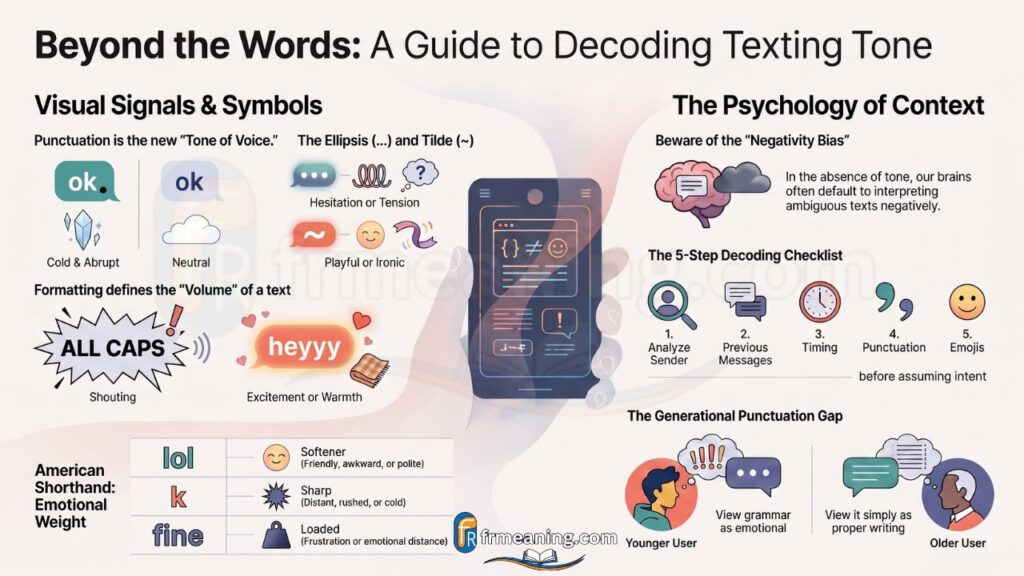
For most readers, text meaning isn’t just about words — it’s visual. Punctuation → signals → emotional tone, and that relationship shows up constantly in everyday chats.
Visual Signals That Shape Meaning
- ALL CAPS often reads as loud, urgent, or even angry
- A single period at the end of a short reply can feel abrupt
- Repeated letters (“heyyyy”) usually feel playful or excited
- Long pauses between replies can suggest hesitation or distraction
- Emojis tend to soften wording that would otherwise sound blunt
Why Format Feels Emotional
A short “k” reads colder than a full “okay.” Meanwhile “okay :)” almost always feels warm and friendly, even though the core word hasn’t changed at all. This is the part a lot of guides skip the format of a message often carries more emotional data than the actual words do.
What Does ~ Mean?
The tilde symbol (~) shows up in texting way more than people realize, and it’s got a pretty specific job.
Mostly, ~ is used to soften a statement or add a playful, sarcastic, or slightly dramatic flair. Something like “I’m ~fine~” usually signals the opposite of fine, wrapped in irony. It can also mean “approximately,” but in casual texting that meaning takes a backseat to its tone-softening role. Younger users especially lean on the tilde to add a light, teasing edge to messages that might otherwise sound flat or serious.
What Does … Mean In Text?
An ellipsis (three dots) is one of the most emotionally loaded pieces of punctuation in modern texting.
Generally, “…” signals hesitation, an unfinished thought, tension, or a pause loaded with unspoken feeling. If a friend texts “we need to talk…” that trailing punctuation practically screams nervousness or seriousness. Older users sometimes use it just as a normal stylistic habit, but younger readers — the ones raised on constant messaging often interpret it as a red flag for awkwardness or bad news. Context, as always, decides which version is true.
What Does ; Mean?
A semicolon in a text message is honestly kind of rare compared to periods or commas, which is exactly why it stands out when it shows up.
In casual texting, ; (especially when paired with a closing parenthesis like 😉 as a winking emoticon) usually signals playfulness, flirtation, or a joking tone. On its own as actual grammar, though, a semicolon in a text can come across as unusually formal — almost stiff — because most people don’t bother with proper punctuation in quick messages. Seeing one used correctly can actually make a message feel more serious or thought-out than it really is.
… Meaning In Text
Circling back to the ellipsis for a second, because it deserves its own spotlight: “…” meaning in text almost always depends on relationship history between the two people texting.
From a close friend, it might just be a habit — no drama attached. From someone you just had an argument with, that same “…” can feel loaded with unresolved tension. This is one of the clearest examples of how context changes everything in digital conversation; identical punctuation can carry totally opposite emotional weight depending on who sent it and when.
^^ Meaning In Text
The double caret symbol (^^) pops up a lot in gaming chats, forums, and younger digital spaces.
Mostly, ^^ functions as a quick way to say “agreed,” “same,” or “what they said” while literally pointing upward at the previous message. It can also represent a simple, happy facial expression (like closed, smiling eyes) in certain online communities, especially ones with roots in anime or gaming culture. It’s a small symbol but it does a surprising amount of communicative work in a tiny amount of space.
The Historical Roots of Reading Hidden Meaning
This whole topic feels super modern, but honestly, humans have been decoding short messages for centuries. It’s not a new struggle — just a new format.
Before Smartphones
Long before texting existed, punctuation already carried feeling in letters and telegrams. A dash, a pause, an exclamation point — these things suggested emotion even in formal writing.
Telegraph culture pushed this even further. Since messages literally cost money per word, people trimmed language down hard, which meant every remaining word (and punctuation mark) had to work overtime to carry meaning.
Ancient Communication Patterns
Even way back in ancient writing systems, readers depended heavily on shared context. In cultures using symbols, glyphs, or compact scripts, meaning often relied on community understanding rather than long, spelled-out explanations. Sound familiar? That’s basically what a group chat inside joke is today.
How American Texting Culture Shaped Modern Meaning
American texting culture played a massive role in defining how modern digital communication actually works, and its influence is still being felt today.
The American Shift Toward Short Forms
Back in the 2000s, texting plans often had character limits or charged per message. That pushed people hard toward abbreviations and shorthand just to save space (and money). Later on, apps and social platforms made short, quick replies the new normal, and honestly it just kinda stuck.
Common American Text Habits
| Abbreviation | Common Meaning | Typical Tone |
|---|---|---|
| “lol” | Softens a sentence | Friendly, sometimes awkward |
| “idk” | Uncertainty | Casual, not careless |
| “k” | Short acknowledgment | Distant, depends on context |
| “brb” | Temporary pause | Neutral |
| “haha” | Amusement or politeness | Warm or filler |
American media, teen culture, and internet humor → spread → these shorthand habits nationwide, and now they’re basically baked into everyday digital vocabulary.
Why Context Matters More Than Words
This might genuinely be the single biggest rule of texting. The exact same word can mean two totally different things depending on the situation surrounding it.
Context Changes Everything
If someone texts “fine,” the real meaning depends on stuff like:
- Who actually sent it
- What happened earlier in the conversation
- How quickly (or slowly) they replied
- Whether an emoji was attached
- The general mood of the chat up to that point
A Small Example
“Sure” from a close friend usually reads as easygoing agreement. “Sure.” from someone right after an argument? That reads as irritated, maybe even a little cold. Same word, completely different emotional package — which is exactly why people ask what a text “means” rather than what a word technically means.
Emotional and Psychological Meaning in Texts (The Gap Competitors Miss)
Most guides mention that texting feels emotional, but they rarely explain why our brains react this way. Let’s actually dig into the psychology behind it, because this is where real understanding starts.
Why the Brain Fills the Gaps
When tone is missing from a message, your brain doesn’t just shrug and move on — it actively searches for clues to fill that gap. Psychologists sometimes link this to a mild version of negativity bias, where ambiguous information tends to get interpreted in a more negative light than intended, especially if you’re already feeling a little anxious or insecure about the relationship.
This is also tied to something researchers call projection — where the reader’s own current mood gets layered onto the sender’s words. If you’re stressed, a plain “k” might feel like rejection. If you’re relaxed, that exact same “k” barely registers as anything at all.
A Practical Framework for Decoding Any Text
Instead of guessing randomly, try running a message through this quick mental checklist:
- Who sent it? — Consider your history and normal texting style with this person
- What came before? — Check the last few messages for context clues
- How long did they take to reply? — Delay isn’t always meaningful, but it can be
- What punctuation did they use? — Periods, ellipses, and caps all shift tone
- Did they include an emoji or gif? — These usually soften or clarify intent
Running through these five steps takes maybe ten seconds, but it stops a huge chunk of unnecessary overthinking before it even starts.
Common Emotional Associations
- Short replies can feel dismissive, even when they’re not meant that way
- Delayed replies sometimes get read as uncertainty
- Extra punctuation (!!!) often reads as heightened intensity
- Lowercase texting can feel relaxed or laid-back
- No response at all can somehow feel like the loudest message of them all
Common Text Meanings in the USA
Here’s a quick reference for how some everyday texting elements tend to get interpreted across American digital culture.
| Text Element | Typical Meaning | Common Associations |
|---|---|---|
| “k” | Brief acknowledgment | Cold, rushed, or neutral |
| “lol” | Softens tone | Friendly, awkward, polite |
| “sure” | Agreement or hesitation | Flexible, cautious |
| “…” | Pause or unfinished feeling | Tension, uncertainty |
| “fine” | Neutral or loaded | Distance, frustration |
Generational Differences in Reading Text Tone
Age changes a lot about how people read texts, and this creates more misunderstandings than most people realize.
Younger Users
Many younger texters read subtle punctuation choices as emotionally significant. A simple period at the end of a sentence can feel unusually formal or even a little harsh to someone who grew up texting without much punctuation at all.
Older Users
Older texters often use full punctuation just because that’s how they learned to write — no hidden emotion intended. That gap alone, between “punctuation as grammar” and “punctuation as feeling,” causes a surprising number of cross-generational miscommunications.
Social Media and Modern Internet Usage
Text meaning doesn’t stay still — it spreads and mutates fast through social platforms, memes, and group chat culture.
- Group chats often develop their own inside meanings over time
- Memes reshape ordinary phrases into something ironic or layered
- Reaction posts create a whole new ironic tone that spreads quickly
- Viral slang can shift meaning nationally within just a few weeks
Because of this constant churn, meaning in text → evolves → faster online than in almost any other form of written communication.
Cross-Cultural and Spiritual Views of Meaning
American texting culture is the main focus here, but it helps to zoom out a bit. Plenty of cultures rely heavily on indirect meaning, not just modern internet users.
In some cultures, bluntness feels rude or even disrespectful. In others, being direct is seen as honest and efficient. This difference shapes how text messages get interpreted across borders, and it’s a good reminder that decoding text isn’t a purely American skill — its a pretty universal human instinct to search for intention behind words, not just literal language.
Misunderstandings, Misuse, and Controversies
Texting creates confusion constantly because tone can be imagined just as easily as it can be intended.
- A short reply might genuinely just mean the person is busy
- A delayed reply could simply mean distraction, nothing deeper
- No emoji might mean absolutely nothing at all
- Formal punctuation could just be someone’s normal writing habit
Sometimes people read texts as passive-aggressive even when zero offense was meant. That doesn’t necessarily mean either side is “wrong” — it just shows how fluid and unpredictable digital language really is.
How Meaning Has Shifted Over Time
American texting culture has changed fast, and what felt totally normal fifteen years ago can feel weirdly different today.
Early texting focused mostly on efficiency — abbreviations existed to save time and character space. Now, tiny details carry way more emotional weight than they used to. A lowercase word, a single emoji, or one stray period can completely shape how a message lands.
Speed and shorthand → created → shorter, more ambiguous messages, and that shift explains why so many people now ask what a message “really means” instead of just reading it at face value.
FAQs
What does “mean in text” actually refer to?
It refers to understanding the emotional tone and hidden intent behind a message, not just its literal wording.
Why do people feel confused reading texts?
Because messages lack voice and facial cues, so slang, punctuation, and short replies get misread easily.
What does ~ mean in texting?
It usually softens a statement or adds sarcasm, irony, or a playful tone to the message.
What does … mean in text?
It typically signals hesitation, tension, or an unfinished thought loaded with emotion.
What does ; mean in a text message?
As punctuation it feels formal; as 😉 it signals a playful, flirty, or joking tone instead.
What does ^^ mean in texting?
It generally means “agreed” or “same,” while also representing a happy, smiling expression.
Why does context matter more than the actual words?
Because identical words carry different emotional weight depending on relationship, timing, and prior conversation history.
Conclusion
At the end of the day, figuring out what “mean in text” really means comes down to reading between the lines — tone, punctuation, timing, and relationship context all blend together to create meaning that goes way beyond the literal words on your screen. Whether its a tilde, an ellipsis, or just a lowercase “k,” these tiny signals carry more emotional information than most people give them credit for. The more you practice decoding these cues, the smoother and more confident your digital conversations become.