

Have you ever gotten a text that just says “WTH?!” and had absolutely no idea how to take it? You’re not alone. The WTH meaning in text is one of those things people look up all the time, especially if they’re newer to online slang or got the message from someone unexpected.
Whether it came from a friend, a coworker, or someone you just started talking to — context matters a lot with this one. In this article, we’re breaking down everything you need to know about WTH: what it means, where it came from, how its used across different platforms, and when you probably shouldn’t use it at all.
What Does WTH Mean in Text?
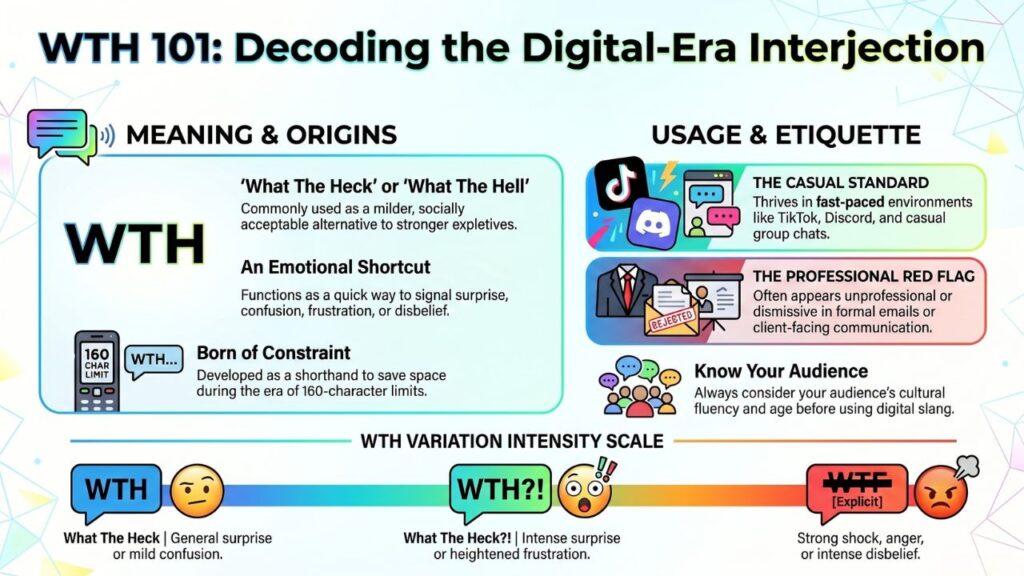
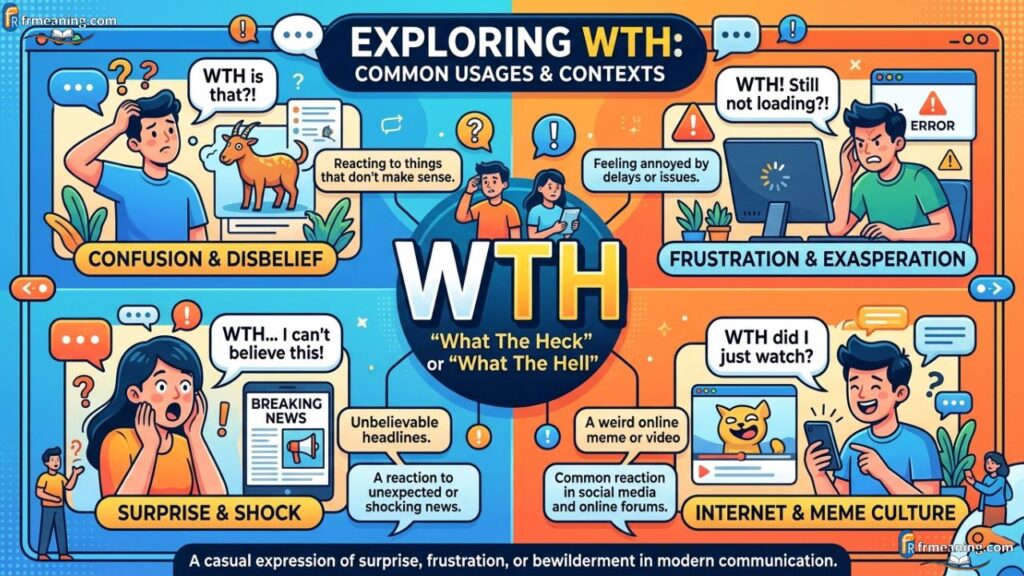
WTH stands for “What The Heck” — and in some cases, depending on the person, it can also mean “What The Hell.” Both interpretations are widely accepted, but “What The Heck” is considered the cleaner, more socially acceptable version. It’s used as a quick emotional reaction to express:
- Surprise — when something catches you completely off guard
- Confusion — when something doesn’t make any sense
- Frustration — when things go wrong or don’t meet expectations
- Disbelief — when you can’t quite believe what you’re seeing or hearing
- Shock — in response to something dramatic or unexpected
The reason WTH is so popular is simple: it let’s people react emotionally without typing out a whole sentence. It’s short, punchy, and expressive all at once. In digital communication where speed matters, that combination is hard to beat.
Origin and Background of WTH
WTH originated in the early days of internet chat rooms and SMS texting, back when character limits were a real constraint. In those early messaging environments — think AOL Instant Messenger, early SMS, and forum threads — users began shortening common expressions just to type faster. Phrases like “What The Heck” naturally became “WTH.”
As platforms like WhatsApp, Instagram, TikTok, Snapchat, and Twitter (now called X) exploded in popularity, internet abbreviations like WTH spread rapidly across digital communities. Because it was a milder alternative to stronger exclamations, it got adopted by a wider audience — including younger users, people in mixed-company conversations, and even older folks who were dipping their toes into internet slang for the first time.
Over time, WTH became a permanent fixture of internet slang and meme culture, showing up in captions, comment sections, reaction posts, and group chats worldwide.
How WTH Became Popular Online
The rise of WTH as a mainstream internet expression is closely tied to the evolution of digital communication itself. In the early days of SMS texting, messages were limited to 160 characters — so people got creative with abbreviations. WTH was one of dozens of shorthand phrases that emerged from this necessity.
But character limits alone don’t explain its staying power. WTH became popular because it struck a perfect balance — it conveyed genuine emotion without crossing into offensive territory. Compared to its stronger cousin WTF, WTH could be used more freely, in more contexts, with a wider range of people.
As social media grew, meme culture and viral content accelerated its adoption. Reaction memes, comment threads under shocking videos, and caption humor all gave WTH a natural home. Today, it’s just as common on TikTok comment sections as it is in a text between two friends.
Common Usage and Contexts of WTH
WTH in Texting and Online Conversations
In everyday texting, WTH functions as a quick emotional shortcut. Instead of writing “I can’t believe that just happened” or “that makes no sense to me,” people just type “WTH?” and the person on the other end instantly understands the vibe. It keeps conversations moving without requiring full sentences.
The WTH full form in chat is still “What The Heck,” but it reads less literally and more emotionally in real conversations. That’s kind of the point — it’s not about the words, it’s about the feeling behind them.
WTH in Social Media and Internet Slang
On platforms like Instagram, TikTok, Snapchat, and X, WTH is most commonly seen in:
- Comment sections under surprising or confusing posts
- Reaction captions on memes and viral videos
- Story replies when someone shares shocking news
- Quote tweets or reposts where the person just slaps “WTH” onto someone else’s content
It’s become part of mainstream internet slang the same way “OMG” or “lol” did years ago. Most people understand it instantly, regardless of age or background.
WTH in Gaming Chats and Online Communities
Gamers are some of the most prolific users of reaction slang, and WTH fits perfectly into that environment. When something goes wrong in a match, when an opponent pulls off an unexpected move, or when a glitch breaks the game — WTH is one of the first things people type in live chats or gaming Discord servers.
The fast pace of gaming means there’s little time for full sentences. Abbreviations like WTH let players express frustration or shock without taking their hands off the keyboard for too long.
WTH in Professional, Business, or Technical Settings
Here’s where things get more complicated. WTH is generally not appropriate in professional or formal communication. In emails, client messages, official Slack channels, or any kind of documented workplace interaction — WTH can come across as unprofessional, dismissive, or even slightly rude depending on the reader.
That said, WTH meaning in work contexts does appear occasionally — usually between close colleagues in casual chat threads. If you’re working in a startup with a very relaxed culture, you might see it pop up. But it’s still a risk, especially if you don’t know how the other person will interpret it.
If you’re confused or frustrated in a work setting, stick to clearer, more neutral alternatives like:
- “Could you clarify what happened here?”
- “I’m having trouble understanding this — can we talk?”
- “There seems to be some confusion. Let’s sort it out.”
Tone and Intent Behind WTH
One of the things that makes WTH interesting from a linguistic standpoint is how flexible it is. The same three letters can carry completely different emotional tones depending on context, punctuation, and your relationship with the person.
Here’s how tone shifts with WTH:
- Playful: “WTH that meme had me dead 😂” — clearly joking, light-hearted
- Confused: “WTH does this even mean?” — genuinely puzzled
- Annoyed: “WTH are you doing right now” — clearly irritated
- Shocked: “WTH?! That actually happened?!” — can’t believe it
Emojis play a huge role here too. “WTH 😭” reads very differently from “WTH 😡.” This is why context and punctuation always determine the real meaning of WTH in any given message.
How and When to Use WTH
WTH works best in casual, informal settings where both people understand that it’s a reaction, not an accusation. Use it freely when:
- Something unexpected happens and you wanna react fast
- You’re joking around with friends and something cracks you up in a weird way
- You’re genuinely confused and need to express that before asking for clarification
- You’re in a gaming or online community chat where abbreviations are the norm
WTH meaning from a girl or WTH meaning in text from a guy — honestly, it doesn’t change. WTH is gender-neutral slang. The tone and intent behind it depends on the individual and the situation, not on gender.
When to Avoid Using WTH
Despite how common WTH is, there are definitely situations where you should leave it out:
- Professional emails or client communication — always use formal, clear language
- Conversations with people you barely know — they might misread the tone
- Sensitive or emotional discussions — it can come off as dismissive
- Conflict resolution — when tensions are high, slang doesn’t help
- Talking to elders or authority figures — it can seem disrespectful, even if unintentional
Examples of WTH in Text Conversations
Sometimes the best way to understand slang is just to see it used in real life. Here’s how WTH naturally shows up in everyday conversations:
Example 1 – Genuine Surprise
Friend: “I just got upgraded to first class for free.” You: “WTH?! That never happens!”
Example 2 – Total Confusion
Coworker (in a casual chat): “The meeting got moved to 7 AM Saturday.” You: “WTH, why??”
Example 3 – Playful Reaction
Friend: sends a ridiculous meme You: “WTH I wasn’t ready for that 😭”
Example 4 – Frustrated Gamer
Teammate: “We just got eliminated in the first round.” You: “WTH bro, again?!”
Example 5 – Shocked by News
Friend: “Did you hear what happened at school today?” You: “No — WTH what happened?!”
Different Variations of WTH and Their Meanings
| Variation | Full Form | Tone / Context |
|---|---|---|
| WTH | What The Heck | General surprise, confusion, or disbelief |
| WTF | What The F*** | Stronger shock or anger — more explicit |
| WTHeck | What The Heck | Spelled out version, slightly more emphasis |
| WTH?! | What The Heck?! | Intense surprise or strong frustration |
| WTH bro | What The Heck, bro | Casual, often used between close friends |
How to Respond When Someone Uses WTH
Getting a “WTH?” text can feel a little jarring if you’re not sure what prompted it. Here’s a simple guide to responding based on their likely intent:
If they’re confused, explain yourself clearly:
“Sorry, let me clarify what I meant…” “Here’s what actually happened — [explanation]”
If they’re surprised, you can play along or give more details:
“I know right?! Crazy isn’t it?” “Yeah, I couldn’t believe it either!”
If they seem frustrated, stay calm and don’t match the energy:
“I think there might be a misunderstanding — let’s talk it through.” “I didn’t mean it that way. Can I explain?”
Reading the context of the conversation before you respond is always the best move. If someone sends “WTH 😂” they’re probably not actually upset.
Similar Slang Terms and Alternatives
Casual Alternatives
If WTH isn’t quite the vibe you’re going for, here are some similar internet slang expressions that work in casual texting and social media:
- “OMG” — expresses shock or excitement, very widely used
- “Bruh” — signals disbelief or mild frustration
- “No way!” — surprise or disbelief, clean and simple
- “Seriously?” — conveys confusion or annoyance
- “What on earth?” — softer, slightly more formal reaction phrase
Formal Alternatives
When you want to express the same feeling but in a more measured, polished way:
- “I’m confused about this — could you elaborate?”
- “This doesn’t quite add up to me.”
- “I wasn’t expecting that outcome.”
Professional Alternatives
In workplace or business settings, replace WTH entirely with solution-focused language:
- “Could you please explain what happened?”
- “I’d appreciate some additional context here.”
- “There seems to be a discrepancy — can we review this together?”
Common Misunderstandings About WTH
A lot of people assume WTH is always rude or aggressive. That’s not really accurate. While it can come across as harsh depending on tone, WTH is generally considered a mild expression — significantly softer than WTF and nowhere near genuinely offensive territory in casual conversation.
Another common misconception is that WTH is only used when someone is angry. But as we’ve seen throughout this article, WTH can just as easily express humor, playful disbelief, or simple confusion. The emotional range of this abbreviation is actually pretty wide.
Finally, some people assume that because they understand WTH, everyone else does too. That’s not always true. Older users, non-native English speakers, and people who aren’t particularly online-savvy may not know what it means — and might even find it off-putting. Always consider your audience before dropping slang into a conversation.
The Psychology of Reaction Slang: Why We Use WTH
This is something the competitor articles don’t really dig into — and it’s actually a fascinating piece of the puzzle. Why do humans gravitate toward abbreviated reaction phrases like WTH in digital communication?
The short answer has to do with emotional immediacy. When we’re surprised, confused, or frustrated, our brain wants to respond quickly. In a face-to-face conversation, we’d rely on facial expressions, tone of voice, and body language to convey how we feel. In text, we don’t have any of those tools.
Exclamatory internet slang like WTH functions as an emotional shortcut — it fills the gap left by the absence of tone and expression in text-based communication. Saying “WTH?!” immediately signals emotional intensity without requiring the person to articulate exactly what they’re feeling. It’s raw, unfiltered, and immediate.
Sociolinguists have pointed out that abbreviated emotional expressions in texting actually serve a similar role to interjections in spoken language — words like “Wow,” “Yikes,” or “Seriously?” These are reflexive emotional signals, not carefully constructed sentences. WTH is essentially the digital-era interjection, evolved from the constraints of early SMS and chat culture.
Generational and Cultural Differences in WTH Usage

Here’s another angle that most articles completely skip over: WTH doesn’t mean the same thing to everyone, and how people react to it varies significantly by generation and cultural background.
For Gen Z and Millennials, WTH is completely unremarkable. It’s the kind of thing you might text your mom and not think twice about. But for older generations — Boomers in particular — it can read as aggressive or confusing, especially if they’re not familiar with the softened-slang interpretation.
From a cultural perspective, WTH is very much an English-language, Western-internet phenomenon. Non-native English speakers may not immediately recognize that it’s a softened version of a stronger phrase, and could actually be more offended by it than a native speaker would be. Context and relationship always matter, but cultural fluency matters too.
Even within English-speaking communities, regional attitudes toward mild expletives vary. In more conservative communities, even “heck” as a word carries some weight — which means WTH might land differently than the sender intended.
The takeaway? Know your audience. WTH might be completely harmless in your friend group and mildly off-putting to someone else.
FAQs
Is WTH a bad word?
WTH isn’t really considered a bad word. It stands for “What The Heck,” which is a mild, socially acceptable expression. While “WTH” can also mean “What The Hell,” even that version is generally seen as pretty minor in casual digital communication. Context and tone matter more than the letters themselves.
What does WTH mean on Snapchat, Instagram, or TikTok?
On social media platforms, WTH means the same thing — “What The Heck.” It’s most often used in comments, captions, and reactions to surprising or confusing content. In meme culture especially, WTH is a standard reaction to anything wild, unexpected, or hard to believe.
What does WTH mean in a schedule or finance context?
In scheduling or finance, WTH is not a standard acronym. If you see it in those contexts, it’s likely still being used as informal slang for “What The Heck” — as in surprise or frustration at a change or unexpected number. Always check the context to be sure.
Is WTH the same as WFH?
No, these are completely different. WFH meaning in text refers to “Work From Home” — a term that became especially common during and after the pandemic. WTH and WFH sound similar, but they have totally different meanings, so don’t mix them up.
🔥 You May Also Like
https://frmeaning.com/what-does-nvm-mean-in-text/
https://frmeaning.com/what-does-irl-mean-in-text/
https://frmeaning.com/what-does-lcr-mean-in-text/
https://frmeaning.com/what-does-ts-mean-in-tex/
https://frmeaning.com/what-does-ima-mean-in-text/
https://frmeaning.com/js-meaning/
https://frmeaning.com/ima-meaning-in-text/
https://frmeaning.com/brb-meaning-in-chat/
https://frmeaning.com/what-does-smb-mean-in-text/