
You just received a message that says, “IMA call you later,” and now you’re staring at your screen wondering what it means. Sound familiar?
You’re not alone. Texting slang changes fast. One week everyone is using a phrase you’ve known for years, and the next week a new abbreviation appears in group chats, TikTok comments, Snapchat streaks, and Instagram messages.
If you’ve searched “What does IMA mean in text?”, you’re probably looking for a quick answer. The good news is that the meaning is actually simple once you understand the context.
This guide explains the IMA meaning in text, where it came from, how people use it, examples from real conversations, and a few alternative meanings you should know about.
Quick Answer: What Does IMA Mean?
The Simple Definition of IMA
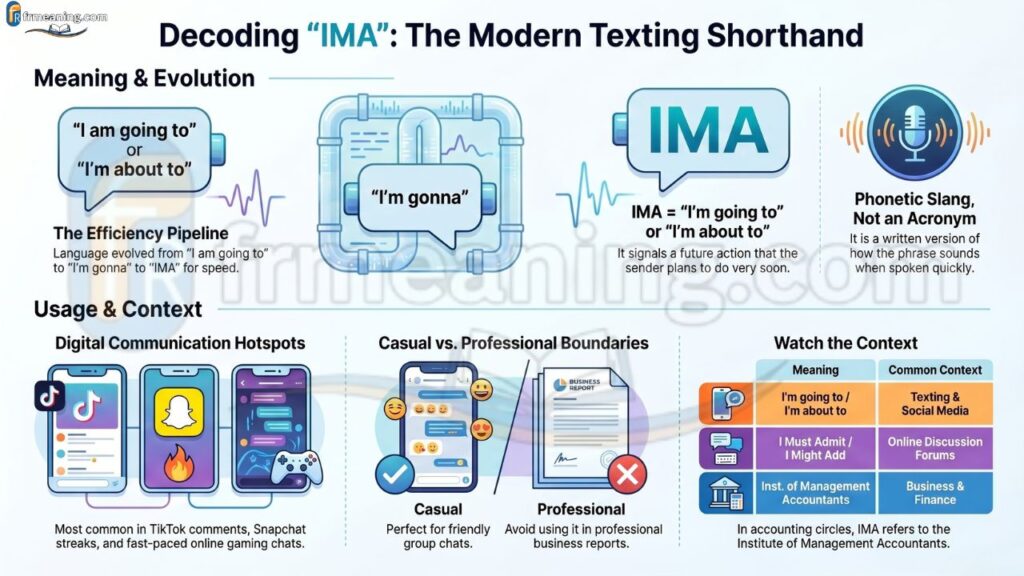
In most text messages and online conversations, IMA means “I’m going to” or “I’m about to.”
People use it as a shortened version of a future action.
For example:
- “IMA head home now.”
- “IMA finish this game first.”
- “IMA text you later.”
In each example, the sender is telling you something they plan to do very soon.
Think of it this way:
IMA = I’m going to
That’s the meaning you’ll encounter most often across texting apps, social media platforms, and online chat communities.
What Does IMA Stand For in Texting?
Text slang rarely appears out of nowhere. Most internet abbreviations evolve from spoken language.
IMA = I’m Going To
The most common IMA meaning is “I’m going to.”
People often shorten words while texting because typing quickly is easier than writing complete phrases.
Instead of writing:
“I’m going to watch a movie.”
Someone may simply type:
“IMA watch a movie.”
The meaning stays exactly the same.
Common examples include:
- IMA leave now.
- IMA order pizza.
- IMA study tonight.
- IMA call my friend.
The phrase signals a future action that will happen soon.
IMA = I’m About To
In some conversations, IMA can also mean “I’m about to.”
The difference is subtle.
“I’m going to” refers to a future action.
“I’m about to” suggests the action will happen almost immediately.
Examples:
- “IMA start the meeting.”
- “IMA post this video.”
- “IMA send the screenshot.”
Most people use these meanings interchangeably, so context matters more than strict grammar.
Why People Use IMA Instead of Full Words
Modern texting values speed.
People naturally shorten common phrases when chatting online.
The evolution looks something like this:
- I am going to
- I’m going to
- I’m gonna
- Imma
- Ima
Each version becomes quicker to type while still remaining easy to understand.
This pattern appears throughout internet slang.
Words become shorter. Conversations become faster.
That’s why IMA continues to appear across digital communication platforms.
Examples of IMA in Text Messages
The easiest way to understand any slang term is to see it in action.
Everyday Texting Examples
Here are some common text message examples:
Friend: What are you doing later?
Reply: IMA watch the game tonight.
Friend: Are you leaving?
Reply: Yeah, IMA head out now.
Friend: Did you finish your homework?
Reply: Not yet. IMA start in a few minutes.
Notice how naturally IMA replaces “I’m going to.”
Social Media Examples
You’ll also find IMA in comments and captions.
Examples:
- “IMA try this trend tonight.”
- “IMA upload part two tomorrow.”
- “IMA never recover from this video.”
- “IMA need that outfit immediately.”
Social media users often favor short, informal language because it feels more conversational.
Gaming Chat Examples
Online gaming communities use abbreviations constantly.
You might see:
- “IMA join the next match.”
- “IMA switch characters.”
- “IMA be back in five.”
- “IMA finish this quest first.”
Fast-paced environments encourage shorter messages.
That’s one reason gaming culture contributes heavily to internet slang adoption.
IMA Meaning on Social Media
Different platforms develop their own communication styles. Even so, the meaning of IMA remains fairly consistent.
IMA on TikTok
TikTok users commonly use IMA before describing something they plan to do.
Examples:
- “IMA recreate this recipe.”
- “IMA buy this immediately.”
- “IMA try this challenge.”
The phrase helps express intention or excitement.
IMA on Snapchat
Snapchat conversations tend to be casual and quick.
Examples include:
- “IMA snap you later.”
- “IMA head to school.”
- “IMA be offline tonight.”
Because messages disappear quickly, users often rely on shorthand language.
IMA on Instagram
Instagram comments frequently contain internet slang.
Examples:
- “IMA save this post.”
- “IMA follow for more tips.”
- “IMA try this workout.”
The abbreviation feels natural in short comment sections.
IMA on WhatsApp
WhatsApp users around the world use informal language with friends and family.
Common examples include:
- “IMA call you later.”
- “IMA reach home soon.”
- “IMA send the details.”
The meaning remains unchanged regardless of the messaging platform.
Is IMA an Acronym or Slang?
Many people wonder whether IMA qualifies as an acronym.
The answer isn’t completely straightforward.
The Difference Between Acronyms and Slang
An acronym is usually formed from the first letters of multiple words.
Examples include:
- LOL = Laugh Out Loud
- BRB = Be Right Back
- IDK = I Don’t Know
Each letter represents a specific word.
IMA works differently.
Why IMA Is Usually Considered Slang
Most language experts classify IMA as internet slang rather than a traditional acronym.
That’s because it reflects pronunciation rather than initials.
People often say:
“I’ma go.”
That spoken phrase eventually became written as “IMA.”
So while it functions like an abbreviation, it behaves more like slang than a classic acronym.
Other Meanings of IMA
Although “I’m going to” is overwhelmingly the most common meaning, there are other possibilities.
Context is everything.
I Must Admit
Occasionally, IMA can stand for “I Must Admit.”
Example:
- “IMA, I didn’t expect that result.”
This usage is relatively uncommon compared to texting slang.
I Might Add
Another possible meaning is “I Might Add.”
Example:
- “The design looks great, IMA, the colors work perfectly.”
This version appears more often in discussion forums or written conversations.
Institute of Management Accountants
In professional or business contexts, IMA may refer to the Institute of Management Accountants.
Examples:
- IMA certification
- IMA membership
- IMA accounting standards
When discussing careers, accounting, or finance, this meaning becomes much more likely.
Quick Comparison Table
| Meaning | Context |
|---|---|
| I’m Going To | Texting |
| I’m About To | Social Media |
| I Must Admit | Casual Conversation |
| I Might Add | Online Discussions |
| Institute of Management Accountants | Business & Accounting |
IMA vs Similar Text Slang
Internet slang often overlaps.
Understanding related terms can help avoid confusion.
IMA vs IMMA
These terms mean essentially the same thing.
Examples:
- IMA leave now.
- IMMA leave now.
IMMA is simply a more phonetic spelling.
Many users switch between the two without thinking about it.
IMA vs GONNA
“Gonna” is closer to standard informal English.
Examples:
- I’m gonna leave.
- IMA leave.
Both express future intent.
IMA is simply more casual.
IMA vs FINNA
FINNA usually means:
“Fixing to” or “about to.”
Examples:
- FINNA go shopping.
- IMA go shopping.
The meanings overlap, though FINNA has different cultural and linguistic origins.
IMA vs BRB
BRB means:
Be Right Back
Unlike IMA, BRB does not describe a future plan.
Instead, it announces a temporary absence.
Examples:
- BRB, getting water.
- IMA get water.
The intentions are similar, but the meanings differ.
When Should You Use IMA?
Not every situation calls for internet slang.
Appropriate Situations
IMA works well in:
- Text messages
- Group chats
- Snapchat conversations
- TikTok comments
- Instagram messages
- Gaming chats
- Casual online communication
These environments encourage relaxed language.
Situations to Avoid
Avoid using IMA in:
- Job applications
- Academic papers
- Business reports
- Professional emails
- Formal presentations
- Official correspondence
Writing “IMA submit the report tomorrow” may appear unprofessional.
Use complete language instead.
Common Mistakes People Make With IMA
Even simple slang can create confusion.
Assuming It Has Only One Meaning
Most people immediately assume IMA means “I’m going to.”
Usually that’s correct.
Still, context can occasionally point toward a different meaning.
Always read the surrounding conversation.
Using It in Professional Writing
Internet slang belongs in informal communication.
Professional writing should prioritize clarity.
Many workplaces discourage excessive abbreviations.
Misreading Context
Context changes everything.
Consider these examples:
- “IMA call you later.” = I’m going to.
- “IMA, that’s surprising.” = I must admit.
- “IMA certification helped my career.” = Institute of Management Accountants.
The surrounding words reveal the intended meaning.
Frequently Asked Questions
What does IMA mean from a girl?
The meaning doesn’t change based on gender.
A girl using IMA usually means “I’m going to” or “I’m about to.”
What does IMA mean on TikTok?
On TikTok, IMA typically means “I’m going to” before an action, reaction, or challenge.
Is IMA proper English?
No. IMA is considered informal internet slang rather than standard written English.
Is IMA rude?
Not at all.
It’s generally neutral and friendly. The tone depends on the rest of the message.
Is IMA the same as IMMA?
Yes. Both usually mean “I’m going to.” IMMA is simply a different spelling variation.
Final Thoughts on IMA Meaning in Text
Key Takeaways
If you remember only one thing, remember this:
IMA usually means “I’m going to” or “I’m about to.”
That’s the definition you’ll encounter in most text messages, social media comments, online chats, gaming communities, and messaging apps.
When someone texts:
“IMA call you later.”
They’re simply saying:
“I’m going to call you later.”
Simple as that.
Like many forms of modern texting slang, IMA exists because people want faster, more natural communication. Once you recognize it, you’ll start noticing it everywhere—from TikTok videos and Snapchat messages to Instagram comments and group chats.
And the next time someone sends “IMA,” you won’t need to guess what they mean.