

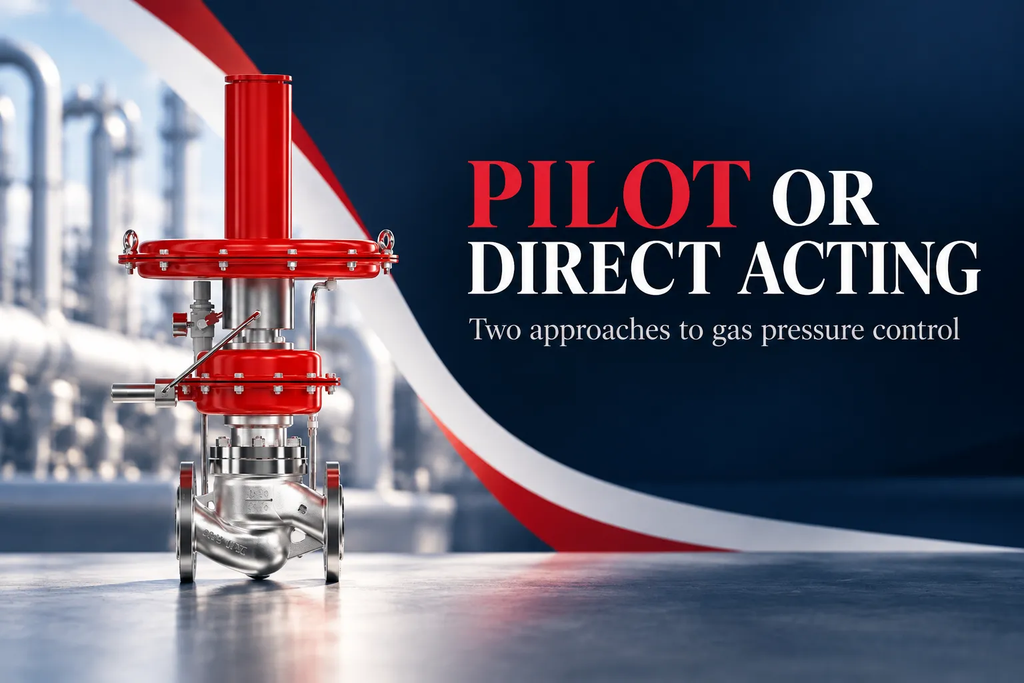
A pilot-operated self-regulating pressure valve separates part of the pressure-sensing task from the main flow-control task. A direct-acting regulator links the sensing and loading forces more directly to the regulating element. The practical choice depends on required flow, allowable pressure variation, supply conditions, and the installation’s complexity and maintenance needs.
Neither approach should be selected by a blanket rule. Direct operation can be a straightforward solution when its capacity and pressure-flow behavior suit the duty. Pilot operation can be useful when the application benefits from its control arrangement, provided the available pressure and operating conditions support the selected design.
Compare the force paths
In a direct-acting arrangement, pressure on a sensing element balances a loading force and other forces associated with the valve. A change in demand changes the pressure and causes the mechanism to move. The resulting position establishes a new balance.
A pilot-operated arrangement uses a smaller regulating mechanism to influence the pressure loading of a main actuator. The main valve then handles the required flow. This can reduce the extent to which the sensing mechanism directly carries the main-valve movement task.
The detailed circuit varies among products. A general comparison should therefore explain the function without assuming that every pilot uses the same pressure connections or internal flow path. Installation and troubleshooting details must follow the actual selected design.
Compare operating pressure rather than the adjustment setting
Both approaches have operating characteristics. The pressure established during flow can differ from the setting observed at another condition. Droop describes a reduction in controlled outlet pressure as flow increases in the relevant regulating arrangement.
The amount of acceptable droop depends on the process. A user that tolerates a broad supply-pressure range may not benefit from a more elaborate arrangement. Another process may require a narrow pressure band over a changing load, making the operating curve a more important selection factor.
When considering a pilot-operated self-regulating pressure valve such as the YSMETER ZZYP-II, define the required pressure band and flow range before comparing configurations. “More accurate” becomes useful only when it refers to a specific requirement and measurement basis.
Separate flow variation from supply variation
A pressure change caused by increased downstream demand is not the same as a change associated with varying inlet pressure. Both can occur in one installation. If inlet pressure falls when several users start simultaneously, the regulator sees a combined change in load and supply.
Record paired operating cases. A peak-flow condition should use the inlet pressure that is actually available during that peak. The highest possible inlet pressure remains important for the operating envelope, but it may not be the correct capacity-sizing case.
Comparing two regulators at different inlet conditions can produce a misleading conclusion. Use the same gas, temperature, flow reference, inlet-pressure cases, and controlled-pressure target. That establishes a common basis for assessing the difference in regulating behavior.
Capacity is not the only selection variable
A regulator that passes the maximum required flow may still behave poorly for the application at low demand. The usable operating range and pressure variation matter. Oversizing can also move normal operation into a region that is less favorable for the intended control task.
Minimum differential pressure can be relevant to a pilot arrangement because the mechanism needs suitable pressure conditions to operate the main valve. The specific requirement belongs to the design. Do not assume that adding a pilot allows a valve to regulate with any arbitrary difference between inlet and outlet pressure.
For direct operation, simplicity does not remove capacity limits either. The main flow path and force balance still need to fit the application. The appropriate comparison uses the full operating envelope rather than selecting one construction from a maximum-flow number alone.
| Decision factor | Direct-acting consideration | Pilot-operated consideration |
| Control structure | Sensing more directly moves regulating element | Pilot influences main actuator loading |
| Pressure band | Compare pressure-flow behavior with requirement | Compare proposed regulation over the same cases |
| Supply conditions | Check the usable operating envelope | Include pilot and main-valve pressure needs |
| Complexity | Fewer elements in many arrangements | Additional pressure paths and components |
| Maintenance | Understand sensing and main-valve condition | Include pilot and sensing-path condition |
Consider the installation’s ability to support the mechanism
Pilot systems include pressure paths whose condition matters to operation. Contamination, an unsuitable sensing arrangement, or unintended restrictions can affect response. The installation must preserve the selected design’s intended pressure relationships.
Direct-operated arrangements can be simpler, but they still require appropriate medium condition, material compatibility, and installation. Simpler does not mean maintenance-free or insensitive to a damaged seat. The comparison should identify the work each arrangement actually requires in the intended service.
External sensing, where used, should represent the pressure the process needs controlled. A point near the regulator may differ from a distant consumer after pipe losses. The choice of sensing location is part of the application design, not an arbitrary detail to be decided solely by convenient tubing access.
Compare two application patterns
Consider a hypothetical utility-gas branch with modest flow variation and a process that tolerates a relatively broad pressure band. A direct-acting regulator may be a practical candidate if its operating curve fits those conditions. Additional complexity should provide a defined benefit before it is added.
Now consider a gas supply with a wider demand range and a narrower required outlet-pressure band. A suitable pilot-operated arrangement may merit evaluation. The selection still needs to establish adequate inlet conditions and acceptable behavior throughout the range, including low demand and transitions.
These examples describe decision patterns rather than guaranteed outcomes. They do not assign universal accuracy, response time, or capacity advantages. The actual comparison must use the data for the proposed regulators and the same process requirements.
Do not confuse regulation with every protective function
A pressure regulator maintains a controlled pressure during its intended operation. The system may have separate requirements for abnormal conditions. Selecting direct or pilot operation does not, by itself, settle every response needed if a sensing path is blocked or the process supply changes unexpectedly.
Likewise, “self-regulating” does not mean the device is independent of energy. It uses pressure energy from the process. If the required pressure conditions are absent, the mechanism cannot create the missing supply. That limitation should be understood when defining interruption behavior.
State the normal regulating task clearly and keep other system functions distinct. This avoids attributing capabilities to a regulator simply because its operation does not depend on a motor or external instrument air.
Make the final comparison readable
Summarize the operating envelope, acceptable pressure band, proposed regulator configuration, sensing arrangement, and maintenance implications. Explain which requirement favors the selected approach. A concise decision note is more useful than a long list of adjectives about precision or reliability.
Yongsheng industrial flow control lists self-operated valve options that can be considered in this review. The relevant question is which configuration fits the gas demand and available pressure while remaining practical for the installation’s operating and maintenance conditions.
If the alternatives are close, identify the assumption that decides the result. It may be minimum inlet pressure, low-flow demand, or the acceptable pressure band. Resolving that assumption is more productive than debating direct and pilot operation in general terms.
Decide whether the added pilot complexity has a purpose
An additional control stage is valuable when it addresses a defined operating requirement. If a direct-acting candidate already meets the required pressure band across the actual demand and supply range, the pilot alternative should be assessed for a specific benefit rather than chosen merely because it appears more sophisticated.
Conversely, if the required pressure band cannot be met by the direct-acting candidate under the relevant cases, that limitation is a concrete reason to evaluate another arrangement. The comparison should identify where the mismatch occurs: high demand, low demand, changing inlet pressure, or a transient requirement. Different mismatches may call for different solutions.
The maintenance implications should be described in the same practical way. A pilot adds components and pressure paths that need to remain in their intended condition. The significance depends on the medium and the installation’s maintenance capability. It is not enough to say that more components are always worse or that improved regulation always outweighs the added work.
Finally, check whether the problem is actually outside the regulator. An inadequate supply branch or excessive downstream loss can prevent either candidate from meeting the consumer’s pressure requirement. A regulator comparison should not conceal a piping or supply constraint. Use measurements and the operating envelope to establish which part of the system needs improvement.
The result should be a short explanation of why the chosen approach fits this application. That explanation can remain valid even when product names change, because it is based on the pressure task and system conditions rather than a preference for one regulating category.
Frequently asked questions
Is direct acting always the low-cost option?
Not necessarily for the complete installation. Component price, required capacity, sensing arrangement, maintenance, and any additional equipment can affect the comparison. Begin with technically suitable alternatives and compare the scope needed to meet the same duty.
Does a pilot guarantee constant outlet pressure?
No. Actual behavior depends on the design and operating conditions. Define the required band and compare the proposed pressure-flow behavior across the relevant inlet and demand cases. A pilot is a control arrangement, not a guarantee of zero variation.
Can a pilot-operated valve work without external electricity?
The basic self-operated mechanism uses pressure energy from the process. A particular installation may add electrical monitoring or accessories. Those additions should be distinguished from the energy source that operates the regulating mechanism itself.
What information is most important for a fair comparison?
The same gas, flow reference, temperature, inlet-pressure range, controlled-pressure target, allowable variation, and demand range. Without a common operating basis, apparent performance differences may simply reflect different assumptions rather than the regulating approach.
Choose the control arrangement from the required operating envelope. The best option is the one that meets the pressure task with an installation and maintenance burden the application can support.
References
[1] Spirax Sarco. Self-acting Pressure Controls and Applications.
[2] Swagelok. How to Flatten a Regulator Flow Curve to Reduce Droop.
[3] Emerson. Industrial Regulators Quick Selection Guide.
