
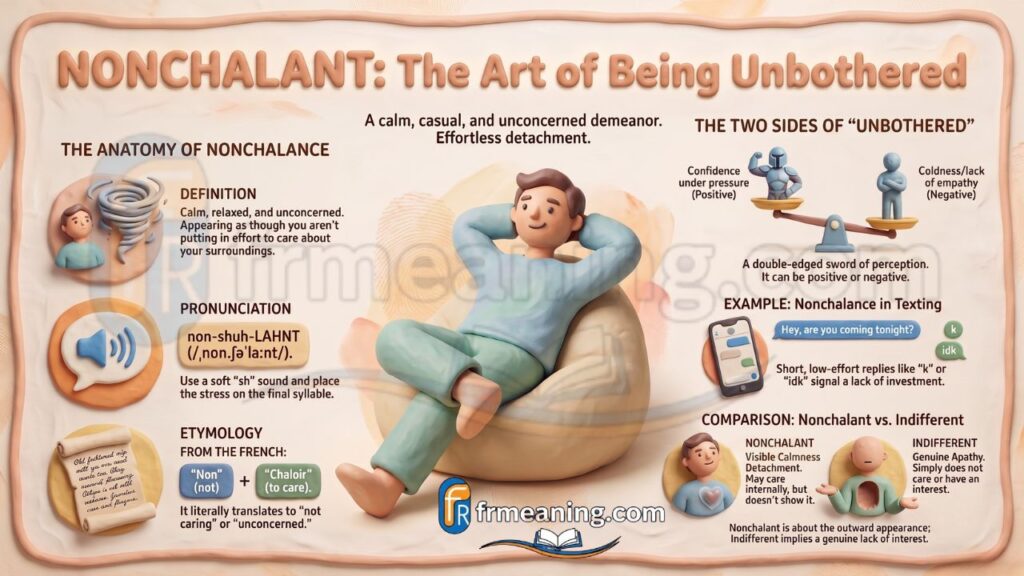

So someone just texted you back “k” after you poured your heart out, and now you’re googling nonchalant meaning at 11pm trying to figure out if that’s a compliment or a red flag. Fair enough.
The nonchalant meaning basically boils down to being calm, casual, and unbothered like nothing can rattle you, even when it probably should.
But there’s honestly more nuance to this word than most quick definitions give it credit for, and that’s exactly what we’re gonna unpack here.
By the end of this article you’ll know exactly what does nonchalant mean, how to pronounce it without embarrassing yourself, where the word even came from, and how to actually use it correctly in a sentence plus we’ll get into the synonyms, opposites, and even how the word shows up differently in texting versus real conversation.
What Does Nonchalant Mean? (Quick Definition)
In simple words, nonchalant means someone who appears calm, relaxed, and unconcerned — almost like they’re not putting in any effort to care about what’s happening around them. Merriam-Webster defines it using words like casual, unconcerned, and indifferent, while Cambridge leans toward “not feeling or showing any worry or excitement.”
Basically if you’re nonchalant, you’re giving off a vibe of “I’m not fussed either way.” It’s not always a bad thing — sometimes it just means you’re composed and collected under pressure.
Nonchalant Meaning in English (Simple Breakdown)
For a non-native speaker or someone just learning the term, here’s the nonchalant meaning in English broken down plainly:
- Adjective: nonchalant (describes a person, tone, or behavior)
- Core idea: acting relaxed and unbothered, even in situations where you’d expect concern
- Tone: can be positive (confident, cool-headed) or negative (careless, detached) depending on context
Think of it like this — imagine your friend just aced an exam and when you ask how it went, they just shrug and go “yeah, it was fine” without any excitement. That shrug, that flat tone, that’s nonchalance in action.
Nonchalant Pronunciation: How to Say It Correctly
This is honestly where most people trip up, so let’s get the nonchalant pronunciation sorted first.
It’s pronounced: non-shuh-LAHNT (/ˌnɒn.ʃəˈlɑːnt/)
A common mistake people make is pronouncing the “ch” like in “chair” — but it’s actually a soft “sh” sound, kind of borrowed straight from French. So say it like “non-shuh-lahnt,” with the stress landing on the last syllable. Practice it a couple times out loud, it’ll feel weird at first but you’ll get it.
Where Does the Word Come From? Chalant and Nonchalant Meaning (Etymology)
Here’s something most articles online completely skip over — the actual origin story of the word, and honestly it’s kinda interesting once you dig into it.
Nonchalant comes directly from French, and it breaks down into two parts:
- Non → meaning “not”
- Chaloir → an old French verb meaning “to care” or “to be concerned”
So literally, nonchalant → translates to → “not caring” or “unconcerned.” Now, you might be wondering — does “chalant” exist as its own word? Not really, not in modern English anyway. The word “chalant” isn’t used independently today; it only survives inside “nonchalant.”
In old French though, “chalant” did exist and meant something closer to “caring” or “warm,” which makes the nonchalant vs chalant relationship basically an opposite pairing — care versus lack of care.
This etymology matters because it explains why nonchalant carries that specific flavor of “effortless detachment” rather than just plain old carelessness. It’s not about not knowing how to care, it’s about choosing (consciously or not) to not show that you care.
Nonchalant in French (Original Meaning)
Since we’re already here, worth noting that nonchalant in French still functions pretty similarly to how English uses it today — describing someone who’s cool, unbothered, or indifferent in their manner. French speakers use “nonchalance” (the noun) quite often to describe an effortless, relaxed style too, almost like a fashion or attitude thing, not just an emotional state. So there’s actually a slight cultural nuance there that got carried into English.
Nonchalant in a Sentence: Real Examples
Seeing the word in context honestly helps way more than just memorizing a definition. Here’s a few nonchalant examples to show how flexible the word is:
- She gave a nonchalant shrug when asked about the breakup, like it didn’t bother her at all.
- He walked into the interview with a surprisingly nonchalant attitude, completely calm despite the pressure.
- “Whatever happens, happens,” he said in his usual nonchalant tone.
- The waiter’s nonchalant response to the spilled drink actually made the customer feel worse, not better.
- Despite failing the test, she remained nonchalant, barely reacting at all.
Notice how in most of these, nonchalant behavior → creates → an impression of emotional distance, whether that’s intentional or not.
Nonchalant Meaning in a Relationship
This one gets searched a LOT, and for good reason — being nonchalant meaning in a relationship context can honestly be confusing and even a little painful to navigate.
When someone is nonchalant in a relationship, it usually shows up as:
- Slow or minimal-effort replies to texts
- Seeming unbothered by plans changing or cancelling
- Not showing much emotional reaction to good or bad news
- Avoiding “deep” conversations, keeping things surface-level
- Acting like they’re not that invested, even if they secretly are
Now here’s the tricky part nonchalant behavior in dating can mean two completely different things. Sometimes it’s a genuine personality trait (some people are just naturally chill and don’t express emotion outwardly). But other times, it’s a defense mechanism, or worse, a sign of actual disinterest.
Context and consistency matter a lot here. If someone’s nonchalant about everything in life, that’s just who they are. If they’re nonchalant specifically with you but not with friends or work, that’s worth paying attention to.
Nonchalant Meaning in Chat / Texting
Similar deal but for digital communication — nonchalant meaning in chat usually refers to short, low-effort, emotionally flat responses. Think “k,” “lol sure,” “idk maybe,” or leaving someone on read and then acting like it’s no big deal.
In texting culture specifically, nonchalance → often signals → either genuine calmness or a deliberate attempt to seem uninterested/unbothered (sometimes as a power move, ngl). It’s become such a common thing that “he’s being so nonchalant” is basically its own relationship red-flag phrase on social media now.
Nonchalant Synonyms (Words That Mean the Same Thing)
If you’re trying to switch up your vocabulary or just want alternatives, here’s a solid list of nonchalant synonyms:
| Category | Synonyms |
|---|---|
| Calm-related | calm, composed, collected, unruffled, cool |
| Casual-related | casual, relaxed, easygoing, carefree, effortless |
| Detachment-related | unconcerned, indifferent, detached, aloof, apathetic |
| Emotion-related | dispassionate, unemotional, stoic, imperturbable |
Any single nonchalant synonym you pick should roughly capture that “not showing much reaction” energy, but they each carry slightly different shades — “carefree” feels lighter and more positive, while “apathetic” leans more negative and disengaged.
Nonchalant Opposite (Antonyms)
On the flip side, the nonchalant opposite words describe people who are the exact opposite — anxious, expressive, or deeply invested emotionally. Some solid antonyms include:
- Concerned
- Anxious
- Enthusiastic
- Worried
- Excited
- Passionate
- Eager
So basically, nonchalant → contrasts directly with → concerned or anxious. If nonchalant is “meh, whatever,” the opposite is “OMG I care so much about this.”
Nonchalant vs Indifferent vs Careless vs Calm
This is genuinely where most people get confused, so let’s clear it up with a direct comparison.
Nonchalant vs Indifferent: These two overlap a lot, but indifferent → implies → a complete lack of interest or investment, almost like apathy. Nonchalant, on the other hand, can still involve caring internally — it’s more about not showing it outwardly. Someone can be nonchalant on the surface while actually caring a lot underneath.
Nonchalant vs Careless: This is an important distinction. Careless → implies → negligence, a lack of attention that leads to mistakes or harm. Nonchalant → doesn’t necessarily imply → any negligence — it’s more about attitude and composure, not competence. You can be a nonchalant driver who’s still perfectly safe, but a careless driver who’s genuinely dangerous.
Nonchalant vs Calm: Calm is more neutral and generally positive — it just means peaceful and steady. Nonchalant leans slightly toward detachment or lack of enthusiasm, which can sometimes come across as dismissive depending on the situation.
Is Nonchalant Positive or Negative?
Honestly? It depends entirely on context, and that’s probably the most important thing to understand about this word.
Positive context: Being nonchalant during a stressful situation (like a job interview or public speaking) → signals → confidence and composure. People often admire this kind of calm, unbothered energy.
Negative context: Being nonchalant about something that genuinely deserves attention or emotional response (like someone else’s pain, or a relationship issue) → can come across as → cold, dismissive, or uncaring.
So there’s really no fixed “good” or “bad” label here — nonchalance is a tool, and how it lands depends heavily on the situation it’s used in.
Nonchalant Person: What Are They Like?
A nonchalant person typically shows these traits:
- Rarely gets visibly excited or upset
- Handles stressful situations without panicking
- Speaks in a flat, even, or laid-back tone
- Doesn’t chase validation or attention
- Comes across as effortlessly confident (even if they’re not internally)
People with a naturally nonchalant attitude are often seen as mysterious or hard to read, which — depending on who you ask — is either really attractive or kind of frustrating.
How to Use Nonchalant Correctly (Usage Tips)
A few quick pointers for using this word properly in writing or speech:
- It’s an adjective, so it directly describes a noun (“a nonchalant reply,” “a nonchalant look”)
- The adverb form is nonchalantly (“she answered nonchalantly”)
- The noun form is nonchalance (“his nonchalance was almost unsettling”)
- Don’t confuse it with “nonchalantly” when you need the adjective form — a really common grammar slip
Nonchalant Meaning in Arabic
For readers searching specifically for nonchalant meaning in Arabic, the closest translation is generally “لا مبالٍ” (lā mubālin), which roughly translates to “unconcerned” or “indifferent.” Some contexts might also use “غير مكترث” (ghayr muktarith), meaning “not caring” — which lines up pretty closely with the word’s French root meaning too, interestingly enough.
Quick Recap Table
| Aspect | Details |
|---|---|
| Meaning | Calm, casual, unconcerned |
| Pronunciation | non-shuh-LAHNT |
| Word origin | French — non (not) + chaloir (to care) |
| Positive use | Confidence, composure under pressure |
| Negative use | Coldness, lack of empathy or investment |
| Synonyms | Calm, indifferent, detached, composed |
| Antonyms | Anxious, eager, concerned, enthusiastic |
Frequently Asked Questions
Is nonchalant positive or negative?
It can be either — positive when it shows confidence and calm, negative when it signals coldness or a lack of empathy toward others.
What is the opposite of nonchalant?
The opposite includes words like concerned, anxious, enthusiastic, and eager — basically anything showing strong visible emotion or investment.
What does nonchalant mean in texting?
It refers to short, flat, low-effort responses that suggest the person isn’t emotionally invested or bothered by the conversation.
How do you use nonchalant in a sentence?
Place it before a noun, like “he gave a nonchalant reply,” describing someone’s calm, unbothered manner or tone.
Is nonchalant the same as indifferent?
Not exactly — nonchalant can hide real emotion behind calmness, while indifferent usually means a genuine lack of interest or concern.
What does chalant mean without the “non”?
“Chalant” isn’t really used in modern English alone; historically in French it meant “caring” or “warm,” the opposite of nonchalant.
How do you pronounce nonchalant correctly?
Say it as “non-shuh-LAHNT,” with a soft “sh” sound and stress on the final syllable, borrowed from French pronunciation.