

If you’ve ever seen an editor scribble “add parens here” on your draft and thought, wait, what’s a paren you’re honestly not alone. The parens meaning trips up a lot of people the first time they run into it, especially students and new writers who assume it’s some fancy grammar term they missed in school. It isn’t.
It’s just a shortcut. In this guide we’re going to break down exactly what parens means, where the word comes from, how it’s used in writing, math, code, and even biology, plus we’ll clear up the confusing overlap with “parens patriae” (which, spoiler, has almost nothing to do with punctuation).
By the end you’ll be able to use the term confidently in a sentence and explain it to someone else without fumbling.
What Does “Parens” Mean?
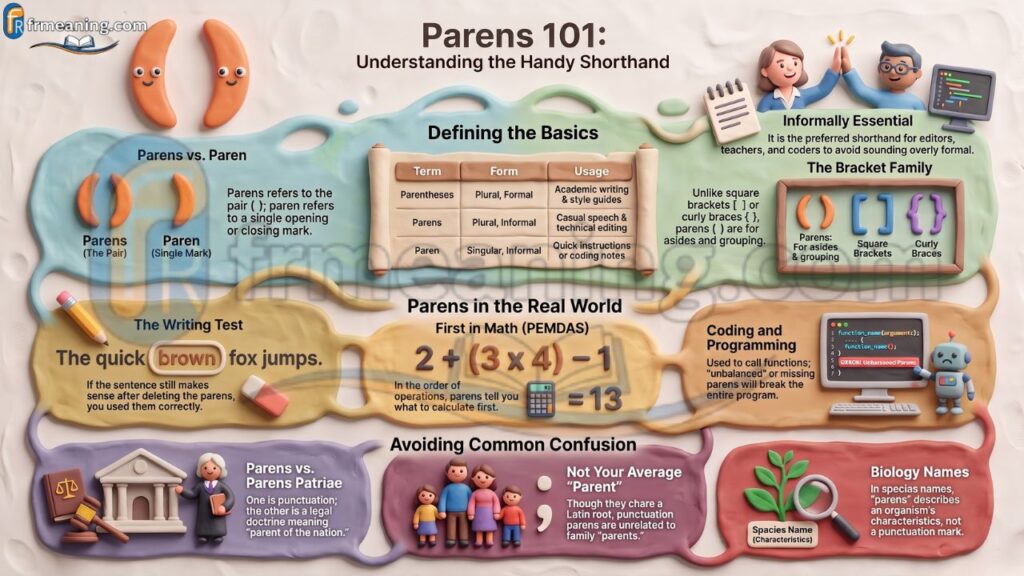
Parens is simply the informal, shortened form of the word “parentheses.” It refers to the pair of curved punctuation marks — ( and ) — that writers use to enclose extra or secondary information in a sentence. So when someone tells you to “put that in parens,” they just mean wrap it in parentheses.
The singular version, paren, refers to just one of the two marks — either the opening one or the closing one. You’ll mostly hear “parens” used in casual conversation, editing notes, classrooms, and technical fields like coding, where people want a quicker way to say the word without sounding overly formal.
Parens Meaning in English
In everyday English, parens meaning boils down to this: they’re punctuation marks that hold information that isn’t essential to the main sentence but still adds something useful. Think of it like a friend leaning over to whisper a side comment during a movie — you don’t need the whisper to follow the plot, but it adds context.
Here’s a semantic breakdown to keep things clear:
- Parens → informal term → refers to → parentheses (plural)
- Paren → informal term → refers to → one parenthesis (singular)
- Parentheses → punctuation category → encloses → non-essential or clarifying text
Native English speakers use parens constantly without even thinking about it, whether they’re adding a quick aside, clarifying a date, or listing options. It’s one of those words that feels obscure until you realize you already understand the concept — you just didn’t know the shorthand name for it.
Parens vs Parentheses: What’s the Real Difference?
There isn’t really a difference in meaning — parens is just a casual, shortened version of parentheses. Both describe the same punctuation marks; the word choice usually just signals how formal the writing is.
That said, it helps to see the full family laid out so you’re not second guessing yourself mid-sentence:
| Term | Form | Common Usage |
|---|---|---|
| Parenthesis | Singular, formal | Academic writing, grammar rules |
| Parentheses | Plural, formal | Style guides, formal documents |
| Paren | Singular, informal | Casual speech, coding, editing notes |
| Parens | Plural, informal | Casual speech, coding, quick instructions |
So technically, you’d say “close the paren” if you’re talking about one mark, but “add parens around that phrase” when referring to the whole pair. Most people don’t split hairs over this in daily conversation, though — parens has basically become an accepted stand in for both forms in relaxed settings.
Parens Meaning in Script (Writing & Formatting Context)
When people search “parens meaning in script,” they’re usually asking how parens function within a written or typed document — basically, how do you actually use them on the page. In script or manuscript formatting, parens serve a few specific jobs:
- Enclosing stage directions in scripts or screenplays (e.g., “(pauses, looks away)”)
- Adding clarifying notes within dialogue or narration
- Marking optional text that a reader or actor could technically skip
- Citing sources inline without breaking the sentence flow
In screenwriting specifically, parens (sometimes called “wrylies” by industry folks) appear right under a character’s name to hint at tone, like (whispering) or (sarcastic). This is a pretty niche but genuinely important use case that a lot of general grammar guides skip over entirely, so if you’re writing scripts, knowing this distinction actually matters.
The Origin & Etymology of “Parens”
The word traces back to Latin, and this is where things get a little interesting linguistically. The Latin word parens originally meant “parent” or “one who gives birth to, produces” — coming from the verb parere, meaning to bring forth or produce. This is a totally separate root from the Greek-derived “parenthesis,” even though the spellings look eerily similar in English.
So to be crystal clear: the punctuation term “parens” and the Latin word “parens” (meaning parent) are not directly related in modern English usage, even though people often assume they are because of the shared spelling. It’s honestly one of the most common mix ups people have with this word, and it’s worth remembering so you don’t accidentally connect the two in an essay or presentation.
The punctuation sense of parens actually comes from parenthesis, which itself derives from Greek — para (beside) + entithenai (to insert) — meaning literally “a putting in beside.” Over time, “parens” became the natural clipped version English speakers used once “parentheses” started feeling like a mouthful in casual writing and speech.
Pare Meaning (A Quick Clarification)
Since we’re on etymology, it’s worth touching on pare, because people occasionally confuse it with paren due to how similar they look on a page. “Pare” is an entirely different word meaning to trim or cut away the outer layer of something, like paring an apple.
It has zero connection to punctuation and comes from a totally different linguistic root (Old French parer, meaning to prepare or trim). So if you see “pare” in a sentence, don’t assume it’s a typo for “paren” — they’re unrelated words that just happen to share a few letters.
Parent Meaning and Its Connection
Interestingly, the English word parent actually does share the same Latin root as the punctuation term — both trace back to parens/parentem, meaning “one who produces or brings forth.” So while “parens” (punctuation) and “parent” (family relationship) look connected and technically share a distant linguistic ancestor, they evolved into completely separate meanings in modern English.
This is a genuinely useful fact to know because a lot of readers assume the punctuation meaning was somehow inspired by the family term, when really both just descended from the same old Latin word independently.
How to Use Parens in a Sentence
Using parens correctly comes down to remembering one rule: whatever’s inside should be removable without breaking the sentence’s grammar. If the sentence still makes sense without the bracketed part, you’re using parens correctly.
Here’s a few natural examples:
- “The meeting (originally scheduled for 3 PM) got pushed to Friday.”
- “She mentioned her thesis topic (climate migration patterns) during the interview.”
- “Add the total cost, including tax ($42.50), to the invoice.”
- “He forgot to close the paren in his code, which broke the whole function.”
Notice how in every one of these, you could delete the part in parens and the sentence would still read fine grammatically. That’s the real test for whether you’re using them right.
A common mistake people make is opening a paren and forgetting to close it — a small thing, but it genuinely confuses readers and, in coding contexts, will straight up break your program. Always double check both marks are there before you move on.
Parens in Math and Order of Operations
In mathematics, parens are used to group numbers and operations together, telling you what to calculate first. This ties directly into the order of operations, often remembered through the acronym PEMDAS (Parentheses, Exponents, Multiplication, Division, Addition, Subtraction).
For example, in the expression 5 × (3 + 2), you’d calculate what’s inside the parens first (3 + 2 = 5), then multiply: 5 × 5 = 25. Without the parens, the answer would come out completely different because multiplication would happen before the addition.
This is why teachers hammer on parens so much in early math classes — get the grouping wrong, and your whole calculation falls apart, even if every individual step you did was technically correct.
Parens in Coding and Programming
In programming, parens are everywhere, and honestly, understanding them is one of the first real skills a beginner coder needs to build. Parens are used to call functions, define parameters, and group expressions so the computer knows exactly what to execute and in what order.
A few common jobs parens do in code:
- Wrapping the arguments passed into a function, like
print("hello") - Grouping conditions in logic statements, like
if (x > 5 && y < 10) - Controlling execution order in math expressions, similar to how they work in regular math
- Marking a method call even when it’s empty, like
getData()
One thing beginners trip over constantly is unbalanced parens — meaning you opened one but never closed it, or you closed one you never opened. Most modern code editors will highlight this for you, but it’s still one of the most common syntax errors new programmers run into, right up there with missing semicolons.
Paren Meaning in Biology
This one’s a bit different from everything else we’ve covered, so it deserves its own explanation. In biology and taxonomy, “parens” occasionally shows up as part of a species name or scientific classification, and it’s not related to punctuation at all in that context — it’s derived from the same Latin root meaning “producing” or “bearing.”
You’ll see this in scientific binomial names like Areca parens (a flowering plant species) or Horornis parens (a bird species), where “parens” functions as a descriptive Latin epithet rather than a grammar term.
If you’re reading a biology textbook or a taxonomic paper and spot the word “parens” attached to a species name, don’t confuse it with the punctuation mark — it’s doing a completely different job there, describing something about the organism’s characteristics or origin rather than telling you to add brackets around anything.
Parens vs. Related Brackets (Square, Curly, Angle)
Parens belong to a broader “bracket family,” and knowing how they differ from their cousins helps avoid mixing them up, especially in technical writing or coding.
| Symbol | Common Name | Typical Use |
|---|---|---|
| ( ) | Parens / Parentheses | Asides, grouping, function calls |
| [ ] | Square brackets | Editorial insertions, array indexing |
| { } | Curly braces | Code blocks, sets in math |
| < > | Angle brackets | HTML tags, generics in programming |
In British English, by the way, what Americans call “parentheses” are often just called “brackets,” while what Americans call “brackets” get called “square brackets” over there. It’s a small but genuinely confusing regional difference that trips up a lot of international readers and writers.
What Is “Parens Patriae” Meaning? (A Different Term Entirely)
Now here’s where a lot of confusion happens, and honestly it’s a fair mix-up. “Parens patriae” is a legal doctrine, not a punctuation term. It’s Latin for “parent of the nation” or “parent of the country,” and it refers to the legal authority a state or government has to act as a guardian for people who can’t protect themselves — most commonly children, or individuals deemed legally incapable of caring for their own interests.
You’ll see this phrase pop up in legal contexts like child custody cases, mental health commitments, or lawsuits where a state sues on behalf of its citizens’ collective welfare. It has genuinely nothing to do with punctuation marks — the shared word “parens” is purely coincidental in terms of modern usage, even though both ultimately trace back to that same Latin root about producing or bearing.
If you’re searching “parens meaning” hoping to understand grammar, and you stumble across “parens patriae” in your results, just know you’re looking at two completely different subjects that happen to share a word.
Common Mistakes People Make With Parens
A few errors show up again and again, so it’s worth listing them out plainly:
- Forgetting to close the paren — leaves the sentence or code broken
- Overusing parens — stuffing too many asides into one paragraph makes writing choppy and hard to follow
- Confusing parens with parent — assuming they’re directly linked in modern meaning
- Mixing up parens patriae with punctuation — treating the legal term like it belongs in a grammar lesson
- Placing punctuation incorrectly — periods and commas usually go outside the closing paren unless the entire sentence is inside the parens
Fixing these small habits honestly makes a noticeable difference in how polished your writing looks, especially in formal or academic contexts.
Key Takeaways
Parens is simply an informal way of saying parentheses, and once you strip away the confusion, it’s a pretty straightforward concept. It shows up in writing to add extra context, in math to control calculation order, in coding to organize functions and logic, and even in biology as part of scientific names with each context giving the word a slightly different flavor, even though the core symbol stays exactly the same.
Understanding the difference between parens, parent, pare, and parens patriae clears up most of the confusion people run into, and now you’ve got all of that sorted in one place.
FAQs
What does “parens” mean in a sentence?
Parens refers to parentheses, the curved punctuation marks used to enclose extra, non-essential, or clarifying information within a sentence.
Is “parens” the same as “parentheses”?
Yes, parens is simply the informal, shortened form of the word parentheses, commonly used in casual or technical writing.
What is the difference between paren and parens?
Paren refers to a single mark, either opening or closing, while parens refers to the full pair together.
What does “parens patriae” mean?
It’s a legal doctrine meaning “parent of the nation,” describing a government’s authority to protect people unable to protect themselves.
Is “parens” related to the word “parent”?
Both share the same Latin root meaning “to produce” or “bear,” but they evolved into completely unrelated modern meanings.
What does “parens” mean in biology?
In biology, parens sometimes appears in scientific species names as a Latin descriptive term, unrelated to punctuation.
How do you use parens correctly in writing?
Place non-essential information inside the marks, ensure both open and close parens are present, and keep punctuation outside unless needed.