

So you were scrolling through a chat and someone dropped “OFC” out of nowhere, right, and now you’re sat there wondering if it’s some new code word your friends invented. Don’t worry, it’s not that deep.
This guide breaks down the full OFC meaning, where it came from, how people actually use it in real life, and the handful of other meanings it carries in totally different fields like medicine and government.
By the time your done reading, you’ll never have to second-guess an OFC text again.
What Does OFC Mean?
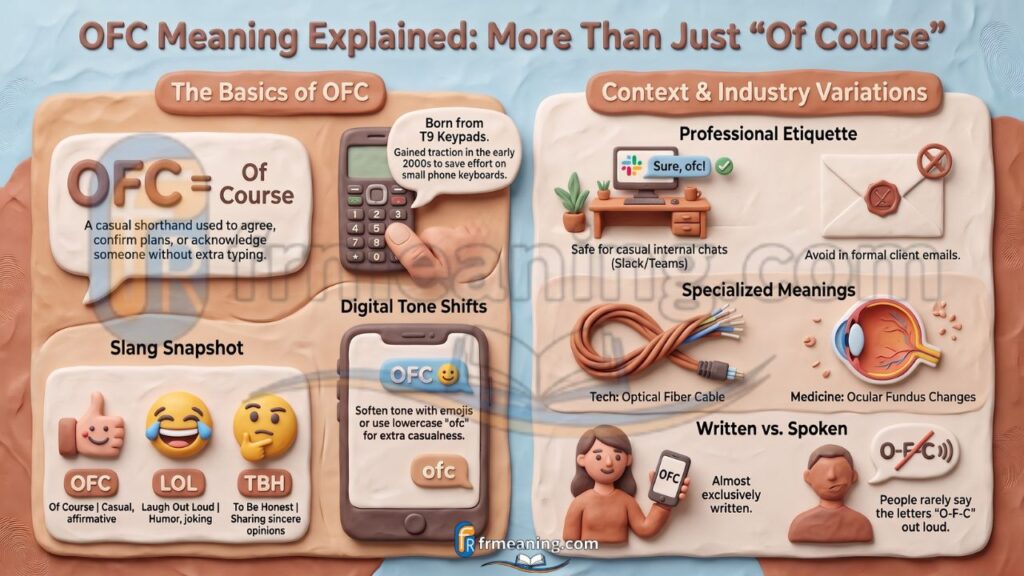
OFC stands for “Of Course,” plain and simple. It’s basically a lazy (in the best way) shorthand people use to agree with someone, confirm a plan, or just say yeah obviously without typing the whole phrase out.
OFC → means → “Of Course.” That’s the core relationship you need to remember, and honestly most of this article just builds on that one fact.
Here’s how it plays out in a normal text convo:
Friend: “Are you coming to the party tonight?” You: “OFC!”
See, that’s it. No big mystery. But like most slang, the tone and meaning can shift a little depending on who’s texting and where the conversation is happening, which we’ll get into below.
OFC Meaning in Chat: How It’s Actually Used
The OFC meaning in chat apps stays pretty consistent — it’s an affirmative, casual way of agreeing. But the vibe changes a bit depending on the platform and the people involved.
Here’s a quick breakdown of common chat scenarios:
| Situation | Example Text | Meaning |
|---|---|---|
| Confirming plans | “OFC I’ll pick you up at 7” | Agreeing to plans, no hesitation |
| Responding to a compliment | “Your outfit looks amazing!” → “OFC, thanks!” | Politely accepting a compliment |
| Agreeing with an opinion | “Pizza is the best dinner choice” → “OFC!” | Confident agreement |
Notice how short and snappy it is? That’s really the whole point. OFC keeps conversations moving without breaking the flow, which is probably why it caught on so fast across texting and social apps in the first place.
OFC Meaning Explained in Chat: Platform-by-Platform
Different apps give OFC slightly different flavors:
- Discord / Messenger — mostly used for quick, no-fuss agreement between friends or gaming buddies.
- Snapchat — pops up in stories and replies, often paired with emojis to soften the tone, like “OFC 🌊.”
- TikTok / Instagram comments — can get sarcastic here. Someone might reply “OFC” to a comment that’s obviously not true, and the tone flips into humor or mild shade.
Basically, context and platform → shape → how OFC lands, so it pays to read the room before firing one off.
OFC Full Form: Where the Abbreviation Comes From
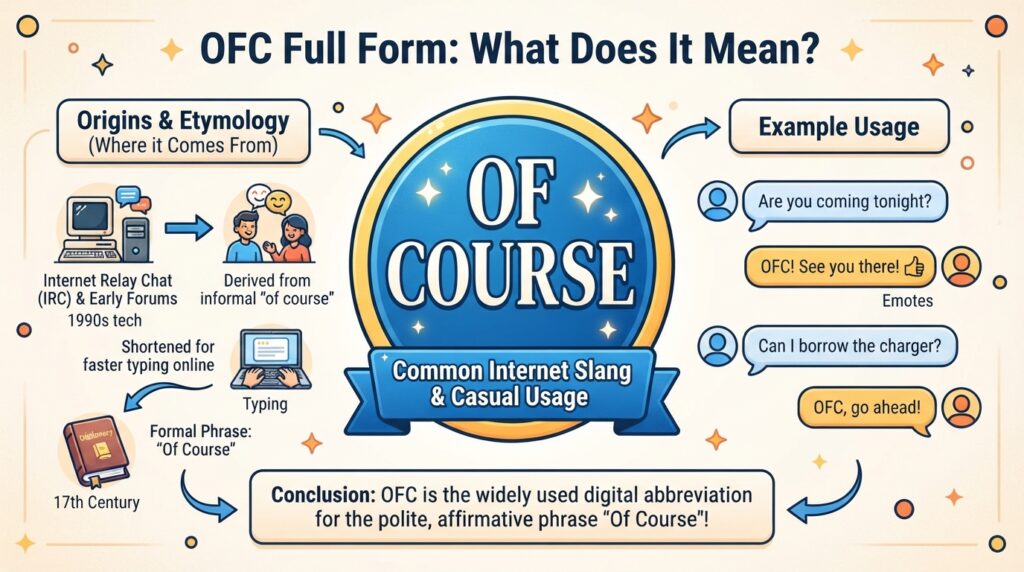
The OFC full form is simply “Of Course,” and it emerged for the same reason most texting slang did — people got tired of typing long phrases on tiny keyboards.
OFC started gaining traction in the early 2000s, back when instant messaging and SMS texting were exploding in popularity. Early usage was mostly confined to chatrooms and MSN Messenger, back when everyone had those cringe usernames we don’t talk about anymore. From there it spread naturally to WhatsApp, Snapchat, and Discord as those platforms took over.
Small phone keyboards → led to → the rise of texting abbreviations like OFC. Typing “of course” every single time felt like a chore on a T9 keypad, so shorthand became the norm, and it just stuck around even after keyboards got way better.
OFC Full Form in Chat vs. Other Fields
It’s worth noting the full form in chat context (Of Course) is completely different from what OFC means in specialized industries. We’ll unpack those alternate meanings a bit later, but just keep in mind — one abbreviation, multiple totally unrelated meanings depending on where you see it.
What Does OFC Mean From a Girl? (And Does Gender Change the Meaning?)
Short answer: no, the core meaning doesn’t change. What does OFC mean from a girl is really the same question as what does OFC mean from anyone — it still translates to “of course.”
That said, there can be small stylistic differences in delivery. A girl texting OFC might soften it with an emoji, something like “OFC 😊” or “ofc!! lol,” which can make the reply feel warmer or more playful. A guy, on the other hand, might just type “OFC” flat, no punctuation, no emoji, and it reads as more matter-of-fact.
This isn’t a hard rule by any means — plenty of people text however they text regardless of gender — but its a pattern people notice in casual observation of texting habits. The underlying semantic meaning stays identical; only the emotional wrapping around it changes slightly.
OFC Meaning in Work and Corporate Settings
Yes, OFC does show up in professional environments, but it needs to be used carefully. The OFC meaning in work contexts is still “of course,” but the formality level matters a lot more here.
Acceptable use cases:
- Chatting with colleagues you’re close with on Slack or Teams
- Quick internal messages where the tone is already relaxed
Not recommended:
- Formal emails to clients
- Messages to senior leadership you don’t know well
- Any written communication that could end up in an official record
Example work chat:
Manager: “Can you review the report by 5 PM?” Employee: “OFC, I’ll have it done.”
That works fine in a casual internal Slack channel. But if that same manager was a client you’d just met? Probably swap it for “Of course, I’ll have that ready by 5.”
OFC Meaning in Corporate Communication: A Word of Caution
The OFC meaning in corporate settings carries a bit more risk than casual texting does. Corporate communication often gets archived, forwarded, or reviewed later, so using overly casual slang can sometimes come across as unprofessional, especially to older colleagues or clients who might not even know what it means.
A good rule of thumb: if you wouldn’t say “yeah obviously” out loud in a client meeting, don’t type “OFC” in a client email either. Professional context → determines → whether OFC is appropriate, and when in doubt, just spell it out.
OFC Meaning Medical: Ocular Fundus Changes
Here’s where things get interesting — outside of texting, OFC meaning medical contexts refers to something entirely different: Ocular Fundus Changes.
In clinical shorthand, a doctor or nurse might jot down something like “Patient shows OFC response to treatment,” and in that sentence OFC has nothing to do with agreement or confirmation. It’s referring to changes observed in the back of the eye (the fundus), which doctors often check when monitoring conditions related to eye health, blood pressure, or diabetes.
This is a great example of how acronyms can carry wildly different meanings depending on the field. Medical OFC → refers to → eye examination findings, not casual agreement, so context is everything here.
OFC Police Meaning: Is It Used in Law Enforcement?
The OFC police meaning is a bit murkier than the medical use case. In formal police reports or official law enforcement documents, OFC as “of course” is rarely, if ever, used — that kind of casual slang doesn’t really belong in formal paperwork.
That said, it might occasionally pop up in informal communication between officers, like a quick text or radio chat where someone’s confirming a request casually. It’s not an official term with a fixed law enforcement definition the way something like “10-4” is.
If you’re seeing “OFC” in an actual legal document, it’s more likely being used as an abbreviation for something specific to that document (like “officer,” honestly, context dependent) rather than the slang meaning at all.
Other Meanings of OFC Beyond Slang
While “of course” dominates casual usage, OFC pops up in a few other specialized fields too:
- Optical Fiber Cable — used constantly in tech and networking discussions, referring to the fiber optic cables that transmit data as light signals.
- Ocular Fundus Changes — the medical usage we covered above.
- Office of Federal Contract Compliance — a government/legal body in the U.S. tied to labor and employment compliance for federal contractors.
- Visa/immigration shorthand — occasionally seen in phrases like “OFC approved for entry,” essentially just a fast way of writing “of course approved.”
Always double check the surrounding sentence before assuming which meaning applies. Industry and context → determine → the correct interpretation of OFC, and mixing them up could genuinely cause confusion in professional settings.
OFC vs. Other Popular Slang: A Quick Comparison
To understand where OFC fits into the bigger picture of internet slang, here’s how it stacks up against a few other common acronyms:
| Slang | Meaning | Tone/Usage |
|---|---|---|
| OFC | Of Course | Casual, affirmative |
| LOL | Laugh Out Loud | Humor, joking |
| BRB | Be Right Back | Temporary absence |
| TBH | To Be Honest | Sharing opinion sincerely |
What makes OFC kind of unique compared to these others is that its purely affirmational — it doesn’t express humor (like LOL) or absence (like BRB), it just confirms. That specificity is probably why it’s stayed so popular for so long.
How Do You Actually Say “OFC” Out Loud?
This is one thing a lot of guides skip over completely, but it comes up more than you’d think. So, do people actually say “OFC” as a word when speaking?
Honestly, not really. Unlike acronyms such as “LOL” (which some people do say as “lol” out loud, weirdly enough), OFC is almost exclusively a written abbreviation. When speaking, people just say “of course” naturally — nobody’s walking around saying “oh-eff-see” in real conversation. If you did say it out loud as letters, most people would probably just look at you confused, ngl.
This matters because it highlights something important about internet slang in general: written shorthand and spoken language don’t always overlap. OFC exists purely to save keystrokes, not to create a new spoken word, which is a bit different from acronyms that eventually crossed over into speech (like “lol” or “fomo”).
Generational Differences in Using OFC

Another gap worth addressing — how does usage differ across generations? This matters a lot for anyone trying to communicate clearly across age groups.
- Gen Z and younger Millennials grew up texting on smartphones with autocorrect, so acronyms like OFC feel completely natural and are used constantly, often paired with emojis or lowercase styling for extra casualness.
- Older Millennials and Gen X who remember flip phones and character-limited SMS plans adopted abbreviations mainly out of necessity (10 cents per text will do that to you), so their usage tends to feel a bit more functional than stylistic.
- Baby Boomers and older users are generally less familiar with OFC and might genuinely misread it or need it explained, since a lot of internet slang simply wasn’t part of their formative communication habits.
This generational gap is exactly why context matters so much — using OFC with your group chat is totally different from using it with your grandma, who might think you’re talking about fiber optic cables.
Should You Use OFC? Pros and Cons
Before you start sprinkling OFC into every conversation, weigh these out:
Pros:
- Saves time when texting quickly
- Sounds friendly, casual, and approachable
- Universally recognized across most digital platforms
Cons:
- Can come across as too casual in formal settings
- Risk of confusion with older generations or non-native English speakers
- Overusing it can make your texting feel repetitive or lazy
The balanced approach here is pretty simple: use OFC freely in casual texts, social media, and relaxed workplace chats, but swap it for the full phrase (or a synonym) in formal emails, academic writing, or legal documents.
Synonyms and Alternatives for OFC
If you want to mix things up a bit, here are some solid alternatives depending on tone:
- Obviously — slightly more formal, works in both casual and semi-formal settings
- Of course — the full, spelled-out version, always safe
- Yeah / Yep — very casual, quick affirmation
- Definitely — confident agreement, works well professionally too
- Sure thing — friendly and warm, good for customer service or casual work chats
Rotating between these keeps your texting from feeling like a broken record.
Examples of OFC in Real Conversations
Just to tie everything together, here’s how OFC shows up across different scenarios:
Casual friend chat: Friend: “Want to grab coffee later?” You: “OFC! What time works for you?”
Social media comment: Comment: “This tutorial literally saved my project!” Reply: “OFC, glad it helped!”
Semi-casual work chat: Colleague: “Can you send me the updated slides?” You: “OFC, sending them over now.”
These examples show just how flexible OFC really is — it slides comfortably between friend groups, social platforms, and relaxed professional spaces.
Final Thoughts on OFC Meaning
At the end of the day, OFC is one of those small but mighty pieces of digital slang that’s become second nature for millions of people. Its core meaning, “of course,” makes it perfect for quick affirmations, but as we’ve seen, the same three letters carry totally different weight depending on whether your texting a friend, reading a medical chart, or reviewing government paperwork.
The real takeaway? Context is king. Use OFC confidently in casual settings, stay mindful of tone in professional spaces, and remember it’s got a whole other life outside of texting entirely.
FAQs About OFC Meaning
What does OFC mean in texting?
OFC means “of course” in texting — it’s a casual, quick way to agree, confirm, or affirm something in a conversation.
Is OFC formal or informal?
OFC is informal and works best in casual chats, texts, or social media. Avoid it in formal emails or documents.
What does OFC mean from a girl in texting?
Same meaning as always — “of course” — though it’s often softened with emojis for a friendlier, warmer tone.
Can OFC be used in professional settings?
Yes, but cautiously. It’s fine for casual internal chats, but risky in formal client emails or corporate communication.
What does OFC mean in medical terms?
In medical shorthand, OFC often stands for Ocular Fundus Changes, referring to findings during an eye examination.
Is OFC used in police or legal documents?
Rarely in formal reports. OFC as slang mainly appears in informal officer communication, not official legal documentation.
What’s the full form of OFC besides “Of Course”?
It can also mean Optical Fiber Cable, Ocular Fundus Changes, or Office of Federal Contract Compliance depending on context.