

So you got a text that just says “dpmo” and now you’re sitting there like… what does that even mean? Honestly, you’re not the only one. This one weird acronym has been popping up everywhere lately group chats, Instagram comments, even in office quality reports and it means two totally different things depending on where you see it.
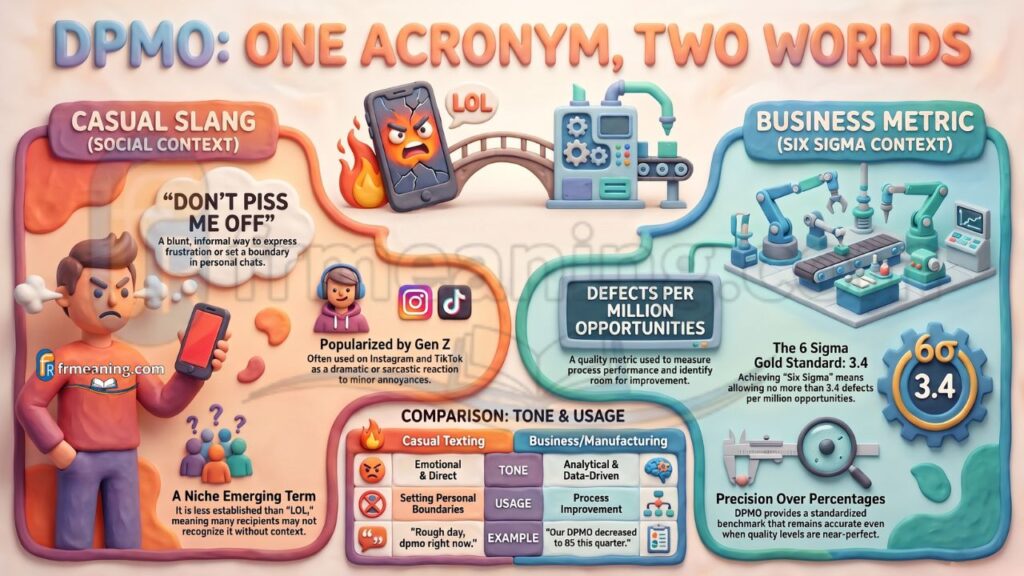
The truth is, DPMO meaning in text isn’t a one-size-fits-all answer. In casual texting, it usually stands for “Don’t Piss Me Off.”
But flip over to a business or manufacturing context, and DPMO suddenly means “Defects Per Million Opportunities,” a serious quality metric used in Six Sigma. Same four letters, completely different worlds. And honestly, mixing the two up can make for a pretty awkward conversation (imagine replying to your manager’s quality report with an eye-roll emoji).
This guide breaks down both meanings properly no fluff, no guessing so next time you see “dpmo” you’ll know exactly what’s going on.
What Does DPMO Mean in Text?
DPMO carries two distinct meanings, and figuring out which one applies really just comes down to context.
- In casual texting: DPMO stands for “Don’t Piss Me Off” — a blunt, informal way of expressing frustration or setting a boundary.
- In business: DPMO stands for “Defects Per Million Opportunities” — a quality control metric used heavily in Six Sigma methodology.
A teenager texting their friend “dpmo” is not saying the same thing as a quality manager presenting a “DPMO score” during a manufacturing review. Context determines the correct interpretation of DPMO, whether it’s slang or a business term, and that’s honestly the single most important thing to remember from this whole article.
DPMO Meaning in Text: The Slang Side
What Does DPMO Mean in Text From a Girl?
This gets asked a LOT, so let’s clear it up. When a girl (or literally anyone) texts “dpmo,” it typically means the same thing regardless of gender — “Don’t piss me off.” It’s not some secret coded message specific to one gender; it’s just informal slang used across all ages and genders in casual conversation.
The tone, though, usually depends on the relationship. Between close friends it often reads as playful or dramatic. From someone who’s clearly annoyed after a rough day? Take it a little more seriously.
DPMO Meaning Gen Z
Gen Z didn’t necessarily invent DPMO, but they’ve definitely popularized it in a whole new way. Instead of using it purely as a warning, younger users often use it as a dramatic or sarcastic reaction — almost like a meme-ified version of frustration. It’s part of a broader trend of turning full sentences into snappy, four-letter acronyms (something Gen Z absolutely loves doing across every platform).
DPMO Meaning in Text Instagram, Twitter, and Snapchat
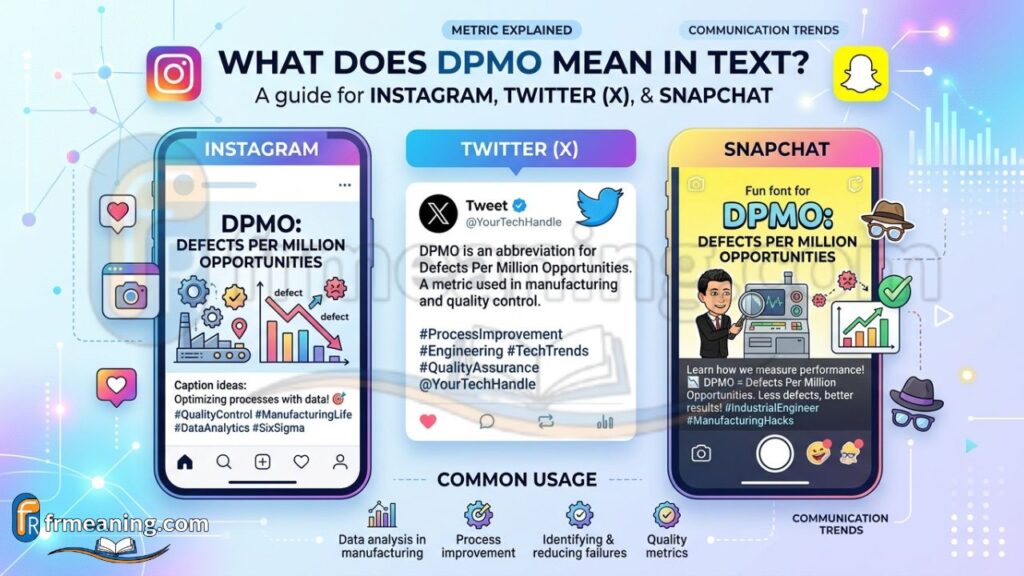
Slang doesn’t stay in one place for long, and DPMO is no exception.
- DPMO meaning in text Instagram: Often used in comment sections or captions, usually paired with a sarcastic or humorous tone rather than genuine anger.
- DPMO meaning Twitter: On Twitter (X), it tends to show up in quote-tweets or replies as a punchy reaction to something mildly annoying.
- DPMO meaning Snapchat: In private Snapchat conversations, it’s typically used more personally — like a quick “back off” to a close friend rather than a public statement.
Basically, the platform changes the audience, but the core meaning of frustration or boundary-setting stays pretty consistent.
DPMO Meaning in Text Urban Dictionary
If you go searching “DPMO” on Urban Dictionary, you’ll find entries defining it as “Don’t Piss Me Off,” though it’s worth noting this isn’t nearly as widely documented or high-traffic a term compared to slang like “LOL” or “IDK.”
It’s more of a niche, emerging abbreviation than an established internet classic which honestly explains why so many people are still confused when they first come across it. We’ll dig into this credibility gap a bit more later in the article, because most guides gloss right over it.
Origin and Background of the Slang Term
The phrase “don’t piss me off” has been part of casual spoken English for decades, showing up in movies, everyday arguments, and general street talk long before texting even existed. As texting exploded in popularity in the early 2000s, people started shortening common phrases to save time and thumb effort think LOL (laugh out loud), BRB (be right back), IDK (I don’t know). DPMO followed that exact same pattern.
Texting culture in the early 2000s popularized abbreviations like LOL, BRB, IDK, and eventually DPMO, and the trend simply carried forward onto newer platforms like TikTok and Discord where short, punchy expressions do really well. Over time, the phrase softened in a lot of friend groups too — going from a genuine warning to more of a playful, dramatic reaction used for comedic effect.
What Does DPM Mean in Text? (Don’t Confuse It With DPMO)
Quick but important detour here. “DPM” (without the O) is a totally separate abbreviation and gets confused with DPMO more often than you’d think. DPM can mean different things depending on context — sometimes it’s used for “damage per minute” in gaming communities, or occasionally as shorthand in other niche contexts entirely.
It is NOT the same as DPMO and doesn’t carry the “don’t piss me off” meaning at all. If someone sends you “dpm,” don’t assume it means the same thing — check the context of the conversation first.
What Does DP Mean in Text?
Similarly, “DP” on its own is unrelated to DPMO and has multiple meanings depending on context most commonly used as shorthand for “display picture” (profile photo) on messaging apps, or in other contexts entirely unrelated to frustration or quality metrics. The extra letters in DPMO genuinely change the whole meaning, so don’t assume they’re interchangeable just because they share a couple letters.
DPMO Meaning in Text vs Business Context
Here’s where things get interesting — because once you leave casual texting behind, DPMO becomes something entirely different and honestly way more technical.
| Aspect | Text Message Context | Business Context |
|---|---|---|
| Full Form | Don’t Piss Me Off | Defects Per Million Opportunities |
| Tone | Emotional, direct, sometimes blunt | Professional, analytical, data-driven |
| Usage | Boundaries, frustration, warnings | Quality measurement, process improvement |
| Example | “I’ve had a rough day, dpmo right now” | “Our DPMO decreased from 150 to 85 this quarter” |
DPMO and Six Sigma Explained Simply
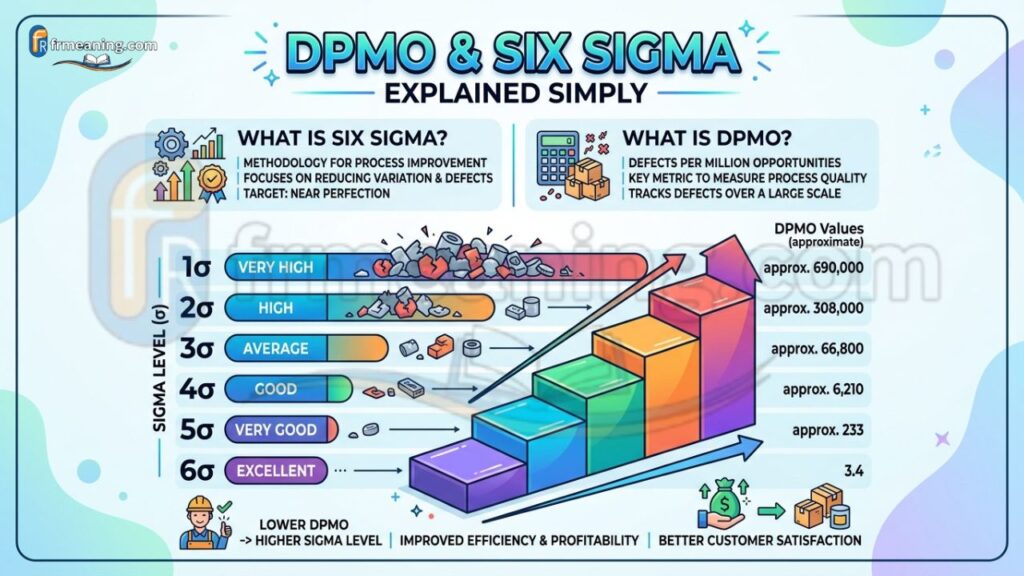
In the business world, DPMO functions as the core measurement tool within Six Sigma methodology, which is a quality management approach aimed at achieving near-perfect processes allowing no more than 3.4 defects per million opportunities. That’s an incredibly high bar, and DPMO is literally the number that tells companies whether they’re hitting it or not.
Here’s how DPMO fits into the bigger picture:
- Establishes a baseline for current process performance
- Tracks improvement (or decline) over time
- Converts directly into a Sigma level, on a 1 to 6 scale
- Helps set specific, measurable reduction targets
Six Sigma methodology also includes something called a 1.5 sigma shift, which accounts for the natural drift processes experience over long periods — because no system stays perfectly consistent forever, no matter how well it’s designed.
Why Use DPMO Instead of Just Percentages?
Great question, and it’s one a lot of people ask when they first encounter this metric. Percentages sound simple, sure, but they fall apart when quality gets really, really high.
- Greater precision: A 99.9% accuracy rate sounds amazing on paper, but it actually reveals 1,000 defects per million opportunities once converted to DPMO.
- Standardized comparison: DPMO creates a universal benchmark that works across completely different industries and processes.
- Better goal setting: Six Sigma’s target of 3.4 DPMO (99.99966% accuracy) is honestly a lot easier to track and communicate than trying to explain that same tiny percentage difference.
- Multiple opportunities recognized: DPMO accounts for the fact that a single unit might have several separate points where a defect could occur, not just one.
| Sigma Level | DPMO | Percentage |
|---|---|---|
| 1 Sigma | 690,000 | 31% |
| 3 Sigma | 66,807 | 93.32% |
| 4 Sigma | 6,210 | 99.38% |
| 6 Sigma | 3.4 | 99.99966% |
How to Calculate DPMO (Step-by-Step, With Real Examples)
The formula itself really isn’t scary at all once you break it down:
DPMO = (Number of Defects / (Number of Units × Opportunities per Unit)) × 1,000,000
Example 1: Bakery Quality Check
- Units produced: 2,000 loaves
- Defects found: 10 loaves
- Opportunities per unit: 2 (undercooking, irregular shape)
- Total opportunities = 2,000 × 2 = 4,000
- DPMO = (10 / 4,000) × 1,000,000 = 2,500
This works out to roughly a 4 Sigma quality level, which is genuinely pretty solid for a small operation.
Example 2: Software Bug Tracking
- Features tested: 500
- Bugs found: 25
- Opportunities per feature (checkpoints): 4
- Total opportunities = 500 × 4 = 2,000
- DPMO = (25 / 2,000) × 1,000,000 = 12,500
Example 3: Call Center Quality
- Calls reviewed: 1,000
- Errors logged (wrong info, dropped calls, tone issues): 8
- Opportunities per call: 3
- Total opportunities = 1,000 × 3 = 3,000
- DPMO = (8 / 3,000) × 1,000,000 ≈ 2,667
Notice how the hardest part in every single example isn’t the math — it’s figuring out what actually counts as an “opportunity” for defects in the first place. That’s the real skill here, honestly, not the arithmetic.
Filling the Gaps: What Most DPMO Guides Get Wrong
Most articles covering this topic either only explain the slang side or only explain the business side, and even then they tend to skip two things that actually matter a lot.
Is the Slang Meaning Actually Documented Anywhere Credible?
Here’s something worth being upfront about: DPMO as slang for “don’t piss me off” isn’t nearly as widely used or documented as terms like “lol” or “smh.” It shows up in some Urban Dictionary-style entries and scattered social posts, but it’s more of a niche, emerging abbreviation rather than an established, high-volume internet classic. If you search engagement or trend data around it, it’s nowhere near the scale of mainstream slang.
That doesn’t mean it’s fake or made up — people genuinely do use it — but treating it as universally recognized slang would be a bit misleading. Good communication means acknowledging that some of your friends might have literally zero idea what you mean if you text them “dpmo” out of nowhere.
Identifying “Opportunities” Correctly in DPMO Calculations
On the business side, the biggest real-world struggle isn’t the formula — it’s correctly identifying what actually counts as a distinct “opportunity” for a defect. Get this wrong, and your whole DPMO number becomes meaningless, even if the arithmetic is perfect.
A good rule of thumb: opportunities should be independent, measurable points of potential failure, not vague or overlapping categories. Companies that skip this step often end up with DPMO scores that look great on paper but don’t reflect real quality issues at all.
DPMO vs Defect Rate (PPM): Key Differences
| Aspect | DPMO | PPM Defect Rate |
|---|---|---|
| Focus | Defects per opportunities | Defective units overall |
| Complexity | Accounts for multiple defect types | Simple pass/fail measurement |
| Best Use | Complex, multi-step products | Simple, single-point products |
DPMO differs from PPM by measuring opportunities rather than defective units, which means DPMO recognizes that a single unit might have multiple separate defects, while PPM only cares whether the whole unit passed or failed.
Is Low DPMO Always Good?
In business, generally yes — but not always without nuance. Achieving extremely low DPMO can require significant investment that might outweigh the actual benefit. Context matters too: a DPMO of 1,000 might be totally fine for a handcrafted artisan product but completely unacceptable for something like prescription filling in a pharmacy. Accurate DPMO tracking also requires a stable, predictable process — if your process changes constantly, the numbers won’t mean much.
On the texting side? There’s no “good” or “bad” score, obviously — it’s purely an emotional signal, not a measurement of anything.
When Should You Use DPMO in Text?
Appropriate for casual use:
- Chatting with close friends
- Informal social media captions
- Gaming communities and Discord servers
- Private group chats with established rapport
Avoid using slang DPMO in:
- Professional emails or work Slack messages
- Conversations with authority figures or new contacts
- Public forums with a wide, unfamiliar audience
- Serious conflict-resolution conversations
Common Misunderstandings About DPMO
- “DPMO only applies to manufacturing.” Not true — it’s used across healthcare, software, admin work, and services too.
- “Lower DPMO always means a better business.” Not always; cost-benefit balance matters just as much as the raw number.
- “DPMO and PPM are the same thing.” They’re not — DPMO measures opportunities, PPM measures whole defective units.
- “You need advanced statistics to use DPMO.” Nope, it’s basic arithmetic — identifying opportunities correctly is the actual challenge.
- “The slang meaning has anything to do with the business meaning.” They’re completely unrelated despite sharing the same four letters.
Final Thoughts
At the end of the day, DPMO meaning in text really does depend entirely on where you’re seeing it. In a casual chat, it’s just someone (playfully or seriously) telling you to back off. In a business report, it’s a precise, data-driven quality metric guiding entire manufacturing and service industries. Knowing the difference isn’t just trivia — it genuinely helps you avoid awkward mix-ups, whether you’re replying to a friend’s text or presenting a quarterly quality report to your boss.
Frequently Asked Questions
What does DPMO mean in text?
It usually means “Don’t piss me off,” a casual slang expression used to signal frustration or set a boundary informally.
What do DPMO mean in text from a business perspective?
In business, DPMO means “Defects Per Million Opportunities,” a quality metric used in Six Sigma to measure process performance.
Is DPMO meaning in text urban dictionary a widely recognized term?
Not exactly — it’s documented on some slang sites but remains a niche term compared to mainstream abbreviations like LOL.
What does DP mean in text?
DP commonly stands for “display picture” or profile photo, and is completely unrelated to DPMO’s meaning.
What does DPM mean in text?
DPM without the “O” often relates to gaming terms like “damage per minute” and isn’t the same as DPMO.
Is a good DPMO score always low?
Generally yes, but context matters — extremely low scores may require costs that outweigh the quality benefit gained.
Can DPMO be used in professional writing?
Only the business meaning; the slang version should never appear in formal or workplace communication.