

If you’ve been scrolling through your DMs or group chats lately and keep running into “yk” popping up everywhere, you’re definitely not alone. Honestly, half the internet types faster than they think these days, and abbreviations like this one have basically become second nature for anyone who texts regularly.
So what exactly does yk meaning in text boil down to, and why does it show up in literally every kind of conversation from your best friend venting about her day to some random comment section on TikTok?
That’s the whole point of this guide, really. We’re gonna break down where YK came from, what it actually means in different situations, when it’s totally fine to use, and when you might wanna steer clear of it (looking at you, work emails). Let’s get into it.
What Does YK Mean? Quick Definition
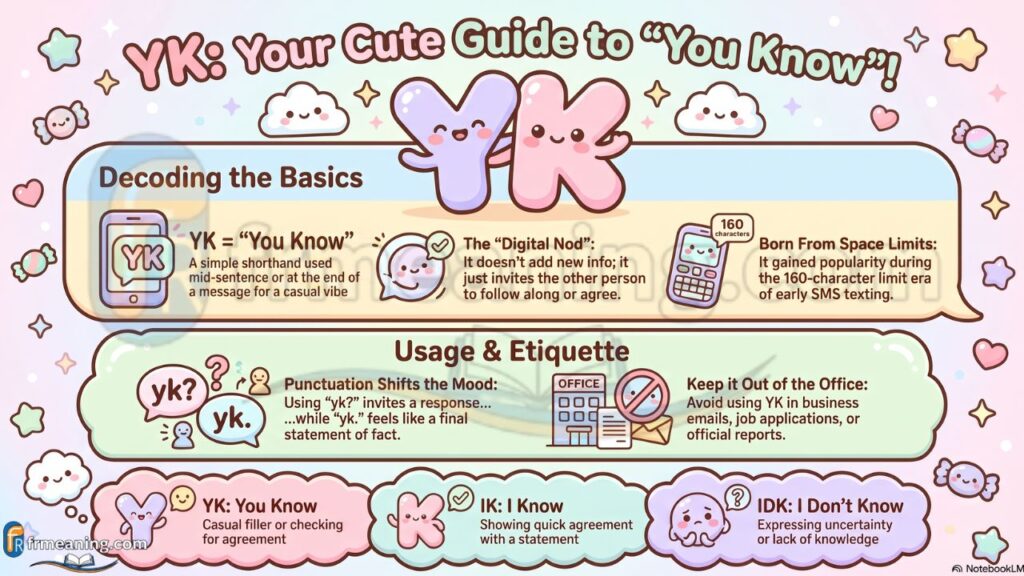
YK stands for “You Know” — plain and simple. It’s a shorthand people use mid-sentence or at the end of a message to add a casual, conversational vibe without really changing what they’re saying.
Here’s the thing though: YK doesn’t carry hidden weight most of the time. It’s less about adding new info and more about making the message feel like a real conversation instead of a formal statement. Think of it like a verbal tic that made its way into text form.
Examples:
- “I just wasn’t feeling it today, yk?”
- “That show was actually insane, yk what I mean”
- “Sometimes you just gotta let things go, yk”
In each case, the sentence would still make sense without YK. But adding it softens the tone and kinda invites the other person to nod along, even through a screen.
Where Did YK Come From? A Quick Look at Its History
The phrase “you know” isn’t new at all — people have been saying it out loud for literally centuries as a verbal filler or emphasis tool. What changed is how it got squished down for texting.
Back in the late 90s and early 2000s, when SMS first blew up, phones had those tiny number-pad keyboards and strict character limits (160 characters, remember that?). This basically forced people to get creative and start abbreviating everything. That’s when we saw the explosion of terms like:
- LOL
- BRB
- BTW
- IMO
- IDK
- YK
While abbreviations like LOL and OMG became universally recognized pretty quick, YK stayed more niche — it never fully broke into mainstream slang the same way, but it stuck around in casual texting circles because, well, it’s just quick to type and easy to understand.
As smartphones and apps like Snapchat, Discord, and Instagram took over, internet shorthand spread even wider. Nowadays people bounce between full sentences and abbreviated slang depending on who they’re texting and how relaxed the convo is.
YK Meaning in Chat: How It’s Used in Everyday Messaging
So what does yk meaning in chat actually look like in practice? Pretty much exactly what you’d expect — it shows up whenever someone wants their message to sound a little more natural and less stiff.
In regular chat apps like WhatsApp or iMessage, YK often gets tacked onto the end of a thought as a soft way of checking if the other person’s following along. It’s kind of like a digital nod.
- “Work was rough today, yk.”
- “I don’t even know how to explain it, yk?”
Context → shapes → how YK reads in chat, so pay attention to what’s being said around it before assuming anything deeper is going on.
YK Meaning in Snapchat: Does the Platform Change Anything?
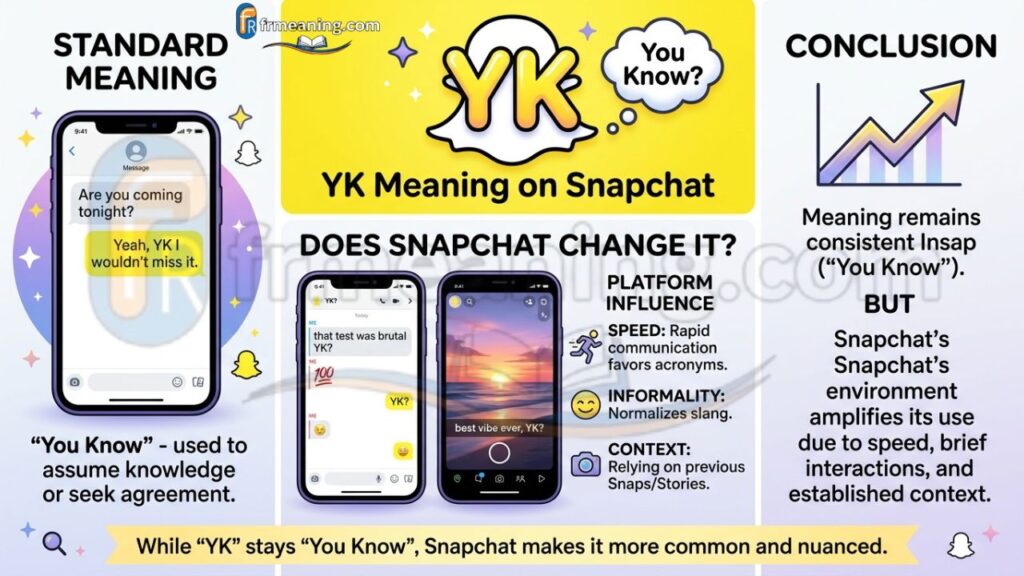
Not really — yk meaning in Snapchat functions basically the same as it does anywhere else, though the tone can feel a bit more intimate given how personal Snapchat conversations tend to be.
Since Snapchat is often used for quick, casual back-and-forths (sometimes with disappearing messages), people lean into YK even more because there’s less pressure to sound formal. You’ll see it in captions, snap replies, or even inside Snapchat stories where someone’s just thinking out loud.
Example: “This week has been a lot, yk 😅”
It’s usually harmless, just adding that relaxed, “I’m talking to a friend” energy that Snapchat culture kind of thrives on.
YK Meaning From a Girl: Does Gender Change the Interpretation?
This one gets searched a lot, so let’s clear it up. YK meaning from a girl isn’t inherently different from anyone else using it — the abbreviation itself doesn’t carry gender-specific meaning. What can differ is tone based on the relationship and context of the conversation.
If a girl texts “I like talking to you, yk?” in a flirty conversation, the YK might be inviting agreement or subtly checking for a reaction — almost like a soft way of testing the waters without being too direct. In a totally platonic conversation, though, it’s just filler, same as it would be from anyone else.
The safest approach is to always read the full message and the emotional tone of the conversation rather than assuming YK itself changes based on who’s sending it. Slang doesn’t discriminate — context does the heavy lifting here, not gender.
Common Usage Across Different Platforms and Situations
YK shows up pretty much everywhere online these days. Here’s a quick breakdown of where and how:
- Casual Texting — “I was exhausted today, yk.”
- Social Media Captions — “Summer nights just hit different yk.”
- Group Chats — “We’ve all been there, yk?”
- Gaming Chats — “That boss fight was brutal, yk.”
- Storytelling — “I wasn’t expecting that at all, yk.”
- Emotional Conversations — “It’s hard to put into words, yk.”
In basically every one of these, YK creates a relaxed, conversational tone rather than adding new information to the sentence. That’s really the throughline across every platform it appears on.
YK Meaning in Text: Urban Dictionary and Alternate Interpretations
If you go digging around YK meaning in text urban dictionary style sites, you’ll notice a few community-submitted definitions floating around beyond just “You Know.” Some entries suggest it can occasionally be used as shorthand within specific niche groups for other phrases, though these interpretations are far less common and usually only make sense within that particular community’s inside jokes.
Bottom line: unless the surrounding conversation strongly suggests otherwise, “You Know” remains the dominant and safest interpretation across nearly all mainstream platforms. Crowd-sourced slang dictionaries can be useful for spotting emerging trends, but they’re not always reliable for everyday usage since anyone can submit a definition.
Common Misconceptions About YK
A lot of confusion around YK comes from people assuming it always means something deeper than it does. Let’s clear a few things up:
- Misconception: YK always has a hidden meaning. In reality, it’s almost always just “You Know.”
- Misconception: It’s inappropriate or rude. Nope — it’s generally harmless and neutral.
- Misconception: Only teens use it. While younger users use it more, plenty of adults who are online-savvy use it too.
People also mix YK up with similar-looking abbreviations like:
- YKWIM (You Know What I Mean)
- YW (You’re Welcome)
- IK (I Know)
- IDK (I Don’t Know)
These all look kinda similar at a glance but serve totally different purposes, so it’s worth knowing the difference before you reply to something incorrectly.
The Nuance Nobody Talks About: Capitalization, Punctuation, and Tone
Here’s something most guides on this topic totally skip over — how YK is typed can subtly shift its emotional weight.
- Lowercase “yk” at the end of a casual sentence usually reads as relaxed and low-stakes. “I miss that place, yk.”
- Capitalized “YK” can sometimes come across as more emphatic or blunt, especially in all-caps messages, since capital letters online often signal intensity.
- “yk?” with a question mark functions almost like a soft request for agreement — it’s inviting a response, not just adding filler.
- “yk.” with a period tends to read more like a statement of fact, almost final, like the person’s closing the thought rather than opening it up for discussion.
This distinction matters more than people realize. Punctuation → changes → the emotional undertone of YK, even though the core meaning technically stays the same.
When YK Becomes Passive-Aggressive or Loaded
This is honestly one of the most overlooked parts of understanding YK. While it’s marketed as a totally neutral filler word, it can absolutely carry an edge depending on how it’s deployed.
Think about a message like: “I mean, I told you already, yk?” That “yk?” at the end isn’t just casual — it’s subtly implying the other person should already understand, almost like a gentle jab. It can function as a way of avoiding fully spelling something out while still applying a bit of social pressure to agree.
Similarly, in tense or emotionally charged conversations, YK can be used to soften criticism without actually softening the point being made. “You always do this, yk” hits differently than “You always do this.” The YK doesn’t remove the sting — it just wraps it in a more conversational package.
Takeaway: don’t assume YK is always harmless just because it usually is. Pay attention to tone, punctuation, and what’s being said right before or after it.
How to Respond When Someone Uses YK
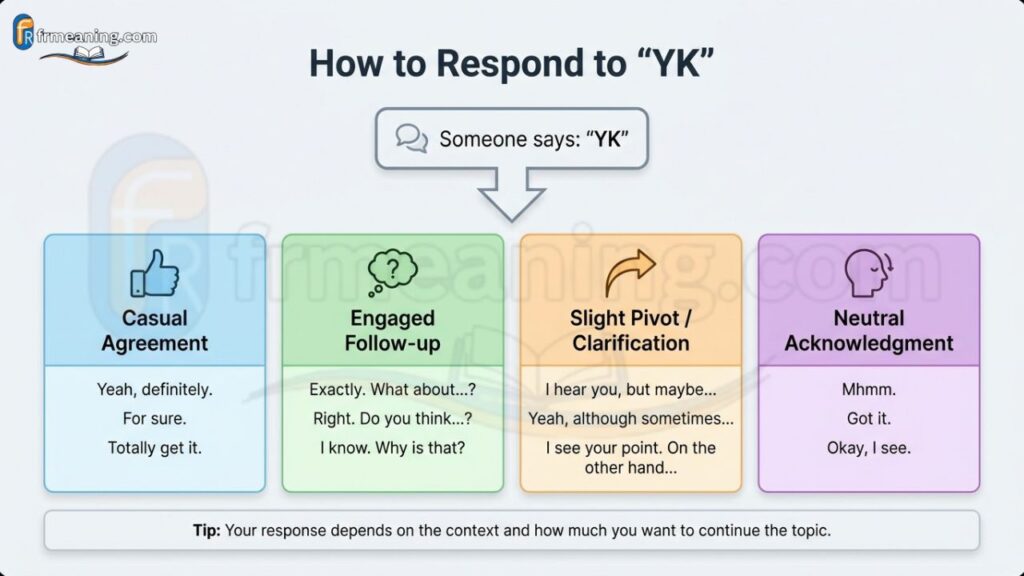
Responding to YK doesn’t require anything fancy since it’s not really asking a direct question most of the time.
If someone texts: “I’ve been so busy lately, yk.”
You could reply with:
- “Yeah, totally get it.”
- “Same here honestly.”
- “I know exactly what you mean.”
If the meaning genuinely feels unclear, it’s completely fine to just ask. Something like “wait, did you mean you know, or something else?” clears up confusion way faster than guessing wrong.
Regional and Cultural Differences in YK Usage
YK is widely understood across English-speaking online spaces, though usage does vary a bit by region.
| Region | Common Usage |
|---|---|
| North America | Very common among teens and young adults in texting |
| UK / Australia / Canada | Recognized, though full phrasing is sometimes preferred |
| Non-native English speakers | Often picked up through online chatting rather than formal lessons |
Since internet culture doesn’t really respect borders, slang like YK ends up spreading internationally pretty fast, even in places where it’s not part of everyday spoken English.
YK vs. Similar Abbreviations: A Quick Comparison
| Term | Meaning | Typical Use |
|---|---|---|
| YK | You Know | Casual texting |
| IDK | I Don’t Know | Expressing uncertainty |
| IK | I Know | Showing agreement |
| IYKYK | If You Know, You Know | Inside jokes |
| IMO | In My Opinion | Sharing opinions |
| TBH | To Be Honest | Giving honest thoughts |
JK Meaning: Don’t Confuse It With YK
Quick clarification since these two get mixed up constantly — JK meaning stands for “Just Kidding,” and it’s used to signal that a previous statement wasn’t meant seriously. It’s completely different from YK in purpose.
Example: “You’re the worst cook ever, jk love your food.”
JK → cancels or softens → the statement before it, while YK just adds conversational tone without negating anything.
YH Meaning: Another Common Mix-Up
Another term people often confuse with YK is YH, which simply means “Yeah.” It’s used as a quick, casual way of agreeing with something, similar to texting “yep” or “yes.”
Example: “You coming tonight?” — “yh, be there in 10.”
While YK and YH look kinda similar at a glance, they serve totally different grammatical roles — YH is a direct answer, while YK is more of a conversational add-on.
Is YK Appropriate for Professional Communication?
Short answer: no, not really. While YK works fine in casual texting, it doesn’t belong in formal writing.
Avoid using it in:
- Business emails
- Job applications
- Academic essays
- Official reports
- Customer service messages
- Professional presentations
Instead, spell out the full phrase — “you know” — or just remove it if it’s not adding anything meaningful. Professional communication → prioritizes → clarity over casual speed, so save the abbreviations for friends and group chats.
Frequently Asked Questions
What does YK mean in text?
YK usually means “You Know,” used casually to make a message sound more relaxed and conversational rather than formal.
Is YK considered slang?
Yes, it’s an internet abbreviation commonly used across texting apps and social media platforms among casual conversations.
Can YK mean something other than “You Know”?
Occasionally, small communities use it differently, but “You Know” remains by far the most common and widely accepted meaning.
Is YK rude or offensive in any way?
No, it’s generally harmless and neutral, though tone and punctuation can occasionally make it feel slightly loaded.
What’s the difference between YK and JK?
YK means “You Know” and adds conversational tone, while JK means “Just Kidding” and cancels a prior statement.
Should I use YK in work emails?
No, professional writing should use full phrases like “you know” instead of casual abbreviations like YK.
Does YK mean something different on Snapchat?
Not really, YK functions the same on Snapchat as elsewhere, though the tone often feels more personal and casual.