
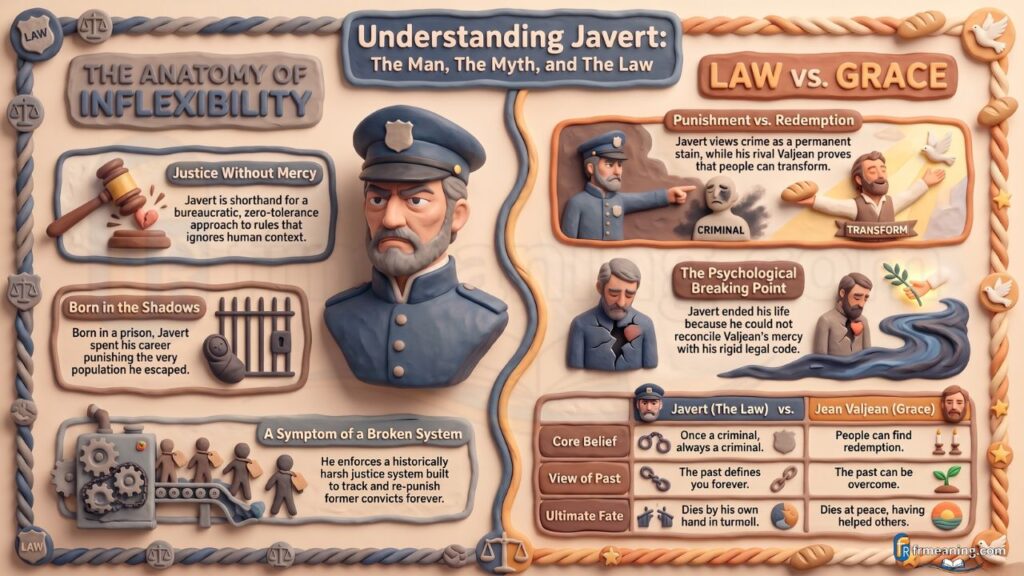

Ever wonder why one fictional cop still gets people talking almost 160 years after he was written? That’s the real javert meaning question — not just “who is he,” but why he refuses to leave our heads. If you typed in “javert meaning” hoping for a quick definition, here it is: Javert is the rigid, duty-obsessed police inspector from Victor Hugo’s Les Misérables, and he’s become shorthand for justice that has no room left for mercy.
This guide goes further than most of the surface-level explainers out there. We’ll cover the javert definition, his pronunciation, his French roots, his psychology, his real historical backdrop, and why he still shows up in conversations about zero-tolerance rules today. No fluff, just the stuff that actually answers your question.
Who Is Javert? (Quick Definition)
In one line: Javert is the police inspector antagonist in Victor Hugo’s 1862 novel Les Misérables, known for chasing ex-convict Jean Valjean for nearly two decades out of an unbending belief in the law.
He isn’t evil in the cartoon-villain sense — he doesn’t steal, lie, or hurt people for fun. He’s obsessive, sure, but it’s an obsession with order, not cruelty. That distinction matters a lot when people try to define Javert, because a lot of casual readers lump him in with straightforward “bad guys,” and honestly that’s just not accurate.
Quick reference:
| Attribute | Detail |
|---|---|
| Creator | Victor Hugo |
| First appearance | Les Misérables (1862) |
| Javert inspector role | Police officer, primary antagonist |
| Born | Inside a prison |
| Core trait | Moral rigidity |
| Famous end | Suicide by drowning in the Seine River |
| Best known adaptation | Les Misérables stage musical (1980, English 1985) |
Javert Meaning in English, French, and Slang
Javert Meaning in English
In everyday English usage now, “a Javert” or “being Javert-like” describes someone who enforces rules so strictly that they lose sight of the human cost. It’s basically become an insult for bureaucratic cruelty — think of the manager who writes someone up for clocking in ninety seconds late even though the bus was delayed. That’s the modern, colloquial javert meaning in english, separate from the literal character.
Javert Meaning in French
There’s no confirmed javert meaning in french because Hugo most likely invented the surname rather than borrowing an existing word. That said, French scholars have floated a few candidates:
- J’avertis — “I warn” or “I inform,” which fits since Javert spends his whole life warning people that the law is coming for them.
- Javertir, an old and mostly forgotten verb meaning “to turn aside,” which also fits — the guy turns away from mercy at basically every opportunity.
- Javart, an old veterinary term for a tumor on a horse’s leg — a darker theory, suggesting Hugo saw his inspector as something that grows inside a system and slowly damages it.
None of these are confirmed by Hugo himself in any surviving letters, so treat them as educated guesses rather than settled fact.
Javert Pronunciation
For anyone stumbling over it out loud, the correct javert pronunciation is roughly “zha-VAIR,” with a soft French “j” sound (like the “s” in “measure”) and the stress landing on the second syllable. English speakers often default to “juh-VERT,” which isn’t technically right but gets understood fine in casual conversation.
Javert Description and Character Profile
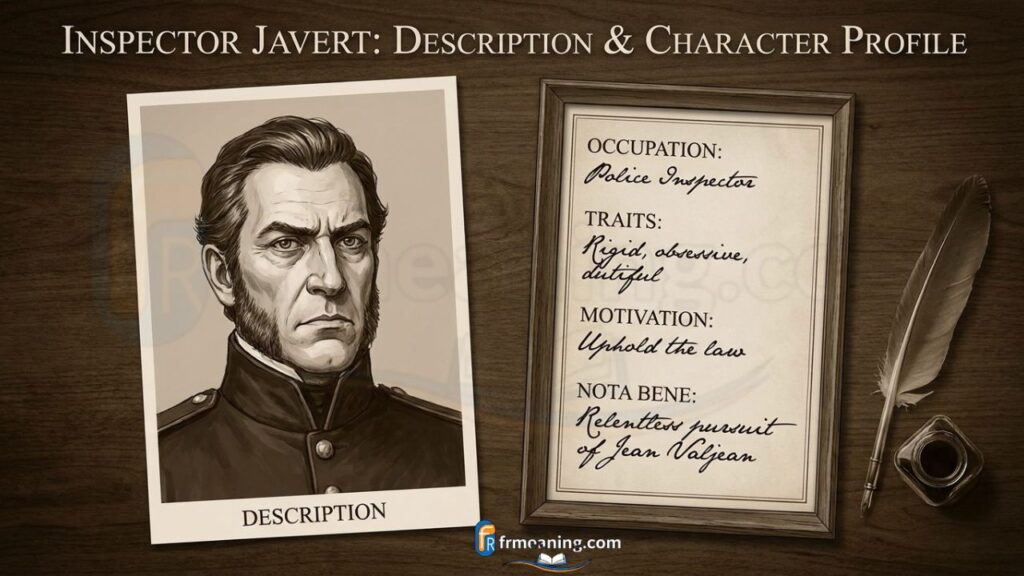
A basic javert description: he’s an older man, somewhere in his fifties or sixties by the time most of the novel plays out, tall, humorless, and almost mechanically disciplined. He sleeps in barracks, eats alone, and — according to Hugo — almost never laughs or cries.
Core personality traits, if you want the shorthand:
- Inflexible — his opinions basically never shift until the very last chapters.
- Self-righteous — he genuinely believes God assigned him to be a policeman.
- Duty-bound — eighteen-hour workdays were normal for him.
- Emotionally shut down — he rarely, if ever, expresses feeling.
- Uncomfortable with gray areas — a “good criminal” is a concept his brain can’t process.
His moral code fits in a single sentence: once a criminal, always a criminal. Full stop, no exceptions, no nuance.
Javert Inspector: Role and Origins in Les Misérables
Javert’s job as inspector is what defines him more than anything else — strip the badge away and there’s honestly not much character left underneath. He was born inside a prison (his mother told fortunes, his father was a galley slave), which is a detail Hugo clearly used on purpose. Javert grows up surrounded by the very population he later spends his career punishing, and that irony sits at the center of who he becomes.
Jean Valjean’s mercy toward Javert → causes → Javert’s eventual psychological collapse. That single relationship — the chase, the near-misses, the barricade scene where Valjean spares his life — is really the engine of the whole novel’s second half.
The Historical and Legal World Behind Javert (What Most Explainers Skip)
Here’s a gap a lot of quick-answer articles gloss right over: the actual French justice system Javert operated inside.
Hugo set the novel in post-Napoleonic France, roughly the 1810s through the 1830s. Former convicts weren’t just released and forgotten — they carried what was called a passeport jaune, a yellow passport that marked them as ex-convicts wherever they went. Employers, innkeepers, and townspeople could refuse them work or shelter just by checking that document. Jean Valjean’s early struggles after prison weren’t dramatic exaggeration; that was standard treatment for parolees at the time.
The penal system also relied heavily on the bagne, brutal forced-labor prisons where convicts served extended sentences for what we’d consider minor theft today (Valjean’s original crime — stealing bread — earned him five years, extended to nineteen after failed escape attempts). Javert, as an inspector, would have operated within this exact framework: a system built to track, flag, and re-punish people long after their official sentence ended.
Understanding this backdrop honestly changes how you read Javert. He’s not applying some abstract, timeless notion of “the law.” He’s enforcing a specific, historically harsh, and — in Hugo’s clear opinion — deeply unjust legal machine. That context is what makes Hugo’s critique land as social commentary rather than just character drama.
Javert Meaning in Les Mis: Symbolism Explained
What does Javert actually represent in Les Misérables? Ask ten professors and you’ll probably get ten slightly different phrasings, but they circle the same core idea: Javert symbolizes law without mercy and order without humanity.
A few ways this shows up:
- Legalism — he follows the letter of the law while completely missing its spirit.
- Authority as identity — take away his title and there’s nothing left underneath.
- Punishment as the only available tool — mercy reads to him as corruption.
- Conscience failure — for most of the story he feels zero internal conflict about the harm he causes.
Hugo wrote Les Misérables partly as a protest against France’s harsh justice system, and Javert was his warning made flesh — not a monster exactly, more like a symptom of something bigger and broken.
Javert vs Jean Valjean: Law Versus Grace
This isn’t really a good-versus-evil setup, even though it’s often framed that way in summaries. The real conflict is law versus grace.
| Javert | Jean Valjean |
|---|---|
| The law | Mercy |
| Punishment | Redemption |
| Believes the past defines you forever | Believes people can transform |
| Hunts others | Helps others |
| Dies by his own hand | Dies at peace |
| Sees crime as a permanent stain | Sees crime as a symptom of poverty |
Both men were born into hard circumstances. Both lived outside polite society for years. But Jean Valjean’s transformation → proves to Hugo’s readers → that redemption is possible, while Javert’s rigidity proves the opposite — that some systems just refuse to see it, even when the proof is standing right in front of them.
Why Does Javert Kill Himself?
Short answer: Javert can’t hold two contradictory truths in his head at once, so he removes himself rather than choose.
Truth one — Valjean is legally a criminal who, by Javert’s own code, belongs in prison. Truth two — Valjean just saved Javert’s life at the barricade, cutting him loose when revolutionaries were about to execute him. If Javert arrests Valjean, he betrays his own conscience. If he lets him go, he betrays everything he’s built his identity around. So instead he walks to the Seine River and jumps.
Javert’s rigid worldview → collapses under → the weight of Valjean’s mercy, and that collapse is really the whole tragedy in miniature. It’s not cowardice and it’s not some sudden mental break out of nowhere — it’s a logical mind finally hitting a wall with no door in it.
Javert in Adaptations: Movie Versions Compared
Javert Movie Casting Through the Years
Different javert movie portrayals lean into different sides of the character:
- Charles Laughton (1935) — arguably the most sympathetic take, you almost feel bad for the guy by the end.
- Geoffrey Rush (1998) — cold, precise, almost reptilian in his stillness.
- Russell Crowe (2012) — plays him as someone already cracking on the inside well before the Seine scene.
The stage musical version (which most people know best) tends to be a bit younger and more theatrical than the novel’s Javert, who reads as older and colder on the page.
Clouseau Javert? Clearing Up a Common Mix-Up
A fair number of people search “clouseau javert” because they’re mixing up two totally unrelated fictional inspectors. Inspector Clouseau is the bumbling, comically incompetent detective from the Pink Panther films — basically Javert’s total opposite in tone. Clouseau is played for laughs; Javert is played for tragedy. Both share the job title “inspector,” and honestly that’s about where the similarity ends.
Javert’s Psychological Profile
If you tried to diagnose Javert from a modern clinical lens, a few patterns jump out:
- Obsessive-compulsive personality disorder (OCPD) — rigid, perfectionistic, order-obsessed, but without the intrusive thoughts or rituals of clinical OCD.
- Alexithymia — real difficulty naming or describing his own emotions.
- Moral scrupulosity — an obsessive fear of being immoral by the law’s own standard.
- Reaction formation — psychologically speaking, he may fight so hard against criminality because of how close he grew up to it.
He’s not narcissistic in the clinical sense, to be clear — narcissists want admiration, and Javert doesn’t seem to want that at all. He wants compliance, from himself most of all.
The Etymology Debate: Where Did Hugo Get the Name?
We touched on the three leading theories earlier, but it’s worth being upfront about something most quick explainers don’t mention: there’s no surviving letter or manuscript note from Hugo confirming any single origin for the name. Everything floating around online is scholarly speculation, some more convincing than others.
For comparison, Hugo’s other character names carry clearer intent — “Valjean” echoes voilà Jean (“there’s Jean”), and “Thénardier” has been linked to regional French place names. Against that backdrop, Javert stands out as one of the more genuinely mysterious names in the book, which is probably part of why it’s stuck with readers this long. A name that resists a tidy translation tends to age well.
Why Javert Still Matters Today
Fast forward to 2026 and you’ll still spot Javert everywhere, honestly:
- Zero-tolerance school policies — a kid brings a butter knife to slice an apple, gets suspended for a year, no room for context.
- Three-strikes sentencing laws — minor repeat offenses stacking into decades-long sentences.
- Bureaucratic cruelty — benefit offices, landlords, and hospitals that punish over a single missed form or late payment.
Hugo’s underlying question was simple: at what point does protecting order just become cruelty dressed up as principle? Javert never once asks himself that question, and that — more than the badge, more than the chase — is really his defining flaw.
FAQs
What is the javert meaning in simple terms?
Javert means rigid law enforcement with zero mercy — someone who follows rules so strictly they lose sight of basic humanity.
What is the correct javert pronunciation?
Roughly “zha-VAIR,” with a soft French “j” and stress on the second syllable, though “juh-VERT” is commonly understood too.
Is there a real javert meaning in french?
No confirmed one exists; Hugo likely invented the name, with theories tracing it to j’avertis (“I warn”) or javertir (“to turn aside”).
Why does Javert kill himself?
He can’t reconcile Valjean’s mercy with his lifelong belief that criminals never change, so he jumps into the Seine River.
Is Javert a villain or hero?
Neither — he’s a tragic antagonist who never lies, steals, or enjoys cruelty, but still causes real harm through blind duty.
Is there a connection between Clouseau and Javert?
Not really; Clouseau is a comic, bumbling detective from Pink Panther, while Javert is a tragic, deadly serious inspector from Les Misérables.
What does the javert inspector represent symbolically?
He represents law without mercy, order without humanity, and the danger of a justice system with no room for redemption.