
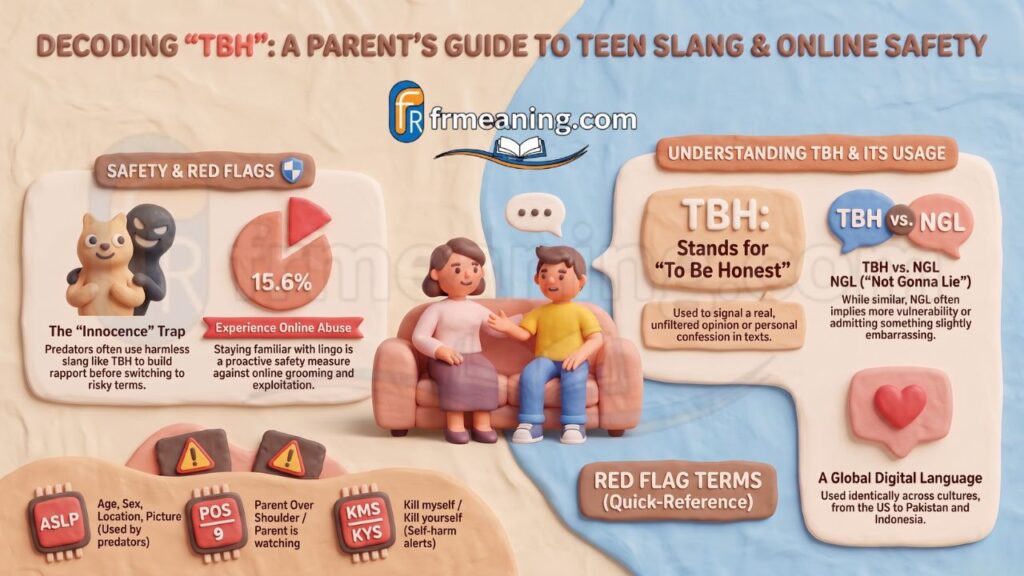

If you’ve scrolled through your teen’s Instagram comments or Snapchat chats and spotted the letters “TBH” popping up everywhere, your not alone in wondering what it actually means. TBH stands for “to be honest,” and it’s one of the most widely used pieces of internet slang across social media today.
But here’s the thing this simple three-letter abbreviation has a history, multiple contexts, and honestly, a few hidden layers that most parents (and even some teens) don’t fully understand.
In this guide, we’ll break down everything from its origin to how it’s used differently on Instagram vs Snapchat, what it means when a guy or girl texts it to you, and why it’s important to understand internet slang in general to keep your family safe online.
How Is TBH Used?
TBH is used to signal honesty or frankness, usually placed at the start or end of a sentence. Someone might text “TBH, I don’t really like that show” or “That movie was mid, TBH.” Its a filler phrase that basically tells the reader, “what I’m about to say is my real, unfiltered opinion.”
According to Google Trends data, the earliest Urban Dictionary entry for TBH dates back to the early 2000s, though the term didn’t really explode in popularity until around 2011. Since then, it has become a staple across nearly every major platform, including Facebook, Instagram, Snapchat, X (formerly Twitter), and WhatsApp. You’ll see it written in all caps or lowercase (“tbh”) — both are grammatically fine in casual texting culture.
TBH Meaning on Instagram
On Instagram, TBH is often dropped into captions, comments, or Story replies to express a candid thought. For example, a caption might read: “TBH, this is my favorite outfit I’ve worn all year.”
Back around 2015-2017, Instagram also had a specific trend where users would post “Like and comment for a TBH,” and once someone engaged, the original poster would visit their profile and leave an honest compliment. This trend has mostly faded, but TBH itself stuck around as a general honesty marker.
TBH Meaning on Snapchat
On Snapchat, TBH functions pretty much the same way — teens use it in snaps or chat to preface an honest opinion, compliment, or even a mild criticism. Its less about a specific “trend” on Snapchat and more just baked into everyday texting shorthand between friends.
TBH vs NGL: What’s the Difference?
A lot of parents get confused between TBH and NGL (“not gonna lie”) because they’re used almost interchangeably. Technically, TBH → introduces → an honest statement, while NGL → admits → something the speaker might be slightly hesitant or embarrassed to say. So “NGL, I cried during that movie” carries a bit more vulnerability than a plain TBH statement. In practice though, teens swap these two phrases constantly and the distinction is pretty minor.
TBH Meaning in Relationships and Texting
When TBH shows up in a romantic or relationship context, it usually signals that someone wants to share real feelings without sugar-coating them. A text like “TBH, I really like you” or “TBH I miss you” carries emotional weight because the sender is flagging that this isn’t just small talk — it’s their genuine truth.
TBH Meaning From a Guy vs From a Girl
There isn’t really a gender-specific definition of TBH — the meaning stays the same whether it comes from a guy or a girl. That said, context matters a lot. TBH meaning from a guy in a flirty conversation often signals he’s building up courage to say something honest (a compliment, an admission of feelings, or even a complaint).
TBH meaning from a girl works the same way — it’s a verbal cue that she’s about to say something real, whether that’s affectionate or blunt. The tone of the rest of the message is what determines whether it’s romantic, friendly, or even a little bit of a red flag warning that criticism is coming.
TBH in Other Languages and Regions
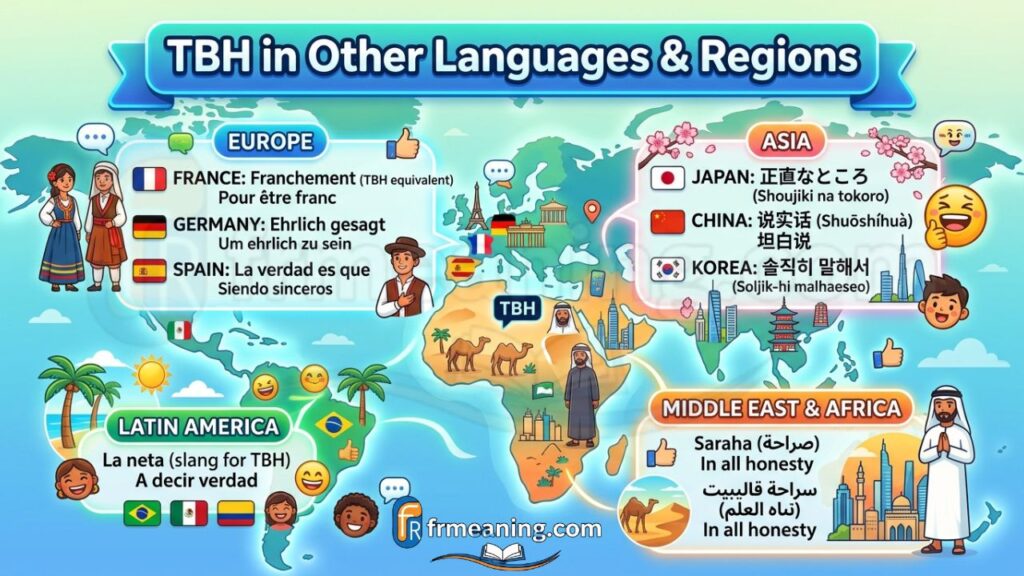
English internet slang doesn’t stay confined to English-speaking countries — it spreads globally, often blending with local languages.
TBH Meaning in Urdu and TBH in Pakistan
In Pakistan, and among Urdu-speaking youth generally, TBH is used almost identically to how it’s used in the US or UK teens simply borrow the English abbreviation rather than translating it.
So “TBH meaning in Urdu” essentially still means “sach kahun toh” (translated loosely as “to tell the truth”), but younger generations texting in Roman Urdu or English-Urdu mix will just type “TBH” directly instead of writing it out. It’s become part of everyday Pakistani youth texting culture on WhatsApp and Instagram, same as anywhere else.
TBH Singkatan Dari / Arti TBH Dalam Bahasa Gaul (Indonesian Slang)
For Indonesian audiences searching “tbh singkatan dari” or “arti tbh bahasa gaul” TBH singkatan dari “to be honest,” and in bahasa gaul (Indonesian slang), it’s used the exact same way as in English: to preface an honest opinion. So “TBH artinya” is simply “sejujurnya” or “jujur aja.” Indonesian teens have fully adopted this English acronym into their own slang vocabulary, proving just how far internet culture travels beyond its country of origin.
Origins of TBH and Other Online Slang
Online slang originates from text message culture, social media, online gaming, and internet forums — and TBH is a textbook example. Before smartphones had full keyboards, people typed messages using multi-tap texting, where each number key represented three or four letters. This was slow and clunky, and combined with character limits on early platforms, it pushed people toward abbreviations like TBH, LOL, and BRB just to save time and thumb effort.
Slang isn’t new, obviously every generation has had it’s own version. What’s different now is that digital slang spreads instantly and globally, thanks to influencers, memes, and viral trends. Pop culture → heavily influences → the spread of internet slang, which is why it’s worth keeping an eye on which influencers, musicians, or TikTok creators your teenager follows, since that content often shapes the language they pick up.
Internet Slang You Should Know: The Good and the Bad
TBH is really just the tip of the iceberg. Teens use dozens of abbreviations daily, and while most are harmless, some are genuinely worth knowing about as a parent.
Common Everyday Slang Terms
Here’s a quick reference table of popular (mostly harmless) slang terms teens use regularly:
| Slang Term | Meaning |
|---|---|
| Bae | “Before anyone else” — a term of endearment |
| Cap / No cap | To lie / to be truthful |
| Delulu | Delusional |
| Fire | Really cool or amazing |
| FOMO | Fear of missing out |
| Ghost | To purposely ignore someone |
| Lowkey | To express something without much intensity |
| Mid | Unimpressive or mediocre |
| NGL | “Not gonna lie” |
| Slay | To succeed or do something impressively well |
Red Flag Slang Terms Parents Should Watch For
Not all slang is innocent, though, and this is where things get more serious. Some terms are used specifically to hide risky or even dangerous behavior online.
| Red Flag Term | Meaning |
|---|---|
| ASLP | “Age, sex, location, picture” — often used by predators |
| CU46 | “See you for sex” |
| GNOC | “Get naked on camera” |
| KMS / KYS | “Kill myself” / “Kill yourself” |
| POS | “Parent over shoulder” |
| Sneaky link | Someone you’re secretly hooking up with |
| 9 / 99 | Code for “parent watching” / “parents are gone” |
Decoding Real Conversations: Where Innocent Slang Meets Red Flags
Here’s something most articles skip over: predators and troubled teens rarely use only “dangerous” slang — they blend it with completely normal phrases like TBH to keep conversations looking innocent to any adult glancing over their shoulder. This is honestly one of the trickiest parts for parents to catch.
For example, a conversation might look totally fine on the surface:
“TBH you seem really mature for your age 😊” “aw thanks, ngl that means a lot” “ASLP? just curious lol” “17, girl, [location]”
See how the TBH and NGL at the start make the exchange feel casual and friendly? That’s intentional — online predators → exploit → familiar teen slang → to build trust and lower suspicion, before sliding into more invasive questions like ASLP.
\If your teen ever mentions a “9” or “POS” in the middle of texting you back slower than usual, that could be a subtle signal that someone else can see the conversation and they’re trying to hide it.
The lesson here isn’t to panic every time you see TBH — it’s genuinely one of the most harmless terms out there. But context is everything, and it’s worth teaching teens to recognize when a “TBH” compliment is followed by increasingly personal or inappropriate questions.
Potential Problems With Online Slang
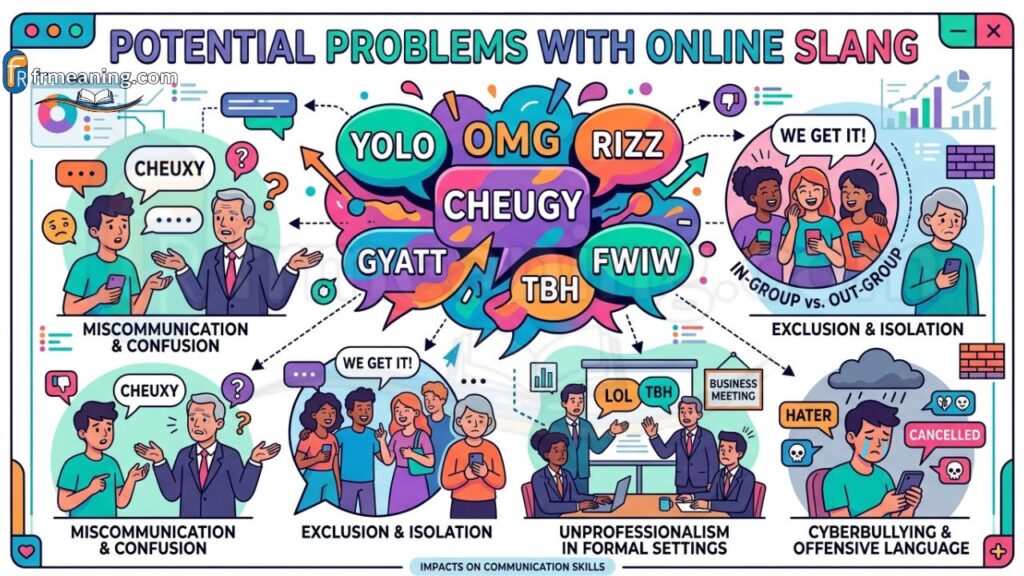
Slang itself isn’t inherently harmful, but it does play a role in two major online risks: cyberbullying and predator contact.
Cyberbullying
Recent statistics from the Cyberbullying Research Center show that around 33% of students reported being cyberbullied within just the last 30 days, and nearly 16% said they’d been called mean names online. About 60% of students who experienced cyberbullying said it directly affected how safe they felt at school. Cyberbullying → correlates with → a reduced sense of safety, both online and in person, which is honestly a pretty alarming stat for any parent to sit with.
To be fair, terms like TBH aren’t inherently part of the problem — its really about how kids use language toward one another, not the abbreviations themselves.
Online Predators
Online predators have gotten pretty savvy about adopting teen slang to build rapport and blend in. A survey from the Crimes Against Children Research Center found that roughly 15.6% of participants experienced some form of online child sexual abuse before turning 18. That’s a sobering number, and it underscores why staying familiar with teen slang and internet lingo isn’t just about “keeping up” — it’s a genuine safety measure.
Online Slang: Tips for Parents
Knowing the lingo is only half the battle. Here’s what actually helps in practice:
- Monitor devices — do occasional spot checks on phones, tablets, and shared family computers.
- Talk about sexting — explain both the emotional and legal risks involved.
- Teach digital skills proactively — don’t assume kids already know how to handle online conflict or strangers.
- Discuss stranger danger online — the same rules that apply in real life apply to DMs and chat apps too.
- Set up parental controls — limit screen time and restrict access where needed.
- Have open conversations about cyberbullying — make sure they know how to report or block someone.
- Stay current on slang — bookmark sites like Urban Dictionary or Urban Thesaurus, or just ask your kids directly (most of them don’t mind explaining, honestly).
Using trusted antivirus and parental control software alongside these conversations gives families an extra layer of protection, especially for younger teens who are still learning to navigate online spaces safely.
FAQ: Common Questions About TBH
What does TBH stand for?
TBH stands for “to be honest,” a common abbreviation used in texting and on social media to express genuine opinions.
What does TBH mean on Instagram?
On Instagram, TBH means “to be honest” and is used in captions, comments, or Stories to share candid thoughts or compliments.
What’s the difference between TBH and NGL?
TBH introduces an honest statement; NGL (“not gonna lie”) admits something slightly more personal or hard to say.
What does TBH mean from a guy or girl in texting?
The meaning doesn’t change by gender — it signals the sender is about to share a genuine, unfiltered thought or feeling.
Where did TBH originate?
TBH originated from early 2000s internet slang, gaining major popularity around 2011 through platforms like Instagram and Twitter.
Is TBH used in cyberbullying?
Not inherently — TBH is neutral and can be positive or negative depending entirely on the context of the message.
What does TBH mean in Urdu or in Pakistan?
In Pakistan, TBH is used the same as in English, borrowed directly into Roman Urdu texting to mean “sach kahun toh” (honestly).