

You get a text back that just says “lol” and now you’re sitting there wondering… did they actually laugh? Or are they being sarcastic? Or do they just not care enough to type more?
If you’ve ever paused mid-conversation to ask what does lol mean in a text, you’re definitely not alone this three-letter combo is one of the most used and most misunderstood pieces of texting shorthand out there.
This guide breaks down every meaning, every context, and every weird variation so you never have to guess again.
What Does LOL Stand For?
LOL stands for “laughing out loud” (sometimes written as “laugh out loud”), and it’s recognized officially by the Oxford English Dictionary as a way to express amusement. It can be pronounced letter by letter (“el oh el”) or read as a single word (“lawl”), depending on who you’re talking to.
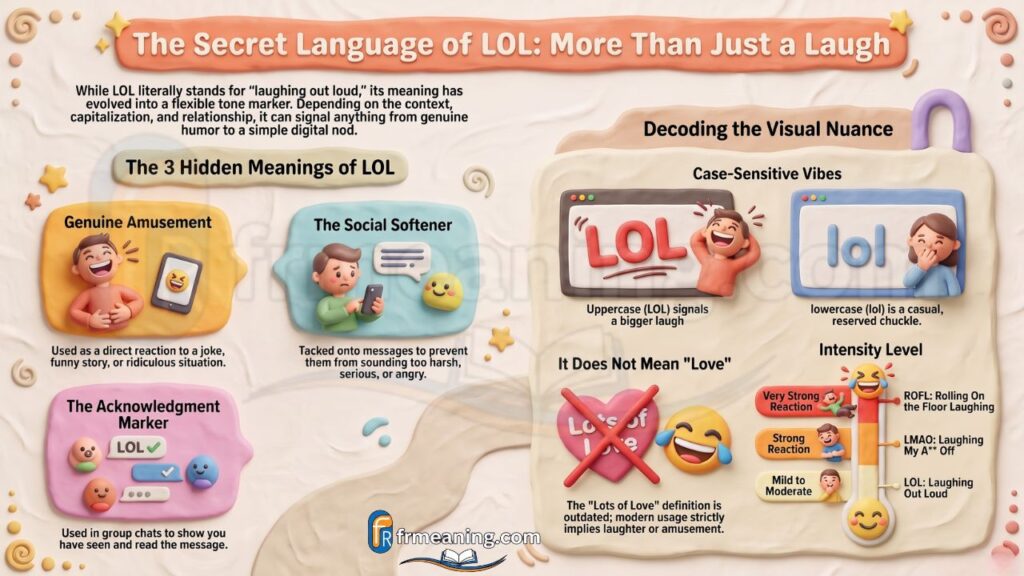
A lot of people don’t realize this, but LOL used to have other meanings too. Older generations, especially folks who weren’t super into texting culture, sometimes used it to mean “lots of love” or “lots of luck.” That usage has mostly died out though, so if you see LOL in a text today, its almost always safe to assume the sender means laughing out loud — not love, not luck.
LOL Meaning in Text: Breaking Down the Basics
The lol meaning in text isn’t fixed — it shifts depending on who’s sending it, where it lands in the message, and what it’s replying to. This is honestly the biggest source of confusion people have. Texting your best friend “LOL” and texting your coworker “lol” can mean two completely different things, even though the letters are identical.
Here’s the semantic relationship worth remembering: context → determines → LOL’s actual meaning. It’s not a fixed-definition word anymore, it’s more like a tone marker that bends to fit the conversation around it.
The 4 Main Ways LOL Meaning in Chat Changes Based on Context
Laughing at Something Genuinely Funny
This is the most straightforward use — someone sends something amusing, and LOL is the reaction. The lol meaning in text funny context usually shows up right after a joke, a funny story, or something ridiculous that happened during the day. Uppercase “LOL” tends to signal a bigger laugh, while lowercase “lol” usually means a smaller, more casual chuckle. It’s a small detail but it matters more than people think.
Indicating Sarcasm
LOL doesn’t always mean someone’s laughing — sometimes it’s doing the opposite job, signaling that the sender means the reverse of what they just typed. Sarcasm → is signaled by → LOL placement (either before or after the sarcastic line). For example, “Can’t wait! lol” after hearing unwanted news is a classic sarcastic use, not a genuine expression of excitement.
Showing Lightheartedness or Unseriousness
Sometimes LOL gets tacked onto a message just to soften the tone. If someone says “I’m so dumb lol,” they’re not actually laughing — they’re using LOL to keep the comment from sounding too harsh or too serious. This is super common in casual venting texts among friends.
Demonstrating Presence or Acknowledgment
Here’s one people miss a lot: LOL by itself, with nothing else attached, often just means “I saw your message and I’m still here.” It’s an acknowledgment marker, not a laughter marker. Think group chats where someone drops a wild update and everyone just replies “lol” — nobody’s necessarily cracking up, they’re just acknowledging they read it.
Lol Ppl Meaning: How Different Groups Use LOL Differently
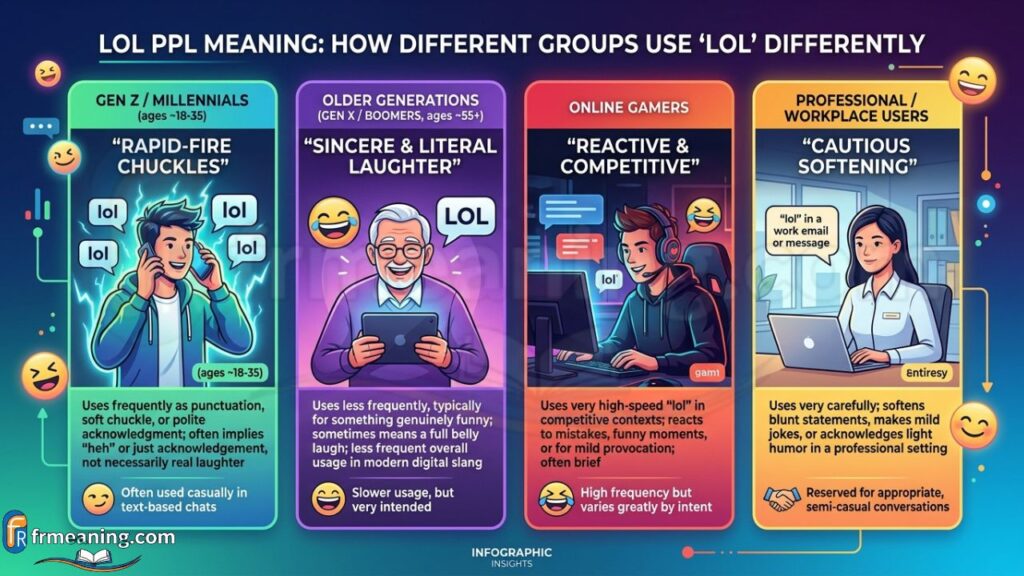
The lol ppl meaning (basically, how different types of people use LOL) really does vary by relationship, age, and even gender in some cases. It’s not one-size-fits-all, and understanding who’s sending it helps you read the actual intent behind it.
Lol Meaning in Text From a Girl
When it comes to lol meaning in text from girl conversations, context is everything (again). Among friends, it’s usually just casual conversational filler — no deeper meaning attached. But in a flirty or early-dating context, “lol” from a girl can sometimes signal light interest or an attempt to keep things playful without coming on too strong. It’s rarely meant to be analyzed too deeply, honestly, so don’t overthink a single “lol.”
Lol Meaning in Text From a Guy
Similarly, lol meaning in text from a guy tends to follow the same casual-acknowledgment pattern in most friend groups. In flirtatious or dating contexts though, guys sometimes use “lol” to diffuse awkwardness, downplay nervousness, or soften a compliment so it doesn’t feel too intense. Basically it works as a social cushion in both directions.
Lol Meaning in Chat From a Guy to a Girl (and Vice Versa)
Lol meaning in chat from a guy to a girl — or the reverse — usually falls into one of three buckets: genuine amusement, nervous/flirty energy, or just filler to keep the conversation moving. If it’s paired with follow-up questions, longer replies, or emojis, that’s a stronger signal of real engagement. A standalone “lol” with nothing else? Probably just casual texting rhythm, nothing to read into.
Does LOL Mean Love? Clearing Up the “Lol Meaning Love” Confusion
No — LOL does not mean “love” in modern texting, even though this myth still floats around, especially among people newer to texting slang. This confusion traces back to the older “lots of love” interpretation mentioned earlier. If someone’s genuinely trying to express affection, they’re way more likely to type “love you,” use a heart emoji, or just say it outright. LOL → almost always means → laughing out loud, not love, in 2026 texting norms.
LOL Meaning in WhatsApp Chat vs. Texting Apps
The lol meaning in WhatsApp chat is essentially identical to its meaning in SMS or iMessage — laughing out loud, acknowledgment, sarcasm, or lightheartedness, depending on context. That said, WhatsApp’s international user base means you’ll sometimes see LOL mixed with region-specific slang or paired with local emoji conventions. In group chats on WhatsApp especially, LOL often functions more as a quick “I saw this and it’s funny” reaction rather than a full laugh, since people are juggling multiple conversations at once.
Is LOL a Bad Word? Understanding “Lol Meaning in Bad Words” Searches
To be clear — LOL is not a bad word or profanity. It’s a completely neutral, widely accepted abbreviation used across texting, social media, and even some professional messaging. People searching for “lol meaning in bad words” are usually confusing it with variations like LMAO or LMFAO, which do contain a mild expletive (“a**”) baked into the acronym. LOL itself, though, stays clean and appropriate for basically any audience, including younger users and formal-ish settings.
LOL Meaning in Game: How Gamers Use It Differently
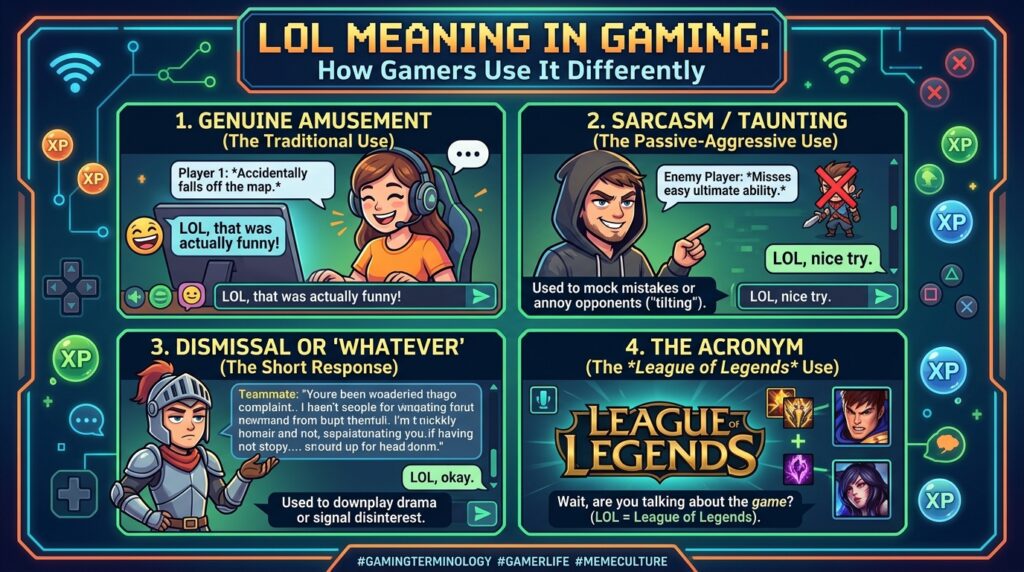
In gaming chat and voice comms, the lol meaning in game context leans heavily toward quick reactions during fast-paced moments — someone gets an unexpected kill, a funny glitch happens, or a teammate makes a rookie mistake, and “lol” fires off instantly.
It’s also sometimes used with a slightly mocking edge in competitive gaming, especially after an opponent messes up. Interestingly, League of Legends players sometimes jokingly reference the acronym overlap between “LOL” the expression and “LoL” the game itself, which adds a bit of a fun double meaning in gaming communities.
Common Variations of LOL (LMAO, ROFL, and More)
LOL isn’t the only laughter-based abbreviation floating around — there’s a whole family of variations, each signaling a different intensity of humor.
| Abbreviation | Meaning | Typical Intensity |
|---|---|---|
| LOL | Laughing out loud | Mild to moderate |
| LMAO / LMFAO | Laughing my a** off | Stronger reaction |
| ROFL | Rolling on the floor laughing | Very strong reaction |
| ROFLMAO | Rolling on the floor laughing my a** off | Strongest/most exaggerated |
LOL → escalates in intensity to → LMAO → which escalates further to → ROFL and ROFLMAO. You’ll also run into stylistic variations like “lololol,” “looool,” or “lolll,” which usually aren’t about intensity at all — they’re more about signaling playfulness, teasing, or a slightly mischievous “trolling” tone.
Uppercase vs. Lowercase LOL: Does Capitalization Actually Matter?
Yes, capitalization changes the read on LOL, though it’s not an exact science. Uppercase LOL generally signals a stronger, more genuine reaction, while lowercase “lol” tends to read as more casual, reserved, or even a bit sarcastic depending on the sentence around it. That said, plenty of people just don’t bother with capitalization rules while texting, so don’t rely on case alone — look at the whole message for the real tone.
The Origin of LOL: A Quick History Lesson
LOL didn’t start on smartphones — its roots actually trace back to early internet chatrooms in the 1980s, well before texting existed as we know it. One frequently cited claim is that Wayne Pearson, a user on a Calgary-based online chat community, coined the term after his brother said something that made him genuinely crack up. As one possible creator of LOL has noted, the abbreviation was originally meant to be used only when someone truly laughed out loud — not for a smirk or a light smile.
From there, LOL spread through IRC (Internet Relay Chat) channels, then AOL Instant Messenger in the ’90s and early 2000s, before becoming a staple of SMS texting once mobile phones took over. By 2011, LOL had officially made it into the Oxford English Dictionary — a pretty wild journey for three casual letters typed by chatroom users decades earlier. This history matters because it explains why LOL has drifted so far from its literal, “genuine laughter only” origin into the flexible, multi-purpose tone marker it is today.
LOL Across Generations and Platforms: Gen Z vs. Millennials
Here’s something most guides skip over — LOL doesn’t mean the same thing to every generation or on every app, and understanding that gap can save you from some awkward misreads.
Millennials and older texters generally still use LOL closer to its traditional sense: acknowledging something funny, or occasionally softening a comment. It’s used somewhat sincerely, even if not every “lol” reflects actual laughter.
Gen Z texters, on the other hand, often use LOL more ironically or dismissively — sometimes even to downplay something or brush it off rather than express amusement at all. On platforms like Twitter/X or Discord, LOL can carry a flatter, almost sarcastic default tone, while on iMessage or WhatsApp among close friends it stays warmer and more genuine.
There’s also an interesting international angle worth mentioning — plenty of other languages have their own “LOL equivalents.” French speakers often use “MDR” (mort de rire, “dying of laughter”), while Thai speakers frequently use “555” since the number five is pronounced “ha” in Thai, so “555” reads like “hahaha.” Knowing these regional variations helps explain why LOL, while dominant in English texting, isn’t quite universal.
When Should You Use LOL in a Text?
Knowing when LOL fits — and when it doesn’t — really depends on the relationship and the setting.
- Personal relationships (friends, family): Almost always safe to use, though older or less tech-savvy relatives might need a little context.
- Casual workplace texting: Generally fine with peers or younger coworkers, but risky with a boss or in formal communication.
- Business/mass texting: Best avoided — clarity matters more than personality when messaging large audiences.
- Customer service: Sometimes acceptable if mirroring a customer’s own casual tone, but only after they’ve used it first.
Relationship type → determines → appropriate LOL usage, so read the room before you fire one off in a professional thread.
Final Thoughts
At the end of the day, LOL is way more flexible than its literal definition suggests. It can mean genuine laughter, sarcasm, a soft acknowledgment, or just a way to keep a conversation moving without an awkward silence.
Once you understand the context clues capitalization, placement, relationship, and platform reading LOL correctly becomes second nature. And now that you’ve got the full picture, you probably won’t second-guess that next “lol” text nearly as much.
Frequently Asked Questions
What does LOL mean in a text message exactly?
LOL typically means “laughing out loud,” signaling amusement, sarcasm, acknowledgment, or a lighthearted tone, depending on context.
Does lol mean love in texting?
No, LOL almost never means love today; it stands for laughing out loud, not “lots of love” as it once did.
What’s the difference between LOL and LMAO?
LMAO (“laughing my a** off”) signals a stronger reaction than LOL, though both are used similarly in casual conversation.
Is lol considered a bad word or inappropriate?
No, LOL is completely neutral and appropriate for any audience, unlike variations like LMAO that contain mild language.
What does lol mean in a WhatsApp chat specifically?
Same as texting — laughing out loud, acknowledgment, or sarcasm — though WhatsApp’s global users may pair it with local slang.
Why do people say lol without actually laughing?
LOL often functions as filler or acknowledgment, showing you’re present in a conversation rather than genuinely laughing aloud.
Does capitalization change what LOL means?
Yes, uppercase LOL usually signals stronger amusement, while lowercase “lol” tends to feel more casual or reserved.