
Ever been mid-conversation on Snapchat and someone drops “ionk” like it’s obvious, and you’re just sitting there squinting at your screen? Yeah, same.
If you’ve been wondering what does IONK mean in text, you’re honestly not alone this little four-letter combo has been popping up everywhere from TikTok comments to group chats, and it’s confusing a lot of people who aren’t chronically online.
In this guide we’re gonna break down exactly what it means, where it came from, how people actually use it, and clear up the mix-ups so you never have to fake-nod through a conversation again.
The Definition of IONK
IONK simply stands for “I don’t know.” It’s a slang abbreviation people type in texts and on social media when they’re unsure about something or just genuinely have no clue.
The word is basically a phonetic shortcut it’s spelled the way it sounds when someone says “I don’t know” real fast, all mushed together. You’ll almost always see it in lowercase, no punctuation, like “ionk lol” or just a plain “ionk” sitting there by itself. This phonetic-spelling trend is a big part of how modern texting slang works, it mimics natural speech instead of following textbook grammar.
Unlike a lot of internet acronyms that shift meaning depending on the situation, IONK stays pretty locked in. It’s almost always about admitting a lack of information or opinion. So if your friend texts “what time’s the party?” and you fire back “ionk,” you’re simply saying you don’t have that info. Quick, casual, done.
IONK Meaning
To put it plainly: IONK → means → “I don’t know.” It’s not slang for anything else in mainstream usage (we’ll cover the rare exceptions later), and Urban Dictionary along with most online slang trackers back this up as the standard, agreed-upon definition.
How to Pronounce IONK (The Gap Nobody Explains)
Here’s something most articles skip over completely — how do you actually say ionk out loud? It’s pronounced roughly like “eye-ONK,” rhyming with “monk” or “honk.” Say “I don’t know” real quick a few times and let the words blur together — that’s basically the sound this term is trying to capture in text form. It’s not “eye-oh-en-kay” like you’d spell out an acronym; it’s meant to be read as one smooth, mumbled word, kinda the way “gonna” replaced “going to” in casual speech.
Origins and History of IONK
Slang like this didn’t just appear out of nowhere overnight. IONK evolved out of the same internet culture that gave us IDK back in the early 2000s, during the AIM and flip-phone texting era when everyone was trying to save keystrokes.
As smartphones got smarter and apps like Snapchat and TikTok exploded in popularity, people started messing around with phonetic spellings to make their messages feel quicker and more expressive — basically writing the way they talk instead of the way a textbook tells them to.
A More Data-Backed Timeline (Filling the Gap)
Most competitor articles just say IONK “gained traction sometime in the mid-2010s” without really backing it up, which honestly isn’t that helpful if you want the full picture. Here’s a rough, more grounded breakdown based on how slang like this typically spreads online:
| Period | What Happened |
|---|---|
| Early 2000s | “IDK” becomes standard shorthand on AIM, early SMS |
| Mid-2010s | Phonetic slang trend grows (ion, iono, etc.) on Twitter/Vine |
| Late 2010s | Urban Dictionary entries for “ionk” start appearing, tagged as Gen Z slang |
| 2020–2022 | TikTok explainer videos (“what does ionk mean”) push it into wider awareness |
| 2023–present | IONK becomes cross-platform, used casually on Snap, IG, Discord, and texting apps |
TikTok → helped accelerate → IONK’s mainstream popularity. Creators made skits and reaction videos around confusing texts, and viewers related hard, which is basically how a lot of niche Gen Z slang crosses over into the mainstream these days. Social trends, memes, and constant group-chat repetition did the rest, turning it from a niche typing quirk into something genuinely mainstream.
How IONK Is Used in Texting
In real conversations, ionk slots in perfectly for quick, casual replies when you’re not sure about plans, facts, or even your own opinion. Say someone texts “who won the game last night?” — you might just reply “ionk, check the score” and keep the convo moving without an awkward pause.
You’ll see it stacked with other slang too, things like “ionk bro” for a bit of extra emphasis, or “ionk why” when someone’s confused about a situation. In group chats specifically, it stops one person from holding up the whole conversation while they think of a “real” answer. On Snapchat or Instagram DMs it’s especially common because those apps basically run on fast, low-effort communication.
Tone matters a lot here too — adding an emoji softens the whole vibe. “ionk 😂” reads way friendlier than a flat “ionk” with nothing after it. Some quick ways people naturally use it:
- Flirting — “ionk if you’re free tonight?”
- Venting — “ionk what to do anymore”
- Joking around — “ionk but it’s hilarious 💀”
Once you get the hang of when to drop it, your texts start sounding way more natural and current.
Examples of IONK in Conversations
Seeing it in context honestly helps more than any definition does. Here’s a few real-world-style examples:
Friend: “What’s the homework for math?” You: “ionk, ask Sarah she always knows.”
Group chat: “Where should we eat?” Reply: “ionk, y’all pick I’m down for anything.”
Flirty text: “You coming to the party?” Reply: “ionk yet, depends if you’re there 😉”
Comment under a confusing post: “What even is this trend?” Reply: “ionk but it’s hilarious.”
And sometimes it’s just standalone — your friend sends a weird meme, you type back “ionk 💀” and that’s the whole message. It conveys confusion instantly without needing a full sentence, which is kinda the whole point.
IONK vs Similar Slang Terms
People mix this one up with a bunch of other similar-looking abbreviations, so let’s actually break it down side by side.
| Term | Meaning | Tone/Vibe |
|---|---|---|
| IONK | “I don’t know” | Casual, friendly, phonetic |
| IDK | “I don’t know” | Neutral, sometimes feels a bit blunt |
| IDC | “I don’t care” | Stronger, can come off dismissive or rude |
| Ion | “I don’t” (e.g. “ion wanna go”) | Shorthand, context-dependent |
| Iono | “I don’t know” (slurred) | Regional variant, very similar to ionk |
IONK → is often perceived as friendlier than → IDK. People tend to say IDK feels more neutral, or even a little short with someone, while ionk comes across softer, like a casual shrug instead of a flat brush-off. Meanwhile “idc” stays firmly in “I don’t care” territory, which is a different emotional register entirely — ionk is about uncertainty, not apathy.
Getting these differences right honestly helps you pick the correct tone for whatever mood you’re going for in a chat.
IONK on Different Platforms
IONK thrives → on apps built for fast communication. On Snapchat it shows up constantly in story replies and quick answers to polls. TikTok comment sections are loaded with it too, especially under those “wait what does this even mean” explainer-style videos.
Instagram DMs see it a lot in casual group threads, and it’s crept into Twitter/X replies when people are debating but wanna admit they’re not totally sure. Even WhatsApp and iMessage group chats have picked it up as general texting slang keeps spreading across platforms.
Gaming chats on Discord or console party chats use it too — something like “ionk the best build honestly, try it yourself” is a pretty typical strategy-talk example. It’s basically platform-agnostic at this point, but it shines hardest anywhere brevity is rewarded. Younger users are still driving most of its usage, though it’s clearly crossing into broader, older audiences now too.
Why IONK Became So Popular
A few things pushed this term into the spotlight all at once. First off, voice-to-text habits and natural speech patterns → drove the creation of → phonetic slang like IONK. “I don’t know” genuinely flows into something close to “ionk” when you say it fast, so the spelling just kinda caught up to how people already talk.
Second, social platforms reward stuff that feels authentic and relatable, and slang that sounds like real speech tends to win out over stiffer, more “proper” phrasing. TikTok explainer and reaction videos amplified this even more — creators built entire skits around confusing texts, and viewers related to it hard, which fed the cycle even further.
There’s also a cultural piece here: Gen Z’s general love of low-effort, kinda ironic communication makes something like ionk feel effortless and a little funny to use. Plus IDK had gotten so overused that a fresh alternative genuinely filled a gap — it kept things feeling current instead of stale.
Common Misunderstandings About IONK
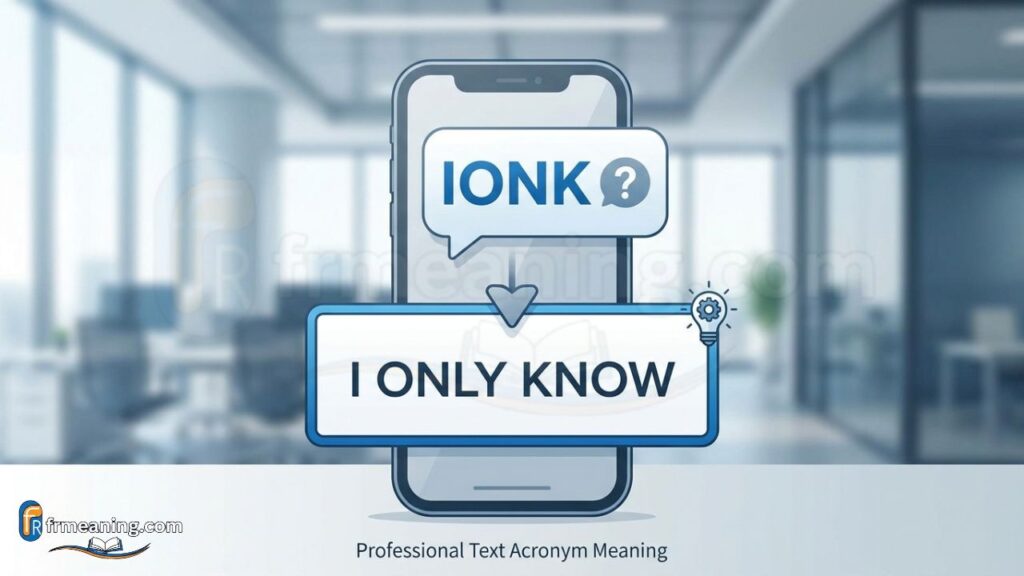
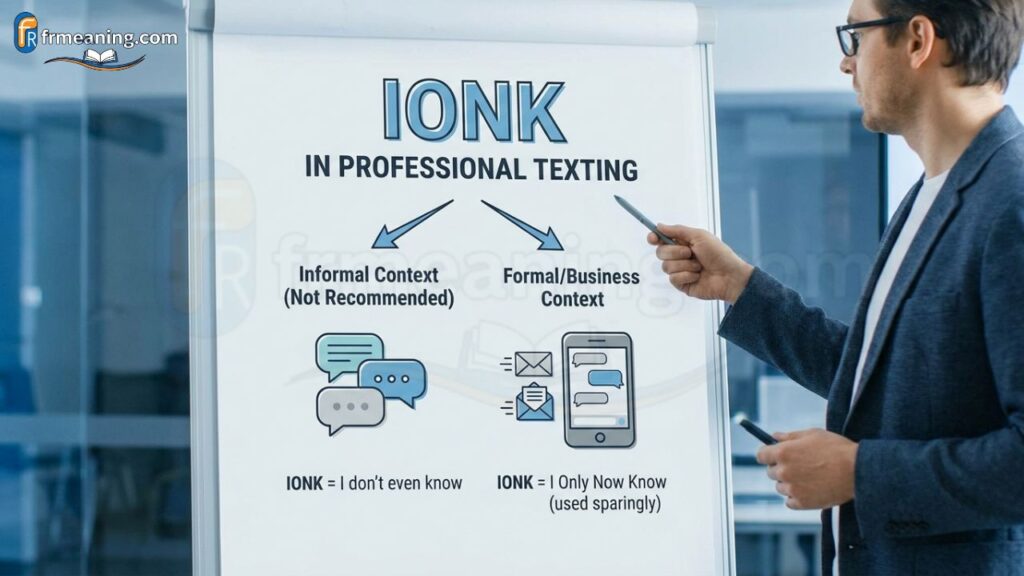
Some people see “ionk” for the first time and assume it’s a typo or just random keyboard mashing. Others confuse it with “ion” (short for “I don’t”) or, way less commonly, mistake it for “I only know,” which isn’t really a standard usage at all.
There’s also a weird meme-y mix-up where “I o n k,” spaced out like that, gets jokingly read as “okay, I don’t know” in some videos — but that’s more of a joke format than an actual real-world usage. In practice it’s almost always just “I don’t know,” plain and simple.
Older folks or people who aren’t super online might genuinely see it as gibberish at first glance, and honestly that’s fair. Context usually clears things up fast though. One more myth worth mentioning: people assume it always sounds sassy or dismissive, but most of the time it’s totally neutral or even friendly, depending on what emoji (if any) gets tacked onto the end.
Conclusion
IONK is a small but genuinely useful piece of modern slang that means “I don’t know,” born out of the same texting culture that gave us IDK decades ago. It’s quick, it’s a little playful, and it fits right into the fast pace of how people actually talk today across Snapchat, TikTok, and basically every messaging app out there.
Now that you know what it means, where it came from, and how to actually use (and pronounce) it, you’ll probably start noticing it everywhere — and maybe even catch yourself typing it out too.
FAQs
What does IONK mean in text?
IONK stands for “I don’t know.” It’s casual slang used to express uncertainty or a lack of information.
Is IONK the same as IDK?
They mean the same thing, but IONK sounds more phonetic and often feels friendlier than the classic IDK.
How do you pronounce IONK?
Say it like “eye-ONK,” rhyming with “honk” — basically a mumbled, fast version of “I don’t know.”
Where did IONK come from?
It evolved from early texting slang like IDK, gaining real traction through TikTok, Snapchat, and Urban Dictionary.
How do you use IONK in a sentence?
Example: “What movie should we watch?” Reply: “Ionk, you pick tonight!”
Can IONK mean something else?
Rarely — it’s almost always “I don’t know.” Surrounding context usually makes the meaning obvious.
Is IONK only used by Gen Z?
Mostly, yes, but it’s slowly spreading to older users as texting slang crosses generational lines online.