

You’ve probably seen “SNM” pop up in a group chat or under a tweet and thought, wait, what does that even mean? You’re not alone this little acronym shows up everywhere in casual texting and social media, and if you don’t know it, the whole conversation can feel a bit confusing.
In this guide we’re going to break down the SNM meaning, where it came from, how people actually use it in real conversations, and a few other meanings you probably didn’t know existed. By the end, you’ll never have to guess again.
SNM Meaning, Origin and Usage
Key Takeaways
- SNM stands for “Say No More” in most casual and online communication.
- It’s used to show acknowledgment, agreement, or understanding without needing extra explanation.
- SNM → is used mostly on → social media platforms like Twitter, Instagram and in text messages.
- The acronym also has a few lesser-known meanings, including a cryptocurrency reference and two religious organizations.
- There’s a right time (and a wrong time) to use it, which we’ll get into further down.
SNM Meaning
What Does SNM Mean?
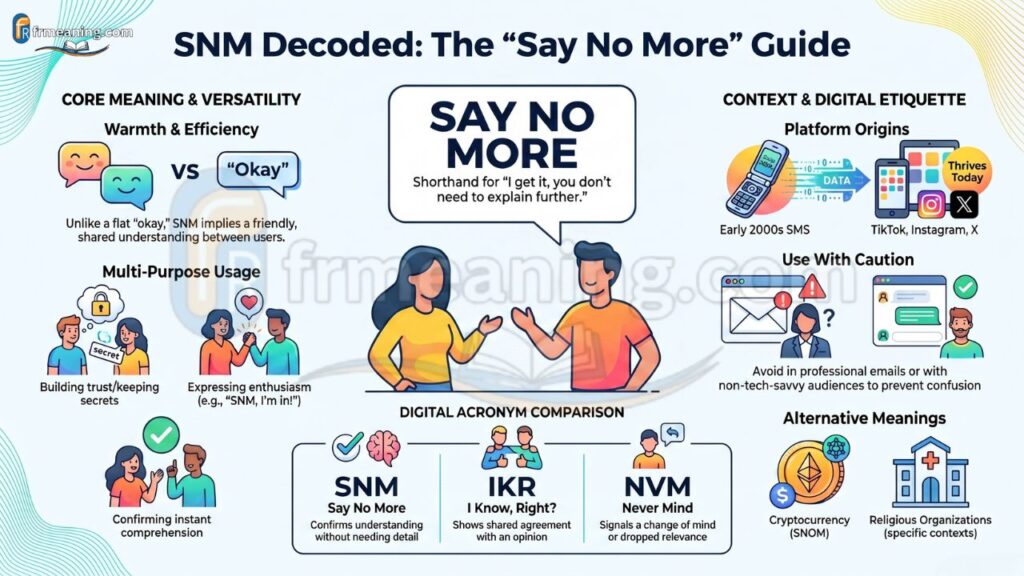
SNM stands for “Say No More.” Simple as that. It’s basically internet shorthand for “I get it, you don’t need to explain any further.” Think of it as the digital equivalent of nodding your head and saying “yep, understood” — except it only takes three letters to type.
SNM → expresses → acknowledgment, agreement, or understanding, and that’s really the core of what it does in a sentence. When somebody sends you a message and you reply with SNM, you’re telling them the point already landed. No further context needed, no follow-up questions, nothing. It’s efficient, which honestly is probably why it caught on in the first place — nobody wants to type out “I completely understand what you’re saying and there is no need to elaborate further” when three letters do the exact same job.
What makes SNM interesting compared to other agreement acronyms is the tone behind it. Saying “okay” can sometimes feel flat, almost like you’re just brushing someone off. SNM carries a bit more warmth — it kind of implies “I get exactly what you mean, we’re on the same page, no need to keep explaining.” That subtle difference is probably why it’s stuck around in casual communication for so long instead of fading out like a lot of internet slang tends to do.
It’s also worth pointing out that SNM works best in text-based, informal communication — think group chats, DMs, comment sections. You wouldn’t typically hear someone say “SNM” out loud in a conversation the same way you’d hear “okay” or “got it” spoken aloud, though it does happen occasionally among younger internet-native crowds who’ve basically absorbed texting slang into their everyday speech.
Origins and History of SNM
Nobody can point to one specific person or platform and say “this is where SNM was born,” which is honestly true of most internet slang. That said, most language trackers agree that SNM → originated in → early 2000s internet slang, right around the same time texting and early instant messaging apps were exploding in popularity. Back then, character limits and slow typing speeds on flip phones pushed people to shorten everything they could, and acronyms like SNM fit right into that culture.
Over the last two decades the phrase has stuck around and even grown, especially as SNM → is used on → social media platforms such as Twitter (now X), Instagram, and increasingly TikTok comment sections. It’s one of those terms that never really had a viral “moment” — it just slowly became part of everyday digital vocabulary, kind of like how “lol” or “brb” snuck into our language without anybody really noticing when it happened.
A Deeper Look at Where SNM Really Comes From (Topical Gap Filled)
Most articles stop at “the origin is unknown,” but let’s actually dig a little further here because that’s not a very satisfying answer, is it? Language researchers who study internet slang generally point to a few patterns that explain how phrases like SNM formed:
- Abbreviation of common spoken phrases — “Say no more” was already a common phrase in movies and everyday speech long before texting existed (you might recall it from mob movies or crime dramas, where a character says “say no more” to signal they understand an unspoken request).
- Forum and early chatroom culture — Places like AOL Instant Messenger and early gaming forums were breeding grounds for acronym culture, where speed of typing mattered more than spelling things out.
- Cross-platform migration — as MySpace gave way to Twitter, and Twitter gave way to Instagram, slang terms tend to hop from one platform to the next, picking up new usage patterns each time.
So while we can’t give you an exact birthdate for SNM, the phrase almost certainly borrowed from an already-existing spoken expression and got compressed down for digital use — which honestly makes a lot more sense than it just appearing out of nowhere.
It’s also worth noting how SNM’s popularity tracks alongside the rise of specific platforms. During the Twitter boom of the mid-2010s, character limits made three-letter replies especially valuable, and SNM fit perfectly into a quote-tweet or reply thread where space was tight. Later, as Instagram comments and TikTok culture took over, the acronym carried right along with it, proving flexible enough to survive multiple platform shifts — something a lot of older slang terms just never manage to do.
Usage of SNM
SNM isn’t a one-trick term. Depending on the tone and context of a conversation, it can mean slightly different things. Here’s a breakdown of the most common ways people use it.
Acknowledgment or Agreement
This is the most straightforward and common use. You’re basically telling someone “got it, I agree, no need to explain more.”
“I need your help moving this weekend.” “Got it, SNM.”
Expressing Enthusiasm
Sometimes SNM isn’t just about understanding — it’s about being excited or ready to jump in.
“Let’s go grab pizza tonight.” “SNM, I’m in!”
Ending a Conversation
When everything’s already been said and there’s nothing left to clarify, SNM works as a polite way to wrap things up.
“The party starts at 7 PM, bring snacks.” “SNM.”
Building Trust
This one’s a bit more personal — it’s used to reassure someone you’ve got their back and they can count on you.
“I need someone I can rely on for this task.” “SNM, consider it done.”
Keeping Secrets
SNM can also double as a quiet promise of discretion, kind of like saying “your secret is safe with me.”
“Don’t tell anyone about this plan.” “SNM, your secret’s safe with me.”
Notice how the same three letters shift meaning slightly depending on what comes before and after them in the sentence. That flexibility is actually part of why SNM has stayed relevant for so long — it adapts to whatever tone the conversation calls for, rather than being locked into just one rigid definition. A single reply of just “SNM” on its own, with no extra words attached, is probably the most neutral use case, functioning almost like a placeholder for “understood” in general.
Other Meanings
Like a lot of three-letter acronyms, SNM isn’t exclusively tied to one definition. Context really matters here. On Twitter, the hashtag #SNM → alternately refers to → SNOM, which is a cryptocurrency coin traded on various exchanges. Outside of internet slang, SNM is also used as shorthand for the Sacred Name Movement, a religious group focused on using the original Hebrew names of God, and the Sant Nirankari Mission, a spiritual organization based in India.
In more casual or pop-culture corners of the internet, you might also see SNM used to mean “show no mercy” or “smoke and mirrors” — though these usages are far less common and usually only make sense within a specific fandom, gaming community, or niche discussion thread.
This is honestly the biggest reason context matters so much with acronyms like this one. If a friend texts you “SNM, I got this,” they almost certainly mean “say no more.” But if you stumble across “#SNM” attached to a crypto trading chart or a post about a religious gathering, you’re looking at a completely different definition. Search engines and readers alike need that context clue, so pay attention to the surrounding words before assuming which meaning applies.
When You Probably Shouldn’t Use SNM (Topical Gap Filled)
Here’s something most guides skip over entirely: not every context is a good fit for SNM. Since the acronym has multiple possible meanings, using it carelessly can actually cause confusion instead of clearing things up. A few situations where it’s worth thinking twice:
- Professional or formal communication — SNM in a work email or a message to your boss is going to look unprofessional, plain and simple. Stick to full sentences there.
- Conversations with older or less tech-savvy audiences — not everyone grew up texting acronyms, and someone unfamiliar with internet slang might genuinely think you’re referencing “show no mercy” or a cryptocurrency instead.
- Ambiguous or high-stakes conversations — if there’s any chance the other person could confuse “say no more” with one of SNM’s alternate meanings, it’s safer to just spell it out.
Basically, SNM works great in casual texting between friends, but it’s not a universal shortcut you can drop into any conversation without a second thought.
Related Terms to SNM
A handful of other acronyms often show up alongside SNM in casual chats. Here’s a quick table comparing them:
| Acronym | Full Meaning | Typical Use Case |
|---|---|---|
| NVM | Never Mind | Signals a change of mind or that something’s no longer relevant |
| IKR | I Know, Right? | Shows agreement and shared understanding |
| TTYL | Talk To You Later | Marks the end of a conversation for now |
| SNM | Say No More | Confirms understanding without needing more detail |
NVM → expresses → a change of mind or dropped relevance, while IKR → demonstrates → shared agreement with someone’s opinion. TTYL → indicates → the temporary end of a conversation. These acronyms often get mixed together in the same chat, so knowing all four gives you a much more complete toolkit for reading (and writing) casual digital conversations.
It helps to think of these terms as belonging to the same family — they all exist to make quick, low-effort replies possible in fast-moving conversations. Someone might text “NVM, figured it out myself” one minute, then reply “IKR, that’s exactly what I was thinking” the next, and wrap the whole exchange up with a casual “TTYL.” SNM slots right into that same rhythm, usually showing up whenever a point has already been made clearly and doesn’t need repeating.
Similar Slang Words
SNM shows up in a bunch of different spellings and stylings, but they all mean the same thing. You might see it written as:
- s.n.m.
- s’n’m
- SnM
- sm
People also use totally different words or phrases that carry the same underlying meaning, like “gotcha,” “okay,” “oh,” “roger,” “10/4,” “you got it,” “np,” and even “omg” depending on tone.
None of these variations change the core meaning much, they’re really just stylistic choices based on the platform or the person’s typing habits. Some folks prefer lowercase stylings like “snm” for a more relaxed vibe, while others might capitalize it fully to give it a bit more emphasis in a fast reply. Either way, the underlying message stays the same: understood, no further explanation needed.
Other Ways to Say the Term
If you want to mix things up (or you’re just not a fan of acronyms), here are some alternative phrases that carry the same energy as SNM:
- Got It
- Understood
- I’m On It
- Consider It Done
- No Problem
- Copy That
- All Right
- Message Received
- Say Less
- I Hear You
Each of these works as a natural substitute depending on how formal or casual you want the reply to sound. If you’re texting a close friend, “say less” or “consider it done” might feel more natural than the acronym itself. If you’re replying to a coworker in a semi-casual Slack channel, “message received” or “no problem” strikes a nicer balance between friendly and professional.
Frequently Asked Questions
What does SNM mean in texting?
SNM means “Say No More” in texting — it’s slang used to show you understand something and don’t need further explanation.
How is SNM used in social media?
People reply with SNM on posts, tweets, or comments that are already self-explanatory, showing they got the point instantly.
Can SNM have military or medical meanings?
Not really. In everyday texting and social contexts, SNM almost always means “Say No More,” not a military or medical term.
What does ‘sn’ mean in texting?
“SN” typically stands for “screen name,” referring to someone’s online alias — it’s unrelated to SNM entirely.
How should one respond to ‘snm’ messages?
Simply reply with something like “thanks,” “got it,” or “okay” — SNM already signals understanding, so no extra detail is needed.
Are SNM and SNN related terms?
No, they’re different. SNN can mean things like “Social Networking News,” while SNM specifically means “Say No More.”
Is SNM appropriate to use in professional emails?
Generally, no. SNM is casual internet slang, so it’s best reserved for texting or social media, not formal or workplace communication.
Discover More:-
https://frmeaning.com/what-does-lwk-mean-in-text/
https://frmeaning.com/what-does-pda-mean-in-text/
https://frmeaning.com/what-does-nty-mean-in-text/
https://frmeaning.com/what-does-bd-mean-in-text/
https://frmeaning.com/what-does-imsg-mean-in-text/
https://frmeaning.com/what-does-pmo-mean-in-text/
https://frmeaning.com/what-does-wyll-mean-in-text/
https://frmeaning.com/what-does-ik-mean-in-text/
https://frmeaning.com/what-does-wth-mean-in-text/