
You opened a message, saw someone reply with “IK,” and paused for a second. Maybe it came after a joke. Maybe during an argument. Or maybe your friend typed it on Snapchat and suddenly you felt 97 years old.
Yeah. Happens fast online.
Text slang changes almost weekly now, especially across TikTok comments, Instagram DMs, Discord chats, and group texts where people type at lightning speed. One tiny abbreviation can completely change the tone of a conversation. “IK” is one of those abbreviations.
The good news? It’s actually simple once you understand the context.
By the end of this guide, you’ll know:
- What IK means in text
- How people use it on social media
- Whether it sounds rude or friendly
- The difference between IK, IKR, and IDK
- How to reply naturally without sounding awkward
Let’s clear it up.
What Does IK Mean in Text?
The Simple Definition of IK
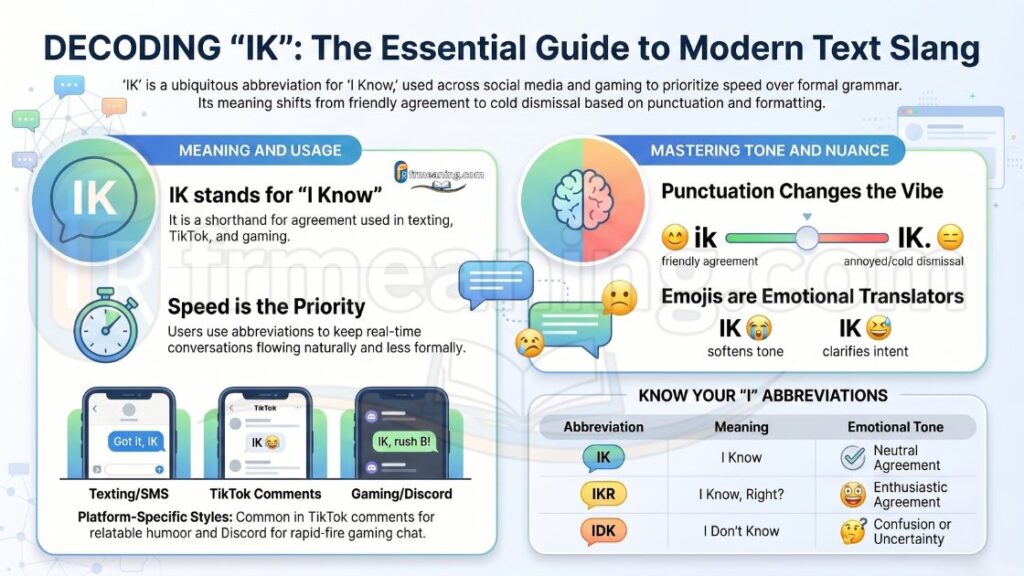
IK stands for “I Know.”
That’s it.
People use it in texting and online chat as a quick response during casual conversations. Instead of typing the full phrase, they shorten it to two letters.
Example:
Friend: “That movie ending was wild.”
You: “IK!”
In that case, IK shows agreement and shared understanding.
It’s part of a much larger internet slang culture where speed matters more than grammar. Similar abbreviations include:
- IDK = I Don’t Know
- IKR = I Know, Right?
- TBH = To Be Honest
- FR = For Real
- IMO = In My Opinion
Most people use IK casually. You’ll see it constantly in texting apps, TikTok comments, Snapchat conversations, gaming chats, and private messages.
Why People Use IK Instead of Full Words
Honestly? Convenience.
Typing “I know” isn’t exactly exhausting, but internet communication rewards speed. The shorter the response, the faster the conversation moves.
That matters online because modern messaging feels almost real-time. Especially among Gen Z users.
People shorten words because it:
- Saves typing time
- Feels casual and natural
- Matches texting culture
- Keeps conversations flowing quickly
- Sounds less formal
There’s also a social element to it. Using abbreviations like IK makes conversations feel relaxed and familiar.
Nobody opens Snapchat hoping for corporate email energy.
How IK Is Used in Conversations
Casual Agreement
Most of the time, IK simply means agreement.
Someone says something obvious, relatable, funny, or true. You reply with IK because you already understand or feel the same way.
Examples:
“This weather is awful.”
“IK.”
“That teacher gives too much homework.”
“IK bro.”
“The line at that concert was insane.”
“IK right?”
Notice the tone there. Friendly. Relaxed. Informal.
It’s basically digital nodding.
Sarcastic or Annoyed Responses
Now things get interesting.
IK can also sound irritated depending on punctuation, capitalization, or context.
Compare these:
- “ik”
- “IK.”
- “IKKK”
- “IK bro chill”
- “I KNOW”
Different vibe every time.
For example:
Person 1: “You forgot again.”
Person 2: “IK.”
That period changes everything. Suddenly the message feels cold or annoyed.
Online conversations rely heavily on tone clues because nobody can hear your voice. Tiny details matter:
- ALL CAPS can feel emotional
- Periods can feel blunt
- Extra letters can sound excited
- Emojis soften the tone
A simple “IK 😭” feels completely different from “IK.”
Social Media Usage
IK shows up almost everywhere online now.
TikTok Comments
TikTok users love fast reactions.
Example:
“When your alarm rings after 2 hours of sleep.”
Comment: “IK this pain too well.”
Snapchat
Snapchat conversations move quickly, so abbreviations dominate there.
Typical example:
“That filter makes everyone look identical.”
“IK LOL.”
Instagram DMs
People use IK in reactions, gossip, memes, and casual replies.
Discord Chats
Gaming communities and Discord servers rely heavily on internet shorthand because conversations happen rapidly during live chats.
You’ll often see:
- ik
- idk
- fr
- ngl
- imo
All packed into one sentence.
IK Meaning on Different Platforms
IK on Snapchat
On Snapchat, IK usually means simple agreement or recognition.
Snapchat conversations are short and informal. Nobody writes full paragraphs unless something dramatic happened.
Examples:
- “IK that guy from school”
- “IK righttt”
- “IK what you mean”
The tone is usually playful or casual.
IK on TikTok
TikTok uses slang aggressively. Trends spread there faster than anywhere else.
In comments, IK often appears as:
- A reaction
- A shared emotional response
- Relatable humor
- Agreement with creators
Example:
“Me pretending I understand math.”
Comment: “IK because same.”
TikTok slang also evolves quickly, so abbreviations become social signals. Using them naturally makes users feel part of internet culture.
IK on Instagram DMs
Instagram DMs blend texting and social media language together.
People use IK there when:
- Reacting to stories
- Talking about posts
- Sharing gossip
- Responding to memes
It feels conversational and lightweight.
IK in Gaming Chats
Gaming culture helped normalize abbreviations long before TikTok exploded.
During multiplayer games, players type fast because nobody has time for full sentences during live action.
You’ll often see:
- IK
- GG
- BRB
- AFK
- IDK
Gaming chats prioritize speed over perfect grammar.
Always have.
Difference Between IK, IKR, and IDK
These abbreviations confuse people constantly because they look similar.
Here’s the easy breakdown.
IK vs IKR
IK = “I Know”
Simple agreement.
Example:
“This song is amazing.”
“IK.”
IKR = “I Know, Right?”
Stronger agreement with excitement or emphasis.
Example:
“That finale was insane.”
“IKR!”
IKR feels more emotional and expressive.
Think of it like this:
- IK = calm agreement
- IKR = enthusiastic agreement
IK vs IDK
This one’s funny because the meanings are basically opposites.
| Abbreviation | Meaning |
|---|---|
| IK | I Know |
| IDK | I Don’t Know |
Examples:
“Do you understand this?”
“IK.”
vs.
“Do you understand this?”
“IDK honestly.”
One shows certainty. The other shows confusion.
Very different energy.
Is IK Rude or Friendly?
This depends almost entirely on tone.
That’s why some people misunderstand it.
When IK Sounds Normal
Usually, IK sounds friendly when:
- Used casually
- Combined with emojis
- Written in lowercase
- Part of a flowing conversation
Examples:
- “ik haha”
- “ikrrr”
- “ik 😭”
- “ik that’s crazy”
These feel warm and conversational.
When IK Sounds Annoyed
IK can sound dismissive if it appears:
- In ALL CAPS
- With a period
- As a one-word reply
- During arguments
Example:
“You already told me.”
“IK.”
That feels sharper.
Not necessarily rude. Just impatient.
Tone interpretation online is tricky because people project emotion onto tiny formatting choices.
How Emojis Change the Tone
Emojis act like emotional translators.
Compare these:
- “IK.”
- “IK 😂”
- “IK 😭”
- “IK ❤️”
Completely different feelings.
The emoji softens the message and gives emotional context that plain text lacks.
That’s why Gen Z communication mixes abbreviations and emojis constantly. Together, they create tone.
Real-Life Examples of IK in Text
Friendly Examples
Here are normal everyday uses:
Friend: “Traffic was horrible today.”
You: “IK I got stuck for an hour.”
Friend: “That pizza place is underrated.”
You: “IK it’s so good.”
These sound natural and relaxed.
Funny Examples
Internet humor loves exaggerated agreement.
Examples:
“Me acting productive after answering one email.”
“IK because same.”
“When your phone falls directly on your face.”
“IK the pain is real.”
Relatable content drives most social media slang usage.
Romantic Chat Examples
IK can appear flirtatious too.
Example:
“You miss me.”
“IK maybe a little.”
Or:
“I’m adorable.”
“IK.”
Short. Playful. Confident.
Group Chat Examples
Group chats move fast, so abbreviations help people react quickly.
Example:
Person 1: “We’re all late again.”
Person 2: “IK.”
Person 3: “Nobody’s surprised.”
Short replies keep conversations moving.
Common Mistakes People Make With IK
Misreading the Tone
This happens constantly.
Someone types “IK” quickly, but the reader assumes they’re angry because the message feels short.
Online communication lacks facial expressions and vocal tone, so misunderstandings happen easily.
Context matters more than the abbreviation itself.
Using IK in Formal Conversations
Probably not the best idea.
You shouldn’t use IK in:
- Professional emails
- School assignments
- Job applications
- Formal business communication
Text slang belongs in casual settings.
Imagine emailing your teacher:
“IK the homework was due yesterday.”
Not great.
Confusing IK With Similar Slang
People often mix up:
- IK
- IKR
- IDK
- IMO
Each serves a different purpose.
Learning internet slang becomes much easier once you understand the emotional tone behind each abbreviation.
Other Popular Text Slang Similar to IK
IKR
Means “I Know, Right?”
Used for stronger agreement and excitement.
Example:
“That concert was unbelievable.”
“IKR!”
IDK
Means “I Don’t Know.”
Probably one of the most common texting abbreviations online.
Example:
“What should we eat?”
“IDK.”
IMO
Means “In My Opinion.”
Used when sharing personal thoughts.
Example:
“IMO that movie was overrated.”
TBH
Means “To Be Honest.”
Often used before honest opinions or confessions.
Example:
“TBH I expected better.”
FR
Means “For Real.”
Shows seriousness or strong agreement.
Example:
“That exam was impossible fr.”
Modern texting culture stacks these abbreviations together constantly.
You’ll see messages like:
“IK fr that class was impossible tbh.”
Perfectly normal online now.
Frequently Asked Questions About IK
What does IK stand for in texting?
IK stands for “I Know.” It’s commonly used in text messages, social media chats, and online conversations.
Is IK rude in messages?
Not usually. Tone depends on context, punctuation, capitalization, and emojis.
What does IK mean on Snapchat?
On Snapchat, IK still means “I Know.” It’s often used casually during quick conversations.
What’s the difference between IK and IKR?
IK means “I Know,” while IKR means “I Know, Right?” which expresses stronger agreement or excitement.
How do you reply to IK?
Usually by continuing the conversation naturally.
Example:
“IK.”
“Right? It was crazy.”
Is IK used by Gen Z?
Very often. Gen Z and younger internet users rely heavily on abbreviations during digital communication.
Why Internet Slang Changes So Fast
A lot of people wonder why slang evolves this quickly now.
Simple answer: social media acceleration.
TikTok trends explode overnight. Discord communities invent phrases constantly. Snapchat encourages rapid-fire messaging. Gaming culture spreads abbreviations globally within days.
Language online behaves differently than traditional language.
It’s faster. Shorter. More emotional. More visual.
That’s why internet slang keeps growing.
And honestly? Most abbreviations exist for the same reason:
People want communication that feels immediate.
Final Thoughts on IK Meaning in Text
So, what does IK mean in text?
Most of the time, it simply means “I Know.”
Easy enough.
The tricky part isn’t the definition. It’s the tone. Depending on context, IK can sound friendly, sarcastic, playful, annoyed, excited, or completely neutral.
That’s why understanding internet slang requires more than memorizing abbreviations. You also have to read the emotional cues around them:
- punctuation
- emojis
- capitalization
- conversation context
- platform culture
Once you start noticing those details, modern texting language becomes much easier to understand.
And honestly, after a while, you’ll probably start typing “IK” too.