

So you were scrolling through TikTok or texting a friend and you saw “YN” pop up somewhere, and now you’re stuck wondering what it means, right? You’re not alone. The YN meaning has become one of those internet slang terms that everyone seems to use but nobody fully explains, and honestly, that’s kind of the point of this article.
Millions of people type “YN meaning” into Google every month because the same two letters can mean completely different things depending on where you see them. In this guide we’ll break it all down properly, no fluff, just the real answers you came here for.
By the time you finish reading, you’ll know exactly what YN stands for, where it came from, how each platform uses it differently, and maybe most importantly how to reply when someone throws a “YN?” at you in chat.
Meaning & Definition of YN
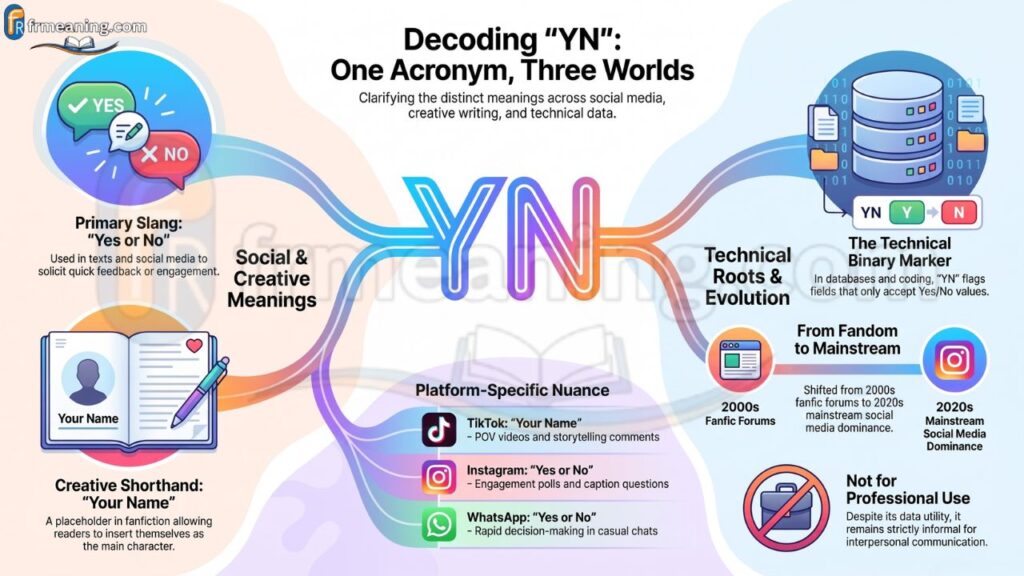
The abbreviation YN most commonly stands for two things, and honestly, context is basically the only thing that decides which one applies.
📌 Primary Meaning: In everyday texting and social media, YN → means → “Yes or No”, usually tacked onto the end of a question or a quick poll.
Examples:
- “Do you like this outfit, YN?”
- “Are you coming tonight YN?”
📌 Secondary Meaning: In storytelling, fanfiction, or roleplay communities, YN → means → “Your Name”, a placeholder that lets the reader insert themselves directly into the story.
Examples:
- “YN walked into the room and saw him staring…”
- “It was YN’s first day at school.”
So yeah, the meaning of YN depends heavily on context, and that’s exactly why so many confused people end up googling it at 2am. Not gonna lie, even we had to double check a few of these usages while researching this piece.
Background & Origin of YN
Where did this whole thing even start? The abbreviation YN grew out of early internet chat culture and fanfiction communities, mostly in the early 2000s. Writers on early story-sharing sites started using “YN” as a stand-in name so readers could picture themselves as the main character. It made the stories feel personal, immersive, kind of like a choose-your-own-adventure but with romance and drama thrown in.
Later on, as texting culture exploded and platforms like Twitter (now X), Instagram, and TikTok took over daily life, YN evolved into shorthand for “yes or no” too. People just don’t wanna type out full sentences anymore, and honestly who can blame them. So this second meaning kind of grew alongside the first one, and both stuck around.
Here’s the semantic relationship in plain terms:
- Fanfiction communities → originated → YN as a reader self-insertion tool
- Rise of Twitter, Instagram, and TikTok → popularized → YN as “Yes or No” shorthand
Over time both meanings just… coexisted. Which is honestly kind of messy but also flexible, since now the term works in like three or four different scenarios depending on the app you’re on.
Usage of YN in Different Contexts
The meaning of YN shifts depending on how and where you come across it. Let’s break it down section by section.
💬 Chat & Text Messages
Used mostly to ask a quick question without spelling everything out.
- “Movie tonight YN?”
- “Pizza or burger YN?”
📱 Social Media Posts
You’ll see this a LOT in captions where creators want quick engagement or feedback.
- “Should I dye my hair YN? 💇♀️”
- “New outfit drop YN?”
🎭 Fanfiction & Storytelling
Here YN works as a placeholder name for the reader themselves.
- “YN looked out the window, lost in thought.”
🧑💼 Informal Surveys or Polls
Used a lot in casual group-decision situations.
- “Meeting at 5pm YN?”
Meanings Across Platforms
Different apps kind of have their own “flavor” of using YN, and it’s worth knowing the differences before you accidentally use it wrong somewhere.
| Platform | Common Usage |
|---|---|
| Mostly casual “Yes or No” chats | |
| Captions asking for audience engagement, e.g. “Should I post this YN? 😅” | |
| TikTok | Comments and storytelling videos, e.g. “YN is literally me in this situation 😭” |
| Snapchat | Quick polls or friend conversations, e.g. “Hang out later YN?” |
Basically, platform context → determines → which YN meaning applies, and once you get a feel for that it stops being confusing pretty fast.
Other Fields & Technical Uses (The Gap Most Articles Miss)
Most articles covering this topic mention technical usage in like one throwaway sentence and move on. That’s honestly doing readers a disservice because there’s actually more depth here worth knowing.
YN in Data, Coding, and Boolean Contexts
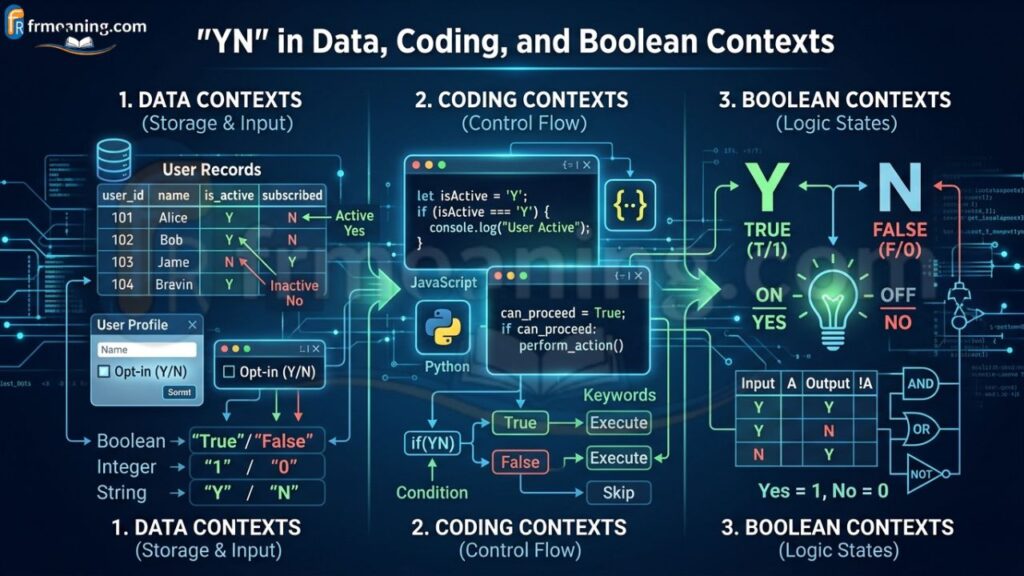
In data science, spreadsheets, and survey research, YN functions as a binary marker — basically a stand-in for TRUE/FALSE or 1/0 values. If you’ve ever opened a CSV file or database table with a column labeled something like “Confirmed_YN” or “Active_YN,” that’s exactly this usage. It’s a naming convention analysts and developers use to flag a field that only accepts two possible answers: Yes or No.
Here’s where you’ll typically run into this technical flavor of YN:
- Survey research — datasets often code responses as Y/N instead of writing out full words, saving space and making analysis faster.
- Database schema design — column names like “IsActive_YN” or “Verified_YN” are common in SQL tables, letting developers quickly scan which fields are boolean.
- Excel/Google Sheets dropdowns — some spreadsheet templates use YN as a validation label for Yes/No dropdown menus.
- Legacy coding standards — older programming style guides sometimes recommended YN suffixes for boolean variables before modern naming conventions (like
isVerified) became the norm.
None of this is officially standardized though — there’s no universal ISO rule that says YN must always mean this in tech. It’s more of an informal convention that stuck around because it’s short and intuitive. So while YN isn’t a recognized technical term in the same way as, say, an HTTP status code, it does show up constantly in real-world data labeling work, which is honestly a detail most competing guides just skip over entirely.
Etymology Timeline: A Closer Look
To really understand the origin story properly, it helps to look at rough eras rather than just “early 2000s”:
- Early-to-mid 2000s — Fan communities on early story-sharing forums began experimenting with reader-insertion placeholders, with “YN” (Your Name) becoming a popular shorthand among writers who didn’t want to hardcode a specific character name.
- Late 2000s to early 2010s — As blogging platforms and early social networks grew, informal abbreviations culture exploded, and “Y/N” started appearing more in casual polls and forum questions.
- 2015–2020 — With Twitter, Instagram, and group texting becoming dominant, “YN” as “Yes or No” shorthand became mainstream in everyday messaging, not just niche fandoms.
- 2020–Present — TikTok storytelling formats (POV videos, “YN” roleplay skits) reignited the fanfiction-style meaning for a whole new generation, while the “Yes or No” usage remained the dominant everyday interpretation.
This layered history is basically why both meanings survived instead of one replacing the other — they grew in somewhat separate communities before merging into the same shared internet vocabulary we see today.
Common Misconceptions & Mistakes
A lot of people mess this one up, and it’s usually for pretty understandable reasons.
- ❌ Mistake 1: Assuming it always means “Your Name.” Not true — depends entirely on context.
- ❌ Mistake 2: Using YN in formal or professional messages. It’s strictly informal, don’t send it to your boss.
- ❌ Mistake 3: Confusing it with similar abbreviations like “Y/N format” in surveys or the standalone “Y/N?” question style.
Similar Terms & Alternatives
| Term | Meaning | Typical Usage |
|---|---|---|
| Y/N | Yes or No | Surveys, forms |
| Yes/No | Full phrase | Formal writing |
| YN | Yes or No / Your Name | Informal chats, storytelling |
| IDK | I Don’t Know | Casual texting |
| TBD | To Be Decided | Planning |
How to Respond to YN (Chat Examples)
Not sure how to reply when someone drops a YN on you? Here’s how real conversations usually go:
Example 1: A: “Dinner tonight YN?” B: “Yes 😋”
Example 2: A: “Should I post this pic YN?” B: “Yes, it looks great 🔥”
Example 3: A: “YN coming to the party?” B: “No, I’m busy 😅”
Example 4 (fanfiction context): Story: “YN walked into the room…” Reader response: “I feel like I’m in the story 😭”
Differences From Similar Words
- YN vs Y/N: Y/N leans more formal, survey-style. YN is casual internet slang.
- YN vs IDK: YN asks for a choice. IDK expresses genuine uncertainty.
- YN vs TBD: YN wants an immediate answer. TBD pushes the decision to later.
Relevance in Online Conversations & Dating Apps
On dating apps and social platforms, YN often gets used to quickly gauge interest or confirmation without the awkwardness of a longer message. It’s low-pressure, which is honestly probably why it caught on so fast in that space.
Examples:
- “Coffee date YN? ☕”
- “Match vibes YN?”
It keeps conversations short and casual — which, let’s be real, matters a lot in modern digital communication where nobody wants to type paragraphs to a stranger.
Popularity & Trends Over Time
The popularity of the YN meaning search has grown a ton, largely thanks to:
- Rise of TikTok storytelling videos and POV-style content
- Fanfiction communities keeping the “Your Name” usage alive
- Increased use of abbreviations in everyday texting
- Google search curiosity spikes whenever a viral trend uses the term
Search interest tends to spike whenever a new viral format or story trend leans on “YN” heavily. It’s not exactly a formal trend term on its own, but it stays consistently searched simply because the dual meaning keeps confusing new users who stumble across it for the first time.
FAQs
What does YN mean in texting?
It usually means “Yes or No” in casual messages, mostly used to ask quick questions between friends.
What does YN mean in fanfiction?
It means “Your Name,” a placeholder letting readers insert themselves into the story as the main character.
Is YN formal or informal?
Strictly informal. Avoid using YN in professional emails, business chats, or any formal written communication.
Can YN have more than one meaning?
Yes, it commonly means both “Yes or No” and “Your Name,” with context deciding which applies.
Quick Summary Points
- YN = Yes or No / Your Name, depending entirely on context
- Mostly used in texting, social media captions, and casual chats
- Common in TikTok storytelling videos and fanfiction communities
- Also appears informally in data labeling as a Yes/No binary marker
- Not suitable for formal or professional communication
Final Words
The term YN meaning looks simple on the surface, but it honestly carries a surprising amount of nuance depending on where and how you run into it. In most casual conversations it just means “Yes or No,” making back-and-forth chatting faster and less awkward.
In fanfiction or roleplay spaces, it flips into “Your Name,” letting readers picture themselves right in the middle of the story. And in more technical corners like spreadsheets or databases, it quietly does a third job as a Yes/No binary flag.
As internet language keeps evolving (and it always does, way faster than any dictionary can keep up with), abbreviations like YN are only gonna become more common across TikTok, Instagram, and every messaging app in between.
Understanding this stuff isn’t just trivia it genuinely helps you avoid those “wait what does that mean” moments in group chats. So next time you spot “YN” anywhere online, you’ll know exactly what’s being asked of you.