
You walked outside, or maybe even inside your own home, and there it was a dead frog, just lying there. No explanation, no warning, just… there. And now your mind is racing a bit, right? Is this a sign? A warning? Something spiritual trying to tell you something?
Here’s the thing the spiritual meaning of a dead frog isn’t some random internet myth. It stretches back thousands of years, across cultures that had almost nothing to do with each other, yet somehow landed on similar interpretations.
Ancient Egyptians, medieval Europeans, Native American tribes, Chinese folklore they all had something to say about frogs, and death only deepens that symbolism.
In this guide we’re going to unpack what it really means, where it comes from, and what to do about it (because honestly, most articles skip that last part).
What Does a Dead Frog Symbolize? (Quick Answer)
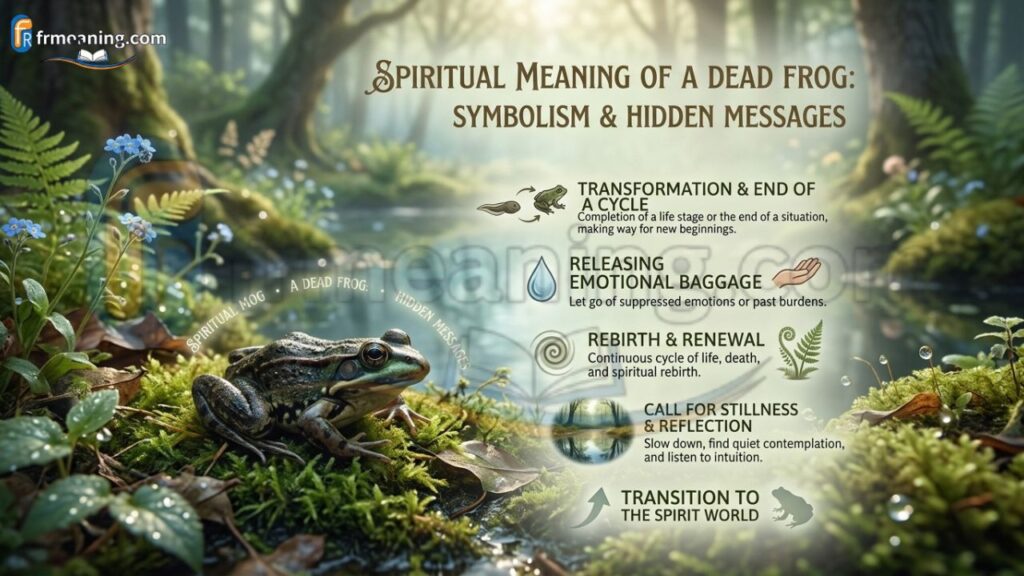
A dead frog typically symbolizes transformation, emotional release, and the closing of a life chapter. It’s rarely a literal warning of doom — more often it’s a nudge that something in your life needs to end so something new can begin.
Frogs live this weird dual existence — water then land, tadpole then adult — so they’ve always stood in as a symbol for change and adaptability. When that symbol dies, the meaning doesn’t vanish, it just shifts direction. Instead of pointing toward active change, it points toward the aftermath of change: closure, release, stillness after the storm.
Why Frogs Carry Spiritual Weight in the First Place
Before we go further, it helps to understand why frogs got this reputation to begin with. It’s not random.
Frogs undergo one of nature’s most dramatic transformations egg, tadpole, then full grown amphibian that can live both underwater and on dry land. That’s basically a built-in metaphor for personal evolution, and ancient cultures picked up on it fast.
Add in the fact that frogs appear (seemingly out of nowhere) after rainfall, and you’ve got a creature tied to fertility, renewal, and abundance almost by default.
So when a frog dies, especially somewhere unexpected, it kind of flips the script. The animal that represents ongoing change suddenly represents a stop. And that contrast is exactly why people feel unsettled by it — our brains are wired to notice when a symbol breaks its usual pattern.
Historical Roots: How Ancient Cultures Viewed Frog Symbolism
Frog symbolism isn’t a TikTok trend, despite what you might think scrolling through spiritual content lately. Its roots go back over 370 million years, give or take, and different civilizations shaped the meaning in wildly different directions.
Ancient Egypt and the Goddess Heqet
In Ancient Egypt, frogs weren’t creepy at all — they were sacred. Heqet, the goddess linked to childbirth and fertility, was often depicted with a frog’s head. Why? Because every year when the Nile flooded, frogs would appear in massive numbers right afterward.
Egyptians connected that flooding → frog appearance → fertile soil pattern, and frogs became tied permanently to renewal and abundance. So in this tradition, Nile flooding directly led to frogs being seen as fertility symbols — a pretty clear cause and effect that shaped centuries of belief.
Greek and Roman Interpretations
The Greeks and Romans were a bit more mixed on frogs. Sometimes they showed up in comedies and fables tied to rain and agriculture (a good omen), but other times their swamp-dwelling habits linked them with decay and disorder. Context mattered a lot here — where you found the frog changed what it meant.
Medieval European Beliefs (And the Toad Problem)
Here’s where things get interesting — and honestly, where most competitor articles get a little sloppy. During the Middle Ages, toads started getting split off from frogs symbolically, and not in a good way.
Toads picked up a reputation as symbols of the devil, witchcraft, and bad luck, even though they were rarely poisonous. In parts of France, toad figures were literally placed at the bottom of holy water stoups to represent evil being “exorcised” by the church. Frogs, meanwhile, mostly kept their more neutral-to-positive folk associations tied to weather and seasonal cycles.
Dead toad meaning in this context leaned darker — closer to omens of illness or misfortune — while a dead frog was more likely interpreted as a natural sign tied to water and renewal cycles. So if you’re researching toad symbolism specifically, know that it historically carried heavier, more superstitious baggage than frog symbolism did.
Dead Frog Biblical Meaning
In Christian scripture, frogs show up pretty famously in the Book of Exodus, as one of the plagues sent upon Egypt. That’s not exactly a flattering start for frog symbolism in biblical terms — frogs were associated with chaos, judgment, and impurity in that specific narrative.
That said, modern Christian interpretation has softened quite a bit. Rather than fear-based readings, a lot of contemporary faith-based perspectives frame a dead frog as symbolic of spiritual cleansing — the idea that something impure or burdensome is being removed from your life so renewal can follow. It’s less “plague and punishment” and more “letting go of what’s weighing you down.”
Spiritual Meaning of a Dead Frog in the House
This is probably the version of the question most people actually came here for, and honestly, it deserves its own breakdown.
Finding a dead frog inside your home hits differently than finding one outside on a sidewalk. Your house is personal space — it represents your inner world, your security, your comfort zone. So spiritually speaking, a dead frog in the house often points to something that needs to end within your personal or emotional life specifically, not just the world around you.
Common interpretations include:
- A relationship or friendship that’s quietly run its course
- An old habit or mindset you’ve outgrown but haven’t fully released
- Emotional stagnation that’s been building inside your home environment
- A signal to clear out clutter — physical or emotional — from your living space
Brown Frog Inside the House Spiritual Meaning
Color matters a bit in symbolic readings, and brown specifically is tied to grounding, stability, and earth energy. A brown frog inside the house — dead or alive — often gets read as a message about practical, real-world matters rather than abstract emotional ones. Think finances, home stability, or physical health rather than romantic or spiritual upheaval. If it’s dead, it may suggest a grounding issue has reached its natural conclusion, like finally closing out a stressful financial chapter.
Frog Inside the House Spiritual Meaning Love
When it comes to matters of the heart specifically, a frog appearing (or dying) inside the home is frequently tied to relationship transformation. This doesn’t automatically mean breakup, to be clear.
It can just as easily mean a relationship is shifting into a deeper, more mature phase the “old version” of the relationship ending so a stronger one can take its place. Context is everything here; how you’re feeling about your relationship right now usually colors which direction the symbolism leans.
Seeing a Dead Frog Meaning: Location Matters
Here’s a gap most articles on this topic completely skip — where you find the dead frog actually changes the reading. Let’s break it down by location, since this is honestly one of the more practical, underexplained parts of frog symbolism.
| Location Found | Likely Spiritual Meaning | Suggested Reflection |
|---|---|---|
| Inside the house | Emotional or relational closure needed | What are you avoiding letting go of at home? |
| Near water (pond, lake) | Natural life-cycle symbolism, less personal | Simple reminder of nature’s balance |
| On your doorstep | A threshold moment — big decision approaching | What choice have you been putting off? |
| In your garden/yard | Growth cycle disruption, possibly literal (pesticides, predators) | Check environmental factors first |
| On a road/path | A journey or plan is ending or being blocked | Is a current path no longer serving you? |
Dead frog omen interpretations shift quite a bit depending on this location factor, so don’t just Google “what does it mean” without thinking about where exactly you found it.
Spiritual Meaning of a Frog Jumping on You at Night
Slightly different topic, but related enough to mention — a live frog jumping on you at night carries its own symbolism, usually tied to sudden, unexpected change arriving in your life. Nighttime specifically is linked to the subconscious mind in most spiritual traditions, so this encounter often points to an internal realization rather than an external event. It’s basically your intuition trying to get your attention in a way you can’t ignore.
Spiritual Meaning of a Dead Frog in Dream
Dream interpretation is huge in American spiritual culture right now, and dead frog dreams come up a lot more than you’d think.
Dead frog in a dream generally reflects unresolved emotional transitions — something in your waking life that you know needs to end but you haven’t fully accepted yet. That said, the feeling of the dream matters just as much as the image itself.
- Fearful or unsettling dreams → often reflect anxiety about upcoming change, or resistance to letting go
- Calm or neutral dreams → typically represent peace with closure, meaning you’ve already accepted the ending emotionally
- Recurring dreams → suggest an ending you keep avoiding in real life, something your subconscious keeps circling back to
Dream analysts also point out that frogs in dreams frequently tie back to emotional exhaustion or loss of motivation, especially if the dream occurs during genuinely stressful periods. So if you’ve been burning the candle at both ends lately, that dream might just be your mind processing burnout.
Cross-Cultural Perspectives on Dead Frog Symbolism
Different regions and belief systems really do land in different places on this, and it’s worth knowing the range.
Native American Traditions
Many Native American tribes associate frogs with rain, cleansing, and communication with nature, though beliefs vary enormously between individual nations — there’s no single unified “Native American meaning” and generalizing too much here does a disservice to that diversity.
Chinese Symbolism
In Chinese culture, the three-legged money frog is one of the most recognizable symbols of wealth and prosperity, often kept near entrances for good fortune. A dead frog, by contrast, is sometimes read as blocked luck or a disruption in financial or personal harmony — basically the opposite energy of its living counterpart.
Modern American Interpretation
In the U.S. specifically, people tend to blend all of this together with a more psychological lens. Rather than treating it as strict religious doctrine, Americans often interpret a dead frog as an invitation for self-reflection — a nature-based nudge toward introspection rather than a literal supernatural warning.
The Environmental Angle (Don’t Ignore This One)
Look, before you go too deep into the mystical side of things, it’s worth saying plainly — frogs are extremely sensitive to pollution, which is exactly why scientists use them as ecosystem health indicators. If you’re finding multiple dead frogs, especially near water sources, there might be a very real environmental explanation before there’s a spiritual one. It doesn’t cancel out the symbolic meaning, but it’s worth ruling out first, honestly.
Is a Dead Frog a Bad Omen?
Short answer: not usually, at least not in the doom-and-gloom sense people fear.
Older rural superstitions did sometimes treat dead frogs as warnings tied to illness or bad weather coming. But modern spiritual thinking has moved away from that fear-based framework almost entirely. Today, most interpretations treat it as a reflective symbol rather than a predictive one — meaning it’s telling you to look inward, not warning you that disaster is coming.
What To Actually Do After Finding a Dead Frog (The Missing Piece)
This is the part most guides skip entirely, and it bugs me a little because knowing the meaning without knowing what to do with it feels kind of incomplete.
- Pause before reacting emotionally. Sit with the moment instead of immediately spiraling into “is this bad luck.”
- Journal what’s currently ending in your life. A relationship, job, mindset, habit — write it down honestly.
- Consider a small cleansing ritual if that resonates with you — this could be as simple as lighting a candle, smudging your space, or even just tidying the room where you found it.
- Check the practical explanation first. Was it near a road, a pesticide-treated garden, a predator zone? Rule out the mundane before leaning fully into the mystical.
- Give yourself permission to let go of whatever the symbol is pointing toward — that’s really the core lesson across almost every culture’s interpretation.
None of this needs to be elaborate. Renewal doesn’t require a huge ceremony, most of the time it just requires honesty with yourself about what needs to change.
FAQs
What does a dead frog symbolize spiritually?
A dead frog spiritually symbolizes transformation, emotional release, and endings that make room for personal renewal and growth.
Is seeing a dead frog bad luck?
Not usually. Older superstitions viewed it negatively, but modern interpretations focus on emotional reflection rather than literal misfortune.
What does a dead frog mean in a dream?
Dead frog dreams often reflect emotional exhaustion, fear of change, or unresolved endings that your subconscious hasn’t processed yet.
What does finding a dead frog in your house mean?
It typically signals something personal — a relationship, habit, or mindset — needs closure within your emotional or home life.
Why are frogs connected to transformation?
Frogs undergo dramatic physical change from tadpole to adult, naturally making them ancient symbols of growth and evolution.
What’s the dead toad meaning compared to a dead frog?
Toads historically carried darker, witchcraft-linked superstitions, while frogs leaned more toward natural cycles and renewal symbolism.
Can a dead frog symbolize renewal instead of something negative?
Yes, many traditions believe endings create space for renewal, so a dead frog often signals rebirth after difficulty.