

Ever typed a word fast, hit send, and then realized you spelled something completely wrong and it changed the whole meaning of your sentence? That’s exactly what happens with skank vs skink. These two words look almost the same on paper and sound eerily close out loud, but they live in totally different worlds.
One is slang that can genuinely hurt someone. The other is just a lizard hanging out in your garden. Mixing them up isn’t just embarrassing, it can be offensive too, so let’s actually break this down properly.
This guide isn’t going to just skim the surface like a lot of other explainers do. We’re getting into pronunciation, etymology, biology, slang culture, and real examples so you walk away actually knowing the difference not just guessing next time.
What Is a Skink? (The Animal Everyone’s Actually Curious About)
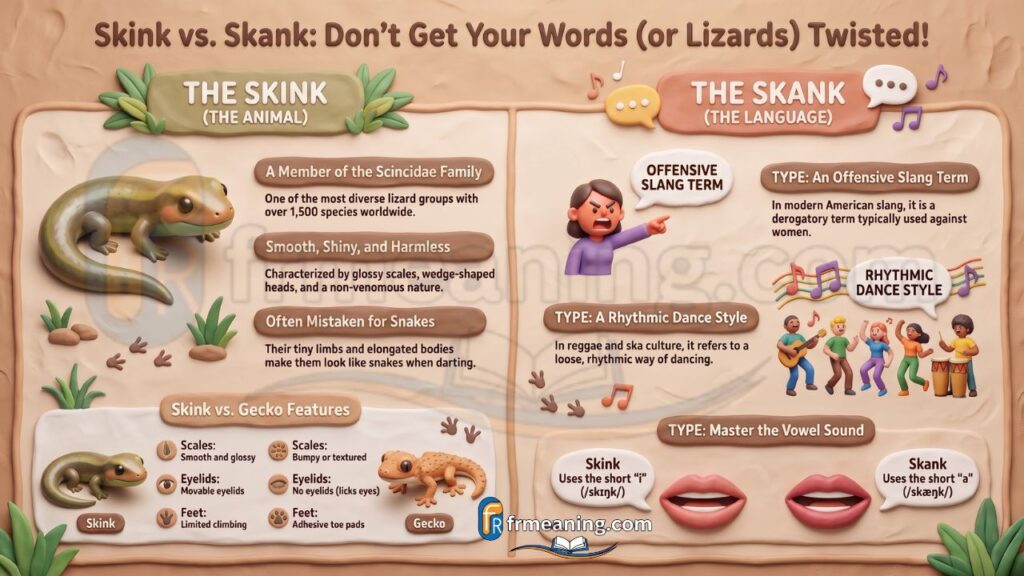
A skink is a small to medium-sized lizard belonging to the lizard family Scincidae, one of the largest and most diverse reptile families on Earth. So yeah — skink → belongs to → lizard family Scincidae, that’s a fact you can take to the bank.
Skinks are found basically everywhere except the coldest regions — deserts, forests, and yes, probably your backyard if you live somewhere warm. There’s over 1,500 known skink species worldwide, which honestly is more than most people realize. Some are burrowers, some climb, some just chill in leaf piles all day doing lizard things.
Skink Lizard Basics: What Makes Them Different
Unlike your typical gecko or garden variety reptile, skinks have a distinct look. Here’s what usually gives them away:
- Smooth, shiny scales (not rough or bumpy like other lizards)
- Small or reduced limbs — some species even look almost snake-like when they move
- Cylindrical, elongated bodies built for quick darting movements
- Wedge-shaped heads that help them burrow into soil or leaf litter
If you’ve ever seen a shiny little lizard zip across your patio in like half a second, that was probably a garden skink. They’re one of the most commonly spotted skink species in residential areas across the U.S., especially in the Southeast.
Skink vs Lizard: Aren’t They the Same Thing?
Technically, yes — a skink IS a lizard, but not every lizard is a skink. Think of it like this: all skinks are lizards, but not all lizards are skinks. Skink vs lizard isn’t really an “either/or” comparison, it’s more of a category thing. Lizard is the umbrella term (which includes geckos, iguanas, chameleons, and skinks), while skink refers specifically to members of the Scincidae family.
This trips a lot of people up honestly, and it’s a fair mistake to make when you’re not into reptiles.
Skink vs Gecko: The Real Differences
People confuse these two a LOT, probably because both are small lizards you spot darting around outside. But there’s some clear differences:
| Feature | Skink | Gecko |
|---|---|---|
| Scales | Smooth and glossy | Often bumpy or textured |
| Eyelids | Have movable eyelids | Most lack eyelids (they lick their eyes) |
| Limbs | Sometimes reduced or tiny | Fully developed legs, adhesive toe pads |
| Climbing ability | Limited, mostly ground-dwellers | Excellent — geckos can climb walls |
| Sound | Silent | Some gecko species chirp or click |
So if you see something climbing straight up a wall, that’s probably not a skink — geckos have those sticky toe pads that let them do that. Skinks stay pretty grounded.
Skink vs Salamander: Don’t Get These Mixed Up Either
Here’s a fun one — skinks are reptiles, salamanders are amphibians. Totally different animal classes. Salamanders have moist, slimy skin and usually need to stay near water, while skinks have dry, scaly skin and can handle drier environments just fine. If it feels slimy, it’s probably not a skink.
Are Skinks Poisonous? (People Ask This a Lot)
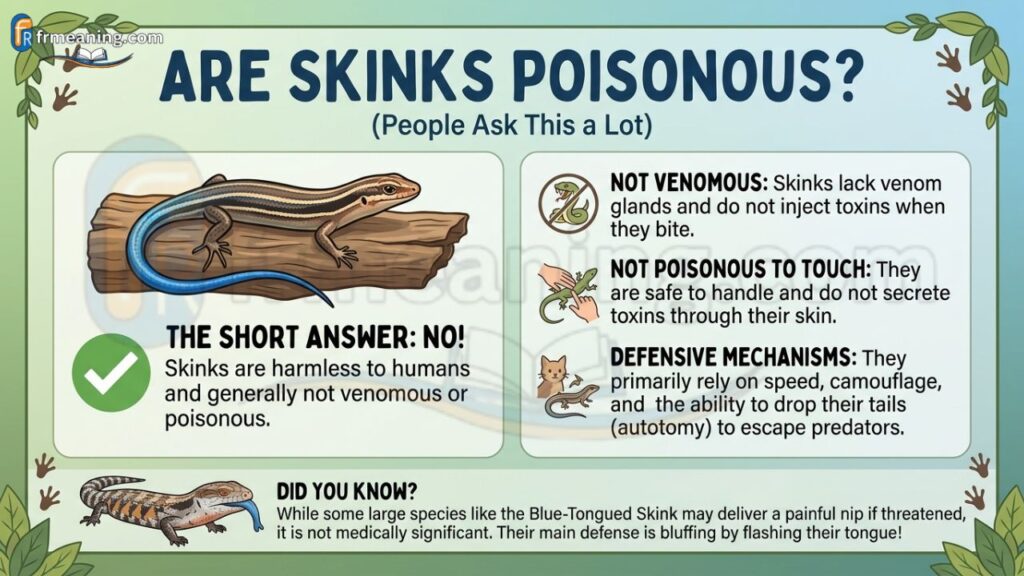
No, skinks are not poisonous, and they’re generally considered harmless to humans. Most skink species are shy and will bolt the second they sense movement nearby. Skinks → pose → no venom threat to humans, which is honestly one of the more reassuring facts in this whole article if you’re someone who panics at reptiles in the yard.
That said, some larger skink species can bite if they feel cornered or threatened, but it’s rarely more than a minor pinch — nothing dangerous.
Skink Snake Confusion: Why Do People Think They’re Related?
Some skink species have such tiny, reduced legs that from a distance (or if you’re moving fast and just glimpse it) they genuinely look like little snakes slithering through grass. This is where the “skink snake” search confusion comes from. But no, skinks are not snakes — they’re lizards that just evolved a body shape suited for burrowing and moving through tight spaces like leaf litter or loose soil.
Skink Size: How Big Do They Actually Get?
Most common skink species stay pretty small usually somewhere between 3 to 8 inches long including the tail. But not all of them stay tiny. The dragon basilisk skink and a few other larger species can grow significantly bigger, sometimes reaching over a foot in length depending on the species and habitat.
There’s also darker-colored varieties often searched as “skink black,” which typically refers to species with darker pigmentation for camouflage or temperature regulation purposes.
What Does Skank Mean? (Time to Cover the Slang Side)
Okay, shifting gears completely now — because skank couldn’t be further from a cute little garden lizard.
The skank meaning in modern American slang is derogatory, and it’s most often aimed at women, typically implying promiscuity or judging someone based on appearance. This falls straight into the category of offensive slang terms, and honestly, it’s one of those words that shows up a lot in conversations about sexist language in English.
Skank → is classified as → offensive slang term, and that classification isn’t up for debate in most modern style guides or educational contexts. It’s rarely, if ever, appropriate to use in polite or professional conversation.
Skank Meaning in Music, Dance, and Reggae Culture
Here’s where it gets interesting though because the word “skank” actually has a totally different, non-offensive meaning in music culture. In reggae and ska music scenes, “skank” refers to a dance move — a loose, rhythmic style of dancing that’s associated with ska and reggae beats.
So when someone says “skank meaning dance” or “skank meaning reggae,” they’re talking about a completely different usage rooted in Jamaican music culture from the 1960s onward.
This is actually a pretty important nuance that a lot of competitor content skips over entirely. Context in communication literally decides which meaning applies — is someone talking about a music genre or making an insult? Same word, wildly different intent.
Skank Meaning Drug Slang — Is That a Thing?

You might also come across “skank” used loosely in some regional or drug-related slang contexts, though this usage is far less common and not widely recognized in standard dictionaries.
It’s inconsistent enough that it’s not something you should rely on in writing — stick to the two main meanings (the offensive insult, and the ska/reggae dance term) since those are the ones actually documented and understood broadly.
Skank Pronunciation and Why It Gets Confused with Skink
Here’s something most articles never actually explain properly — the skank pronunciation breakdown.
- Skank is pronounced /skæŋk/ — a short “a” sound, like in “bank” or “tank”
- Skink is pronounced /skɪŋk/ — a short “i” sound, like in “sink” or “pink”
Honestly? When you break it down phonetically like that, they don’t sound that similar. The confusion mostly comes from fast speech, regional accents, or just people not being familiar with one of the words at all (most people know “skank” way more commonly than “skink,” so their brain autocorrects to the word it recognizes).
This is a gap most competitor articles just gloss over — they say “these words sound alike” without ever explaining the actual phonetic difference.
Skank vs Skunk: Another Common Mix-Up
Just to clear this up too — skank vs skunk is a totally separate confusion. A skunk is a mammal known for its smelly defensive spray, completely unrelated to either skank or skink. Skunk, skank, skink — three different words, three completely different meanings, and honestly it’s easy to see why English learners especially get tripped up here.
Is “Skank” a Scrabble Word?
Yes, actually — “is skank a scrabble word” comes up a lot, and the answer is yes, it’s valid in most official Scrabble dictionaries (including the TWL and SOWPODS word lists used in tournament play). Same goes for “skink” — both are valid, playable words if you’re stuck with a rough letter combo during game night.
Etymology: Where Do These Words Actually Come From?
This is a section most competitor content skips completely, but it matters if you actually want to understand these words properly.
Skink traces back to the Latin word scincus, which itself came from the Ancient Greek skinkos. Naturalists and scholars used this term for centuries to describe smooth-scaled lizards, and it eventually made its way into English through scientific and zoological writing.
Skank, on the other hand, has murkier and more debated origins. Some linguists trace it to British slang from the mid-20th century, possibly linked to Caribbean or Jamaican dialects (which lines up with its early use in ska and reggae dance culture).
The derogatory meaning developed later, likely through slang evolution in American English during the late 20th century. Unlike “skink,” which has a stable scientific root, “skank” is a good example of how slang vs scientific terms evolve completely differently over time one stays fixed, the other shifts with culture.
Skink as a Pet: Can You Actually Keep One?

Believe it or not, some skink species make surprisingly good pets. The blue-tongued skink is probably the most popular pet species, known for being pretty docile and low-maintenance compared to other reptiles.
If you’re considering a skink dog search (meaning: is it safe around pets like dogs), generally skinks will just avoid confrontation and flee rather than engage, so they’re not a threat to household pets, though supervision is always smart with any small reptile and larger animals around.
Is It Okay to Touch Skinks?
Generally yes, skinks can be handled gently, though wild skinks may be stressed by handling and could drop their tail as a defense mechanism (a trait called autotomy, common in many lizard species). Pet skinks that are used to handling tend to tolerate it just fine.
Why Getting This Right Actually Matters
Look, at the end of the day, skank vs skink isn’t just a fun trivia fact — it’s a genuine lesson in language sensitivity and inclusive language usage. Using the wrong word in the wrong context can range from mildly funny (calling a lizard a slang insult) to genuinely offensive (the reverse). Writers, students, and honestly anyone communicating in English professionally should understand this distinction clearly.
Correct word usage → depends on → audience, tone, and context — that’s really the core takeaway here. Whether you’re writing a nature blog about a skink lizard you spotted in your yard, or discussing derogatory language examples in a linguistics class, knowing exactly which word fits where keeps your writing accurate and respectful.
Frequently Asked Questions
What is a skink in English?
A skink is a type of lizard belonging to the family Scincidae, known for smooth scales and small limbs.
Is a skink harmless?
Yes, skinks are generally harmless, non-venomous, and tend to flee rather than confront humans or pets.
What does “skink” mean in slang?
Skink has no common slang meaning; it’s used almost exclusively as the scientific and everyday name for this lizard.
Is skink a snake?
No, a skink is a lizard, not a snake, though some species have reduced limbs that resemble snake movement.
What is another name for a skink?
There’s no single common alternative name, though specific species like “blue-tongued skink” refer to particular varieties.
What do skinks eat?
Skinks primarily eat insects, spiders, worms, and occasionally small plants or fruit, depending on the species.
What is a skink good for?
Skinks help control insect populations naturally and play a useful role in garden and ecosystem balance.
Why is it called a skink?
The name comes from the Latin “scincus” and Ancient Greek “skinkos,” historical terms used for smooth-scaled lizards.
Is it okay to touch skinks?
Generally yes, though wild skinks may drop their tail if stressed, so gentle handling is recommended.
Is a skink a pet?
Yes, certain species like the blue-tongued skink are popular, low-maintenance pets among reptile owners.
What does a skink symbolize?
In some cultures, skinks and lizards broadly symbolize adaptability, quick thinking, or renewal due to their tail regeneration.
Can a skink lizard bite?
Yes, though rarely, and typically only when they feel cornered or threatened — bites are minor and non-venomous.