

Have you ever received a message containing RT and paused for a second wondering what it actually means? You’re not alone. Digital communication changes fast, and new abbreviations appear almost every day. While some internet slang fades away quickly, RT has remained one of the most widely used abbreviations across texting, social media, and online conversations.
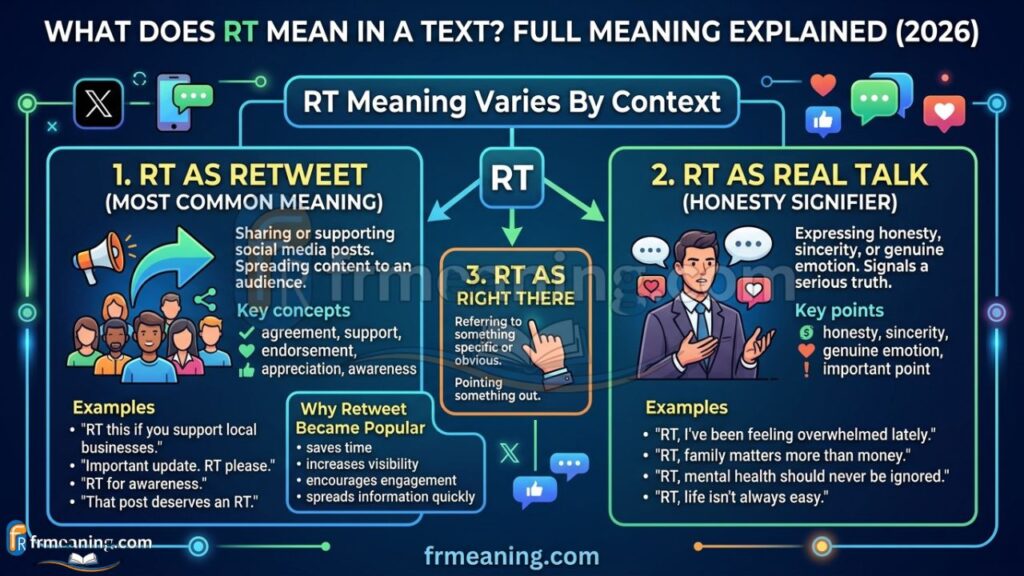
If you’re searching for what does RT mean in a text, the simple answer is that RT can mean Retweet, Real Talk, or sometimes Right There. The correct meaning depends entirely on the context of the conversation. That’s where many people get confused.
In this complete guide, you’ll learn the meaning of RT in text messages, social media posts, online discussions, and modern digital communication. You’ll also discover real-life examples, platform-specific uses, common mistakes, and how RT compares with similar internet slang terms.
What Does RT Mean in a Text?
RT most commonly means Retweet or Real Talk in modern texting and social media communication.
The abbreviation has multiple meanings, which is why understanding the surrounding words is important. Context decides everything.
The three most common meanings are:
- Retweet – Sharing or supporting a social media post.
- Real Talk – Expressing honesty or serious truth.
- Right There – Referring to something specific or obvious.
Although all three meanings exist, Retweet remains the most recognized interpretation online.
The Origin of RT
Before social media became a major part of daily life, abbreviations mainly appeared in SMS messages due to character limits. As online communication evolved, platforms introduced new shorthand expressions.
The abbreviation RT became popular through Twitter, now known as X. In the early days, users manually copied another person’s tweet and added “RT” before it to indicate they were sharing someone else’s content.
Eventually, the platform introduced a built-in retweet feature, but the abbreviation remained part of internet culture. Over time, people started using RT outside Twitter, giving it additional meanings like Real Talk.
This evolution shows how digital culture drives language development. New terms emerge, spread rapidly, and become part of everyday conversations.
RT as Retweet: The Most Common Meaning
When most people see RT online, they immediately think of Retweet.
What Does Retweet Mean?
A retweet is the act of sharing another person’s post with your own audience. It helps spread information, opinions, news, and entertaining content.
In simple terms:
RT → shares → content
This semantic relationship has become deeply connected with social media communication.
People often use RT to show:
- Agreement
- Support
- Endorsement
- Appreciation
- Awareness
Examples of RT as Retweet
Consider these examples:
- “RT this if you support local businesses.”
- “Important update. RT please.”
- “RT for awareness.”
- “That post deserves an RT.”
In each example, RT refers to sharing content with others.
Why Retweet Became Popular
Several factors contributed to the popularity of RT:
- It saves time.
- It’s easy to understand.
- It increases visibility.
- It encourages engagement.
- It spreads information quickly.
Modern social media rewards speed, and RT fits perfectly into that environment.
RT as Real Talk
The second most common meaning of RT is Real Talk.
What Does Real Talk Mean?
Real Talk signals honesty, sincerity, and genuine emotion. It tells readers that the speaker is about to express something meaningful or truthful.
The semantic relationship is simple:
Real Talk → signals → honesty
When someone uses RT in this way, they are usually emphasizing an important point.
Examples of RT Meaning Real Talk
Here are several examples:
- “RT, I’ve been feeling overwhelmed lately.”
- “RT, family matters more than money.”
- “RT, mental health should never be ignored.”
- “RT, life isn’t always easy.”
In these situations, RT introduces a serious statement rather than referring to social media sharing.
Why People Use Real Talk
People often choose RT instead of writing “Real Talk” because:
- It’s shorter.
- It’s trendy.
- It creates emphasis.
- It instantly sets the tone.
In texting culture, brevity matters, and RT communicates a lot using only two letters.
RT as Right There
A less common but still valid meaning of RT is Right There.
What Does Right There Mean?
Right There refers to something specific, obvious, or nearby within a conversation.
Examples include:
- “The answer is RT on the screen.”
- “Look RT beside the photo.”
- “It’s RT in front of you.”
Although this interpretation exists, it appears much less frequently than Retweet or Real Talk.
How Context Determines the Meaning of RT
One of the biggest challenges with internet slang is that the same abbreviation can have multiple meanings.
Fortunately, context usually makes the intended meaning clear.
| Situation | Likely Meaning of RT |
|---|---|
| Social media sharing | Retweet |
| Honest conversation | Real Talk |
| Directions or references | Right There |
| Online marketing discussion | Retweet |
| Emotional text message | Real Talk |
Remember this simple rule:
Context → determines → RT meaning
Reading the surrounding words almost always reveals the correct interpretation.
RT Meaning on Different Social Media Platforms
Different platforms influence how people use abbreviations.
RT on X (Twitter)
On X, RT nearly always means Retweet.
Examples:
- “RT if you agree.”
- “Please RT this update.”
- “RT for visibility.”
The platform’s history is directly connected to the abbreviation.
RT on Instagram
Instagram users often use RT in comments and captions.
Examples include:
- “RT if this made you smile.”
- “Big mood. RT.”
- “Definitely RT.”
Sometimes it means agreement rather than literally reposting content.
RT on WhatsApp
On WhatsApp, RT frequently means Real Talk.
Examples:
- “RT, you need some rest.”
- “RT, that’s exactly how I feel.”
- “RT, relationships require effort.”
Since WhatsApp focuses on personal communication, Real Talk appears more often.
RT on TikTok
TikTok users commonly use RT to express agreement with a video.
Examples:
- “RT!”
- “Huge RT.”
- “This deserves an RT.”
In comment sections, RT often acts as a quick endorsement.
RT on Facebook
Facebook users may use RT when discussing posts, opinions, or social issues.
The abbreviation often serves as a digital sign of approval or support.
RT in Text Messages Between Friends
Among friends, RT usually works as a shortcut for agreement.
Consider this conversation:
Friend A: “Gas prices keep rising.”
Friend B: “RT.”
Friend A: “It’s getting expensive.”
Friend B: “RT, seriously.”
Here, the abbreviation replaces a longer response such as:
- I agree.
- Exactly.
- That’s true.
- You’re right.
That’s one reason RT remains popular in texting culture.
RT in Professional Communication
While RT works well in casual conversations, it’s generally not appropriate in formal communication.
Avoid using RT in:
- Business emails
- Academic papers
- Legal documents
- Official reports
- Professional presentations
Instead, use complete phrases such as:
- I agree.
- I support this statement.
- This should be shared.
- This is an important point.
Professional communication values clarity over shorthand expressions.
Why RT Became So Popular
Many internet abbreviations disappear after a few years, but RT has remained relevant.
Several reasons explain its staying power.
It Saves Time
Short messages are easier to type and read.
It Expresses Agreement Quickly
Users can respond instantly without writing lengthy replies.
It Works Across Platforms
Unlike some slang terms tied to a single platform, RT appears almost everywhere.
It Adapts to Different Meanings
RT can represent sharing, honesty, or agreement depending on the situation.
That flexibility helps it survive changing trends.
RT Compared to Similar Internet Slang
Many abbreviations serve similar purposes.
Here’s how RT compares.
| Abbreviation | Meaning | Purpose |
|---|---|---|
| RT | Retweet / Real Talk | Sharing or agreement |
| TBH | To Be Honest | Honest opinion |
| FR | For Real | Agreement or emphasis |
| IMO | In My Opinion | Personal viewpoint |
| IKR | I Know Right | Strong agreement |
| FYI | For Your Information | Sharing information |
Although these terms overlap occasionally, each has a unique tone and purpose.
RT vs TBH
People often confuse RT and TBH.
RT
RT usually expresses agreement or introduces a truthful statement.
Example:
“RT, success takes patience.”
TBH
TBH introduces a personal opinion.
Example:
“TBH, I didn’t enjoy the movie.”
The difference is subtle but important.
RT vs FR
FR stands for For Real.
Both abbreviations communicate agreement, but FR sounds more conversational and emotional.
Examples:
- “FR, that’s amazing.”
- “RT, that’s true.”
RT often feels slightly more universal across different contexts.
How Brands and Marketers Use RT
One area competitors often overlook is marketing.
Brands regularly use RT to expand their reach.
Increasing Visibility
Companies encourage users to retweet promotional content.
Example:
“RT for a chance to win.”
Building Engagement
Retweets increase interaction and audience participation.
Spreading Awareness
Organizations use RT campaigns to promote causes, events, and announcements.
The relationship is straightforward:
RT → increases → content visibility
This explains why marketers continue encouraging retweets.
How RT Differs Across Generations
Not everyone uses RT the same way.
Teenagers
Younger users often use RT to signal agreement.
Example:
“RT, that’s facts.”
Millennials
Millennials frequently associate RT with Twitter culture and Retweets.
Professionals
Professionals recognize RT but generally avoid it in formal communication.
Content Creators
Creators use RT strategically to encourage sharing and audience growth.
Understanding these differences helps you interpret messages more accurately.
The Evolution of RT in Digital Culture
The history of RT reflects broader changes in online communication.
Originally, RT had one primary purpose: sharing tweets.
Over time, users adapted it for:
- Agreement
- Emotional honesty
- Community discussions
- Online engagement
This evolution demonstrates how language changes naturally within digital communities.
A phrase created for one purpose can eventually gain multiple meanings.
That’s exactly what happened with RT.
Common Mistakes People Make With RT
Many users misunderstand RT because they assume it always means the same thing.
Here are common mistakes.
Ignoring Context
RT can mean different things in different conversations.
Assuming It Always Means Retweet
Social media isn’t the only place people use RT.
Using It Professionally
Formal communication requires clearer language.
Overusing It
Too much slang can make messages harder to understand.
Being aware of these mistakes improves communication.
Real-Life Examples of RT Usage
Example 1
Person A: “Kindness matters.”
Person B: “RT.”
Meaning: Agreement.
Example 2
Person A: “Please RT this announcement.”
Person B: “Done.”
Meaning: Retweet.
Example 3
Person A: “RT, life moves fast.”
Meaning: Real Talk.
Example 4
Person A: “The answer is RT on the page.”
Meaning: Right There.
These examples show how context changes interpretation.
Is RT Positive or Negative?
RT is generally neutral or positive.
The tone depends on how it’s used.
Examples:
- “RT 😊” feels friendly.
- “RT!” feels enthusiastic.
- “RT.” feels serious.
- “RT 😂” feels playful.
Unlike some slang expressions, RT rarely carries negative meaning by itself.
Should You Use RT?
The answer depends on your audience.
Use RT when:
- Texting friends.
- Chatting online.
- Commenting on social media.
- Participating in digital communities.
Avoid RT when:
- Writing business emails.
- Preparing official documents.
- Submitting academic assignments.
- Communicating professionally.
Choosing the right language for the situation always matters.
The Future of RT in 2026 and Beyond
Internet slang changes rapidly, yet RT continues to survive because it serves practical purposes.
It remains:
- Short
- Flexible
- Familiar
- Easy to understand
- Widely recognized
As digital communication evolves, RT will likely remain part of online conversations for years to come.
New platforms may emerge, but the need for quick agreement and efficient sharing isn’t going away anytime soon.
Final Thoughts
If you’ve been wondering what does RT mean in a text, you now have the complete answer.
RT most commonly stands for Retweet, Real Talk, or Right There. The intended meaning depends on the context, platform, and conversation. In social media environments, RT usually refers to sharing content. In personal conversations, it often signals honesty or agreement.
The key takeaway is simple: Context determines RT meaning.
Once you understand the surrounding message, interpreting RT becomes surprisingly easy. Whether you’re texting friends, scrolling social media, or participating in online discussions, you’ll now recognize exactly what RT means and how people use it in modern digital communication.
FAQs
What does RT mean in a text message?
RT usually means Retweet or Real Talk. In social media discussions, it often refers to sharing content. In personal conversations, it commonly signals honesty, agreement, or a serious statement. The surrounding context helps determine the intended meaning.
Does RT always mean Retweet?
No. Although Retweet is the most common meaning, RT can also stand for Real Talk or Right There. Different platforms and conversations influence which interpretation is correct, so always consider the context before making assumptions.
Is RT considered internet slang?
Yes. RT is a popular internet slang abbreviation used in texting, social media, and online communication. It became widely recognized through Twitter and later expanded into broader digital culture with additional meanings and uses.
Can I use RT in professional emails?
Generally, no. RT is best reserved for casual communication. Professional emails, reports, and business documents should use complete phrases instead of internet abbreviations to maintain clarity, professionalism, and credibility.