
So you got a text that just said “IMY” and now you’re sitting there staring at your phone like it’s some kind of riddle. Yeah, been there. Texting slang has this weird habit of squishing whole feelings into three or four letters, and honestly it can throw you off, especially when there’s no context attached to it.
What makes this one a little trickier than most is that What Does IMY Mean in Text isn’t a one-size-fits-all answer the same four letters can feel warm and sincere, or totally casual, depending entirely on who sent it and when.
This guide breaks down exactly what IMY means, how real people actually use it across different chats and platforms, and how you should respond so you don’t accidentally read too much (or too little) into it.
What Does IMY Mean In Text?
IMY stands for “I miss you.” That’s the short answer, plain and simple.
It’s a shorthand emotional expression that people use in digital communication to express absence-based affection, basically saying “hey, I notice you’re not around and I feel that.” Linguistically speaking, IMY falls under the category of initialisms — where every single letter stands in for a whole word. Semantically, the core of it always circles back to emotional distance, whether that distance is physical (like someone moved away) or relational (like you just haven’t talked in a while).
From a social encoding standpoint, IMY lets people express a bit of vulnerability without writing some big emotional paragraph they might feel weird about later. IMY → belongs to category → Initialism (linguistic shorthand), and that classification alone explains why it’s spread so fast across English-speaking digital spaces. Communication moves quick these days, and people want quick tools that still carry weight.
In terms of pure communication economy, IMY takes a full sentence like “I really miss having you around” and crushes it down to three characters. Fast, repeatable, and it fits into basically any texting rhythm without slowing the conversation down.
Most Common IMY Meaning In Text
The most common meaning shows up when someone genuinely feels the absence of another person and wants to say so without making a whole thing out of it.
This usually pops up in situations like long-distance relationships, after a stretch of radio silence, or during those random nostalgic moments where you just start thinking about someone. The trigger is almost always silence, distance, or a memory that hits out of nowhere.
Example: “I haven’t seen you in days… IMY”
Socially, this signals genuine affection and emotional attachment, even when it’s typed out casually with zero punctuation.
Common IMY Meaning
Sometimes IMY gets used in a lighter way — basically just to reconnect or keep a conversation feeling warm without cranking up the emotional intensity.
People lean on it when they want to show friendliness without it turning into a Big Moment.
Example: “IMY, we need to hang out soon”
Here it’s really just signaling social closeness, not deep longing.
Less Common IMY Meaning
In some chats, IMY starts to feel routine, almost habitual, rather than something loaded with meaning.
This tends to happen in ongoing conversations where it gets used so often it kind of loses its punch.
Example: “Goodnight, IMY”
At this point it functions more like a conversational filler that still carries a little emotional tone, but nothing heavy.
Rare IMY Meaning
On rare occasions — and I mean rare — IMY gets read as “I’m Yours” in romantic or poetic contexts.
You’ll mostly spot this in captions, song lyric references, or messages that are already leaning dramatic or expressive.
Example: “Always yours… IMY”
This meaning is niche, and honestly you’d need a lot of surrounding context clues to land on this interpretation instead of the standard one.
Origin And Evolution Of IMY
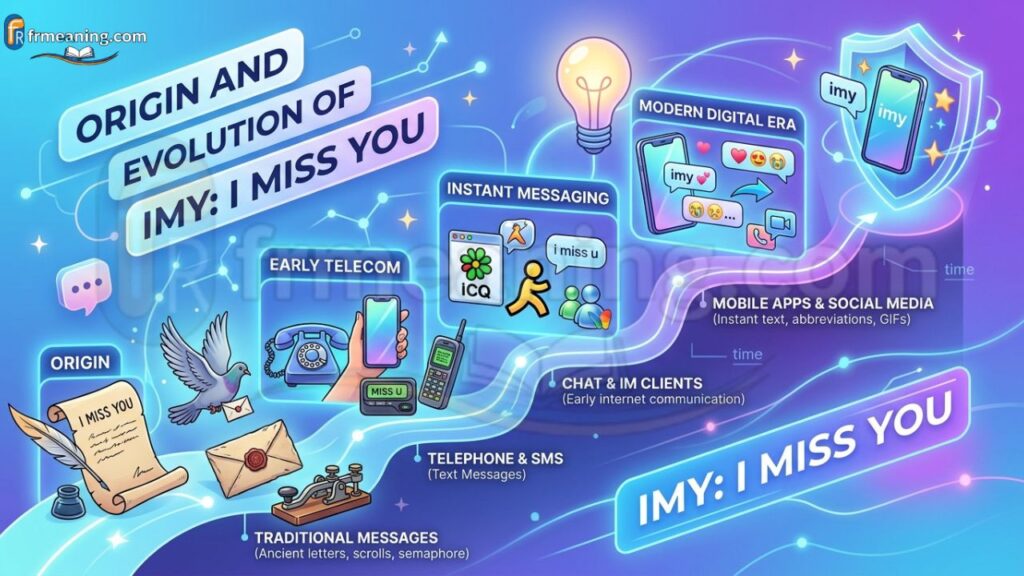
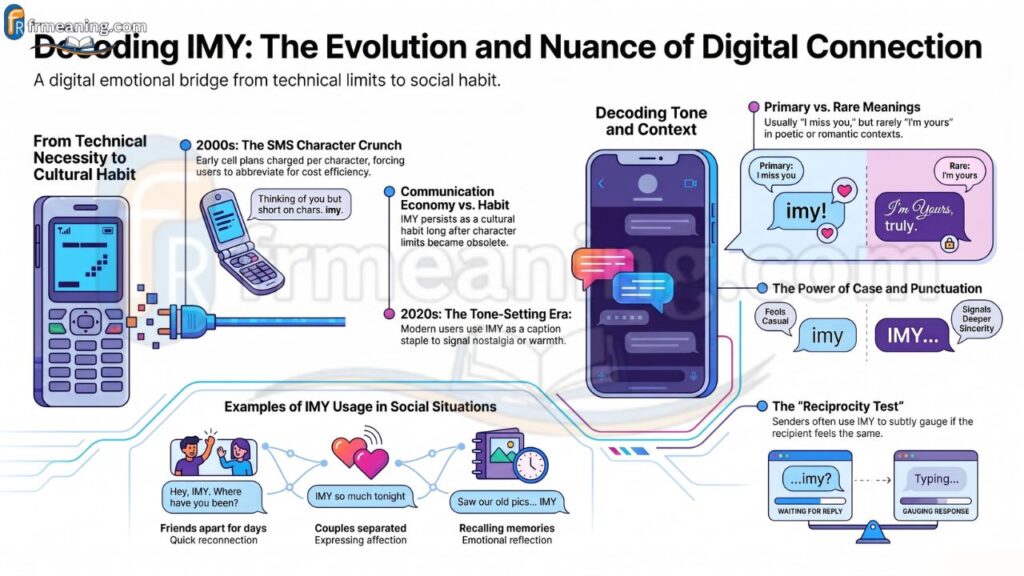
IMY traces its roots back to early SMS texting culture, back when phones charged you per character or capped messages at 160 characters, so abbreviating literally saved money and time. Think early-to-mid 2000s flip-phone era, when typing out “I miss you” on a T9 keypad was genuinely annoying and slow.
From there, IMY carried over into instant messaging platforms like AIM and MSN Messenger, and later got a second wind once smartphones and social apps took over. Its simplicity and emotional clarity made it stick around, especially among younger users who were already fluent in abbreviation culture from years of texting on a budget.
A Closer Look At The Timeline
Most articles on this topic gloss over the actual history, so here’s a bit more detail on how IMY evolved over time:
- Early 2000s: Character-limited SMS plans push users toward abbreviations like IMY, BRB, and TTYL.
- Mid-to-late 2000s: Instant messaging platforms (AIM, MSN, Yahoo Messenger) normalize initialisms in casual chat.
- 2010s: Smartphones and unlimited texting plans remove the need for abbreviation, but IMY sticks around because it’s become a habit, not a necessity.
- 2020s: Social platforms like Snapchat, TikTok, and Instagram give IMY a second life as a caption and comment staple, often stripped of urgency and used more for tone-setting than efficiency.
So really, communication economy → drives → adoption of IMY, but cultural habit is what kept it alive long after character limits stopped mattering.
Psychological And Emotional Meaning Of IMY
Psychologically, IMY reflects a basic human need for connection and a little reassurance. It’s a way of saying “I still think about you” without writing something that feels too exposed or intense.
It can also work as a subtle test of reciprocity — people who send IMY are often, whether they admit it or not, hoping to get a similar reply back. If that reply doesn’t come, it can sting a bit, even if the original message was sent casually.
Communication Function Of IMY
IMY functions basically as an emotional bridge between two people. It reconnects conversations that have gone quiet, softens awkward silences, and reinforces whatever relationship is already there.
It also works well as a conversation starter when things have slowed down. IMY → functions as → a low-pressure reconnection tool, which is exactly why it shows up so often after a lull in texting.
Cultural And Generational Context Of IMY
Younger generations, especially Gen Z, tend to toss IMY around more casually and more often — sometimes multiple times a day in a group chat. Older users, on the other hand, may read it as more serious or sincere simply because they’re less used to seeing it thrown around lightly.
Across different cultures, the core meaning generally holds steady, but emotional intensity can shift depending on how openly a culture tends to express feelings. Some cultures view any expression of missing someone as a big deal; others treat it like a passing comment.
Why IMY Became Popular
Its popularity really comes down to three things: simplicity, emotional clarity, and speed. It fits perfectly into fast digital conversations where people want to express something real without slowing everything down with a full sentence.
Semantic Core Meaning Of IMY
At its core, IMY → communicates → emotional absence and a desire for presence, whether that presence is physical (being in the same room) or just conversational (getting a reply back).
Most Common IMY Meaning In Text (Deep Dive)
What It Means
IMY expresses missing someone, plain and simple, but the actual tone can swing anywhere from deeply emotional to just friendly-casual depending on the situation it’s used in.
Typical Use Cases
| Situation | Why The Slang Is Used | Example |
|---|---|---|
| Friends haven’t talked in days | Quick emotional reconnection | “Hey, IMY. Where have you been?” |
| Couples apart physically | Express affection simply | “IMY so much tonight” |
| Thinking about past moments | Emotional reflection/nostalgia | “Saw our old pics… IMY” |
Examples In Different Tones
- “IMY, come back soon”
- “IMY lol we haven’t talked”
- “IMY fr”
- “IMY so bad right now”
- “IMY, text me when free”
What It Can Sound Like
Sincere: Feels heartfelt mostly because of timing. Example: “IMY… it’s been hard without you”
Casual: Feels light because of relaxed, low-effort wording. Example: “IMY haha we need to chill”
Distant: Feels routine when it’s overused. Example: “IMY, goodnight”
Meaning Based On Context
Positive Use: Warm and affectionate tone, made obvious by emotional timing and sincerity. Example: “IMY, can’t wait to see you”
Neutral Use: Friendly but not intense, shown through casual phrasing. Example: “IMY, we should catch up”
Negative Or Critical Use: Carries a slight guilt or pressure undertone, made obvious by implied absence. Example: “IMY… you never text anymore”
Dry Or Rushed Use: Low effort, usually standalone. Example: “IMY”
The meaning stays constant — missing someone — but the tone shifts hard depending on delivery, punctuation, and timing.
How IMY Is Used In Real Conversations

Understanding Or Clarifying: Used to reopen communication after silence. Example: “IMY, everything okay?”
Reacting Or Labeling: An emotional reaction to a memory. Example: “That reminded me of you… IMY”
Social Or Dating Context: Used to build emotional closeness in romantic settings. Example: “IMY already after today”
Group Or Online Context: Used to maintain bonds within friend groups. Example: “IMY guys, group chat is dead”
Gaming Context: Used to reconnect socially with gaming friends. Example: “IMY bro, we haven’t gamed in weeks”
Relationship → sustained by → repeated small check-ins like IMY, and that’s really the social glue holding a lot of these casual friendships together online.
IMY Meaning On Different Platforms
IMY Meaning On Snapchat
Used inside streaks or private chats to maintain that emotional connection. Example: “IMY, send snaps”
IMY Meaning On TikTok
Often shows up in captions or comments expressing nostalgia. Example: “Old days… IMY”
IMY Meaning On Instagram
Used in captions, DMs, or comments for a quick emotional expression. Example: “IMY bestie”
IMY Meaning In Texting Or Messaging
Direct, personal, and pretty straightforward usage. Example: “IMY, call me later”
IMY Meaning On Discord Or Communities
Used casually among friends inside servers. Example: “IMY guys, where everyone at?”
Capitalization plays a small role too — “IMY” in all caps feels fairly neutral, while lowercase “imy” tends to feel softer, quieter, and more casual.
When To Use Vs When To Avoid IMY
When To Use: Use it when you’re reconnecting emotionally with someone. Example: “IMY, it’s been a while”
When To Avoid: Avoid it in formal or professional settings entirely. Example: not suitable for a work email, obviously.
Professional And Safe Alternatives
Instead of IMY, in professional contexts, go with full phrases like “I hope you’re doing well” — it reads warmer and doesn’t risk any weird misinterpretation from a colleague or client.
Hidden Or Risky Meanings Of IMY
Sometimes IMY can come across as a little manipulative if it’s used to guilt someone into responding. Example: “IMY… you don’t care anymore”
Context is really what determines whether this feels genuine or like it’s applying pressure. Same three letters, very different intent.
Variations And Forms Of IMY
IMYSM (I miss you so much): A more intense, amplified version. Example: “IMYSM, come back soon”
imy (lowercase): Feels softer and more casual than the capitalized version. Example: “imy, text me”
IMY Vs Similar Slang
IMY vs ILY: IMY expresses absence, while ILY → represents → love, a completely different emotional category. Example: “IMY today” vs “ILY always”
IMY vs MISS U: “MISS U” reads as more direct and spelled-out, while IMY feels more digital and shorthand-heavy. Example: “MISS U bro” vs “IMY bro”
How To Decode The Correct Meaning
- Look at the relationship context between you and the sender.
- Check the timing of the message — right after a fight, right before bed, out of nowhere?
- Analyze tone and punctuation (ellipses often signal something more sincere).
- Consider how frequently this person uses IMY in general.
- Evaluate the overall emotional intensity of the surrounding conversation.
How To Respond To IMY
Casual Replies: “Same here” or “IMY too”
Friendly Replies: “I miss you too, let’s talk soon”
Mature Or Respectful Replies: “I appreciate that, hope you’re doing well”
Boundary Or Privacy Responses: “I’ve been busy, but hope you’re good”
Common Misunderstandings About IMY
People often assume IMY always signals deep emotion, but honestly it can just as easily be casual or habitual depending on the context it shows up in. Don’t read a novel into three letters unless the rest of the conversation backs that reading up.
Regional And Cultural Usage Of IMY
While IMY is understood pretty widely across English-speaking regions, some cultures interpret it more seriously, particularly in places where open emotional expression isn’t the norm day-to-day.
Global Equivalents Of IMY
Most guides on this topic stop at “it varies by culture” without actually showing how. Here’s a quick look at comparable expressions in other languages, which helps explain why IMY doesn’t always translate one-to-one:
- Spanish: “Te extraño” is the direct equivalent, but Spanish-speaking texters often skip abbreviating it and just type the full phrase, since it doesn’t save much space.
- French: “Tu me manques” literally translates to “you are missing from me,” a slightly different grammatical framing than the English “I miss you,” which shows how emotional distance gets encoded differently across languages.
- Filipino/Tagalog texting culture: Uses “IM” or “miss na kita” in casual chats, often blended with English initialisms like IMY in code-switched conversations.
- Emoji substitution: In many non-English-dominant chats, people skip the initialism entirely and use emoji combos (🥺💭 or 😢❤️) to express the same sentiment IMY carries in English texting culture.
This shows that IMY → is culturally specific to → English-language digital shorthand, even though the underlying emotion (missing someone) is universal.
Conclusion
Understanding What Does IMY Mean in Text really goes beyond just knowing the definition. While it commonly translates to “I miss you,” the actual tone and emotional weight riding along with it depend heavily on context, timing, and the relationship between the two people texting. It can signal real affection, come across as casual friendliness, or just function as routine conversational filler depending on how it’s dropped into a chat. Once you start picking up on these small nuances, you’ll find it a lot easier to read messages accurately and respond in a way that actually fits the moment. At the end of the day, IMY is a small phrase doing a lot of emotional work — simple on the surface, but genuinely rich in meaning once you know what to look for.
Frequently Asked Questions
Does IMY Always Mean Love?
No, it usually just means missing someone — it’s not automatically tied to romantic love in most contexts.
Is IMY Romantic?
It can be, especially between couples, but it’s also used casually and often between friends.
Can IMY Be Casual?
Yes, definitely — especially in regular, ongoing conversations where it’s used frequently and loses intensity.
What’s Stronger Than IMY?
IMYSM (“I miss you so much”) or writing out a full, sincere emotional sentence instead.
Is IMY Safe For Work?
Generally yes, but it’s still best to avoid it in formal emails or professional settings.
Why Do People Use IMY Instead Of Typing It Out?
It’s faster, feels less intense, and fits naturally into quick, casual digital conversations.
Does Capitalization Change What IMY Means?
Not the core meaning, but lowercase “imy” often reads as softer and more casual than “IMY.”