
Ever gotten a text back that just says “IDGAF” and had to sit there for a second wondering what it even means? Yeah, you’re definitely not the only one. Internet slang moves fast, and honestly, if you’re not chronically online, some of these abbreviations can leave you scratching your head.
Understanding the IDGAF meaning in text is actually pretty important these days, because this one shows up everywhere texts, Instagram captions, Reddit threads, you name it.
Unlike a lot of the softer texting abbreviations floating around, this one hits different. It’s blunt, it’s got some attitude, and it’s not something you’d wanna type in a work email (trust me on that one).
In this guide we’re gonna break down what IDGAF actually stands for, where it came from, how people use it in real conversations, plus we’ll clear up a bunch of the confusing variations people search for things like idgf meaning, igaf meaning in chat, and even that weird idgafwabgtsam thing that keeps popping up.
IDGAF Meaning in Text + Definition
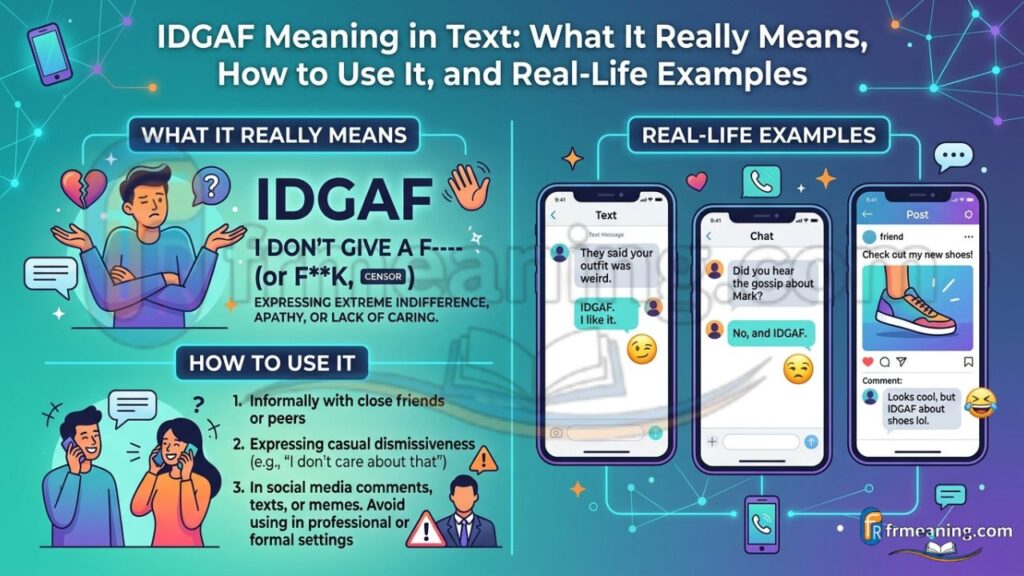
IDGAF stands for “I Don’t Give a F*”** — it’s a slang term people use when they wanna express that they really don’t care about a person, situation, or opinion.
Because it contains a swear word, IDGAF is strictly informal. You’ll mostly see it flying around between friends, in casual group chats, or on social media captions where people wanna sound bold and unbothered. It’s not the kind of thing you drop in a customer service chat or a school assignment (learned that the hard way once, don’t ask).
Quick Definition Table
| Term | Meaning |
|---|---|
| IDGAF | I Don’t Give a F*** |
| Usage | Expressing strong indifference |
| Tone | Blunt, informal, emotionally charged |
| Common Platforms | Texting, TikTok, Instagram, X, Reddit, Discord |
| Formal Use | Not recommended, avoid in professional settings |
What Does IDGAF Mean in a Text Message?
When somebody texts you just “IDGAF,” they’re basically telling you they don’t care about whatever’s being discussed. Simple as that, but the emotion behind it can shift depending on context.
Depending on the convo, it might express:
- Complete indifference toward an outcome
- Frustration after a long argument
- Confidence in a personal decision
- Defiance against criticism
- Dismissal of someone else’s opinion
Because there’s profanity baked right into the acronym, the tone lands way stronger than just typing “I don’t care.”
Example: Friend: People are talking about your outfit. You: IDGAF. I’m wearing what I like.
Here the person’s not being rude, they’re just showing confidence and shrugging off other people’s judgment.
The Origin of IDGAF (And Its Timeline)
Like most internet abbreviations, IDGAF grew alongside the rise of texting and early online forums back in the 2000s, when SMS character limits made people shorten literally everything they typed. “I Don’t Give a F***” got compressed into IDGAF because, well, nobody wants to type all that out on a flip phone keyboard.
The abbreviation really took off in stages:
- Early-to-mid 2000s — Started circulating in gaming forums and early instant messaging platforms like AIM and MSN Messenger.
- 2010s — Spread onto Twitter (now X) and Facebook as social media use exploded and shorter, punchier expressions became the norm.
- Mid-2010s onward — Picked up serious momentum thanks to pop culture, including songs and captions that leaned into the “IDGAF attitude” as a whole personality trait, not just a phrase.
- 2020s — Became a TikTok and Instagram staple, often used in captions to signal confidence, independence, or a “done with the drama” vibe.
Today, IDGAF is basically one of the most recognized indifference-expressing slang terms on the internet, right up there with IDC and SMH.
How IDGAF Is Used Today
The core meaning stays the same, but the way people deploy IDGAF really depends on the platform and the crowd they’re talking to.
1. Text Messaging
Friends throw this around casually all the time in one-on-one chats.
Example: “Honestly, IDGAF what they think.”
2. Social Media Captions
A ton of users post idgaf meaning in chat-style captions to project confidence or independence, especially on Instagram and TikTok.
Example: “Living my life. IDGAF about the drama.”
3. Online Discussions and Forums
On Reddit or comment sections, people sometimes drop IDGAF to shut down an argument or signal they’re checking out of the debate.
Example: “Believe whatever you want. IDGAF.”
4. Gaming Chats
Gamers use it a lot when reacting to criticism, trash talk, or a rough loss.
Example: “IDGAF. It’s just a game.”
Examples of IDGAF in Text Conversations
Here’s a breakdown of common examples across different emotional tones, because IDGAF really isn’t a one-note phrase.
Confident Tone
| Situation | Example |
|---|---|
| Ignoring opinions | “IDGAF what people say.” |
| Personal choices | “IDGAF if they don’t like it.” |
| Social media | “IDGAF. I’m doing what’s best for me.” |
Frustrated Tone
- “At this point, IDGAF anymore.”
- “Honestly, IDGAF about all this.”
- “IDGAF what they heard.”
Humorous Tone
- “IDGAF. I’m sleeping all day.”
- “IDGAF. I’m eating pizza tonight.”
- “IDGAF, tell me how it ends.”
Tone of IDGAF in Texting
Generally speaking, IDGAF carries a strong and emotional tone. It’s not one of those neutral texting abbreviations you can toss in without a second thought — it usually means the person feels something pretty strongly, whether that’s confidence, frustration, or just plain exhaustion with a topic.
Depending on the conversation, it can come across as:
- Confident
- Defiant
- Frustrated
- Angry
- Dismissive
- Humorous
Since it includes profanity, readers who don’t know you well might read it as aggressive, even if you didn’t mean it that way. Context really matters here, and so does knowing your audience.
Friendly Tone
Among close friends, IDGAF is often just playful. Example: “IDGAF, let’s order dessert.”
Strong Tone
In a heated moment, it can sound bold and unapologetic. Example: “IDGAF what anyone thinks.”
IDGAF vs Similar Texting Abbreviations
A bunch of abbreviations express similar feelings, but they’re not interchangeable — each one carries its own weight.
| Abbreviation | Meaning | Usage |
|---|---|---|
| IDGAF | I Don’t Give a F*** | Strong indifference |
| IDC | I Don’t Care | Milder version |
| IDK | I Don’t Know | Uncertainty |
| IMO | In My Opinion | Personal opinion |
| SMH | Shaking My Head | Disappointment |
| TBH | To Be Honest | Honest opinion |
IDGAF → is a stronger version of → IDC. IDGAF includes profanity, sounds way more emotional, and lands with more force. IDC, on the other hand, is softer and more appropriate for everyday, low-stakes conversations.
Example comparison:
- IDC if they disagree.
- IDGAF what they think.
Common Variations, Typos, and Confusing Spinoffs
This is where things get a little messy, because people search for all kinds of near-matches and typos when they’re trying to figure out what a text meant. Let’s clear a few of these up.
- Idgf meaning — this is usually just a typo or shorthand slip of IDGAF, missing the second “A.” It means the same thing: “I don’t give a f***.”
- Igaf meaning in chat — another common typo variation, again referring back to the core IDGAF phrase.
- Idaf meaning in chat — same deal, a dropped letter that still points back to “I don’t give a f***.”
- Idgafer meaning in chat — this one’s a playful noun form, basically describing a person who has an “IDGAF attitude,” aka someone who genuinely doesn’t care what others think.
- Idgac meaning in text — less common, but usually used as a lighter, censored-feeling variation of IDGAF in certain group chats.
- Idgas meaning — stands for “I don’t give a sh*t,” a close cousin to IDGAF with a slightly different swear word swapped in.
- Idgaf meaning in Instagram — functions exactly the same as in texting; it’s used in captions, comments, and bios to project a confident, unbothered vibe.
- Idgaf lxne — this seems to be a stylized or misspelled reference some users type when searching for IDGAF-related content or captions, often tied to song lyrics or meme text on social platforms.
- What does idgafwabgtsam mean / idgafwabgtsam ikwtfidawtfidd — these are stacked, mega-acronyms that combine multiple slang phrases together (a trend some users do just for humor or shock value). They generally string together sentiments like “I don’t give a f*** what anybody but God thinks, so a**hole move,” though exact meanings shift depending on who’s using them and the context of the chat. Because they’re not standardized, it’s best to just ask the sender directly what they meant.
Why People Use IDGAF
There’s a handful of solid reasons this abbreviation stuck around and didn’t just fade out like other internet fads.
- Saves time — typing IDGAF is way faster than spelling out the full phrase.
- Shows strong emotion — it hits harder than a plain “I don’t care.”
- Popular on social media — captions and memes lean on it because it sounds bold.
- Fits casual conversations — among friends, it feels natural, not forced.
Alternative Ways to Say IDGAF
If you like the sentiment but wanna skip the profanity, there’s plenty of options depending on the setting.
Casual Alternatives
- I don’t care.
- It doesn’t bother me.
- I’m not worried about it.
- That’s their opinion.
Polite Alternatives
- I’m not concerned.
- It doesn’t affect me.
- I’m okay with that.
- I respect their opinion, but I disagree.
These softer phrases work a lot better in professional or respectful conversations where dropping profanity just isn’t gonna fly.
When Should You Use IDGAF?
Good situations include casual texting with friends, social media captions, memes, and gaming chats. Situations to avoid include professional emails, workplace Slack messages, school assignments, and customer service conversations — basically anywhere profanity could get you in hot water.
Since the phrase contains explicit language, it’s always worth pausing and thinking about who’s gonna read it before you hit send.
Regional, Generational, and Cultural Differences in IDGAF Usage
This part doesn’t get talked about enough, but honestly it matters. IDGAF usage differs quite a bit depending on generation and platform. Gen Z tends to use it more loosely and often ironically — sometimes it’s not even about genuinely not caring, it’s more of a meme-y way to react to something mildly annoying. Millennials, on the other hand, tend to reserve it for moments of actual frustration or defiance, using it a bit more sparingly and with more intensity behind it.
There’s also a spoken-word element worth mentioning. When people say IDGAF out loud (which does happen, more than you’d think), it’s usually pronounced letter by letter — “eye-dee-gee-ay-eff” — rather than as one blended word, though some people do jokingly say it as “id-gaf” in a sing-songy way, especially when quoting a meme or song lyric.
Internationally, IDGAF has been adopted pretty widely in English-speaking online spaces, but it’s also crept into non-English chats as a borrowed English phrase, similar to how “lol” or “omg” get used across languages without translation. This kind of cross-cultural slang adoption shows just how far internet English has spread beyond native speakers.
Common Mistakes When Using IDGAF
Using it in professional settings is probably the biggest one — avoid IDGAF in workplace communication entirely because of the profanity. Assuming everyone’s comfortable with it is another mistake; some people genuinely find it rude, so read the room first. And lastly, confusing it with IDC — remember, IDGAF is much more intense than IDC, so don’t use them interchangeably if tone matters to you.
FAQ About IDGAF Meaning in Text
What does IDGAF mean in texting?
IDGAF stands for “I Don’t Give a F***,” expressing strong indifference toward a person, situation, or opinion.
What does IDGF mean in text?
IDGF is just a common typo or shorthand of IDGAF, meaning the exact same thing: “I don’t give a f***.”
What does IDGAD mean in text?
IDGAD typically stands for “I Don’t Give A Damn,” a slightly milder, less profane cousin of IDGAF.
What does “IGDAF” mean?
IGDAF is simply a letter-swap typo of IDGAF, carrying the identical meaning of not caring about something.
What is an IDGAF personality?
An IDGAF personality describes someone confident and unbothered by judgment, who prioritizes their own choices over others’ opinions.
Is IDGAF stronger than IDC?
Yes, IDGAF expresses much stronger, more emotionally charged indifference than the softer, everyday abbreviation IDC.
Can I use IDGAF at work?
No, it’s best avoided in professional settings entirely because it contains explicit profanity unsuitable for formal communication.