

Ever got a reply that just said “hn” and had absolutely no idea what to do with it? You’re not alone. The HN meaning in text is one of those things that seems simple on the surface but can actually carry a whole range of emotions — from a warm yes to a cold, dismissive brush-off. Two letters, but so much going on behind them.
Whether you’re texting a friend in Karachi, scrolling through a Wattpad story, or trying to decode a TikTok comment, understanding what HN means in different contexts can save you a lot of confusion. This guide breaks it all down — every platform, every tone, every use case.
What Does HN Mean in Text?
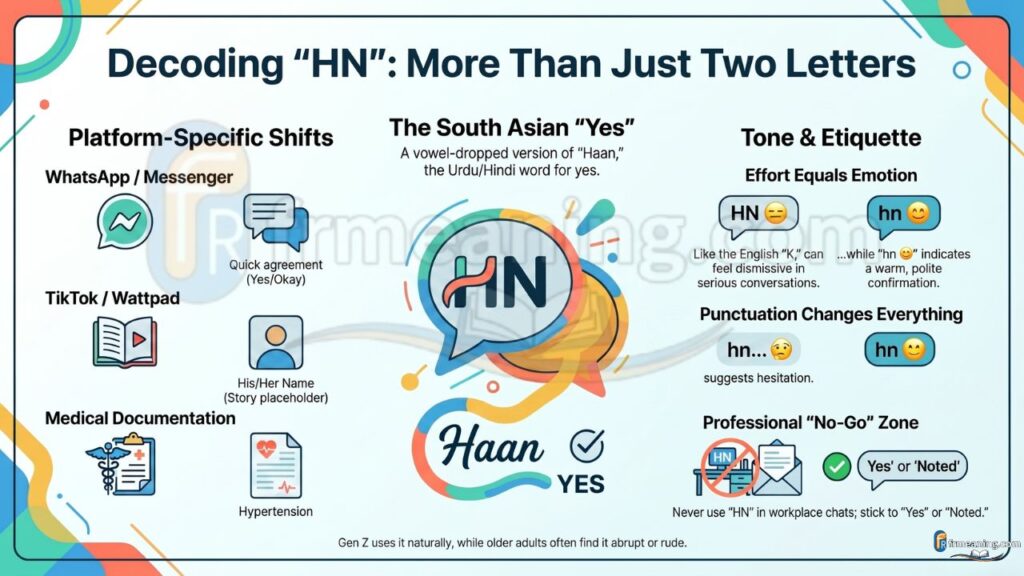
HN in text most commonly means “haan” — the Urdu and Hindi word for “yes.” It’s a compressed, casual version of the word that’s widely used in South Asian texting culture, especially in Pakistan and India.
Think of it like how English speakers type “k” instead of “okay.” It’s the same energy — fast, low-effort, and totally normal in the right context. But just like “k” can sometimes feel cold or passive-aggressive, hn carries tone too. Depending on what’s going on in the conversation, it can mean:
- A warm, soft yes
- A dry, neutral acknowledgment
- A slightly annoyed “yes, I heard you”
- A shy or hesitant confirmation
And then separately, H/N (with a slash) has a completely different meaning in fanfiction and TikTok content — but we’ll get to that.
HN Meaning in Text (Quick Overview Table)
| Context | What HN Means |
|---|---|
| General texting (South Asian) | Haan / Yes / Okay |
| WhatsApp & Messenger | Quick agreement or acknowledgment |
| Instagram DMs | Hmm / thinking / soft yes |
| TikTok (H/N) | His/Her Name (storytelling placeholder) |
| Wattpad & Fanfiction (H/N) | His/Her Name in reader-insert stories |
| Medical documentation | Hypertension |
| Romantic chat | Shy or soft confirmation |
| Group chats | Quick acknowledgment without effort |
The Origin of HN in Texting
HN comes directly from the Urdu word “haan” (ہاں), which is the standard way to say “yes” in Pakistan and across large parts of India. As mobile texting became popular in South Asia — especially with the rise of WhatsApp and SMS culture in the early 2010s — people naturally started shortening everyday words to type faster.
“Haan” became “han,” then eventually just “hn” — dropping the vowels entirely, the same way people drop them in other informal abbreviations. It’s a reflection of how language always adapts to the medium its being used in. Texting rewards speed, and hn is about as fast as it gets for saying yes.
This kind of vowel-dropping is actually super common in South Asian internet slang. You’ll see similar patterns with words like “kk” for “theek” (okay) or “toh” shortened even further in casual conversations. HN is simply the most widely used among them.
How HN Is Used in Everyday Text Conversations
The way hn is used in text depends almost entirely on tone, context, and your relationship with the person. Here’s a breakdown of the most common ways it shows up:
1. Soft, Polite Confirmation
This is the warmest version of hn. When someone is being agreeable and respectful, they might use it with a calm tone — sometimes followed by more words for clarity.
Mom: Aa gaye? You: hn bas pahunch gaya
2. Dry, Neutral Acknowledgment
Sometimes hn is just… hn. No emotion, no extra words. It means “yes, I got the message” and nothing more. Common in quick back-and-forth chats.
Friend: Assignment submit kiya? You: hn
3. Shy or Hesitant Yes
When someone isn’t totally sure or feels a little nervous about agreeing, they might send hn… with ellipsis. The pause communicates uncertainty even though the word technically means yes.
Someone: Tumhein pasand aya kya? You: hn…
4. Slightly Annoyed Agreement
If someone keeps repeating the same question, the hn that comes back can carry some real irritation behind it — even if the words look the same.
Friend: Sun raha hai? You: hn yaar sun raha hun
5. Half-Hearted Agreement
When someone agrees but clearly isn’t excited about it. The tone here is flat and a little disengaged.
Friend: Kal wahan chaltay hain? You: hn theek hai
6. Group Chat Quick Reply
In busy group chats where multiple people are responding, hn works as a fast “I’m in” or “got it” without cluttering the thread.
Group: Sab 8 bje ready? You: hn
7. Romantic Soft Confirmation
In a romantic or close conversation, hn can feel sweet and a bit shy — especially if the person pairs it with an emoji.
Them: Free ho call pe? You: hn 😌
8. Agreement Without Enthusiasm
This one is different from annoyance — it’s more like someone going along with something they don’t really care about. Passive, but not hostile.
Friend: Chalo coffee pi ke aate hain? You: hn thik hai
HN vs Other Similar Text Abbreviations
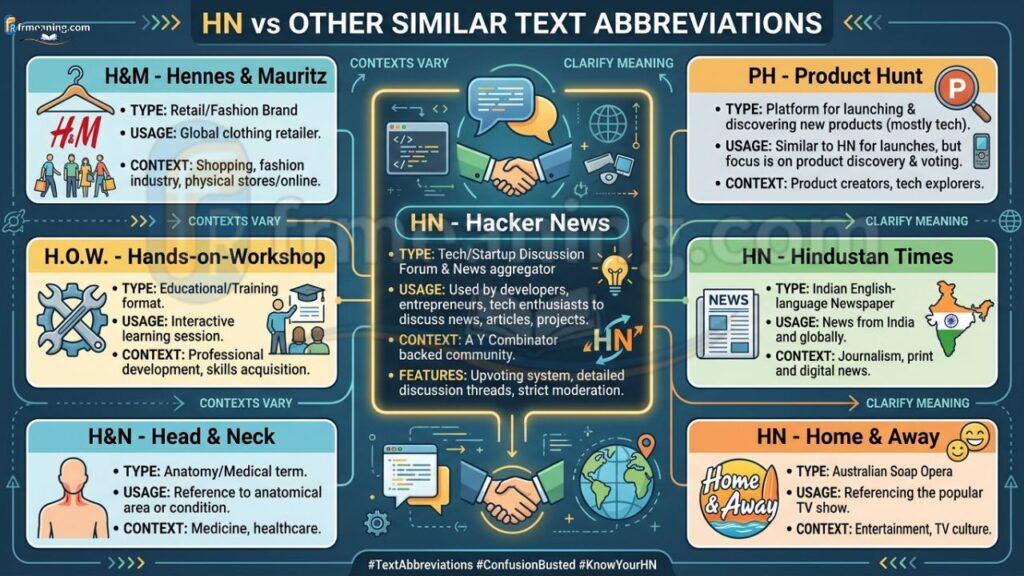
People sometimes confuse hn with other similar-looking slang, so here’s how it stacks up:
- HN vs Hmm — “Hmm” suggests thinking or uncertainty. “Hn” usually leans toward yes, not just pondering.
- HN vs Han — “Han” is slightly warmer and more complete. “Hn” is the faster, lazier cousin.
- HN vs Haan — “Haan” is the full word and feels clearest and most sincere. “Hn” strips it down for speed.
- HN vs Yh — “Yh” is English slang for “yeah.” Same vibe, different language base.
- HN vs OK/K — “K” is similarly dry in English texting. Both can come off cold if used alone in serious conversations.
- HN vs mm — “Mm” is a soft murmur of agreement, even more neutral than hn.
Understanding these differences helps you gauge what someone actually means when they reply — especially when the relationship and conversation topic matter.
Is HN Rude or Offensive?
HN is not inherently rude, but it absolutely can feel that way depending on how and when it’s used. Context is everything here.
In a fast, casual chat with your best friend or sibling, “hn” is completely normal and nobody thinks twice about it. But if someone sends you a heartfelt message about something important and your reply is just “hn” — that’s going to sting. Not because the word is offensive, but because the effort level communicates indifference.
The tone behind hn is largely shaped by:
- Punctuation — “hn.” vs “hn 😊” feel like completely different messages
- What came before it — agreeing to meet someone vs acknowledging a serious conversation
- Relationship closeness — the closer you are, the more you can get away with
So if someone tells you their hn felt dismissive, they’re probably not wrong. It’s worth adding a word or two when the situation calls for it.
HN Meaning in Text Across Social Media Platforms
On WhatsApp & Messenger
On WhatsApp, hn is incredibly common — probably more than any other platform. It shows up in one-on-one chats, family groups, and friend circles constantly. People use it to quickly reply to questions, confirm plans, or just acknowledge that they’ve seen a message. On Messenger (Facebook), you’ll find it more among older South Asian users who carried their texting habits there.
On Instagram & TikTok Comments
HN meaning in text on Instagram leans slightly toward “hmm” rather than “haan,” especially in comment sections where people are reacting to posts. Someone might reply “hn interesting” to a reel or story when they’re mildly engaged but not hyped.
On TikTok, H/N (with a slash) takes on a completely different role — it stands for His/Her Name, used as a storytelling placeholder in POV videos and fictional narratives. Creators write scripts where “H/N walked into the room” so viewers can mentally insert their own name into the story. This is a massive trend in South Asian, Desi, and general fanfic TikTok communities.
On Twitter (X)
HN appears occasionally on Twitter/X, mostly in replies within South Asian Twitter threads. It’s not a dominant slang there compared to WhatsApp, but you’ll spot it in casual reply chains and quote tweets within Desi online communities.
On Snapchat
HN on Snapchat is really common for streak replies — those quick one-word or two-letter snaps people send just to keep the streak alive. It’s perfectly acceptable in that low-stakes context.
How to Respond When Someone Sends “HN”
Getting an “hn” reply can leave you wondering if the person is fine, annoyed, or just busy. Here’s how to handle it:
If the conversation is casual — just keep going. They said yes (or acknowledged you), so no need to overthink it.
If it felt cold and the topic was important — you can gently ask “sab theek?” or “kuch hua?” without making it a big deal. Sometimes people are just distracted.
If you needed a clear answer and hn wasn’t enough — follow up with something specific: “Matlab aa rahe ho ya nahi?” This invites a clearer response without coming off as aggressive.
If it was in a romantic context and felt distant — don’t panic right away. Try sending something warmer to shift the energy before reading into it too deeply.
Common Misinterpretations of HN
One of the biggest issues with hn in text is how easily it gets misread — especially across different cultures or age groups.
Western users who aren’t familiar with South Asian internet slang often have no idea what hn means. They might read it as a typo, a random noise, or even as “hmm” — which technically could apply in some contexts but misses the South Asian “haan” meaning entirely.
Older South Asian users sometimes find it too abrupt or dismissive, even when the sender meant nothing negative by it.
Romantic misreads are super common too — someone might send a thoughtful message and receive “hn” back, interpreting it as disinterest or annoyance when the sender was just busy or typing quickly.
This is exactly why tone awareness matters. HN is a minimalist reply in a maximalist emotional world, and the gap between those two things causes most of the confusion.
Should You Use HN in Your Own Texts?
Honestly? It depends on who you’re talking to and what the situation is.
Use hn freely when:
- Chatting with close friends or family you’re comfortable with
- Responding quickly to casual questions
- Replying in a group chat where brevity is expected
- You’re in a light, informal back-and-forth
Avoid hn when:
- The conversation is emotionally charged or serious
- You’re talking to someone you don’t know well
- It’s a professional or workplace chat
- Someone has asked you something that deserves a proper response
- You’re dealing with a buyer, customer, or authority figure
A good rule of thumb: if you’d feel awkward saying just “hn” out loud in that situation, you probably shouldn’t send it either.
HN Meaning in Text for Different Age Groups
This is something competitors totally gloss over, but its actually really important.
Teenagers and young adults (15–25) use hn the most freely and naturally. For them, it’s just part of how they talk — no second thought, no hidden meaning. It’s the digital equivalent of a nod.
Adults (25–40) use it too, but with a bit more awareness of tone. They’re more likely to add emojis or extra words when they want to make sure hn doesn’t come off as cold.
Older adults (40+) in South Asian families often find hn either too abrupt or genuinely don’t recognize it. They may prefer “haan” or “ji haan” — especially in family group chats where respect and warmth matter more.
Cross-cultural users — people who grew up between South Asian and Western texting cultures — sometimes toggle between hn and “yeah” depending on who they’re talking to. For them, hn is reserved for desi conversations only.
Understanding your audience matters more than the word itself. The same two letters land completely differently depending on who’s reading them.
FAQs
What does HN usually mean in texting?
HN usually means “haan” (yes) in South Asian texting — a casual, quick way to agree or acknowledge.
Is HN always negative?
No. HN is neutral by default — it only feels negative when the conversation tone or context makes it seem dismissive.
Can HN mean something else?
Yes. H/N means “His/Her Name” in fanfiction and TikTok. In medical notes, HN can stand for hypertension.
Is HN okay to use at work?
No. HN is too informal for professional settings — use “yes,” “noted,” or “sure” instead.
How do I know which meaning applies?
Look at the platform and relationship context — casual South Asian chat means “haan”; TikTok stories or Wattpad means “His/Her Name.”