
Have you ever opened a text message, scrolled through social media, or read a meme and suddenly spotted the abbreviation FML? If so, you’re not alone. Internet slang changes quickly, and new expressions appear almost every year. Yet some terms manage to stick around for decades. One of those enduring slang expressions is FML.
If you’ve been wondering about the FML meaning in text, you’ve come to the right place. This guide explains what FML means, where it came from, how people use it in texting culture, and why it remains one of the most recognizable internet acronyms in 2026.
Whether you’re navigating text messages, online communication, meme culture, or social media slang, understanding FML can help you better interpret conversations and connect with modern digital communication.
What Does FML Mean in Text?
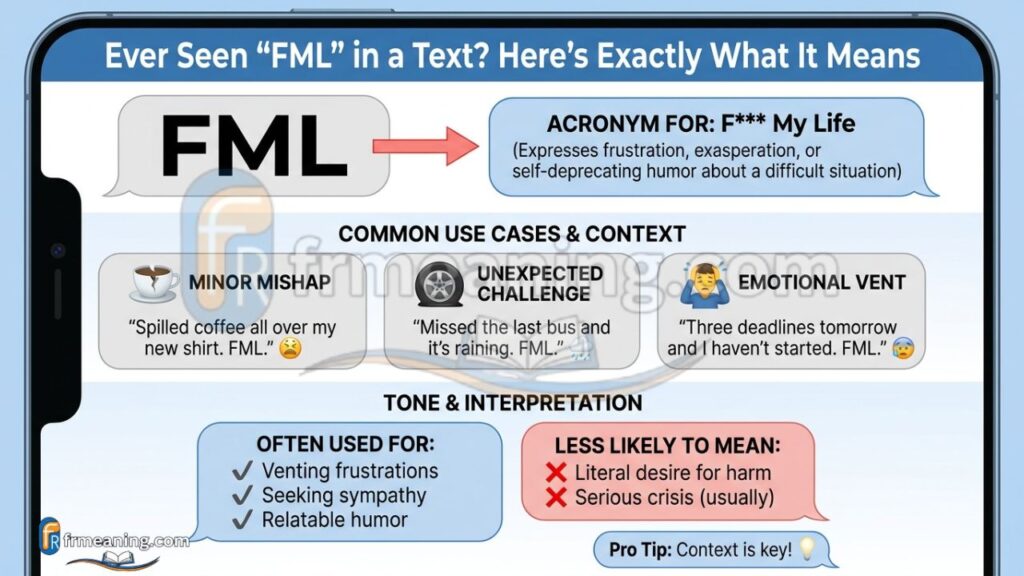
FML stands for “F* My Life.”**
It is a popular texting abbreviation used to express frustration, disappointment, embarrassment, bad luck, or annoyance. Most people use it after something unfortunate happens, especially when the situation feels ironic or unfair.
In simple terms, FML means:
“Something went wrong, and I’m frustrated about it.”
Examples:
- “I forgot my homework at home. FML.”
- “My phone died during an important call. FML.”
- “Spent two hours studying the wrong chapter. FML.”
In most cases, people don’t use FML literally. Instead, it serves as a dramatic and humorous way to react to life’s everyday problems.
Quick Answer: FML Meaning at a Glance
| Term | Meaning | Tone | Usage |
|---|---|---|---|
| FML | F*** My Life | Frustrated, sarcastic, humorous | Informal texting and social media |
The phrase is designed to communicate an emotional reaction quickly. Rather than writing a long explanation, users can simply type three letters and instantly convey their feelings.
The Real Meaning Behind FML
While the phrase sounds harsh at first glance, modern usage tells a different story.
Today, FML functions as a humorous response to bad luck. Most users aren’t expressing genuine despair. They’re simply highlighting an annoying situation in a funny and relatable way.
The expression commonly communicates:
- Frustration
- Embarrassment
- Regret
- Disappointment
- Mild anger
- Self-deprecating humor
- Sarcasm
- Irony
For example:
“Walked into class wearing two different shoes. FML.”
The speaker isn’t experiencing a life crisis. They’re laughing at an embarrassing mistake.
This combination of frustration and humor explains why FML has remained relevant for so many years.
FML Stands for More Than Just Words
Many internet acronyms lose popularity over time. FML survived because it represents a universal human experience.
Everyone experiences:
- Bad days
- Awkward moments
- Unlucky situations
- Small failures
- Unexpected setbacks
Because these experiences are universal, people continue using FML across different generations.
In fact:
FML → expresses → frustration or disappointment
This simple semantic relationship remains the foundation of its meaning.
People instantly understand the emotional context without needing additional explanation.
The Origin of FML
The history of FML is surprisingly interesting.
The phrase became widely known during the early 2000s when internet users began sharing short stories about unfortunate events online.
People would describe something unlucky that happened and end their story with:
“FML.”
Soon entire websites emerged around this concept, allowing users to submit funny tales of bad luck.
These stories often included:
- Dating disasters
- School failures
- Workplace mistakes
- Family misunderstandings
- Everyday accidents
As internet culture expanded, the abbreviation spread rapidly into:
- Text messaging
- Online forums
- Social media
- Meme culture
- Group chats
This created another important semantic relationship:
FML → became popular through → online forums and blogs
Eventually, the acronym became part of mainstream internet slang.
How FML Entered Modern Texting Culture
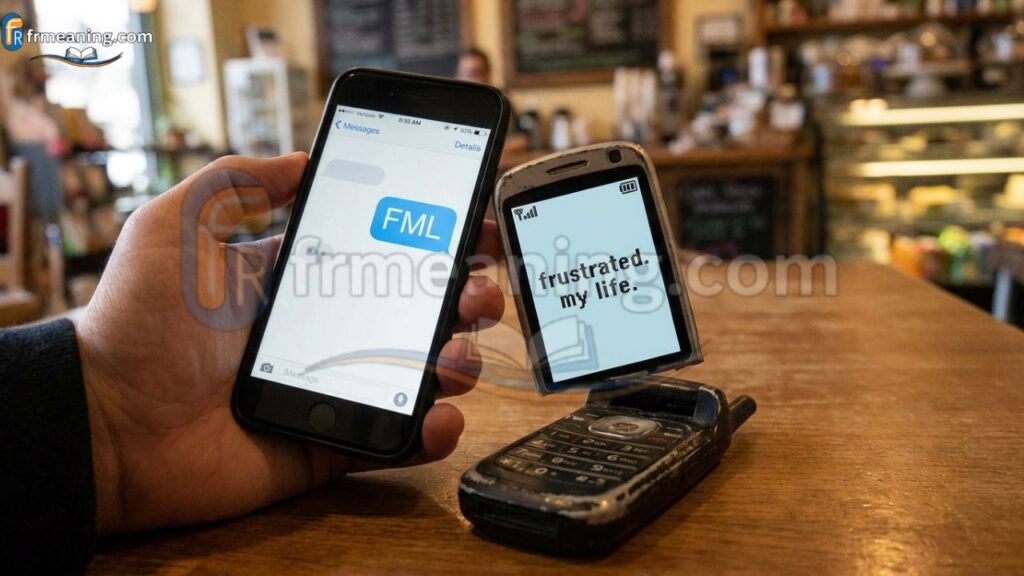
The rise of smartphones transformed communication.
Users wanted faster ways to express emotions without typing long paragraphs. Abbreviations became essential.
Popular examples included:
- LOL
- BRB
- IDK
- TBH
- SMH
- OMG
- FML
Among these expressions, FML stood out because it combined emotion, humor, and storytelling.
Unlike many acronyms that simply save time, FML helps communicate a complete emotional experience.
That’s one reason why:
FML → is commonly used in → text messages and social media
The abbreviation fits naturally into modern conversations.
Common Situations Where People Use FML
Everyday Annoyances
The most common use involves minor inconveniences.
Examples:
- Missing the bus
- Spilling coffee
- Losing keys
- Forgetting passwords
Example text:
“Locked myself out again. FML.”
Embarrassing Moments
People often use FML after awkward social situations.
Examples:
- Tripping in public
- Sending messages to the wrong person
- Calling someone by the wrong name
Example text:
“Waved back at someone who wasn’t waving at me. FML.”
School Problems
Students frequently use FML when discussing academic challenges.
Examples:
- Failed quizzes
- Missed deadlines
- Forgotten assignments
Example text:
“Finished my essay and forgot to save it. FML.”
Workplace Stress
Employees sometimes use FML when dealing with professional frustrations.
Examples:
- Extra assignments
- Tight deadlines
- Technical failures
Example text:
“My presentation crashed five minutes before the meeting. FML.”
Relationship Drama
Relationships create countless opportunities for awkward situations.
Examples:
- Texting an ex by mistake
- Missing anniversaries
- Misunderstandings
Example text:
“Accidentally liked my ex’s photo from 2018. FML.”
Why FML Is So Relatable
One reason FML remains popular is relatability.
Everyone experiences moments where life seems determined to create problems.
These moments often include:
- Unexpected bad luck
- Embarrassing mistakes
- Minor disasters
- Funny failures
- Frustrating coincidences
When people share these experiences online, others instantly recognize the feeling.
That’s why:
Social media users → use FML → to share relatable failures
The phrase creates a sense of community through shared experiences.
People often respond with:
- “Same.”
- “I’ve been there.”
- “That’s rough.”
- “I feel your pain.”
This shared understanding strengthens social connections online.
Different Emotional Tones of FML
Not every use of FML sounds the same.
The tone depends heavily on context.
Humorous Tone
“Burned my toast, dropped it, then stepped on it. FML.”
The speaker is clearly joking.
Sarcastic Tone
“Of course it starts raining right after I wash my car. FML.”
Here, irony plays a major role.
Frustrated Tone
“My internet died during my final exam. FML.”
The frustration feels more genuine.
Self-Deprecating Tone
“Tried fixing my computer and made it worse. FML.”
The user is laughing at their own mistake.
Understanding these emotional nuances helps you interpret FML correctly in conversations.
Why FML Still Matters in 2026
New slang appears constantly.
Yet FML continues thriving because it fulfills a unique role.
It is:
- Short
- Memorable
- Emotional
- Relatable
- Versatile
Many modern expressions come and go, but FML remains useful because people will always encounter frustrating situations.
Human nature hasn’t changed.
People still make mistakes.
People still experience bad luck.
People still enjoy laughing at life’s chaos.
That’s why FML continues to occupy a permanent place in internet slang and digital communication.
How FML Is Used on Different Platforms
One topical gap many articles miss is that FML usage changes depending on the platform. The core meaning remains the same, but the tone and style can vary quite a bit.
FML in Text Messages
Texting is where FML feels most natural.
Friends often use it to describe annoying events without writing long explanations.
Examples:
- “Missed the train by ten seconds. FML.”
- “Forgot my charger during a trip. FML.”
In private conversations, the phrase usually feels casual and relatable.
FML on Instagram
Instagram users frequently add FML to captions.
The abbreviation helps turn frustrating experiences into entertaining content.
Examples:
- “Spent an hour getting ready and it started raining. FML.”
- “Dropped my ice cream before taking a photo. FML.”
The goal is often engagement because followers enjoy relatable stories.
FML on TikTok
TikTok creators often use FML while sharing personal fails.
Videos showing cooking disasters, embarrassing moments, or unexpected mistakes frequently include the term.
Example:
“POV: You studied all week and the test covers something else. FML.”
Because TikTok thrives on authenticity, FML fits naturally into its storytelling style.
FML on X (Twitter)
On X, users commonly post short observations about daily frustrations.
Examples:
- “Alarm didn’t go off. FML.”
- “Internet died during the meeting. FML.”
The platform’s short-form format makes abbreviations especially useful.
FML in Memes
Meme culture helped keep FML alive.
Memes often pair unlucky situations with humorous captions.
Examples include:
- Failing simple tasks
- Experiencing terrible timing
- Unexpected life setbacks
This relationship remains important:
FML → is commonly used in → social media and memes
The phrase instantly communicates the joke without requiring additional explanation.
Alternative Meanings of FML
Although “F*** My Life” is by far the most common definition, some people encounter alternative meanings depending on context.
Less common interpretations include:
- Family Medical Leave
- Facility Management Limited
- Financial Management Leader
However, in texting, online communication, social media, and internet slang, FML almost always means:
F* My Life**
If someone texts:
“Locked my keys in the car. FML.”
They are definitely not talking about business management or workplace policies.
Context matters.
When Should You Use FML?
FML works best in casual situations.
Appropriate uses include:
- Talking with friends
- Group chats
- Social media posts
- Meme captions
- Informal online discussions
Good examples:
- “Forgot my wallet at home. FML.”
- “Phone battery died at 2%. FML.”
- “Spilled coffee on my laptop. FML.”
The expression feels natural when discussing everyday frustrations.
When You Should Avoid FML
Not every situation calls for internet slang.
Avoid using FML in:
- Professional emails
- Job applications
- Academic papers
- Formal presentations
- Business communications
Examples of situations where FML may seem inappropriate:
- Speaking with clients
- Communicating with supervisors
- Writing official reports
The profanity hidden within the abbreviation can still create a negative impression.
Professional communication generally requires more formal language.
How to Respond When Someone Says FML
Understanding responses is just as important as understanding the phrase itself.
Supportive Responses
If someone genuinely feels frustrated:
- “Sorry that happened.”
- “That really sucks.”
- “Hope things improve soon.”
Humorous Responses
If they’re joking:
- “That’s classic.”
- “Only you could do that.”
- “That’s actually hilarious.”
Relatable Responses
These responses create connection:
- “Same thing happened to me.”
- “I’ve been there.”
- “I know that feeling.”
Matching the other person’s emotional tone helps conversations feel natural.
FML vs Other Popular Slang Terms
Many people confuse FML with similar internet expressions.
The table below highlights the differences.
| Slang | Meaning | Primary Emotion |
|---|---|---|
| FML | F*** My Life | Frustration + Humor |
| SMH | Shaking My Head | Disapproval |
| OMG | Oh My God | Surprise |
| WTF | What The F*** | Confusion or Shock |
| RIP Me | I’m doomed | Exaggerated Humor |
| LMAO | Laughing My A** Off | Amusement |
| IDK | I Don’t Know | Uncertainty |
FML vs SMH
SMH focuses on disappointment toward a person or situation.
Example:
“People still believe that? SMH.”
FML focuses on personal misfortune.
Example:
“Lost my wallet again. FML.”
FML vs WTF
WTF expresses confusion or shock.
Example:
“What just happened? WTF.”
FML expresses frustration after something unfortunate occurs.
Example:
“Just locked myself out. FML.”
FML vs RIP Me
These expressions often overlap.
Example:
“Forgot my speech notes. RIP me.”
Example:
“Forgot my speech notes. FML.”
However, RIP Me often sounds more dramatic and exaggerated.
The Psychology Behind FML
One of the most interesting aspects of FML involves human psychology.
Why do people use a phrase that sounds so negative?
The answer lies in emotional coping mechanisms.
Humor Reduces Stress
Research in communication psychology consistently shows that humor helps people manage frustration.
When something annoying happens, people often:
- Share the story.
- Add humor.
- Receive social validation.
FML helps complete all three steps.
Instead of dwelling on a problem, users transform it into a joke.
Shared Experiences Create Connection
People enjoy discovering they’re not alone.
When someone posts:
“Spent three hours on a project and accidentally deleted it. FML.”
Others immediately understand the feeling.
Responses like:
- “Same.”
- “Been there.”
- “That happened to me.”
create a sense of community.
This explains why:
FML → functions as → a humorous response to bad luck
The phrase turns frustration into social bonding.
Self-Deprecating Humor Feels Authentic
Modern social media rewards authenticity.
Perfect lives feel unrealistic.
Small failures feel human.
FML allows people to laugh at themselves while remaining relatable.
That’s one reason it continues thriving in digital communication.
The Evolution of FML in Internet Culture
Another major topical gap involves the complete evolution of FML.
Let’s look at how the expression developed over time.
Early 2000s
The phrase gained traction on internet forums and blogs.
Users shared short stories about unfortunate events ending with FML.
Late 2000s
Dedicated websites focused entirely on collecting FML stories.
The expression became widely recognized.
2010s
Smartphones accelerated adoption.
Text messaging and social media helped spread the abbreviation globally.
2020s
FML became deeply embedded within meme culture.
Users incorporated it into:
- TikTok videos
- Instagram captions
- X posts
- Reddit discussions
- Group chats
2026 and Beyond
Despite constant changes in internet slang, FML remains relevant.
Many newer abbreviations disappear after a few years.
FML continues surviving because the emotional experience it describes remains universal.
People still experience:
- Bad luck
- Embarrassment
- Frustration
- Everyday failures
As long as those experiences exist, FML will likely remain part of online communication.
Cultural Impact of FML Around the World
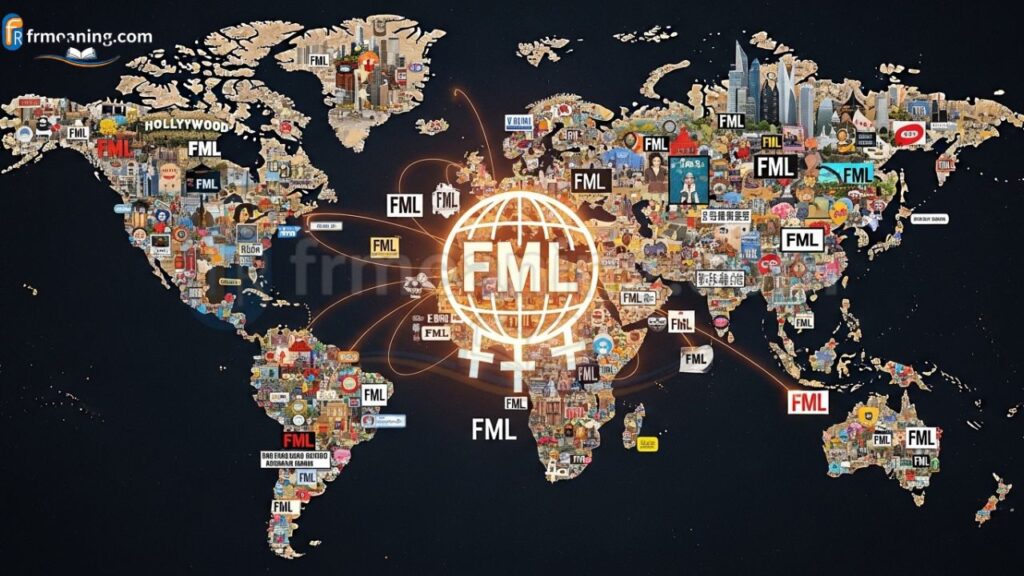
FML may have originated in English-speaking communities, but its influence is global.
Today, people across different countries recognize the abbreviation.
Even users who don’t speak English fluently often understand what FML communicates.
The reason is simple.
Bad luck is universal.
Embarrassment is universal.
Frustration is universal.
The expression crosses language barriers because the underlying emotions are shared by everyone.
Many international users even combine FML with emojis such as:
- 😭
- 😩
- 😂
- 🤦
These symbols strengthen the emotional message and make the meaning easier to understand.
Here’s Part 3, the final section of the article.
Real-Life Examples of FML in Conversations
Understanding real examples makes it easier to recognize FML in everyday communication.
Example 1: School Frustration
Friend 1: “I studied for three hours last night.”
Friend 2: “That’s good.”
Friend 1: “For the wrong chapter. FML.”
In this example, FML communicates disappointment mixed with humor.
Example 2: Workplace Mishap
Employee: “Finished the entire report.”
Coworker: “Nice!”
Employee: “Then my laptop crashed before I saved it. FML.”
The phrase highlights a frustrating situation without sounding overly serious.
Example 3: Social Embarrassment
Person A: “I waved at someone across the street.”
Person B: “Did they wave back?”
Person A: “They weren’t waving at me. FML.”
This is a classic example of self-deprecating humor.
Example 4: Technology Problems
User: “My phone updated overnight.”
Friend: “Cool.”
User: “Now none of my apps work. FML.”
Technology-related frustrations often inspire FML usage.
Example 5: Relationship Drama
Friend: “Everything okay?”
Friend 2: “Accidentally texted my ex instead of my sister. FML.”
The abbreviation instantly communicates embarrassment and regret.
Most Common FML Text Examples
Here are some examples commonly seen online:
- “Dropped my phone in the sink. FML.”
- “Missed the bus by five seconds. FML.”
- “Forgot my password again. FML.”
- “Locked my keys inside the car. FML.”
- “Spilled coffee on my white shirt. FML.”
- “Alarm didn’t go off this morning. FML.”
- “Got stuck in traffic for two hours. FML.”
- “Studied the wrong material for the exam. FML.”
Notice a pattern.
The situations are frustrating, but they aren’t usually life-changing events.
That’s what makes FML effective. It works best for everyday setbacks rather than major tragedies.
Why FML Continues to Survive While Other Slang Disappears
Internet slang evolves at an incredible pace.
Terms that seem popular today may disappear within months.
Yet FML has remained relevant for over two decades.
Several factors explain its longevity.
It Solves a Communication Need
People constantly need ways to express frustration quickly.
FML provides an efficient solution.
Instead of typing:
“I’m extremely annoyed because something unfortunate happened.”
Users simply type:
“FML.”
The message remains clear.
It Is Easy to Understand
Some internet slang requires insider knowledge.
FML does not.
Even first-time users usually understand the emotional meaning once they see the context.
It Is Emotionally Flexible
The phrase works in multiple situations.
It can communicate:
- Humor
- Irony
- Frustration
- Regret
- Embarrassment
- Mild anger
Few abbreviations offer such versatility.
It Fits Every Platform
Whether someone uses:
- Text messages
- TikTok
- X
- Discord
FML remains useful.
This flexibility helps keep the expression alive.
The Future of FML in Digital Communication
Will people still use FML in the future?
Most likely, yes.
Although new slang appears every year, FML benefits from something many newer expressions lack:
Universal relevance.
The emotions behind FML never disappear.
People will always experience:
- Awkward moments
- Bad timing
- Minor failures
- Unfortunate coincidences
- Everyday frustrations
As long as those experiences exist, people will continue looking for quick ways to express them.
The abbreviation has already survived multiple generations of internet culture.
From forums and blogs to social media and short-form video platforms, FML has consistently adapted.
That adaptability suggests it will remain part of online communication for years to come.
Common Alternatives to FML
Some users prefer alternatives depending on the situation.
Popular options include:
SMH
Meaning: Shaking My Head
Best used when expressing disappointment or disbelief.
Example:
“People still fall for that scam? SMH.”
RIP Me
Meaning: I’m doomed.
Best used for exaggerated humor.
Example:
“Forgot my presentation notes. RIP me.”
WTF
Meaning: What The F***
Best used when confused or shocked.
Example:
“WTF just happened?”
Ugh
Meaning: General frustration.
Best used for mild annoyance.
Example:
“Ugh, Monday morning again.”
Why Me?
Meaning: Expressing personal bad luck.
Example:
“Another flat tire? Why me?”
While these phrases overlap somewhat, FML remains unique because it combines frustration, irony, and humor all at once.
Key Takeaways About FML
If you only remember a few things from this guide, remember these points:
- FML means “F* My Life.”**
- It is a popular internet acronym and texting abbreviation.
- The phrase expresses frustration, bad luck, embarrassment, or disappointment.
- Most uses involve humor, sarcasm, or irony.
- FML is commonly found in text messaging, social media, and meme culture.
- The expression became popular through online forums and blogs.
- It should generally be avoided in professional communication.
- Its continued popularity comes from its relatability and emotional flexibility.
Most importantly:
FML → stands for → F* My Life**
FML → expresses → frustration or disappointment
FML → functions as → a humorous response to bad luck
These relationships capture the essence of the phrase.
Conclusion
Language constantly changes, but some expressions prove remarkably durable. FML is one of those rare internet slang terms that continues to resonate across generations.
At its core, the phrase offers a quick and relatable way to react when life throws an unexpected problem your way. Whether you’re dealing with an embarrassing mistake, a streak of bad luck, a missed opportunity, or a simple daily annoyance, FML provides a shorthand expression that millions of people instantly understand.
Its combination of humor, sarcasm, frustration, and relatability explains why it remains a major part of texting culture, social media slang, and online communication in 2026.
The next time you see someone type “FML,” you’ll know exactly what they’re saying. Chances are, they’re not giving up on life. They’re simply laughing at one of life’s many little disasters and moving forward.
Frequently Asked Questions
What does FML mean in a text message?
FML stands for “F*** My Life.” It is a texting abbreviation people use when something frustrating, embarrassing, or unlucky happens. The phrase is usually intended humorously rather than literally and often appears in casual conversations, social media posts, and memes.
Is FML considered offensive?
FML contains an implied profanity, so some people may consider it offensive. However, among friends and in informal online communication, it is generally used as a lighthearted expression of frustration rather than as an insult directed at someone.
Can I use FML at work?
It’s best to avoid FML in professional settings. Since the abbreviation contains a hidden swear word, it may appear inappropriate in emails, reports, workplace chats, or formal communication with managers, clients, teachers, or colleagues.
What is the difference between FML and SMH?
FML expresses personal frustration or bad luck, while SMH means “Shaking My Head” and usually expresses disappointment or disbelief about another person’s actions or a situation. FML focuses on your own misfortune, whereas SMH focuses on criticism or disapproval.