

You open a message, see someone reply with “TY,” and suddenly your brain does that annoying little pause. Was that friendly? Lazy? Sarcastic? Did they mean “thank you” or something else entirely?
That confusion happens more often than people admit.
Texting slang changes fast. One month everyone types full sentences. Next month, conversations look like coded fragments from another planet. “TY” sits right in the middle of that modern internet shorthand culture, especially on TikTok, Snapchat, Discord, and gaming chats.
The short answer? Yes. TY usually means “Thank You.”
But context matters. A lot.
Sometimes it sounds warm and appreciative. Sometimes it feels dry. Sometimes it’s just a fast typing shortcut because someone is juggling six chats while watching videos and ordering food at the same time.
Here’s what TY really means in text, how people actually use it in 2026, when it can sound rude, and how to reply naturally without sounding awkward.
What Does TY Mean in Text?
TY Definition Explained Simply
TY stands for “Thank You.”
It’s one of the oldest and most widely used internet slang abbreviations in digital communication. People use it in:
- text messages
- social media comments
- gaming chats
- direct messages
- group conversations
- online forums
You’ll usually see it as a quick acknowledgment instead of typing the full phrase.
For example:
- “TY for helping me.”
- “tysm!!”
- “TY, appreciate it.”
- “Ohhh TY”
Simple. Fast. Efficient.
That speed is exactly why the abbreviation survived for years while dozens of other slang terms disappeared.
What TY Stands For in Messages
Unlike some confusing acronyms with multiple meanings, TY is pretty straightforward in most online conversations.
It nearly always means:
- thank you
- thanks
- appreciation
- gratitude
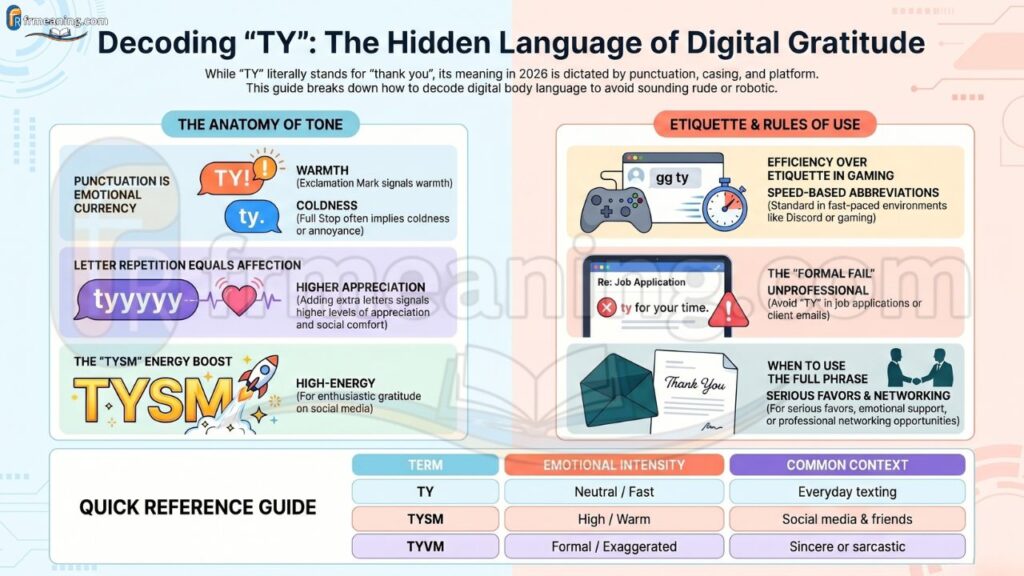
The tone changes depending on punctuation, capitalization, emojis, and context.
Compare these:
- “TY :)” = warm and friendly
- “TY!!” = excited gratitude
- “ty” = casual and neutral
- “TY.” = possibly cold or annoyed
Tiny differences. Big emotional shift.
That’s modern texting culture in a nutshell.
The Origin of TY in Internet Slang
Early SMS and Chatroom Culture
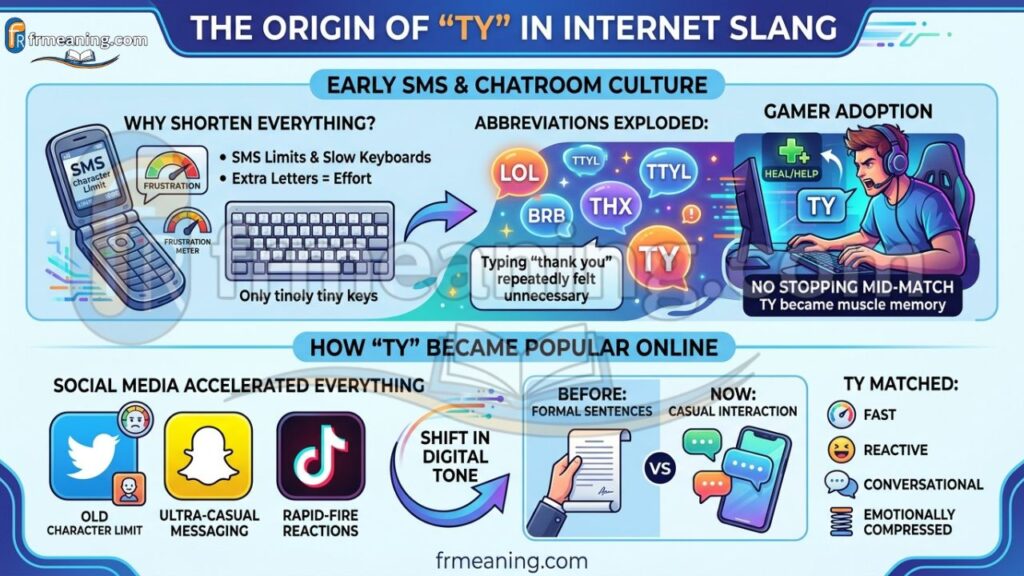
Back in the early SMS era, texting wasn’t unlimited. Messages had character limits, phone keyboards were painfully slow, and every extra letter felt like work.
People shortened everything.
That’s how internet slang exploded:
- LOL
- BRB
- TTYL
- THX
- TY
Typing “thank you” repeatedly in early chatrooms and flip-phone texting felt unnecessary when “TY” communicated the same thing instantly.
Gamers adopted it quickly too.
In fast-paced multiplayer games, nobody wanted to stop mid-match and type a complete sentence after receiving help or healing.
So “TY” became muscle memory.
How TY Became Popular Online
Social media accelerated everything.
Platforms rewarded short-form communication. Twitter’s old character limits pushed abbreviations even harder. Snapchat normalized ultra-casual messaging. TikTok comments became rapid-fire reaction zones.
Suddenly, full sentences started feeling formal.
Short expressions like TY became part of normal digital communication because they matched how people interacted online:
- fast
- reactive
- conversational
- emotionally compressed
You can still see that behavior today across Gen Z messaging culture.
TY in Modern Digital Communication
In 2026, TY works almost like digital body language.
People use it instinctively.
Not because they can’t spell “thank you,” but because online messaging has its own rhythm now. Abbreviations signal familiarity and casual comfort.
Using TY can suggest:
- friendliness
- speed
- informality
- comfort with texting culture
At the same time, overusing abbreviations in serious conversations can make messages feel detached.
That balance matters.
How TY Is Used Across Different Platforms
TY Meaning on Snapchat
On Snapchat, TY usually appears in quick, disappearing conversations.
Examples:
- “TY for the streak”
- “TY lol”
- “tyyy”
Snapchat conversations move fast. Users rarely type perfectly polished messages there, so TY feels completely normal.
Adding extra letters often changes emotional tone:
- “ty” = neutral
- “tyy” = sweeter
- “tyyyy” = extra appreciative
Yes, people absolutely judge emotional intensity based on repeated letters.
TY Meaning on TikTok
TikTok comments are chaotic. Fast-moving. Hyper-casual.
You’ll often see TY in responses like:
- “TY for the tutorial”
- “ty needed this”
- “TYSM queen”
Here, TY usually signals appreciation toward creators, commenters, or helpful replies.
Tone matters heavily on TikTok though. A dry “TY.” can accidentally sound passive-aggressive because users are extremely tuned into subtle communication cues online.
TY Meaning on Instagram
Instagram DMs and comments use TY similarly, though the tone leans slightly more polished than Snapchat.
Common examples:
- “TY for the follow”
- “TY bestie”
- “ty for tagging me”
Instagram communication tends to blend aesthetics with casual texting culture. People often pair TY with emojis to soften tone:
- “TY ❤️”
- “TY 😊”
- “tyyyy 😭”
The emoji changes everything.
TY Meaning on WhatsApp
WhatsApp conversations often include family members, coworkers, classmates, and friend groups all mixed together.
Because of that, TY usage varies more widely.
Younger users might type:
- “ty”
- “tysm”
- “thx”
Older users usually prefer full phrases like:
- “thank you”
- “thanks so much”
In professional or family chats, typing only “TY” can sometimes feel abrupt.
TY in Discord and Gaming Chats
Gaming culture practically runs on abbreviations.
Discord servers, multiplayer lobbies, and competitive games use TY constantly because communication speed matters.
Examples:
- “ty for heals”
- “TY tank”
- “ty gg”
Nobody expects perfect grammar in gaming chat. Fast acknowledgment is the goal.
That environment helped keep TY popular for decades.
Is TY Friendly, Polite, or Rude?
How Tone Changes Meaning
This is where people get tripped up.
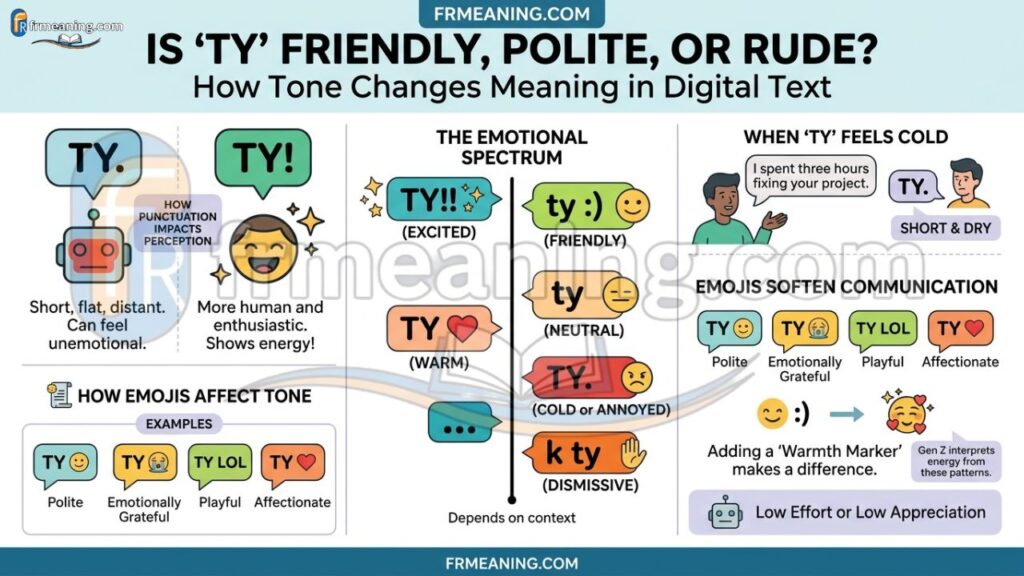
TY itself isn’t rude. Context creates the emotional interpretation.
Think about these versions:
| Message | Tone |
|---|---|
| TY!! | Excited |
| ty 🙂 | Friendly |
| TY ❤️ | Warm |
| ty | Neutral |
| TY. | Cold or annoyed |
| k ty | Dismissive depending on context |
Text lacks facial expressions and vocal tone. Your brain fills in emotional gaps automatically.
That’s why punctuation becomes emotional currency online.
TY vs TY!
One exclamation mark changes perception dramatically.
Compare:
- “TY”
- “TY!”
The second feels more human and enthusiastic.
People unconsciously interpret energy levels from punctuation patterns all day long. Especially Gen Z users.
Short replies without warmth markers can sometimes feel emotionally flat even when no offense was intended.
When TY Can Feel Dry or Cold
Sometimes TY sounds distant because the conversation itself is tense.
Imagine this:
Person 1: “I spent three hours fixing your project.”
Person 2: “TY.”
Ouch.
Now compare:
Person 2: “TYSM seriously appreciate it”
Completely different emotional impact.
Short abbreviations during emotional conversations can accidentally communicate low effort or low appreciation.
That’s why many people switch back to full “thank you” in serious moments.
How Emojis Affect Tone
Emojis soften digital communication.
Examples:
- “TY 😊” = polite
- “TY 😭” = emotionally grateful
- “TY LOL” = playful
- “TY ❤️” = affectionate
Without those emotional markers, short abbreviations sometimes feel robotic.
That’s especially true in relationships or emotionally sensitive conversations.
Real TY Examples in Conversations
Friendly Text Examples
Here’s how people naturally use TY casually:
- “TY for helping earlier”
- “tyyy that was so sweet”
- “TY bestie”
- “ty appreciate u”
Notice how spelling variations add personality.
School and College Examples
Students use TY constantly in academic chats.
Examples:
- “TY for the notes”
- “ty for sending homework”
- “TY I missed class today”
Fast acknowledgment matters in busy group chats.
Nobody wants to type formal paragraphs while rushing between classes.
Gaming Chat Examples
Gaming culture keeps things ultra-short.
Examples:
- “ty healer”
- “TY bro”
- “ty gg”
- “TY for revive”
Efficiency wins.
During gameplay, even one extra second typing can matter.
Workplace Chat Examples
Workplace usage depends heavily on company culture.
Casual teams might say:
- “TY!”
- “ty for the update”
Formal workplaces usually prefer:
- “Thanks so much”
- “Thank you for the update”
If you’re unsure, mirror the communication style around you.
Social Media Comment Examples
Common TikTok or Instagram replies include:
- “TY needed this”
- “TY for explaining”
- “ty queen”
- “TYSM this helped”
Short. Reactive. Human.
That’s social media communication now.
How to Reply to TY Naturally
Casual Replies
Simple replies work best.
Examples:
- “yw”
- “no problem”
- “np”
- “anytime”
- “ofc”
Nobody expects formal etiquette in casual texting.
Professional Replies
Professional chats need slightly more warmth.
Better options include:
- “You’re welcome”
- “Happy to help”
- “Glad it helped”
- “Anytime”
Tiny wording changes make conversations feel more polished.
Funny Replies
Friends often turn replies into jokes.
Examples:
- “I accept snacks as payment”
- “My services aren’t free”
- “You owe me fries now”
Humor keeps texting human.
Flirty Replies
Yes, people absolutely flirt through abbreviations.
Examples:
- “Anything for you”
- “always got you”
- “you’re cute when you say TY”
Tone carries everything there.
Popular TY Variations You Should Know
TYSM Meaning
TYSM means:
“Thank You So Much.”
It communicates stronger gratitude and emotional enthusiasm than plain TY.
Examples:
- “TYSM for helping”
- “tysm omg”
- “TYSM YOU SAVED ME”
Very common on TikTok and fandom communities.
TYVM Meaning
TYVM stands for:
“Thank You Very Much.”
It sounds slightly more formal or exaggerated depending on context.
Sometimes sincere. Sometimes sarcastic.
THX vs TY
Both mean thanks, but they feel slightly different emotionally.
| Term | Tone |
|---|---|
| TY | softer |
| THX | quicker and more casual |
People often perceive TY as warmer.
TYY Meaning
Extra letters increase emotional intensity online.
Examples:
- “tyy”
- “tyyy”
- “tyyyyy”
It usually signals affection, excitement, or stronger appreciation.
Strange? Maybe.
Common? Absolutely.
Other Common Texting Acronyms
You’ll often see TY alongside:
- LOL = laughing
- BRB = be right back
- TTYL = talk to you later
- IMO = in my opinion
- IDK = I don’t know
- WYD = what are you doing
Modern texting basically operates as its own evolving language system now.
Common Mistakes When Using TY
Using TY in Formal Emails
This is the biggest mistake people make.
“TY” is usually too casual for:
- job applications
- client emails
- academic requests
- professional networking
Full phrases work better there.
Use:
- “Thank you”
- “Thank you for your time”
- “Thanks so much”
Professional communication still values clarity and warmth.
Misreading Tone in Short Replies
People overanalyze short messages constantly.
Sometimes “TY” is just fast typing. Not hidden anger.
Still, if someone repeatedly gives ultra-short replies during serious conversations, emotional distance may genuinely exist.
Context always matters more than the abbreviation itself.
When Full “Thank You” Works Better
Certain situations deserve more effort.
Examples:
- emotional support
- serious favors
- apologies
- professional opportunities
- thoughtful gifts
A full message feels more sincere there.
Shortcuts aren’t always the best emotional choice.
Frequently Asked Questions About TY
Can TY Be Used Professionally?
Sometimes.
Internal team chats may use TY casually, especially in relaxed workplaces. Formal communication usually requires full wording.
Is TY Still Popular in 2026?
Yes. Very.
Despite newer slang constantly appearing, TY remains common because gratitude expressions never disappear from digital communication.
Do Older Adults Use TY?
Some do, especially if they text frequently or use social media often.
Younger users still dominate abbreviation-heavy messaging culture though.
Does TY Mean the Same Everywhere?
Mostly yes.
In nearly all texting contexts, TY means “Thank You.” Rare alternate meanings exist, but they’re uncommon in everyday messaging.
Final Thoughts on TY Meaning in Text
When You Should Use TY
Use TY when conversations are:
- casual
- fast-paced
- friendly
- social
- informal
It works perfectly in everyday texting culture.
Just pay attention to emotional context.
Sometimes “thank you” feels warmer. Sometimes “TYSM” feels more expressive. Sometimes a simple “ty :)” says exactly enough.
Digital communication is weird like that.
Tiny details carry huge emotional weight.
The Future of Texting Slang
Texting slang keeps evolving, but efficiency never goes out of style.
That’s why abbreviations like TY survive while trendier phrases disappear every few months. People want communication that feels fast, natural, and emotionally recognizable.
And honestly?
TY still does that pretty well.