

You’re staring at a charcuterie board, there’s a little dish of tiny, bumpy, dark-green pickles sitting next to the pâté, and somebody at the table casually says “pass the cornichons.” You nod like you know exactly what that means. But do you, really?
The cornichon meaning goes a lot deeper than “small pickle,” and honestly, most articles online only scratch the surface of it. This guide is going to walk you through the real definition, the pronunciation, where the word actually comes from, and even a slightly cheeky second meaning the French use that almost nobody outside of France knows about.
By the end of this you’ll not only know what a cornichon is, you’ll know how its made, how it differs from a gherkin and a regular dill pickle, and why it shows up on so many fancy menus in the first place.
Quick Answer: What Does Cornichon Mean?
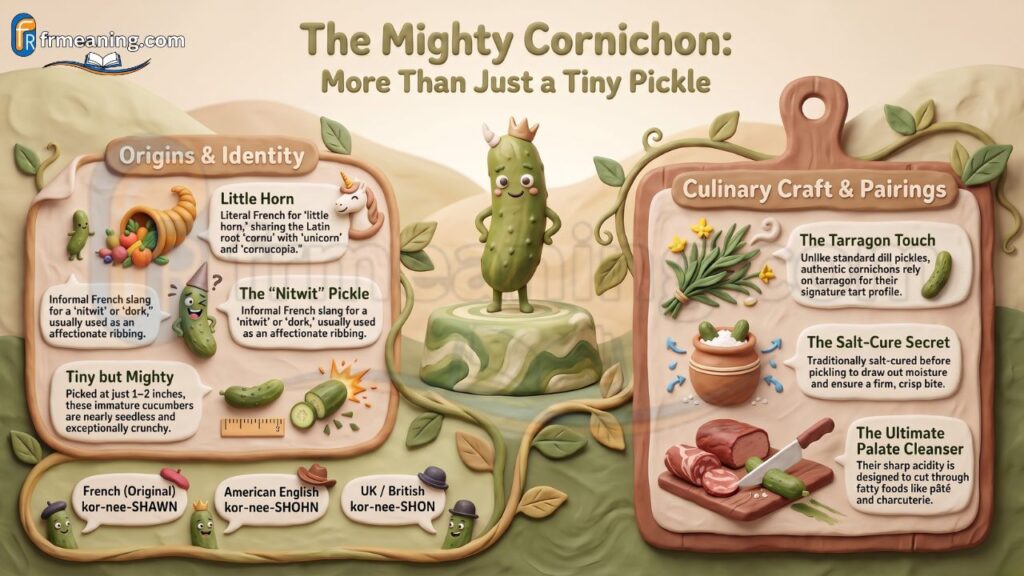
A cornichon is French for “little horn,” and it refers to a small, tart, crunchy pickled cucumber that’s harvested while still immature and cured in a vinegar-and-tarragon brine. Cornichons are traditionally served alongside pâté, charcuterie, and other rich meat dishes because their sharp acidity cuts right through the fattiness.
That’s the short version. Now lets actually unpack all the layers, because there’s more nuance here then most people realize.
Cornichon Meaning in French
In French, cornichon literally translates to “little horn” built from corne (horn) plus the diminutive suffix -ichon. It’s a straightforward, visual name: the small, slightly curved pickle genuinely does resemble a tiny horn shape once it’s been cured and pickled.
But here’s the part most English guides skip entirely in everyday spoken French, cornichon isn’t just a food word. It doubles as informal slang for someone who’s a bit foolish, silly, or naive. More on that a little further down, because it’s honestly one of the more fun facts in this whole topic.
Cornichon Meaning in English
When English speakers use the word cornichon, it refers almost exclusively to the pickle — the slang meaning basically never crosses over. In menus, cookbooks, and food writing, “cornichon” means a small, tart pickled cucumber, full stop.
Interestingly, cornichon is a fairly recent addition to everyday English food vocabulary. Dictionary.com dates its entry into English specifically to the period between 1965 and 1970. So while the pickle itself has centuries of history in France, the word only really became common in English kitchens within the last sixty-ish years.
Cornichon Pronunciation (US & UK)
So how do you actually say it without sounding awkward at the dinner table? Roughly: “kor-nee-SHOHN.”
Here’s a quick breakdown:
| Region | Pronunciation Style | Notes |
|---|---|---|
| French (original) | kawr-nee-SHAWN | Nasal “on” ending, softer “r” |
| American English | kor-nee-SHOHN | Slightly anglicized, harder “r” |
| UK / British English | kor-nee-SHON or kor-nee-SHONG | Often closer to the French nasal sound, though many Brits just say “gherkin” instead and skip the word entirely |
The cornichon pronunciation UK version tends to lean a bit closer to the original French than the American version does, mostly because British English has more overall exposure to French loanwords in food culture. Still, don’t stress too much over getting it “perfect” — even native French speakers will tell you regional accents change how it sounds anyway.
Cornichon Etymology: Tracing the Word Back
The cornichon etymology is actually a nice little linguistics rabbit hole if you enjoy that kind of thing. The word traces back through French corne (“horn”) to the Latin root cornu, which also means horn. That same ancient root gives us other English words like:
- Cornucopia — literally “horn of plenty”
- Unicorn — “one horn”
- Cornea — the horn-like transparent part of the eye
So Cornichon → Corne → Cornu is a direct lineage, and the whole naming logic comes down to visual resemblance: a small, curved pickle looking sort of like a miniature horn. It’s a pretty literal name once you break it down, honestly more literal then a lot of food words get credit for.
Cornichon Pickles: What Actually Makes One a Cornichon
A cornichon pickle is defined by several specific traits, not just “small size.” Here’s what actually sets a true cornichon apart:
- Size — typically 1 to 2 inches long, picked while the cucumber is still immature
- Texture — firm, crisp, and crunchy; a good cornichon should never go soft or mushy
- Flavor — tart and bright, sharper than a standard dill pickle but not overwhelmingly sour or salty
- Appearance — dark green, narrow, often slightly curved, with small soft spines on the skin
- Flesh — pale, crisp, and nearly seedless inside
The defining flavor note is tarragon. That’s the herb that gives a classic cornichon its signature taste, and its presence (or absence) is honestly one of the easiest ways to tell a true French-style cornichon apart from a generic small pickle sold under the same name.
How Cornichons Are Made
The process starts long before the jar — it actually starts in the field, with cucumbers picked at just 1 to 1.5 inches, way before they’d normally be harvested for regular eating. Because they’re picked so young, sourcing cucumbers small enough for genuine cornichons can be surprisingly difficult; home picklers often need a farmer willing to thin their crop early, since a single cucumber plant usually produces way more fruit than it can support to full maturity.
Here’s the general cornichon production process:
- Harvest young — cucumbers are picked at just 1 to 1.5 inches long
- Salt cure — the cucumbers are cured in salt first, which draws out excess moisture and firms up the texture (this step doesn’t actually make the finished product taste salty, which surprises a lot of people)
- Brine — they’re pickled in a mix of white vinegar, water, and salt
- Flavor — tarragon goes in as the signature herb, often joined by black pepper, bay leaves, mustard seeds, or cloves depending on the recipe
- Cure and jar — the pickles rest in the brine until they develop that classic tart, bright flavor with a crisp bite
Good cornichons should retain real crunch even after weeks in the jar — if they’ve gone soft, something went wrong in the process (or they’ve just been open too long).
Cornichon vs Pickle: What’s the Real Difference?
This comparison trips a lot of people up, so let’s untangle it properly.
Cornichon vs pickle, in the broadest sense: a “pickle” is just any vegetable preserved in a vinegar or brine solution — that’s a huge, general category. A cornichon is a specific type of pickle, made from very young cucumbers and flavored distinctively with tarragon.
Compared to a standard dill pickle, cornichons are:
- Noticeably smaller (1–2 inches vs several inches long)
- Made from immature cucumbers rather than fully grown ones
- Sharper and brighter in tartness, rather than deeply sour or heavily salted
- Flavored with tarragon rather than dill and garlic
So basically: every cornichon is technically a pickle, but not every pickle is a cornichon. The word “cornichon” points to a very specific French preparation, size, and flavor profile.
Cornichon vs Gherkin: Are They the Same Thing?
Short answer, mostly yes, but there’s a wrinkle. In everyday British English, “gherkin” is simply the standard word for the same small pickled cucumber that Americans and the French call a cornichon. In that casual sense, the words are basically interchangeable.
But there’s a more technical layer here too. “Gherkin” can also refer to:
- The raw, unpickled cucumber itself, before it’s cured
- A botanically distinct cucumber variety in some regional usages
Under this more precise framing, a cornichon is best understood as a specific French style of pickled gherkin — small cucumbers, salt-cured, then pickled in vinegar with that characteristic tarragon flavor. So: all cornichons are gherkins in the loose British sense, but “gherkin” is the broader umbrella term while “cornichon” names the specific French preparation.
Cornichon Meaning Urban Dictionary: The Slang Definition
If you search “cornichon meaning urban dictionary”, you’ll find entries pointing to the French slang usage — where cornichon is used informally to describe someone silly, foolish, or a bit naive. It’s roughly the equivalent of calling someone a “dork,” “goof,” or “nitwit” in English.
A common phrase is “Ne sois pas un cornichon!” — which translates to something like “Don’t be such a fool!” It’s usually said affectionately rather than as a genuine insult, closer to gentle ribbing between friends than a real put-down. This is a broader pattern in French, actually — borrowing food words for lighthearted teasing happens a lot. English speakers occasionally borrow this slang sense as a joke, but in day-to-day English, “cornichon” is understood almost exclusively as the pickle.
A Long History at the French Table
Cornichons have been a staple accompaniment in French cuisine for centuries, traditionally paired with rich, fatty foods that benefit from a sharp acidic counterpoint — liver pâtés, meat terrines, charcuterie boards, and cold cuts especially. Some culinary historians trace the tradition back to small cucumber varieties historically grown along trellises near French castles, prized specifically for their tiny size and suitability for pickling whole.
One of the most well-known real-world examples is the jambon-beurre — the classic French ham-and-butter baguette sandwich — which is very often served with cornichons on the side. The pickle’s sharp acidity cuts through the richness of the butter and ham in a way that just makes sense once you’ve tried it. Cornichons also traditionally accompany raclette, smoked salmon, and steak tartare, where the tang balances rich or delicate flavors across very different dishes.
How Cornichons Are Used Today
Beyond the classic pâté-and-charcuterie pairing, cornichons show up in a surprisingly wide range of dishes:
- Charcuterie and cheese boards — their tang and crunch act as a palate reset between rich bites
- Egg dishes — chopped into tuna salad, egg salad, or deviled eggs for bright acidity
- Steak tartare — a classic accompaniment alongside capers, shallots, and mustard
- Sauces and vinaigrettes — including the French pairing of cornichon with grapefruit (pamplemousse) for a sweet-acidic vinaigrette
- Cocktail garnishes — a natural stand-in for a cocktail olive in martinis and other savory drinks
Because of their popularity, cornichons → have become → widely available in mainstream supermarket chains, not just specialty French grocers anymore.
Nutrition, Sourcing & Storage: What Most Guides Leave Out
Most articles on this topic stop at “here’s what it is and here’s how its used” — but there’s a couple of things worth knowing that rarely get covered properly.
Are Cornichons Healthy? Nutrition Basics
Cornichons are low in calories (a serving is usually under 10–15 calories) and fat-free, since they’re basically just cucumber and vinegar brine. The catch is sodium — the salt-curing and brine process means cornichons, like most pickles, can be relatively high in sodium per serving. If you’re watching sodium intake for health reasons, it’s worth checking the label, since brands vary quite a bit here. They’re generally fine for low-carb or keto-style eating too, given the minimal sugar content in a traditional tarragon-vinegar brine (though some commercial brands do sneak in added sugar, so its worth a quick label check).
Regional Varieties & Sourcing
Not all jars labeled “cornichon” are created equal. In France, specific cultivars like Cornichon de Paris and Vert Petit de Paris are commonly used for true cornichon production, prized for their small size and thin skin. When buying, look specifically for jars labeled as tarragon-flavored, French-style pickles if you want the traditional flavor profile — some internationally labeled jars use a different seasoning blend entirely and just borrow the name for marketing purposes.
If you’re growing your own, smaller and younger genuinely is better. Cucumbers marketed as “cornichon-style” but left to grow larger will lack the tiny size and tender-crisp bite that defines the real thing.
Storage Tips
Once opened, cornichons should be kept refrigerated in their original brine — this preserves both the crunch and the tang for weeks. Don’t drain the brine off and store them dry; that’s basically the fastest way to ruin the texture.
Cornichon Meaning: Quick Recap Table
| Aspect | Detail |
|---|---|
| Literal Translation | “Little horn” (French corne + diminutive suffix) |
| Etymological Root | Latin cornu (“horn”) |
| English Usage Since | Roughly 1965–1970 |
| Primary Meaning | Small, tart pickled cucumber |
| Secondary Meaning (French slang) | A foolish or silly person |
| Signature Flavor | Tarragon |
| Classic Pairings | Pâté, charcuterie, jambon-beurre, steak tartare |
Frequently Asked Questions
What does cornichon mean in simple terms?
It’s French for “little horn,” referring to a small, tart, crunchy pickled cucumber flavored traditionally with tarragon.
Is a cornichon the same as a gherkin?
Largely yes in casual British usage, though gherkin can also mean the raw cucumber before it’s pickled.
What’s the difference between a cornichon and a regular pickle?
Cornichons are smaller, made from immature cucumbers, and taste sharper but less heavily sour or salty overall.
How do you pronounce cornichon?
Roughly “kor-nee-shohn,” though English speakers commonly anglicize the original French pronunciation somewhat.
Does cornichon mean anything besides the pickle?
Yes, in French it’s informal slang for a silly or foolish person, similar to “dork” in English.
Can you make cornichons at home?
Yes, but it requires very small, immature cucumbers, which can be genuinely hard to source outside specialty growing.
Why are cornichons paired with rich or fatty foods?
Their sharp acidity and crunch cut through richness, balancing fatty dishes like pâté, butter, and cured meats.