
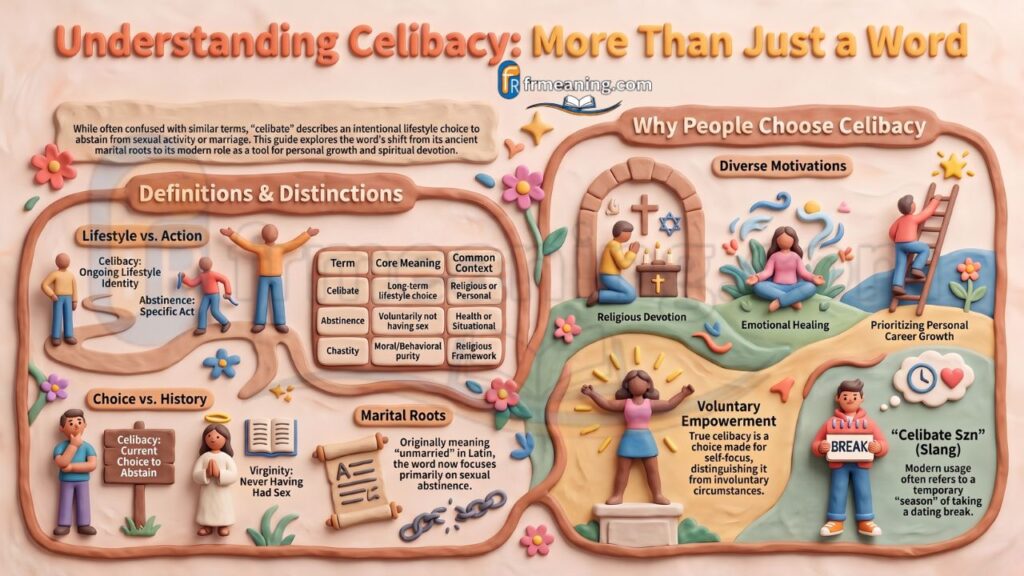

So you’ve stumbled across the word “celibate” somewhere maybe in a conversation, a movie, or a dating app bio and you’re wondering, what does celibate actually mean? You’re not alone, honestly, this word confuses a lot of people because its meaning has shifted quite a bit over time.
In simple terms, celibate describes someone who has chosen not to engage in sexual activity, or in its older sense, someone who remains unmarried.
This article breaks down the full celibate meaning, its history, how it differs from similar words like abstinence and chastity, and how real people use it today.
What Does Celibate Mean?
Celibate (adjective) means abstaining from sexual activity, often by personal choice, and sometimes for religious, spiritual, or personal reasons. As a noun, “a celibate” refers to a person who lives this way. It’s one of them words that sounds simple but actually carries a lot of nuance depending on context — religious, cultural, or just personal lifestyle.
The state of celibacy can be temporary (someone taking a break from dating or sex) or permanent (like clergy members who take formal vows). Either way, the core idea stays the same: abstaining from sexual activity by choice, not by circumstance forced on someone.
Celibate Meaning in English (Definition, Pronunciation & Usage)
Celibate Definition in English
According to most English dictionaries, celibate is defined as:
- Abstaining from sexual relations, typically due to religious vows.
- Not married; remaining single, especially by choice.
So really there’s two layers to this word — the older, more traditional meaning tied to marriage, and the modern usage which leans more toward sexual abstinence, whether or not the person is married.
Celibate Pronunciation
The celibate pronunciation is: SEL-ih-bit (/ˈsɛlɪbət/). A lot of people mispronounce it as “SEE-libate” or stress the wrong syllable, but the correct stress falls on the first syllable. It’s a small detail but it trips up a surprising number of non-native speakers, and honestly even some native speakers too.
Celibate vs Celibacy: What’s the Difference?
This one confuses people constantly, and for good reason — the two words look almost identical. Here’s the breakdown:
- Celibate → an adjective (or noun for a person) describing someone who abstains from sex or marriage.
- Celibacy → the noun describing the state, practice, or condition itself.
Example: “She has been celibate for two years now” (describes the person) vs. “She chose celibacy after her divorce” (describes the practice/state).
Think of it like happy vs. happiness — one describes a person or thing, the other describes the abstract condition. Once you see it that way it clicks pretty fast.
Celibate vs Abstinence: Are They the Same Thing?
Not exactly, though people use them interchangeably all the time. Celibate vs abstinence is actually a really common search because the two terms overlap heavily but aren’t identical twins.
| Term | Core Meaning | Duration | Common Context |
|---|---|---|---|
| Celibate | Ongoing lifestyle choice to avoid sex or marriage | Often long-term or permanent | Religious, personal, lifestyle |
| Abstinence | The act of voluntarily not engaging in sex | Can be short-term or situational | Health, education, personal choice |
| Chastity | Moral/behavioral purity, may include restraint within marriage too | Varies | Religious, moral framework |
Basically, abstinence is the act, while celibacy is more of a lifestyle or identity built around that act. All celibate people practice abstinence, but not everyone practicing abstinence considers themselves celibate — sometimes it’s just temporary, like someone taking a break after a breakup.
Origin of the Word Celibate (History & Etymology)
Here’s something most articles skip over, and it’s honestly one of the more interesting parts of this whole topic — where did this word even come from?
The word celibate traces back to the Latin word caelibatus, which itself comes from caelebs, meaning “unmarried.” Interestingly, the original Latin meaning had almost nothing to do with sex directly — it was purely about marital status. A “celibate” person in ancient Rome was simply someone who wasn’t married, full stop.
The word later passed through French (célibat) before entering English around the 17th century, still carrying that “unmarried” connotation. It wasn’t really until the 19th and 20th centuries that the meaning shifted toward what we understand today — abstaining from sexual activity, regardless of marital status.
This semantic drift matters because it explains why you’ll still see celibacy discussed in two separate contexts:
- The traditional/religious sense — tied to remaining unmarried and devoted to spiritual life.
- The modern/secular sense — tied purely to sexual abstinence, married or not.
So when somebody asks “what is the history of celibacy,” the honest answer is: it started as a word about marriage, and evolved into a word mostly about sex. Kind of a big shift for one little word.
Celibate Meaning Slang: How People Use It Today
In casual, modern slang, celibate meaning has expanded quite a bit beyond its dictionary roots. On social media especially, “I’m celibate” often gets used loosely to mean:
- Taking a break from dating or sex, often after a bad breakup (“celibate szn” is a real thing people say)
- A humorous exaggeration, not necessarily a serious lifelong commitment
- A statement of self-focus, prioritizing personal growth over romantic relationships
This slang usage is way less formal than the religious meaning, and it’s usually temporary — someone might say they’re “celibate” for a few months and then go right back to dating. It’s less about vows and more about vibes, if that makes sense.
Types of Celibacy: Voluntary vs Involuntary
Not all celibacy looks the same, and this distinction is actually pretty important to understand.
Voluntary celibacy happens when a person actively chooses to abstain, whether for religious, personal, health, or emotional reasons. This is the classic definition most people think of.
Involuntary celibacy, sometimes shortened online to “incel,” refers to someone who wants a sexual or romantic relationship but is unable to find one, not by choice. This is a very different situation psychologically and socially, and it’s worth noting that the two concepts — while sharing the word “celibate” — describe fundamentally different experiences. One is empowerment through choice; the other is often tied to frustration or unmet desire.
The Celibate Lifestyle: Why Do People Choose It?
People choose the celibate lifestyle for a wide range of reasons, and it’s really not a one-size-fits-all decision. Some common motivations include:
- Religious devotion — many faiths view celibacy as a path to spiritual focus
- Emotional healing — recovering from trauma, heartbreak, or unhealthy relationship patterns
- Personal growth — wanting to focus on career, self-discovery, or mental health without romantic distractions
- Health reasons — avoiding sexually transmitted infections or managing medical conditions
- Rejecting societal pressure — some people simply don’t feel the need for sex or relationships to feel fulfilled
Religious Celibacy: Vows, Priests, and Monks
Religious celibacy is probably the most well-known and formalized version of this practice. In many faith traditions, a vow of celibacy is a formal, lifelong commitment. The celibate priest, for example, is a cornerstone of Catholic tradition — priests take a vow of celibacy as part of their ordination, symbolizing full devotion to their spiritual role rather than a family life.
Similarly, the celibate monk in Buddhist, Christian, and other monastic traditions abstains from marriage and sexual activity to focus entirely on spiritual practice and community life. Religious clergy across many traditions view celibacy not as deprivation, but as a deliberate redirection of energy toward faith and service.
It’s worth pointing out: → Vow of celibacy → is formally practiced by → clergy such as priests and nuns, and this practice has existed for centuries, long predating modern secular interpretations of the word.
Celibate Meaning in a Relationship
This is where things get interesting for a lot of readers. Can you be in a relationship and still be celibate? Actually, yes — plenty of couples choose celibate meaning in relationship contexts where they remain emotionally and romantically committed but abstain from sexual activity, whether temporarily or long-term. This might happen due to:
- Religious beliefs (waiting until marriage)
- Health issues affecting one or both partners
- A mutual decision to strengthen emotional intimacy first
- Recovery from sexual trauma
It’s a lifestyle choice that some couples find actually deepens their bond, since it forces communication and connection outside of physical intimacy.
Celibate Woman: What Does It Mean to Be a Celibate Woman?
The term celibate woman doesn’t carry a different dictionary definition than the male equivalent, but socially and culturally, it does get discussed differently — often tied to conversations about dating culture, self-respect, or reclaiming autonomy over one’s body and choices. A celibate woman might choose this path for the same reasons anyone does: religious conviction, emotional healing, or simply prioritizing herself for a while. There’s honestly nothing unusual or “extreme” about it — it’s just a personal decision like any other.
Celibate Meaning in Other Languages
Since this is a word with roots across multiple cultures, people often search for its meaning in other languages too. Here’s a quick reference:
| Language | Translation / Equivalent Term |
|---|---|
| French | Célibataire (though note: in French, this word actually often just means “single/unmarried,” not necessarily sexually abstinent — a subtle but important difference!) |
| Farsi | مجرد (mojarad) — generally used to mean unmarried/celibate |
| Arabic | عازب (aazib) or متعفف (muta’affif) depending on religious vs. general context |
| Chinese | 独身 (dúshēn) — meaning single or celibate, often used in religious contexts too |
Worth noting that translations aren’t always perfect one-to-one matches — the celibate meaning in French, for instance, leans more toward “single” than strictly “sexually abstinent,” which shows how the word’s dual meaning (marriage vs. abstinence) carries differently across cultures.
Celibate Synonyms: Other Words for Celibate
Looking for celibate synonyms? Depending on context, here are some close alternatives:
- Chaste
- Abstinent
- Continent (in the older, formal sense — not related to geography!)
- Unmarried
- Single
- Virgin (though not always accurate — see below)
- Self-restrained
Just a heads up, some of these aren’t perfect substitutes. “Virgin,” for example, refers to someone who has never had sex, while celibate can describe someone who has had sex before but currently abstains. Small difference but it matters.
Celibacy vs Virginity: Clearing Up the Confusion
People mix these up all the time, so let’s clear it up. Celibacy is a choice to abstain from sexual activity, and it can apply to anyone regardless of sexual history. Virginity, on the other hand, specifically refers to someone who has never engaged in sexual activity. So → Celibacy → does not require → virginity, and someone can absolutely be celibate after previously being sexually active.
Celibate Examples: How to Use Celibate in a Sentence
Here’s a few celibate examples to show how the word fits naturally into sentences:
- “After the breakup, she decided to stay celibate for a while to focus on herself.”
- “The priest took a vow of celibacy as part of his ordination.”
- “He’s not asexual, he’s just celibate by choice right now.”
- “Many monks live a celibate lifestyle as part of their spiritual discipline.”
- “They agreed to remain celibate until marriage.”
How to Use Celibate (Grammar Notes)
A quick grammar tip since this trips people up: celibate functions as both an adjective (“She is celibate”) and, less commonly, a noun (“She lives as a celibate”). The noun form is a bit old-fashioned honestly and you’ll mostly see the adjective used in modern writing and speech. Avoid saying “celibacy person” — the correct phrasing is “celibate person.”
Final Thoughts
At the end of the day, the celibate meaning boils down to a personal choice — whether rooted in religion, healing, self-growth, or just needing a break from dating. It’s not a one-size-fits-all label, and it’s definitely not something to be judged. Whether it’s a celibate priest taking lifelong vows or someone simply choosing a celibate lifestyle for a season of their life, the underlying theme is the same: intentional abstinence, by choice.
Frequently Asked Questions
What does a celibate person mean?
A celibate person is someone who chooses to abstain from sexual activity, often for religious, personal, or emotional reasons.
What does it mean when a girl is celibate?
It means she’s chosen not to engage in sexual activity, usually by personal choice, not because of any inability to date.
What is celibate vs abstinent?
Celibate is often a lasting lifestyle choice; abstinent describes the act itself, which can be short-term or situational.
What is another word for celibate?
Common synonyms include chaste, abstinent, continent, unmarried, and self-restrained, depending on context.
Can we kiss when celibate?
Yes, celibacy typically refers to abstaining from sex specifically; kissing usually isn’t excluded unless personally defined otherwise.
What is celibacy vs virginity?
Celibacy is choosing to abstain now; virginity means never having had sex, regardless of current choices.
Can celibate people marry?
Yes, secular celibacy allows marriage; only certain religious vows of celibacy (like Catholic priesthood) prevent marriage.
How to be celibate as a woman?
Set clear personal boundaries, avoid triggering situations, focus on self-growth, and communicate your choice confidently to others.
Can a guy be celibate?
Absolutely — celibacy applies equally to men and women; it’s a personal choice, not a gender-specific concept.
Can I say I am celibate?
Yes, anyone choosing to abstain from sexual activity, regardless of past experience, can accurately describe themselves as celibate.