

If you’ve landed here typing “SAQ meaning” into Google, chances are you’ve come across this acronym in a totally different place than you expected maybe a payment compliance email, a football coaching plan, or even a research survey.
Honestly, that’s the tricky bit about SAQ: it’s one of those acronyms that changes its whole identity depending on who’s using it.
In this guide, we’ll break down what SAQ stands for across industries, but we’ll spend most of our time on the version that trips up the most business owners: the PCI DSS Self-Assessment Questionnaire, since that’s where the term carries the heaviest real-world consequences (fines, failed audits, lost merchant accounts — the works).
Let’s get into it.
What Does SAQ Stand For?
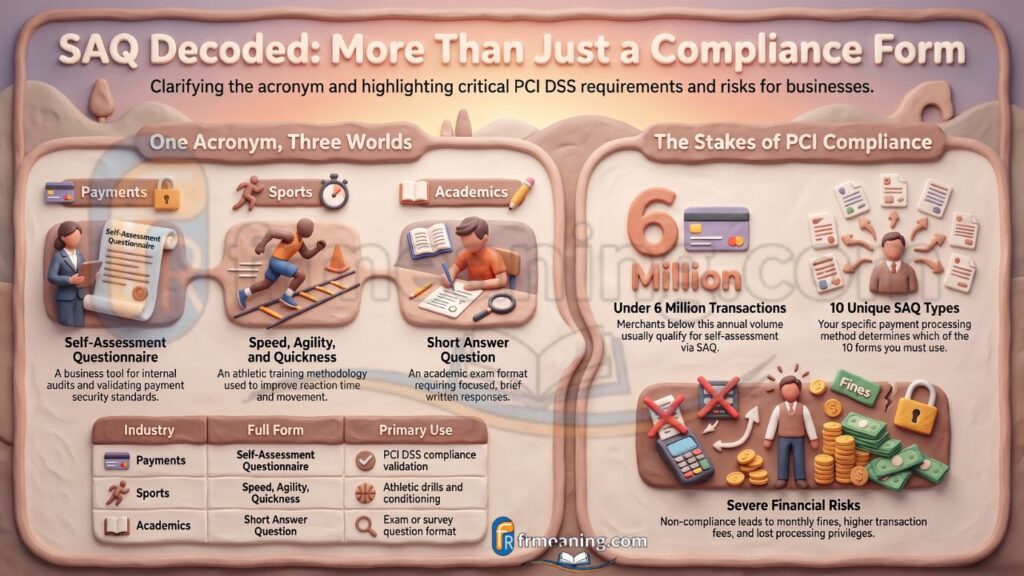
SAQ most commonly stands for “Self-Assessment Questionnaire,” though the exact meaning shifts depending on context — in payments it means a PCI compliance document, in sports it usually means Speed, Agility and Quickness training, and in research it can refer to a Short Answer Question format.
So when someone asks “what is SAQ” or “what is a SAQ,” there isn’t one single universal answer — you kinda have to know the industry first. Below, we’ll quickly cover the non-payment meanings before diving deep into the PCI definition, which is what most professional searches are actually after.
SAQ Meaning in Different Fields (Quick Overview)
Here’s a snapshot table so you can jump straight to the section relevant to you:
| Industry/Context | SAQ Full Form | Typical Use |
|---|---|---|
| Payments & Compliance | Self-Assessment Questionnaire | PCI DSS compliance validation for merchants |
| Sports, Football & Soccer | Speed, Agility, Quickness | Athletic training drills and conditioning programs |
| Research & Academics | Short Answer Question | Exam or survey question format |
| Business/Corporate | Self-Assessment Questionnaire | Internal audits, vendor risk assessments, compliance checks |
| Jewelry | Varies by maker | Sometimes used as a maker’s mark or model/reference code (always confirm with the seller’s documentation, since it isn’t a standardized industry term) |
Now let’s unpack each of these a bit more.
SAQ Meaning in Sports, Football & Soccer
In sports, SAQ stands for Speed, Agility, and Quickness — a training methodology built to improve an athlete’s short-burst movement, direction changes, and reaction time.
What is SAQ Training?
SAQ training combines drills like ladder work, cone drills, shuttle runs, and reactive sprints. Coaches use it to sharpen an athlete’s footwork and body control, not just raw straight-line speed. This is a big deal in football (soccer), where players need to change direction constantly, not just run fast in one line.
Why SAQ Matters for Athletes
SAQ training → improves → an athlete’s game-day performance, especially in sports that demand rapid direction changes such as soccer, football (American), basketball, and tennis. Coaches usually introduce SAQ drills early in pre-season, since building these neuromuscular patterns takes repetition over weeks, not days.
SAQ Meaning in Research & Business
In academic and research settings, SAQ often refers to a Short Answer Question, which is a question format that sits between multiple-choice and full essay responses, requiring brief, focused written answers.
In a business or corporate context, though, SAQ usually circles back to the Self-Assessment Questionnaire, used for internal audits, third-party vendor risk checks, or regulatory compliance (this is where it starts overlapping with the PCI definition we’ll cover below). Businesses use these questionnaires to self-report their own risk posture rather than paying for an external audit every single time — which, frankly, saves a ton of money for smaller companies.
SAQ Meaning in English (General Usage)
There isn’t really a fixed, dictionary-level “SAQ meaning in English” — it’s not a word you’ll find in standard usage outside of these specific industries. It’s purely an acronym, and its meaning is entirely dependent on context. If someone uses it without explaining themselves, you’ll basically have to ask which field they’re talking about.
Alright — now let’s get into the meat of this article: the compliance version of SAQ, since this is the one that actually has legal and financial stakes attached.
What is PCI SAQ? (Full Definition)
A PCI SAQ is a self-assessment questionnaire that merchants and service providers complete to confirm their security practices meet PCI DSS (Payment Card Industry Data Security Standard) requirements.
Basically, if your business accepts, processes, stores, or transmits card data in any capacity, PCI DSS compliance applies to you. Not every business, though, needs a full external audit — this is where the SAQ comes in as a lighter-weight, self-reported alternative.
A completed SAQ pairs with an AOC (Attestation of Compliance), a formal document confirming whether your business has met the required standards or not. Once both are filled out, you submit them to your payment card brand or whichever entity requested them (usually your acquiring bank).
Merchant/Service Provider → must comply with → PCI DSS. That’s the core relationship underpinning literally everything in this article.
Who Must Complete an SAQ
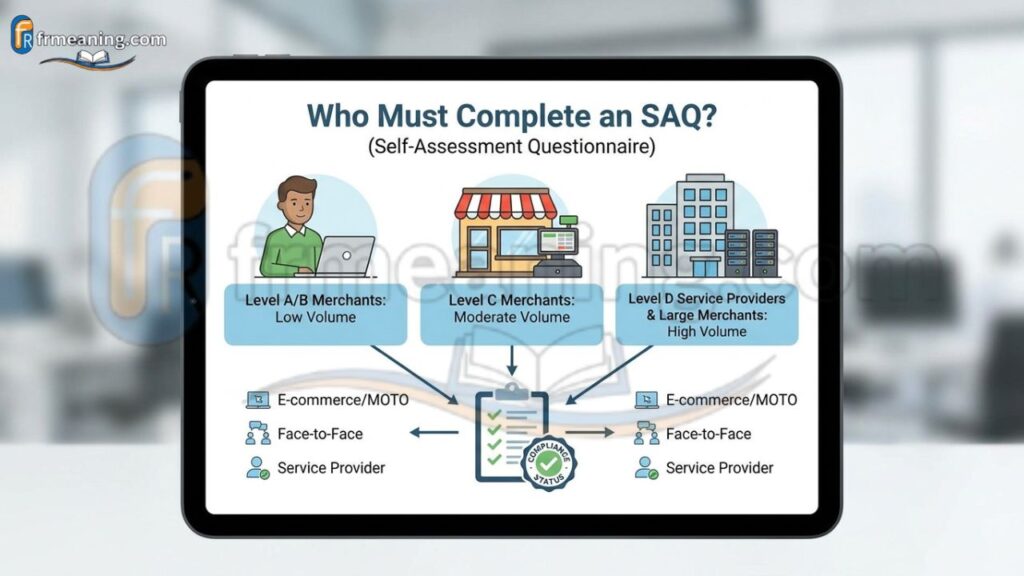
Not every business qualifies for the “easier” self-assessment route. Eligibility depends heavily on your transaction volume.
Generally speaking:
- Merchants and service providers processing fewer than six million card transactions annually are typically eligible to complete an SAQ.
- Businesses processing more than six million transactions per year are usually classified as Level 1 organizations, which are considered higher-risk in the PCI compliance hierarchy.
Transaction volume → determines → merchant level (1 through 4). And that level, in turn, dictates whether you can self-assess or whether you need something heavier.
Level 1 organizations don’t get to use an SAQ at all — instead, they must undergo a full PCI DSS Assessment conducted by a Qualified Security Assessor (QSA), culminating in a Report on Compliance (ROC). This is a much more rigorous (and expensive) process, so it’s worth checking your level with your specific payment brand before assuming you’re eligible for the lighter option.
Types of PCI DSS SAQ (2026 Update)
As of PCI DSS v4.0.1, there are ten distinct SAQ types, each built for a specific merchant or service provider environment. Picking the wrong one is a common (and costly) mistake, so here’s a breakdown:
| SAQ Type | Who It’s For |
|---|---|
| SAQ A | Card-not-present merchants who fully outsource payment processing |
| SAQ A-EP | E-commerce merchants using a payment page but not storing data on-site |
| SAQ B | Merchants using standalone dial-out terminals or imprint machines |
| SAQ B-IP | Merchants using a PTS Point of Interaction (POI) device connected to processors |
| SAQ C | Merchants with internet-connected payment applications, no stored account data |
| SAQ C-VT | Merchants using third-party virtual terminals on isolated devices |
| SAQ D Merchant | Merchants who don’t qualify for any other SAQ category |
| SAQ D Service Provider | Eligible service providers (requires extra documentation) |
| SAQ P2PE | Merchants using a PCI-listed Point-to-Point Encryption solution |
| SAQ SPoC | Merchants using PTS-secured card reader-PIN devices |
Payment processing method → determines → correct SAQ type. So really, the first step is figuring out how your business actually handles cards — outsourced, in-person, virtual terminal, encrypted, etc. — before you even open the form.
A Quick Note on Choosing Correctly
A common mistake businesses make is assuming SAQ A applies to them just because they’re small. In reality, if you store even a little bit of card data anywhere on your own systems (even briefly, even accidentally), you likely need SAQ D Merchant instead, which is the “catch-all” category. When in doubt, it’s genuinely worth consulting the PCI Security Standards Council (PCI SSC) documentation directly, or working with a compliance specialist.
What to Expect Inside an SAQ
Every SAQ is structured around the 12 core requirements of PCI DSS, though not every SAQ type covers all twelve (some sections simply won’t apply to your setup).
Expect questions covering:
- How you build and maintain a secure network
- How you protect stored or transmitted account data
- What access controls you have in place
- Your vulnerability management program
- Whether your information security policies are documented and reviewed regularly
Most questions come with multiple-response answers, and if a section doesn’t apply to your business, you’ll need to mark it “Not Applicable” and explain why. Same goes for anything marked “Not Tested” — you can’t just skip it silently.
According to the PCI SSC, the SAQs were updated specifically to reflect PCI DSS v4 language, so the wording inside each questionnaire now mirrors the standard itself, and the responses align with the formal Report on Compliance template used for larger audits.
If your cybersecurity setup has any gaps or constraints, you may also need to document compensating controls — essentially, failsafe measures that make up for a weakness elsewhere in your system.
Steps to Completing an SAQ
Here’s the process broken down simply (because honestly, most guides make this sound way more complicated than it needs to be):
- Determine your business type — are you a merchant or a service provider, and which of the four PCI levels applies to you?
- Confirm your compliance expectations directly with your payment brand, since requirements can vary slightly.
- Download the correct SAQ and AOC from the official PCI SSC document library — don’t rely on random third-party templates.
- Use a compliance management tool if possible (something like SecureTrust’s PCI Manager) to simplify the scanning, testing, and recording process.
- Manually test and record your compliance data if you’re not using software — this includes network scans and internal reviews.
- Complete your AOC, either internally or through a qualified assessor, legally attesting that your business meets the standard.
- Submit both documents to your acquiring bank or whichever entity requested them.
Completed SAQ + AOC → gets submitted to → your acquiring bank or payment card brand. That’s the final step, and it’s the one businesses sometimes forget under deadline pressure.
Consequences of SAQ Non-Compliance (What Most Guides Skip)
This is a part a lot of competitor articles gloss over, and it’s honestly one of the most important things to understand before you treat your SAQ like a box-ticking exercise.
Failing to complete your SAQ correctly, submitting it late, or being found non-compliant during a review can lead to:
- Fines from your payment card brand or acquiring bank, which can range from a few hundred dollars a month to much larger penalties depending on severity and how long the issue goes unresolved.
- Increased transaction fees, since non-compliant merchants are often moved into a higher-risk pricing tier.
- Loss of card processing privileges, meaning your acquirer could suspend your ability to accept card payments altogether.
- Liability shifts in the event of a data breach — if you’re found non-compliant and a breach occurs, you may be held financially responsible for related costs (chargebacks, forensic investigations, customer notifications).
- Reputational damage, which, while harder to quantify, can genuinely hurt customer trust if a breach becomes public.
None of this is meant to scare you, but it’s worth being real about it — an SAQ isn’t just paperwork, it’s a legal attestation, and treating it casually can backfire badly.
How Many Questions Does Each SAQ Have?
The number of questions varies quite a bit by type. SAQ A is the shortest, with a relatively small handful of questions since it applies to fully outsourced, card-not-present merchants. SAQ D, on the other hand, is by far the longest, covering close to all 12 requirements in detail because it applies to businesses that don’t fit anywhere else.
As a rough guide, expect SAQ A to take a few hours to complete, while SAQ D can take several days to weeks depending on how prepared your documentation already is.
SAQ vs ROC: What’s the Difference?
An SAQ is a self-reported compliance document, while a ROC (Report on Compliance) is a formal assessment conducted by a Qualified Security Assessor. Smaller merchants (generally under six million annual transactions) typically use an SAQ, while Level 1 organizations are required to go through the full ROC process instead.
The ROC is more thorough, more expensive, and involves an external, independent evaluator rather than self-attestation.
Final Thoughts
At the end of the day, SAQ meaning really does depend on context — sport, research, business, or payments — but if you’re a merchant or service provider handling card transactions, the PCI version is the one that matters most for your bottom line.
Getting your SAQ type right, filling it out honestly, and keeping your AOC updated isn’t just a compliance checkbox, it genuinely protects your business (and your customers) from real financial and reputational risk.
FAQs
What does SAQ stand for in payments?
SAQ stands for Self-Assessment Questionnaire, a PCI DSS compliance document merchants use to confirm their security practices.
What is a SAQ in football or soccer?
It stands for Speed, Agility, and Quickness — a training method used to boost quick movement and reaction time.
Who needs to complete a PCI SAQ?
Merchants and service providers processing fewer than six million card transactions annually typically qualify to complete one.
How many types of PCI SAQ exist?
As of PCI DSS v4.0.1, there are ten SAQ types, each suited to a specific payment processing environment.
What happens if I fail my SAQ?
Non-compliance can lead to fines, higher transaction fees, loss of processing privileges, and breach-related liability exposure.
What is the difference between SAQ and ROC?
SAQ is self-reported by smaller merchants; ROC is a formal audit conducted by a Qualified Security Assessor for larger organizations.
What does SAQ mean in research or exams?
In academic contexts, SAQ typically stands for Short Answer Question, a brief written-response question format.