
You’re scrolling through your phone at 11pm and your friend texts “ugh major FOMO rn” after seeing a story from a party she wasn’t invited to. You kind of get it, but not really. What is she actually feeling? Is it sadness? Jealousy? Something else entirely?
If you’ve ever paused mid-conversation wondering what someone meant, you’re not alone. Understanding FOMO meaning in text has become almost a requirement for keeping up with modern digital conversations. This term shows up in captions, DMs, group chats, and even work Slack messages now, and honestly, it’s not going away anytime soon.
So let’s actually break it down properly this time where it came from, what it really means, and how you can use it (or respond to it) without sounding out of touch.
What Is FOMO? (Full Form & Quick Definition)
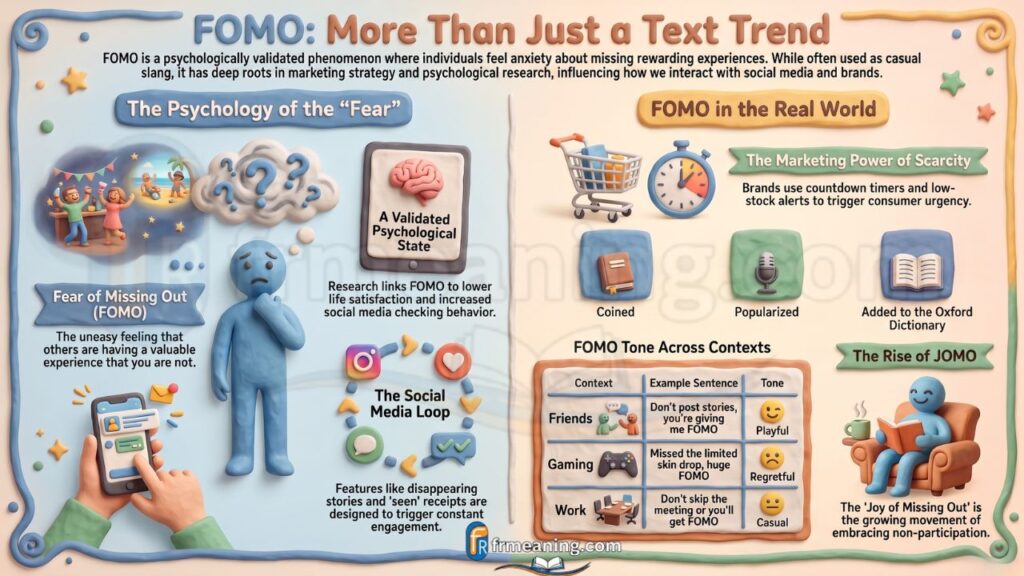
FOMO full form is “Fear of Missing Out.” In simple terms, it’s the anxious or uneasy feeling you get when you think other people are having an experience — fun, exciting, or valuable — that you’re not part of.
That’s the textbook version anyway. In real texting, FOMO is way more flexible than a dictionary would suggest. It can be:
- A genuine emotional reaction (sadness, regret, mild anxiety)
- A joking exaggeration among friends
- A subtle nudge to be included next time
- A reaction to literally anything, from parties to sneaker drops
The fomo fear of missing out meaning essentially captures a very human worry: that somewhere, something better is happening without us. Social psychologists actually link this to older concepts of social comparison, but the term itself is newer than most people assume.
Where Did FOMO Actually Come From? (The Origin Story Most Articles Skip)
Most guides on this topic completely skip this part, which is kind of wild honestly, because it actually adds a lot of context.
The concept traces back to marketing strategist Dr. Dan Herman, who is credited with coining the term in a 1996 research paper on brand loyalty. However, it wasn’t until Patrick McGinnis, a Harvard Business School student, used and popularized the acronym “FOMO” in a 2004 op-ed that it started spreading into casual use.
Then in 2013, psychologist Andrew Przybylski and a team of researchers published one of the first academic studies validating FOMO as a real psychological experience — not just internet slang. Their research found FOMO correlates with lower mood, lower life satisfaction, and increased social media checking behavior.
So basically: Academic Research → validates → FOMO as a genuine psychological phenomenon, not just a throwaway text trend. This matters because it explains why the feeling behind the word feels so real, even when people use it jokingly.
FOMO Meaning in Social Media
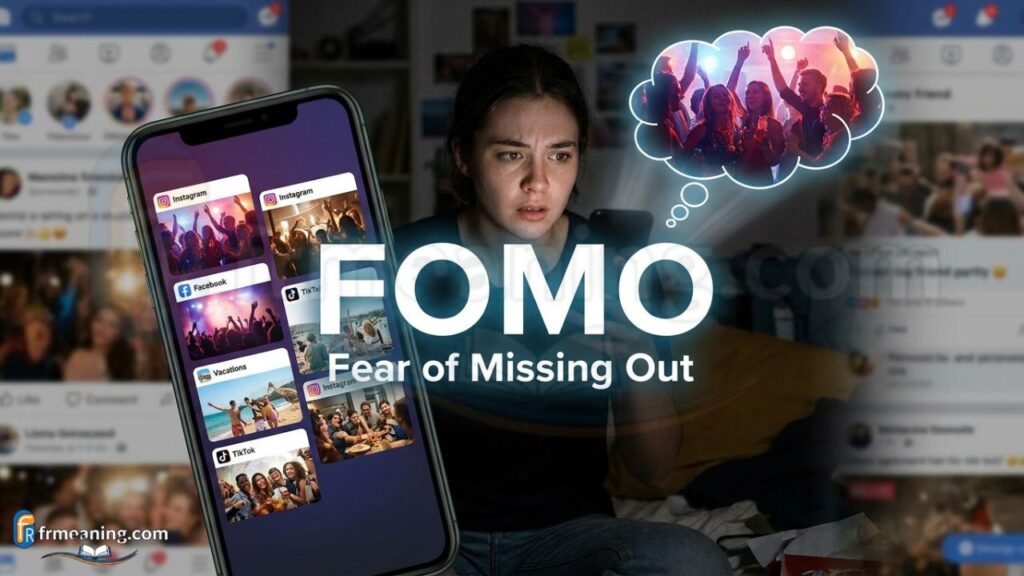
On platforms like Instagram, TikTok, and Snapchat, fomo meaning in social media takes on an amplified version of the original definition. It’s not just about missing one event anymore — it’s about a constant stream of curated highlight reels making you feel like you’re perpetually behind.
Common social examples include:
- “Weekend vibes = instant FOMO” (caption under a party photo)
- “This story is literally giving me FOMO” (comment reply)
- “Why does everyone’s life look better than mine lately” (implied FOMO without saying the word)
Social media exposure → triggers → FOMO, and platforms are somewhat designed around this loop. The endless scroll, the “seen” receipts, the disappearing stories — all of it nudges users to keep checking so they don’t miss anything.
FOMO in a Sentence: Real Examples Across Contexts
Seeing fomo in a sentence actually helps way more than a plain definition does, so here’s a breakdown by situation.
| Context | Example Sentence | Tone |
|---|---|---|
| Friends/Texting | “Don’t post stories, you’re giving me FOMO” | Playful |
| Social Media | “Seeing this story is hurting my FOMO” | Emotional |
| Dating Apps | “If I don’t reply fast I’ll lose the match, FOMO hits different” | Anxious |
| Gaming | “Missed the limited skin drop, huge FOMO” | Regretful |
| Work Chat | “Don’t skip the meeting or you’ll get FOMO later” | Casual/light |
Notice how the same three letters shift meaning depending entirely on where and who’s using them. That’s honestly the trickiest part of decoding internet slang — context does most of the heavy lifting, not the word itself.
FOMO’s Other Meaning: Beyond Just Texting
A lot of people don’t realize FOMO has an fomo other meaning outside casual chat — it’s actually a legitimate term in marketing and business strategy too.
FOMO Marketing: The Gap Most Guides Miss
This is honestly one of the most important applications of the term, and most articles covering “FOMO meaning in text” completely leave it out.
FOMO marketing refers to the deliberate use of urgency and scarcity tactics to drive consumer action. Brands, e-commerce stores, and even SaaS companies build entire campaigns around triggering this exact emotion. Common tactics include:
- Countdown timers on checkout pages (“Sale ends in 2 hours!”)
- Low stock alerts (“Only 3 left in stock”)
- Limited-time offers or flash sales
- Social proof notifications (“14 people bought this in the last hour”)
- Exclusive access or “early bird” messaging
Semantically: Scarcity Messaging → triggers → FOMO → drives → Consumer Urgency and Purchase Decisions
This is the exact same emotional mechanism gaming companies use with limited-time skins or rewards — the “log in daily or lose it” model. Once you understand this, you start noticing it literally everywhere, from Amazon listings to Instagram ads to app notification badges.
Understanding this business side of FOMO gives you a much more complete picture than just the texting slang definition alone.
FOMO in a Relationship: What It Really Signals
The fomo meaning in relationship context is a little different from friend-group or social media FOMO, and it’s worth breaking down separately since it comes up a lot in dating conversations.
In romantic contexts, FOMO can mean:
- Worrying your partner might be having fun without you
- Fear that a potential match or date might “get away” if you don’t act fast
- Anxiety about being replaced or forgotten in a budding connection
- Comparing your relationship to others you see online (relationship FOMO)
Example: “Everyone else is matching and talking, FOMO is activated” — this reflects dating-app anxiety, where the fear isn’t about a party, it’s about losing a romantic opportunity.
This kind of FOMO tends to hit a little harder emotionally because it’s tied to attachment, not just social status.
Is There a “FOMO Baby” Meaning?

You might’ve seen the term fomo baby meaning floating around parenting forums or TikTok, and it’s honestly a fairly niche but growing usage.
It generally refers to two slightly different ideas:
- Parents having “fear of missing out” on their child’s milestones (work commitments pulling them away from key moments)
- A term sometimes used jokingly for a baby conceived partly out of “FOMO” — meaning the parents felt like they might miss out on the experience of having another child if they waited too long
It’s not an official or widely standardized phrase, but it shows just how flexible this acronym has become across totally unrelated communities.
Is FOMO in the Oxford Dictionary?
Yes, actually. The fomo oxford dictionary entry confirms FOMO is officially recognized as a real word, not just internet slang. Oxford Dictionaries added “FOMO” back in 2013, defining it essentially as anxiety that an exciting event may be happening elsewhere, often triggered by posts on social media.
This matters because it shows the term has moved beyond casual texting into legitimate, dictionary-recognized vocabulary — which is honestly a pretty rare achievement for an acronym that started as slang.
How to Respond When Someone Says They Have FOMO
Your reply really depends on the tone and relationship. Here’s a quick breakdown:
Casual Friend Replies
- “Next time you’re definitely coming with us”
- “Honestly, you didn’t miss much”
Funny Replies
- “FOMO level: expert unlocked 😂”
- “Should I send you live updates next time?”
Professional Replies
- “I’ll share the meeting notes so you’re not out of the loop”
- “You’re welcome to join the next session”
The key thing is matching energy — a joking FOMO text deserves a light response, while a genuinely upset one deserves reassurance, not sarcasm.
Similar Slang Terms Worth Knowing
FOMO doesn’t exist in isolation — it’s part of a broader internet vocabulary. Some related terms include:
- JOMO (Joy of Missing Out) — the direct opposite of FOMO
- YOLO (You Only Live Once) — often paired with FOMO in decision-making contexts
- No cap — meaning “no lie” or “for real”
- Hits different — describes something feeling uniquely impactful
- Mood — a relatable feeling or situation
JOMO → is the opposite of → FOMO, and it’s actually gained popularity as a kind of pushback movement, encouraging people to embrace missing out rather than stress about it.
When You Should Avoid Using FOMO
There are a few situations where dropping this slang isn’t really ideal:
- Formal emails or job interviews — it reads as too casual
- Cross-cultural conversations — not every audience knows internet slang
- Sensitive moments — if someone’s genuinely upset about being excluded, joking about “FOMO” can feel dismissive rather than funny
Reading the room matters more than the word itself, honestly.
FAQs
What does FOMO mean in simple words?
FOMO means fear of missing out — the anxious feeling that others are enjoying something exciting without you.
Is FOMO a real psychological emotion?
Yes, research by psychologist Andrew Przybylski confirmed FOMO as a genuine, measurable emotional experience tied to social comparison.
What’s the opposite of FOMO?
The opposite is JOMO, meaning “Joy of Missing Out,” which reflects contentment with not participating.
Is FOMO only used online?
No, FOMO applies to real-life situations too, including work, relationships, and everyday social plans.
Can businesses use FOMO in marketing?
Yes, brands use scarcity tactics like countdown timers and low-stock alerts to trigger FOMO and boost sales.
Is FOMO officially recognized in dictionaries?
Yes, Oxford Dictionaries added FOMO in 2013, confirming it as a legitimate, widely recognized English term.
Can FOMO be a positive feeling?
Sometimes, yes — playful FOMO can motivate people to join future plans rather than cause real distress.