
So you saw “wlw” in someone’s bio, or maybe your cousin texted it and you just… nodded like you understood. Relatable, honestly. The wlw meaning in text thing trips up a LOT of people, and if you’ve been quietly Googling it at 1am, welcome, you’re in good company.
Here’s the thing though this isn’t just some random internet code. It’s tied to real identities, real relationships, and a whole community that’s been using this shorthand for over a decade now. Once you get it, you’ll start noticing it everywhere TikTok captions, Snapchat stories, book recommendations, the lot.
Let’s actually break it down properly, no fluff.
What Does WLW Mean?
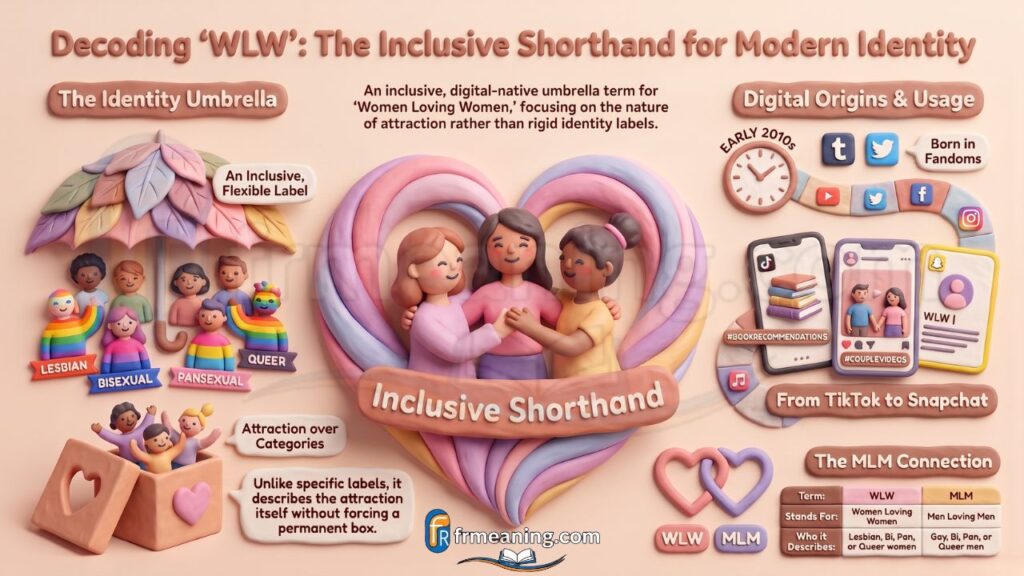
WLW stands for “women loving women.” Simple as that. It’s used to describe women who feel romantic or emotional attraction toward other women.
This isn’t one single identity though — it’s more like an umbrella that covers:
- Lesbian women
- Bisexual women
- Pansexual women
- Queer women who love women
The beauty of it (and I say this as someone who’s spent way too long reading Reddit threads about this) is that wlw doesn’t force anyone into a box. You don’t have to pick a super specific label to use the term. It just describes the attraction itself.
Quick examples so it clicks:
- “This show has such a wholesome wlw storyline.”
- “She’s openly wlw and pretty vocal about LGBTQ+ rights.”
- “I’ve been binging wlw creators on YouTube lately.”
See how casual it sounds? That’s kind of the point.
What Does WLW Stand For — The Full Breakdown
Okay so technically WLW stands for “Women Loving Women” — but the “stand for” question usually comes up because people confuse it with actual full sentences vs. just an identity shorthand. It’s not an organization, not a hashtag campaign, nothing formal like that. It’s literally just describing attraction between women, full stop.
Some people write it lowercase (wlw), some cap it (WLW) — doesn’t change the meaning either way.
Where Did WLW Come From? (Origin and Background)
The term wlw grew out of online LGBTQ+ communities, particularly Tumblr and Twitter, back in the early 2010s. Tumblr especially had this whole culture of shorthand identity tags, and wlw fit right in alongside similar terms.
It developed hand-in-hand with:
- MLM (men loving men) — the male equivalent
- Sapphic — a broader poetic term referring to women attracted to women
Now here’s an important semantic point: WLW → does not replace → the word “lesbian.” It was never meant to. Instead, it gave people a wider, more flexible option — because, real talk, not every woman who’s attracted to women wants to call herself a lesbian, and some don’t want to label things at all.
As these online spaces grew, so did wlw’s usage. It slid naturally into:
- Social media bios
- Fan communities and fandom spaces
- Dating apps
- General online discussions
It’s basically part of the everyday digital vocabulary now, especially for anyone under 35ish who spends time online.
If you actually trace the timeline a bit, wlw picked up steam alongside the broader “shipping culture” on Tumblr — where fans would tag their favorite fictional couples with identity shorthand so other fans could find similar content easier.
Around 2013-2015, fandoms built around shows with confirmed or heavily-implied wlw couples (think early 2010s cartoons and teen dramas) basically exploded, and the tag became a shortcut for finding fan art, fanfiction, and discussion threads.
Twitter picked it up not long after, mostly through book communities and “stan” culture, where readers started using #wlw to recommend novels with sapphic leads. By the time apps like TikTok rolled around, the term was already baked into internet culture, so it just carried over naturally — no reinvention needed.
That’s honestly one of the things competitor articles tend to gloss over. They’ll say “it started on Tumblr in the early 2010s” and just leave it there, but the actual spread — fandom to book communities to mainstream apps — is what explains why wlw feels so universally understood today, even by people who aren’t deeply embedded in LGBTQ+ online spaces.
MLM and WLW Meaning — How They Relate
You’ll almost always see mlm and wlw mentioned together, and that’s not an accident. They’re companion terms:
| Term | Meaning | Who It Describes |
|---|---|---|
| WLW | Women Loving Women | Women attracted to women (lesbian, bi, pan, queer) |
| MLM | Men Loving Men | Men attracted to men (gay, bi, pan, queer) |
Both terms emerged from the same online LGBTQ+ spaces around the same time, and both work the exact same way — describing attraction without demanding a super rigid label. Kinda handy honestly, since it lets fandom and media discussions group content by relationship type without getting into everyone’s personal identity specifics.
There’s also WLM, which stands for “women loving men” — used way less often but it does pop up occasionally, usually in discussions about attraction spectrums or bisexual experiences where someone’s talking about their attraction to multiple genders separately.
What Does WLW Mean on TikTok?
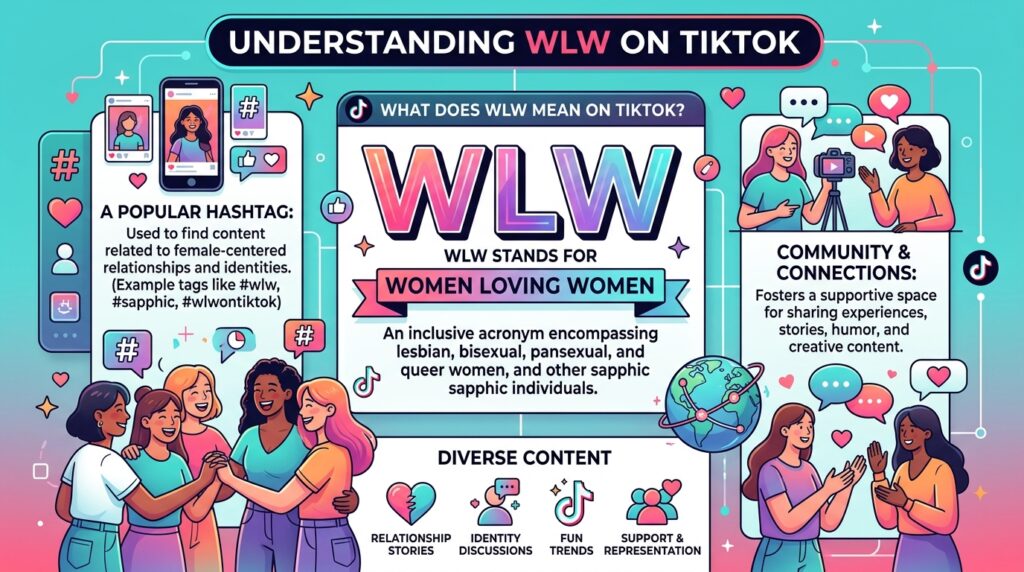
TikTok basically runs on shorthand, so wlw shows up constantly in captions, comment sections, and video tags. On the app, wlw usually appears in:
- Couple content — creators tagging their videos #wlw to show it’s a wlw relationship
- Book and movie recommendations (“wlw books you NEED to read”)
- Coming out or identity videos
- Fan edits for TV couples (“this wlw ship deserved better”)
The meaning doesn’t change from platform to platform, but TikTok’s fast pace means you’ll see it used almost like a genre tag — like how people use #cottagecore or #foodtok. It helps the algorithm and other users instantly know what kind of content they’re looking at.
What Does WLW Mean on Snapchat?
Snapchat’s a bit more private and personal than TikTok, so wlw shows up differently there. On Snapchat, people mostly use it:
- In their bio or Snap Score caption to indicate their identity
- In private conversations, like “omg is she wlw??”
- On Snapchat’s Discover/Spotlight content that features LGBTQ+ creators
Since Snapchat leans toward closer friend groups rather than public audiences, the term often comes up in more personal, direct conversations — like someone confiding in a friend about their identity, rather than a public declaration.
WLW Relationship — What It Actually Looks Like
A wlw relationship simply refers to a romantic relationship between two women (or more broadly, between people who identify as women). This could include:
- Two women who both identify as lesbian
- A bisexual woman dating another woman
- A pansexual or queer woman in a relationship with another woman
There’s nothing structurally “different” about a wlw relationship compared to any other romantic relationship — same ups, downs, communication issues, all of it. The term is really just describing who’s in the relationship, not how it functions.
Media representation matters a lot here too. When people say “we need more wlw relationship stories,” they’re asking for realistic, non-stereotyped portrayals — not just tragic storylines or side-character romances that never get the spotlight.
WLW Breakup Meaning — Is There Something Unique?
Honestly? A wlw breakup isn’t fundamentally different from any other breakup emotionally — heartbreak is heartbreak. But there are some layered challenges that come up more often in wlw relationships specifically:
- Less social support — some wlw couples deal with family or community pushback, which can make breakups feel more isolating.
- Smaller dating pools — depending on location, finding new wlw partners can feel harder, which sometimes adds pressure during a breakup.
- Identity questions resurfacing — breakups can sometimes reopen questions about identity or belonging, especially for women still figuring things out.
None of this means wlw breakups are “worse,” just that the surrounding context can add extra emotional weight sometimes.
WLW Other Meaning — Does It Ever Mean Something Else?
Occasionally people ask if wlw has another meaning outside the LGBTQ+ context, and yeah — technically letters get reused everywhere online. But in the overwhelming majority of cases, especially in texts, bios, hashtags, and dating apps, wlw refers to “women loving women.” If you see it in an unrelated context (like gaming forums or random acronyms), it’s probably a coincidence rather than the same term — always check the surrounding context to be sure.
Emotional and Cultural Meaning Behind WLW
This is honestly the part that gets skipped over a lot, but it matters. WLW isn’t just shorthand — it carries real emotional weight for a lot of women.
For many, finding or using the term feels genuinely validating. It kind of says:
- You belong here.
- Your identity is seen, not questioned.
- You don’t owe anyone a full explanation.
Understanding WLW → fosters → empathy and better communication, even for people who don’t personally identify with the term. In a world where identity gets misread constantly, having a soft, non-restrictive word like wlw creates breathing room. It allows for fluidity instead of forcing someone into a permanent box before they’re ready.
Culturally, it’s tied closely to visibility and representation. When someone says “we need more wlw stories in media,” they’re pushing for authentic, non-tokenized portrayals of women loving women — not just background characters or subtext that never gets confirmed.
Similar or Related Terms (And How They’re Different)
People mix these up constantly, so here’s a quick breakdown:
- Lesbian – a woman exclusively attracted to women
- Bisexual – attracted to more than one gender
- Pansexual – attraction regardless of gender
- Sapphic – a broader, more poetic term for women attracted to women
- Queer – an umbrella term covering non-heterosexual identities generally
The key distinction? WLW → focuses on → attraction between women, without pinning down someone’s entire sexual orientation. It’s descriptive, not definitive.
WLW vs. Sapphic — Which One Should You Actually Use?
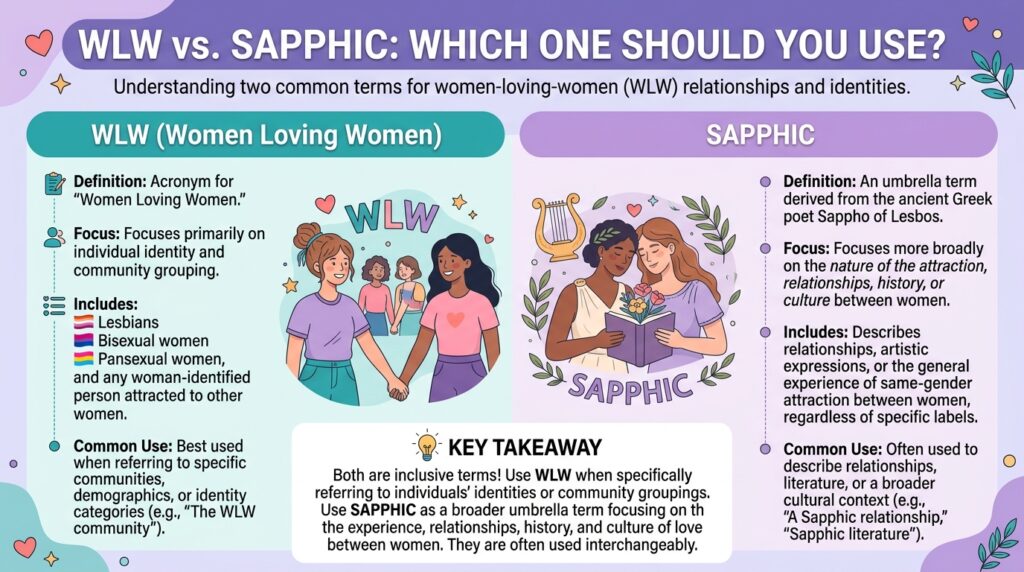
This one trips people up a lot, ngl. Both terms describe women attracted to women, so what gives?
Generally speaking:
- Use “wlw” when you’re talking casually — bios, hashtags, quick text descriptions, fandom tags. It’s the more internet-native, informal version.
- Use “sapphic” when you want something that sounds a bit more literary or poetic — it’s often used in book descriptions, film reviews, or more artistic contexts. The word actually traces back to Sappho, the ancient Greek poet from Lesbos who wrote about love between women (yep, that’s also where “lesbian” comes from).
Neither term is “more correct” than the other — it really just comes down to tone and setting. A goodreads review might say “gorgeous sapphic romance,” while someone’s Twitter bio might just say “wlw, 22, hi.” Same meaning, different vibe.
Also worth mentioning: some non-binary people who are attracted to women also use wlw or sapphic loosely, since both terms can flex a bit depending on the community using them. It’s not always strictly binary in practice, even if the literal wording focuses on “women.”
Common Misunderstandings About WLW
Let’s clear up the confusion that keeps circulating:
- “WLW only means lesbian.” Nope — it includes lesbian women but isn’t limited to just them.
- “It’s some new trend or phase.” Not true. The experience isn’t new at all; only the abbreviation is relatively recent.
- “It’s inappropriate slang.” It’s informal, sure, but it’s respectful and widely accepted within LGBTQ+ spaces.
- “It excludes bisexual women.” Actually, it includes them, as long as they love women too.
- “It’s only an online thing.” Mostly online still, but it’s creeping into offline conversations more and more each year.
How WLW Is Used in Everyday Life
You’ll mostly catch wlw in casual, digital settings rather than formal writing. Some real examples:
- Social media bios: “Photographer | 23 | wlw”
- Hashtags: #wlw #wlwcommunity #wlwbooks
- Dating apps: used to clarify attraction preferences upfront
- Fan communities: “This series desperately needs more wlw representation”
- Text messages: “Wait, is that show actually wlw?”
It’s short, it’s clear, and pretty much anyone active in LGBTQ+ online spaces understands it instantly.
Why Understanding WLW Meaning in Text Matters Today
Language moves fast, and digital language moves even faster. Knowing the wlw meaning in text genuinely helps you:
- Communicate more respectfully
- Avoid awkward misunderstandings in conversations
- Support inclusive, judgment-free discussions
- Stay culturally aware in digital spaces
Even if you don’t personally identify with the term, understanding it just shows a bit of empathy — and empathy tends to build better conversations, both online and off. When people search “wlw meaning in text,” they’re often looking for straightforward clarity, sometimes because they’re exploring their own identity, sometimes because they just saw a tweet and got curious. Either way, a little knowledge goes a long way.
FAQs
What does wlw mean in simple words?
It means “women loving women” — women who feel romantic or emotional attraction toward other women.
What does wlw mean on TikTok?
Same core meaning, but used as a content tag for couples, book recs, and fan edits involving women loving women.
What does wlw mean on Snapchat?
Used similarly, often in bios or private chats to describe identity or discuss someone’s attraction casually.
What’s the difference between mlm and wlw meaning?
MLM means “men loving men,” while wlw means “women loving women” — both describe same-gender attraction respectively.
What does wlw stand for exactly?
It stands for “Women Loving Women,” describing romantic or emotional attraction between women specifically.
Is a wlw relationship different from other relationships?
Not structurally — it just refers to a romantic relationship where both partners identify as women.
Does wlw ever have another meaning?
Rarely, and usually unrelated coincidences — in nearly all text and social contexts, it means women loving women.