

You’re scrolling through a group chat and someone drops “that party was insane ONB” and you just… stare at it. You’re not alone. Slang moves fast these days, sometimes faster than we can keep track of, and ONB meaning in text is one of those phrases that seems to have exploded out of nowhere. One minute nobody’s heard of it, the next it’s showing up in comments, captions, and texts from your younger cousin.
So what is it actually about? This guide breaks down where ONB came from, what it really signals, how it’s used across different platforms, and why it matters more than you’d think for reading tone correctly online.
We’ll also go deeper than most guides out there by covering the platform-specific usage patterns and syntax rules that other articles kind of skim past.
ONB Meaning
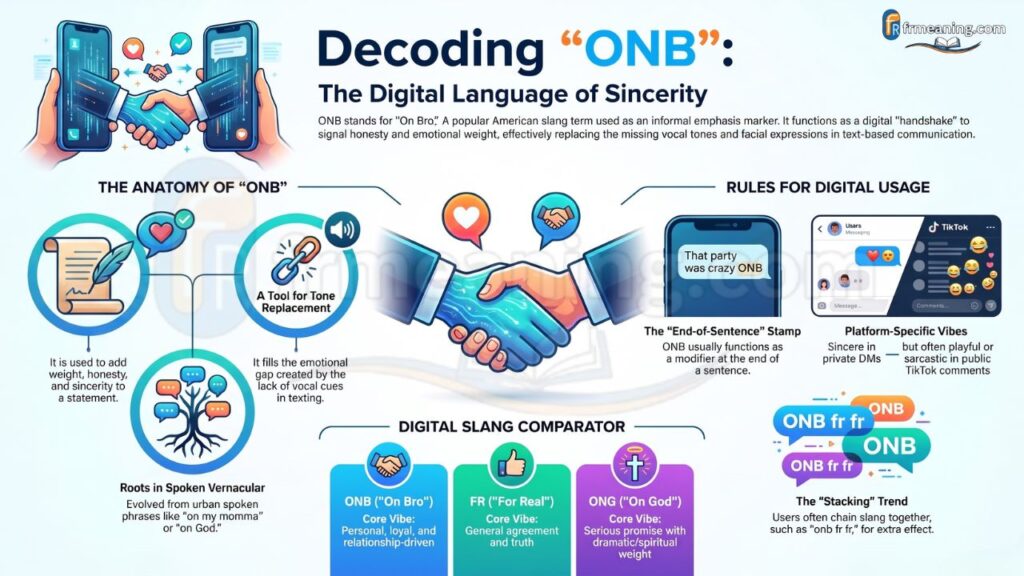
Short answer first, because nobody wants to scroll forever: ONB stands for “On Bro”, a slang expression used mostly in the United States to add weight and honesty to a statement. It’s basically a digital handshake — a way of saying “I’m not lying to you” or “I really mean this.”
Think of it like the texting cousin of “I swear” or “on my life.” It doesn’t carry a formal dictionary definition (yet), but its meaning is pretty consistent across the platforms where it shows up. ONB → functions as → an emphasis marker, and that’s really the core of it.
A few quick points to keep in mind:
- It’s almost always informal
- It’s tied closely to trust and sincerity
- It works best between people who already have some kind of rapport
- Tone still depends heavily on context, so it’s not a one-size-fits-all phrase
What Does ONB Mean?
In plain terms, ONB is used when someone wants to stress that they’re being truthful or serious about what they just said. It’s less about the literal words and more about the emotional charge behind them.
Here’s the thing though — text doesn’t carry tone of voice, facial expressions, or body language. So when you’re typing something intense or emotional, there’s a risk the other person just reads it flat. Words like ONB exist to patch that gap. It’s a small linguistic tool that fills in for the stuff we’d normally show with our face or voice in a real conversation.
ONB → replaces → missing vocal tone in digital communication, which is honestly the whole reason short emphasis-slang like this keeps popping up generation after generation (remember when everyone said “no cap”? Same job, different word).
Where Did It Come From
Like most internet slang, ONB didn’t start in a dictionary or a marketing meeting. It grew out of spoken language first, specifically from urban and street vernacular where phrases like “on bro,” “on my momma,” or “on God” were already common ways to swear to something. As texting culture took over daily communication, people naturally started shortening these verbal habits into quick abbreviations that were faster to type.
- Rooted in spoken slang and community speech patterns
- Carried through urban and youth culture first
- Picked up steam through social media reposts and comment sections
- Eventually got compressed down to just three letters for speed
ONB Meaning in Text

When you actually see ONB inside a real text message, it usually sits at the end of a sentence, functioning almost like a stamp of approval on whatever was just said. It rarely opens a sentence, and honestly that placement matters more than people realize — putting the emphasis word last mirrors how we naturally add stress to the end of a spoken sentence too (“I’m not joking, I swear”).
Some real-world style examples:
- “That game was crazy ONB”
- “I didn’t even touch it ONB”
- “You gotta watch this show ONB”
- “I’m telling you the truth ONB”
Notice a pattern? In every case, ONB is reinforcing something the person already said, not introducing new information. That’s a subtle but important distinction — it’s a modifier, not a standalone statement.
Grammar and Placement Rules (The Part Most Guides Skip)
Most articles mention that ONB “usually goes at the end” and just leave it there, which honestly isn’t very helpful if you’re trying to actually use it right. So let’s go a bit deeper.
Capitalization is loose and inconsistent — you’ll see it as ONB, Onb, and onb all in the same conversation thread, and none of them are technically “wrong.” Lowercase tends to feel more casual and playful, while all-caps ONB often reads as more intense or urgent, kind of like digital shouting but without actually being aggressive.
Punctuation matters more than people expect too. A period after ONB (“I mean it ONB.”) tends to read as more serious or even a little cold. Dropping the punctuation entirely, which is the more common style, keeps things feeling casual and quick — which fits the whole point of the phrase anyway.
It also stacks with other slang pretty naturally. You’ll see combinations like “onb fr fr” or “no cap onb” where multiple emphasis markers pile up for extra effect. This layering is actually a growing trend in youth texting, where a single emphasis word isn’t considered strong enough anymore, so people chain two or three together.
What Does ONB Mean in Text (Platform by Platform)
This is where a lot of coverage gets a little too general, saying stuff like “it’s used on social media” without breaking down where or how. So here’s a more specific look.
| Platform | How ONB Typically Appears | Common Vibe |
|---|---|---|
| Snapchat/DMs | End of casual chat messages | Personal, sincere |
| TikTok comments | Reaction to relatable or funny content | Playful, exaggerated |
| Instagram captions | Paired with bold or emotional statements | Confident, attention-grabbing |
| Twitter/X replies | Quick agreement or reaction | Blunt, fast-paced |
| Group texts | Reinforcing a claim among friends | Loyal, in-group tone |
The pattern that jumps out is pretty clear — the more personal and private the platform (like a direct message), the more sincere ONB tends to feel. On more public platforms like TikTok or X, it drifts toward being playful or even a bit sarcastic, almost performative. Platform context → shapes → the emotional weight of ONB, and that’s a detail that changes how you should read it depending on where you spot it.
ONB Meaning Slang: How It Compares to Similar Terms
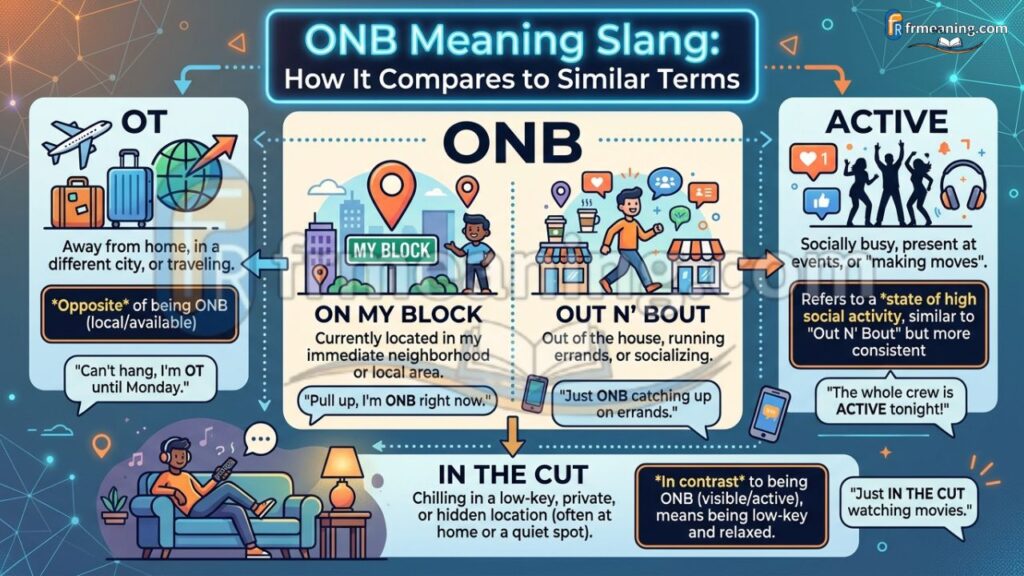
ONB isn’t operating alone out there — its part of a whole family of emphasis slang that’s flooded texting culture over the last several years. Knowing the difference helps you actually read the room better.
| Term | Meaning | Common Association | Notes |
|---|---|---|---|
| ONB | “On Bro” | Loyalty, honesty | Personal, relationship-driven tone |
| FR | “For Real” | Agreement, truth | Broader, more general usage |
| ONG | “On God” | Serious promise | Often carries a spiritual weight |
| TBH | “To Be Honest” | Openness | Softer, less emotionally intense |
So while these all fall into the same rough category, ONB → carries → a more personal and relational tone compared to something like FR, which anyone can throw into a sentence without it feeling tied to a specific relationship. ONG leans more dramatic. TBH is honestly the mildest of the bunch.
ONB in American Culture and Identity
Slang rarely exists just for the sake of communication efficiency — it also signals who you are, what group you belong to, and how plugged in you are to current trends. ONB fits right into that pattern.
Using it can:
- Build a sense of closeness between speakers
- Show cultural fluency and awareness of current trends
- Signal belonging to youth or online-native communities
- Reflect a broader shift toward informal, expressive digital communication
Slang usage → reflects → group identity and belonging, which is really why terms like this spread so fast among younger audiences specifically. It’s not just about the words, it’s about showing you’re “in the know.”
Emotional Weight Behind ONB
Even a tiny three-letter abbreviation can carry real emotional signal. When someone uses ONB, they’re usually trying to communicate one of a few things: urgency, excitement, or a genuine need to be believed. It’s not random.
Because texting strips away so much nonverbal communication, people lean on phrases like this to close that gap. Lack of vocal tone in text → creates → demand for emphasis slang like ONB. That’s basically the whole engine driving this kind of language evolution, and it’s not new either — every generation invents its own version of this.
Misunderstandings Around ONB
Not everyone reads ONB the same way, and that’s led to a fair bit of confusion, especially across generational or cultural lines.
Common issues people run into:
- Older audiences sometimes misread it as aggressive or confrontational
- It gets confused with other similar-looking abbreviations
- International readers unfamiliar with US slang may not catch the meaning at all
- Context gets lost when the phrase is used sarcastically without other cues
To be clear though — ONB isn’t offensive on its own. It’s neutral. The tone comes almost entirely from what surrounds it, not the word itself.
Cross-Cultural Meaning of ONB
Outside the US, this phrase mostly falls flat. ONB → remains largely tied to → American digital slang culture, and it hasn’t really crossed over into other English-speaking regions the way some other terms have.
- Rarely recognized in UK, Australian, or Canadian slang circles
- Meaning shifts or disappears entirely outside US-based platforms
- May need explaining in international group chats
- Reflects how regionally specific a lot of internet slang actually is, even in an era where everything feels globally connected
Should You Actually Use ONB?
Depends who your talking to, honestly. If your texting close friends or posting something casual online, it fits right in. If your emailing a coworker or writing something formal, leave it out completely — it’ll just read as out of place.
Quick guide:
- Use it: casual chats, close friend groups, social captions
- Avoid it: professional emails, formal writing, unfamiliar audiences
FAQs
What does ONB mean in texting?
ONB usually means “On Bro,” a slang phrase used to emphasize honesty or seriousness in a casual message.
Is ONB slang or formal language?
It’s slang, plain and simple. You’ll mostly encounter it in casual texts, social media comments, or group chats.
Can ONB be used jokingly?
Yes, definitely. It often still carries some sincerity, but it’s frequently used playfully too, especially online.
Is ONB widely understood in the USA?
Mostly among younger, internet-active users. Older generations may not recognize or understand the term at all.
Does ONB have more than one meaning?
It can shift slightly by context, but “On Bro” remains the dominant and most widely accepted meaning.
Is ONB appropriate for professional communication?
No, it should be avoided in formal settings like work emails, official messages, or professional social platforms.
Where did ONB originate from?
It grew out of spoken street slang tied to loyalty and trust, later shortened for speed once texting became dominant.
Final Thoughts
Slang like ONB says a lot about how digital communication keeps adapting to fill in the gaps that texting naturally creates. At its core, ONB meaning in text boils down to honesty, emphasis, and emotional weight packed into just three letters. It’s casual, it’s expressive, and it’s deeply tied to how younger, internet-native audiences build trust and connection online.
Whether it sticks around for years or fades out like so many slang terms before it, ONB is a small but pretty telling window into how language keeps reshaping itself for a faster, more digital world. Understanding it — where it came from, how it’s used, and where it doesn’t quite translate just makes reading between the lines online a little bit easier.