
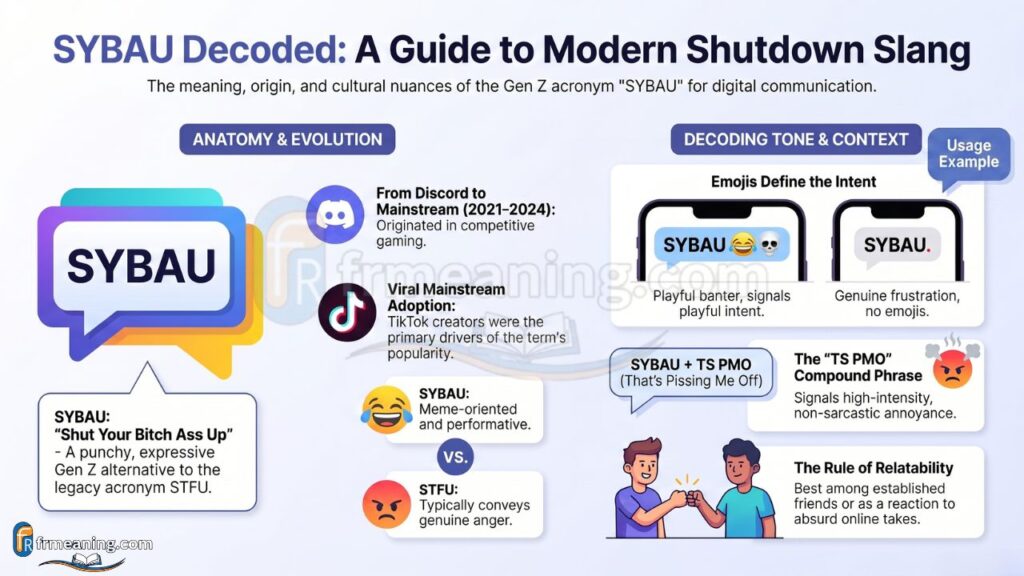

If you’ve been scrolling through TikTok comments or Discord servers lately and keep seeing “SYBAU” pop up everywhere, your not alone. This acronym has been quietly taking over Gen Z digital conversations since around 2021, and by 2024 it had fully exploded into mainstream internet slang territory.
Understanding the SYBAU meaning slang isn’t just about keeping up with trends it’s about actually understanding how young people communicate online today.
So what does it mean, where did it come from, and how do you use it without accidentally offending someone? Let’s break it all down.
What Does SYBAU Mean
SYBAU stands for “Shut Your Bitch Ass Up.” It’s a internet slang abbreviation that functions as a shutdown phrase — basically a more expressive, Gen Z-flavored version of the older STFU. The term carries a punchy attitude that makes it perfect for meme culture, reaction content, and online banter between friends.
The SYBAU meaning shifts depending heavily on context and tone. Between close friends in a gaming Discord server, it’s basically just playful trash talk. In a heated Twitter argument between strangers, it reads completely different — more aggressive, more dismissive. That tonal flexibility is actually a big part of why it caught on so fast across multiple platforms.
What’s interesting is that SYBAU doesn’t carry a single fixed emotional weight. It can be used sarcastically, humorously, defensively, or genuinely — and the person reading it usually figures out which one based on emojis, previous messages, and overall vibe of the conversation.
SYBAU
Before we dig deeper, here’s the simplest possible breakdown of the term itself:
S — Shut Y — Your B — Bitch A — Ass U — Up
That’s the complete SYBAU acronym. Simple, direct, and honestly kind of hard to forget once you know it. The word “bitch ass” in the middle is what gives it that extra edge compared to similar phrases — it’s more colorful and expressive than a plain “shut up” or even STFU.
The term belongs to the broader family of internet slang abbreviations that Gen Z has developed as a kind of digital shorthand. These phrases spread rapidly through social media ecosystems because their short, they’re visually distinctive in comment sections, and they carry a lot of emotional weight in very few characters.
SYBAU Meaning
The SYBAU meaning goes beyond just the literal translation. In real usage, it functions as a social signal — it tells someone that their opinion, argument, or behavior has been completely dismissed. Think of it as a conversation ender with attitude.
There are actually a few layers to how this term gets deployed in digital conversations:
When someone posts a genuinely controversial or absurd take online, SYBAU shows up in the comments as a way to mock or dismiss that opinion without writing a whole essay. When friends are roasting each other in group chats, it works as an affectionate jab — the digital equivalent of a playful shove. In competitive gaming environments, it’s practically a standard part of the trash talk vocabulary.
The SYBAU meaning in text also changes based on what surrounds it. If someone types “SYBAU 💀😂” they’re almost certainly joking. If someone types just “SYBAU.” with no emojis and no other context, that’s probably genuine frustration. Digital tone indicators — primarily emojis — are absolutely essential to interpreting this word correctly.
Here’s a quick reference for how tone shapes SYBAU’s meaning:
| Tone | Context | Example Usage |
|---|---|---|
| Playful | Friends roasting each other | “You think you can beat me? SYBAU 😂💀” |
| Sarcastic | Reacting to absurd opinions | “Earth is flat? SYBAU honestly 😏” |
| Genuinely annoyed | Real frustration in arguments | “SYBAU, I’m done with this conversation.” |
| Meme-style | Reaction content, viral posts | “POV: someone has a bad take → SYBAU 💀” |
SYBAU Meme Meaning
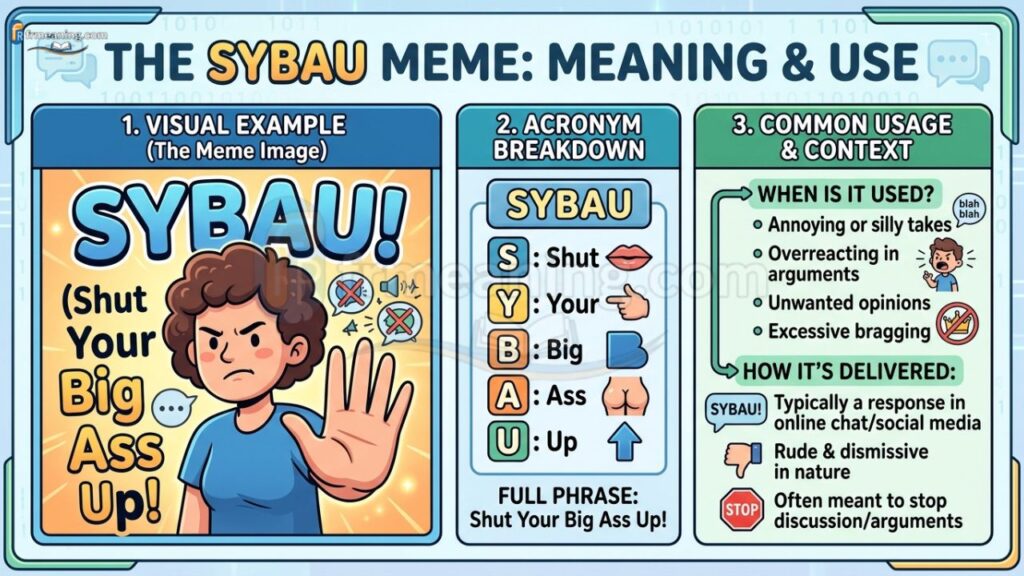
The SYBAU meme meaning is slightly different from its direct conversational use. In meme culture, SYBAU functions as a punchline — it’s the reaction text that appears at the end of a setup. TikTok creators popularized this format where you’d see a “POV” or “when someone says…” setup followed by “SYBAU 💀” as the payoff.
Meme culture took what was essentially a trash-talk phrase and turned it into a broadly relatable reaction format. You’ve probably seen it as text overlay on TikTok videos, as the caption on Discord screenshot posts shared to Twitter, or as Instagram story templates with fill-in-the-blank frustrating scenarios.
What makes the SYBAU meme meaning work so well is its versatility. Unlike memes that require specific cultural context to land, SYBAU translates across almost any situation where someone did or said something dumb, annoying, or deserving of dismissal. The phrase carries enough inherent sass that it works as its own punchline without needing much setup.
Some of the most common SYBAU meme formats include:
- TikTok stitch reactions where creators respond to bad takes with a simple SYBAU text overlay
- Discord screenshot compilations showing someone saying something wild followed by “SYBAU” as the top reply
- Twitter quote tweets where the entire reply is just “SYBAU” — no additional commentary needed
- Gaming highlight clips where a player does something embarrassing and the clip title or caption includes SYBAU
The meme format also helped separate SYBAU from being purely aggressive. When you see a skull emoji 💀 next to it in a meme context, everyone understands its comedic. That’s a important distinction that kept the term from getting flagged as purely toxic content on most platforms.
SYBAU Meaning Slang: Where It Actually Came From
Understanding the SYBAU meaning slang requires knowing its origin story. The phrase didn’t appear overnight — it evolved organically from online gaming communities and chat rooms where quick, aggressive comebacks were basically a cultural norm.
Gaming communities were the incubator. In competitive online gaming — whether that’s Valorant, Call of Duty, or any number of popular titles — trash talk is practically a second language. Players needed short, punchy phrases for voice chat and text chat alike, and SYBAU fit perfectly into that ecosystem. It was direct, it was dismissive, and it could be typed in about two seconds.
From gaming servers, the phrase migrated to Discord — which makes sense because Discord was already the primary communication hub for gaming communities. Once it was normalized in Discord servers, it was only a matter of time before content creators started bringing it into their TikTok content.
TikTok creators accelerated SYBAU’s viral adoption through reaction videos and comment section usage starting around 2022-2023. Once creators with large followings started using it regularly, their audiences picked it up and spread it outward to Twitter, Instagram, and Snapchat. By 2024, SYBAU was fully cemented as part of the mainstream TikTok slang dictionary.
This trajectory — from niche gaming Discord servers to mainstream social media — is actually a really common path for Gen Z slang terms. The gaming community consistently functions as an early adopter environment for internet language.
TS PMO SYBAU and ICL: What These Combo Phrases Mean
You might’ve seen SYBAU appear alongside other acronyms, particularly TS PMO and ICL. These compound slang phrases layer additional emotional intensity onto the base meaning of SYBAU, and its worth knowing what they each add.
TS PMO SYBAU breaks down like this:
- TS = That’s
- PMO = Pissing Me Off
- SYBAU = Shut Your Bitch Ass Up
Put together, the phrase essentially means “That’s pissing me off, shut your bitch ass up.” It signals genuine frustration — someone who’s not just joking around but actually done with a conversation or person. The TS PMO prefix transforms SYBAU from a potential joke into something that reads more seriously.
TS PMO ICL SYBAU adds one more layer:
- ICL = I Can’t Lie
So the full phrase translates roughly to “I can’t lie, that’s pissing me off, shut your bitch ass up.” The ICL addition is actually interesting because it signals brutal honesty — the speaker is acknowledging that what follows is their genuine, unfiltered reaction rather than performative frustration.
These compound phrases are most common in group chat contexts where participants are already in escalating conversations, or in comment sections where someone is reacting to genuinely aggravating content.
SYBAU vs STFU: The Real Difference
A lot of people wonder how SYBAU is different from the classic STFU — and its a fair question since they technically mean similar things. But the differences are real and they matter for understanding how each term functions in digital communication.
STFU (Shut The F**k Up) has been part of internet culture since the early 2000s. It’s blunt, universally understood, and carries a genuinely harsh tone in most contexts. When someone types STFU, there’s not a lot of ambiguity — they want you to stop talking and they’re not being particularly subtle about it.
SYBAU is newer, more platform-specific, and carries a different energy. The extra words in the middle (“bitch ass”) add a layer of expressiveness that somehow makes it feel less serious in playful contexts — like the added flair signals that you’re performing frustration rather than genuinely experiencing it. That’s a weird linguistic thing but it’s real.
Key differences worth remembering:
- STFU dates back to early internet culture; SYBAU is distinctly Gen Z slang 2024-2026
- STFU works in almost any heated context; SYBAU is most at home on TikTok, Discord, and Twitter
- STFU typically reads as genuinely angry; SYBAU reads as sarcastic or meme-inflected more often
- STFU requires no cultural context to understand; SYBAU assumes familiarity with current internet slang
Neither is inherently worse or better — they serve slightly different communicative purposes and fit different conversational registers.
Why People Use Shutdown Slang: The Psychology Behind SYBAU
This is actually a area that most articles on SYBAU meaning slang completely skip over, but it’s genuinely interesting and helps explain why phrases like this become so popular online.
Shutdown phrases like SYBAU satisfy a specific psychological need in digital communication — the need for efficient emotional expression in low-stakes social environments. Online interactions, particularly in gaming and social media, often involve strangers or semi-strangers who interact in brief, high-stimulation bursts. There’s not time or social incentive to write a nuanced rebuttal. SYBAU gives people a way to register strong emotional reactions — dismissal, annoyance, amusement — in a single typed burst.
There’s also a digital disinhibition element at play. People say things online they’d never say face-to-face, and slang terms like SYBAU give that disinhibition a culturally sanctioned form. Instead of constructing an original insult or expressing genuine anger in full sentences, users reach for a shared cultural shorthand. It’s almost a ritualized form of online aggression that both parties usually understand as performative.
Within tight-knit communities particularly gaming communities and friend groups — SYBAU also functions as in-group bonding through aggressive humor. Using edgy slang confidently signals that you’re culturally fluent, that you understand the unspoken rules of the space, and that you’re comfortable enough with your relationships to push boundaries verbally. It’s the same reason close friends in real life often communicate through insults and teasing — the content is aggressive but the relationship subtext is affectionate.
This psychological dimension is also why context matters so much for SYBAU. The same four letters carry completely different social meaning depending on whether they appear between two friends who’ve known each other for years versus between strangers in a public comment section.
How TikTok’s Algorithm Helped SYBAU Go Viral

Another gap in most SYBAU content is any real explanation of how platform algorithms amplified this term’s spread. It didn’t go viral just because people liked it — social media algorithms actively rewarded the content that used it.
On TikTok specifically, engagement metrics drive content distribution. When creators used SYBAU in comment sections or video captions, they were often responding to controversial or divisive content — which already generates high engagement. Comments containing SYBAU tended to get high “like” counts and reply activity because they were punchy, relatable reactions. TikTok’s algorithm interprets high comment engagement as a signal of interesting content and pushes that content to more users, creating a feedback loop.
Additionally, TikTok’s “For You Page” algorithm prioritizes trending slang and audio in part because these create natural communities of interest. When SYBAU started appearing consistently in certain content niches, the algorithm effectively identified it as a marker of content those audiences enjoyed and began surfacing more of it.
On Twitter (now X), the mechanism was different but equally powerful. Viral quote tweets using just “SYBAU” as a response to bad takes performed extremely well because they were simple, legible, and emotionally satisfying — all qualities the platform’s engagement metrics reward. Each viral instance introduced the term to thousands of new users who then carried it to other platforms.
This cross-platform algorithmic amplification explains why SYBAU went from niche Discord slang to mainstream internet vocabulary in a relatively short period. The content ecosystems of TikTok and Twitter were essentially designed in ways that made punchy, expressive, reaction-oriented slang thrive.
How to Use SYBAU Without Causing Problems
Using internet slang abbreviations like SYBAU correctly comes down to knowing your audience and reading the room. Here are some practical guidelines:
- Use it with established friends — The playful interpretation works best when both parties already have a banter-based relationship
- Add emojis when joking — A 💀 or 😂 next to SYBAU signals clearly that you’re not being genuinely hostile
- Avoid it in professional or semi-professional spaces — Discord servers with mixed audiences, work-adjacent Slack channels, or any community with older demographics probably isn’t the right place
- Match the conversation’s energy — If everyone’s clearly joking around, SYBAU fits naturally; if things have gotten genuinely tense, it can escalate rather than defuse
- Be ready to clarify — If someone takes it badly, a quick “lol I was joking” goes a long way. Intent doesn’t always translate perfectly in text
FAQ
What does SYBAU mean in text messages?
SYBAU means “Shut Your Bitch Ass Up” — a playful or sarcastic internet slang phrase for dismissing someone.
Is SYBAU considered offensive or friendly?
It depends entirely on context — between friends it’s usually playful banter, but it can read as genuinely rude with strangers.
Where did the SYBAU slang term originally come from?
SYBAU originated in online gaming communities and Discord servers around 2021 before spreading through TikTok.
What is the difference between SYBAU and STFU?
SYBAU is more Gen Z, meme-oriented and playful; STFU is older, more direct, and typically reads as genuinely angry.
You May Also Like
https://frmeaning.com/wyo-meaning-in-text/
https://frmeaning.com/gng-meaning/
https://frmeaning.com/wyf-meaning-in-text/
https://frmeaning.com/wyll-meaning/
https://frmeaning.com/gyatt-meaning/